

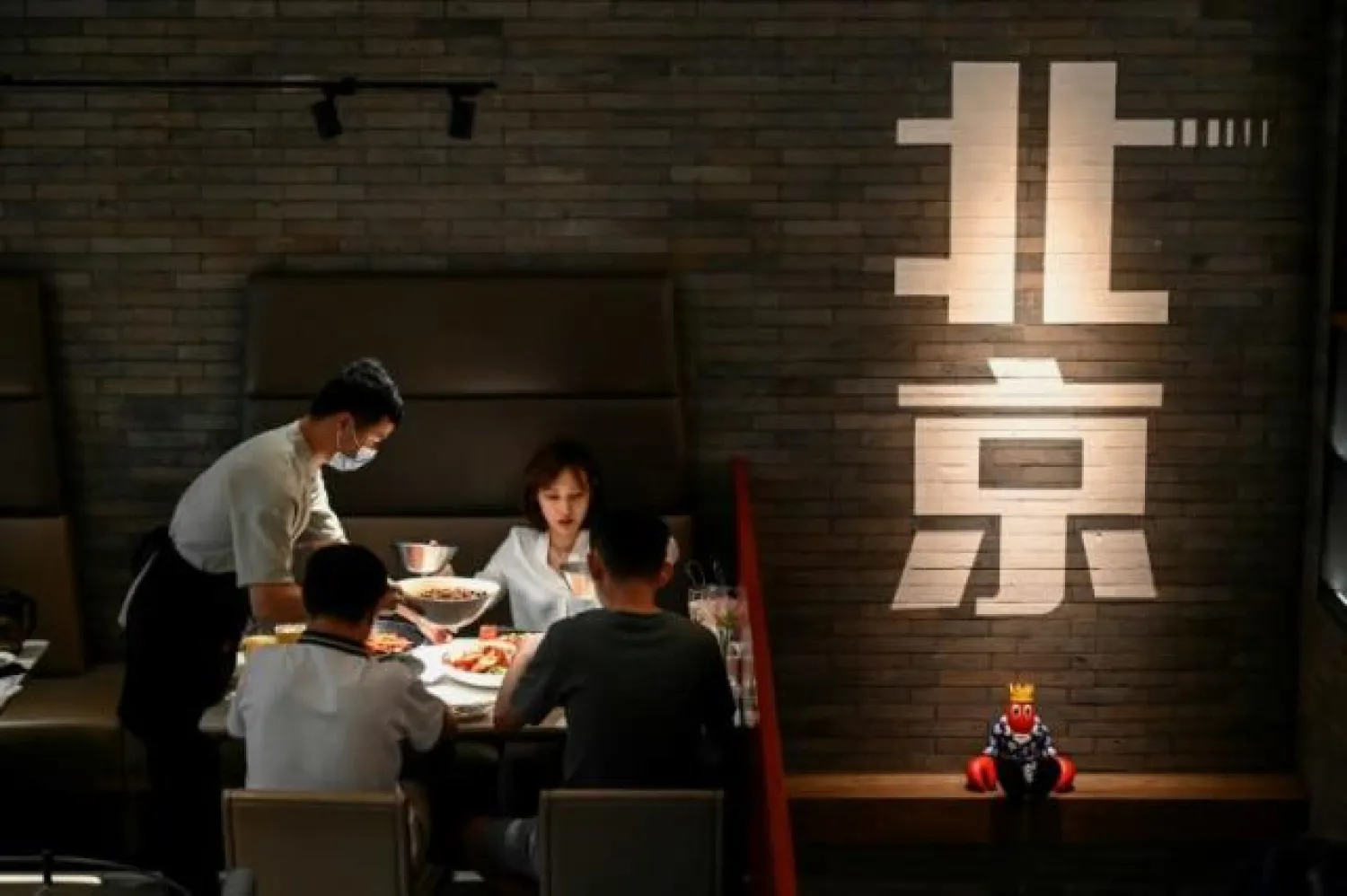

Relief, Caution in Beijing as City Lifts Covid Dine-in Curbs

Beijing stopped residents from eating out last month, along with a number of other restrictions, to try and stamp out a Covid outbreak Jade GAO AFP
TT

Relief, Caution in Beijing as City Lifts Covid Dine-in Curbs

Beijing stopped residents from eating out last month, along with a number of other restrictions, to try and stamp out a Covid outbreak Jade GAO AFP

After staying home for more than a month, Chen Chunmei joined a long line of customers at a popular Beijing restaurant where diners tucked into massive bowls of crayfish following an easing of Covid restrictions in the Chinese capital.

Last month, the city of 22 million stopped people from eating out, closed gyms and sealed off dozens of subway stations to try and stamp out a coronavirus outbreak.

The curbs are now finally easing, including at restaurants.

"I'm very excited, mainly because we'd been sealed off for so long," Chen told AFP.

"I've been ordering takeout or cooking every day. I really wanted to come out for meals."

At its peak, Beijing logged just dozens of infections every day.

But authorities in China are committed to a zero-Covid strategy -- using rapid lockdowns, mass testing and severe travel restrictions to eliminate even the smallest outbreaks.

Chen, 28, said her compound was initially locked down for two weeks but when she was finally allowed to leave, the nearby subway station was closed.

"Since then, I'd been staying at home," she said. "At first I thought working from home was pretty good but after a while, I got bored."

As Beijing's case numbers fell -- it reported just two local asymptomatic infections on Tuesday -- authorities told residents they could return to work this week, while schools would reopen from June 13.

The Universal Beijing resort said it will reopen on June 15, while Chinese media reported that cinemas and gyms will run at 75 percent capacity from this week in most areas.

Dine-ins at restaurants have also mostly resumed, although two districts still have restrictions in place because of recent Covid cases.

- 'Losing money' -
While authorities have persisted with their zero-Covid policy, its economic costs have piled up.

Businesses in Beijing told AFP that the last month bit a large chunk out of their earnings.

"Our revenue for the month of May fell around 65 percent on-year," said Zhang Shengtao, operations director at Beijing Huda Catering.

He added that staff income at the restaurant chain, which employs nearly 800 people, also dropped by around 30 percent last month.

Some breathed a sigh of relief on Monday as restrictions on dining-in were eased.

"I've been longing for the resumption," said Wu Ziwen, a manager at restaurant chain Nanjing Dapaidang.

"There's no doubt that we were losing money," he told AFP, adding that the outlet has been relying on food deliveries to survive.

The dine-in resumption in Beijing is still partial, however: due to Covid controls, his restaurant can only accept up to 50 percent of regular capacity "even if customers flood in," Wu said.

Beijing is requiring people to produce a negative test done within three days if they want to take public transport or enter office buildings.

The outbreak in the capital has also kept visitors like 33-year-old Sun Tao from returning home to Shanxi.

The dine-in relaxation gave him some respite.

"I'm nervous and alert," said Sun, who ventured out of the hotel where he was staying with his wife on Monday evening and waited for a table at a restaurant.

"But I also wanted to feel my tastebuds again."


Russia: Man Suspected of Shooting Top General Detained in Dubai

An investigator works outside a residential building where the assassination attempt on Russian Lieutenant General Vladimir Alexeyev took place in Moscow, Russia February 6, 2026. REUTERS/Anastasia Barashkova
TT

Russia: Man Suspected of Shooting Top General Detained in Dubai

An investigator works outside a residential building where the assassination attempt on Russian Lieutenant General Vladimir Alexeyev took place in Moscow, Russia February 6, 2026. REUTERS/Anastasia Barashkova

Russia's Federal Security Service (FSB) said on Sunday that the man suspected of shooting top Russian military intelligence officer Vladimir Alexeyev in Moscow has been detained in Dubai and handed over to Russia.

Lieutenant General Vladimir Alexeyev, deputy head of the GRU, ⁠Russia's military intelligence arm, was shot several times in an apartment block in Moscow on Friday, investigators said. He underwent surgery after the shooting, Russian media ⁠said.

The FSB said a Russian citizen named Lyubomir Korba was detained in Dubai on suspicion of carrying out the shooting.

Russian Foreign Minister Sergei Lavrov accused Ukraine of being behind the assassination attempt, which he said was designed to sabotage peace talks. ⁠Ukraine said it had nothing to do with the shooting.

Alexeyev's boss, Admiral Igor Kostyukov, the head of the GRU, has been leading Russia's delegation in negotiations with Ukraine in Abu Dhabi on security-related aspects of a potential peace deal.


Factory Explosion Kills 8 in Northern China

Employees work on an electric vehicle (EV) production line at the Volkswagen Anhui factory in Hefei, Anhui province, China, February 4, 2026. REUTERS/Florence Lo
TT

Factory Explosion Kills 8 in Northern China

Employees work on an electric vehicle (EV) production line at the Volkswagen Anhui factory in Hefei, Anhui province, China, February 4, 2026. REUTERS/Florence Lo

An explosion at a biotech factory in northern China has killed eight people, Chinese state media reported Sunday, increasing the total number of fatalities by one.

State news agency Xinhua had previously reported that seven people died and one person was missing after the Saturday morning explosion at the Jiapeng biotech company in Shanxi province, citing local authorities.

Later, Xinhua said eight were dead, adding that the firm's legal representative had been taken into custody.

The company is located in Shanyin County, about 400 kilometers west of Beijing, AFP reported.

Xinhua said clean-up operations were ongoing, noting that reporters observed dark yellow smoke emanating from the site of the explosion.

Authorities have established a team to investigate the cause of the blast, the report added.

Industrial accidents are common in China due to lax safety standards.
In late January, an explosion at a steel factory in the neighboring province of Inner Mongolia left at least nine people dead.


Iran Warns Will Not Give Up Enrichment Despite US War Threat

Traffic moves through a street in Tehran on February 7, 2026. (Photo by ATTA KENARE / AFP)
TT

Iran Warns Will Not Give Up Enrichment Despite US War Threat

Traffic moves through a street in Tehran on February 7, 2026. (Photo by ATTA KENARE / AFP)

Iran will never surrender the right to enrich uranium, even if war "is imposed on us,” its foreign minister said Sunday, defying pressure from Washington.

"Iran has paid a very heavy price for its peaceful nuclear program and for uranium enrichment," Abbas Araghchi told a forum in Tehran.

"Why do we insist so much on enrichment and refuse to give it up even if a war is imposed on us? Because no one has the right to dictate our behavior," he said, two days after he met US envoy Steve Witkoff in Oman.

The foreign minister also declared that his country was not intimidated by the US naval deployment in the Gulf.

"Their military deployment in the region does not scare us," Araghchi said.
