

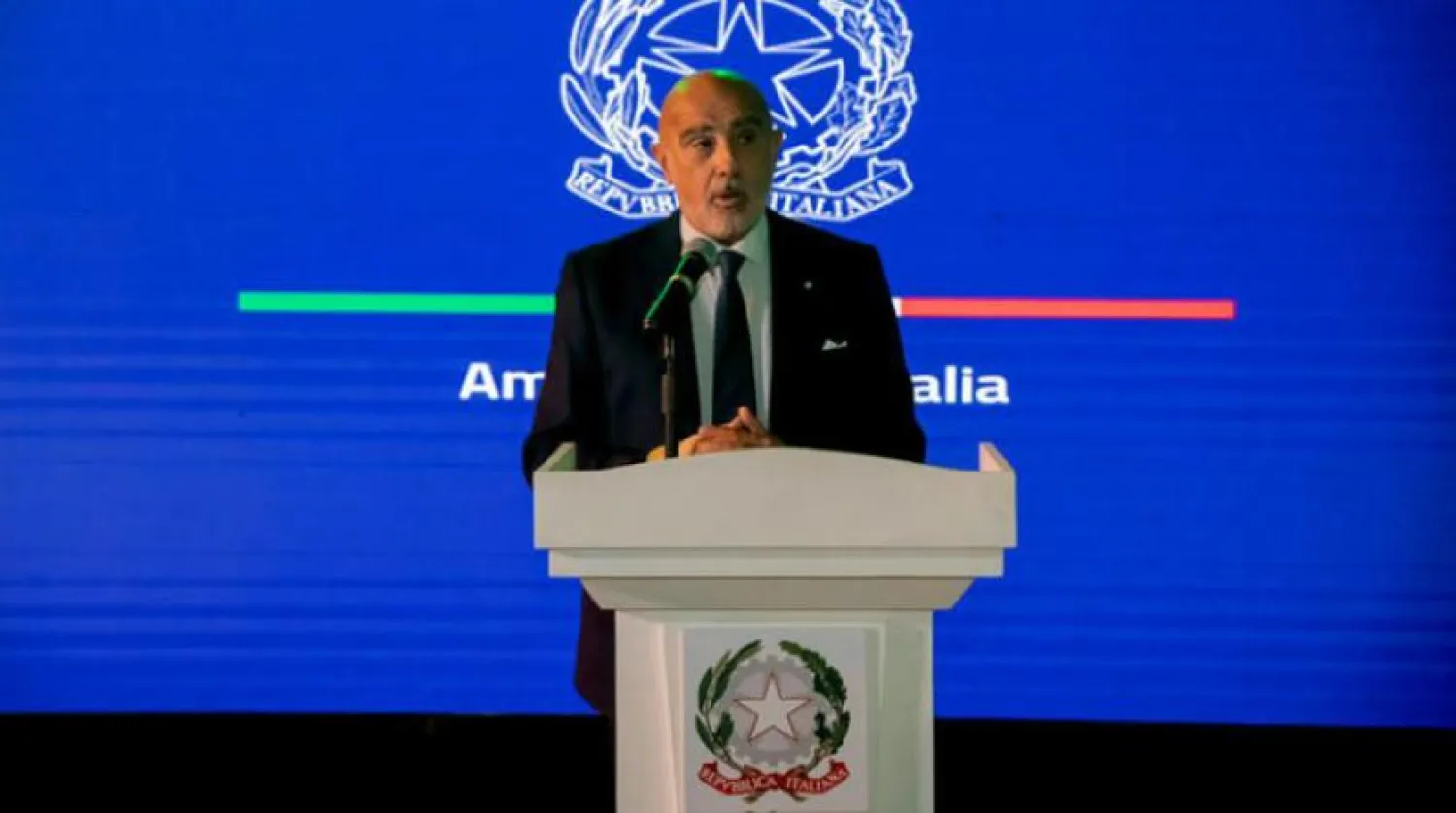

Italy Looks Forward to Long-term Partnership with Saudi Arabia in Green Hydrogen

Italian Ambassador to Saudi Arabia Roberto Cantone addresses the embassy’s celebration of Italy’s National Day in Riyadh. (Asharq Al-Awsat)
TT

Italy Looks Forward to Long-term Partnership with Saudi Arabia in Green Hydrogen

Italian Ambassador to Saudi Arabia Roberto Cantone addresses the embassy’s celebration of Italy’s National Day in Riyadh. (Asharq Al-Awsat)

Italian Ambassador to Saudi Arabia Roberto Cantone said his country was making great efforts to diversify its gas supplies to achieve independence from Russia, by expanding its cooperation with other gas-exporting partners.

He stressed in this regard that his country was looking forward to establishing a long-term partnership with a future source of hydrogen such as the Kingdom.

In remarks to Asharq Al-Awsat, Cantone noted that cooperation in the field of energy would cover renewable energy sources and hydrogen, as the Kingdom is investing in the transition towards carbon neutrality through its Saudi Green Initiative, while Italy has extensive experience in all types of renewable energy sources.

The Italian ambassador stressed that the Saudi-Italian political dialogue was aimed at addressing relevant international issues within the framework of the G20 joint action and security challenges that affect both countries in the Mediterranean and the Middle East. In this context, he pointed to a memorandum of understanding on strategic dialogue signed last year between Saudi Foreign Minister Prince Faisal bin Farhan and his Italian counterpart Luigi Di Maio.

“Italy has always imported oil from the Kingdom at an estimated level. In general, 80 percent of Italian imports are oil and petrochemical products, while many Italian companies support Saudi Aramco’s operations at various levels,” he told Asharq Al-Awsat. He noted that Saudis were interested in Italian-made products, such as food, fashion and interior design.

Cantone added that infrastructure was another very important area of cooperation.

He said that as part of investments planned within Saudi Vision 2030, many Italian construction companies were applying to tenders launched by the government to develop the giga-projects, as well as Saudi projects in the field of sustainable mobility and connectivity.

Regarding imports from Saudi Arabia, the diplomat noted that the stock market depended on the direction of the oil sector. He said that imports declined during the pandemic, but stressed that recovery was now on the right track, with imports amounting to 4.8 billion euros in 2021, compared to 2.9 billion euros in 2020.

The level of trade exchange remained essentially unchanged despite the coronavirus pandemic, amounting to 3.1 billion euros in 2020 and 3.3 billion euros in 2021, according to Cantone, who said that last year, the total balance was in favor of the Kingdom, while it is likely to remain the same in 2022, given the current high oil price per barrel.

“Our bilateral relationship is also based on an important economic partnership, taking into account the number of Italian firms that show a tangible interest in Vision 2030 and invest in the Kingdom by opening branches or new companies,” the ambassador remarked.



Environment Ministry Launches Saudi Citrus Season with Production Exceeding 158,000 Tons

The citrus production season in the Kingdom begins in July and continues through March each year. (SPA)
TT

Environment Ministry Launches Saudi Citrus Season with Production Exceeding 158,000 Tons

The citrus production season in the Kingdom begins in July and continues through March each year. (SPA)

The Saudi Ministry of Environment, Water and Agriculture launched on Wednesday the Kingdom’s citrus season in local markets as part of its efforts to support and develop the agricultural sector and enhance food security in the country, in line with the Saudi Vision 2030.

The is part of the ministry’s ongoing efforts to support national agricultural products, raise awareness of citrus varieties and their nutritional benefits and production areas, and highlight their year-round diversity across production seasons.

These efforts help in improving marketing efficiency, boost competitiveness, and achieve rewarding economic returns.

Citrus fruits are among the most widely cultivated crops in the Kingdom. They are grown in several regions that produce a variety of citrus types, most notably lemons, oranges, mandarins, grapefruit, citron, and kumquats.

The ministry said lemon production leads Saudi citrus output, with total production exceeding 123,000 tons and more than 1.5 million fruit-bearing trees. Orange production follows, with total output reaching 35,700 tons and more than 397,000 fruit-bearing trees.

The citrus production season in the Kingdom begins in July and continues through March each year, it added.

The ministry said the Saudi citrus season has been launched with a number of major retail markets across the Kingdom showcasing local products through innovative packaging and display methods. This boosts the quality and reliability of local products and increases consumer demand during production seasons.


SLB Awarded 5-Year Contract to Stimulate Unconventional Gas in Saudi Arabia

SLB has been awarded a five-year contract by Saudi Aramco to provide stimulation services for its unconventional gas fields. (Asharq Al-Awsat)
TT

SLB Awarded 5-Year Contract to Stimulate Unconventional Gas in Saudi Arabia

SLB has been awarded a five-year contract by Saudi Aramco to provide stimulation services for its unconventional gas fields. (Asharq Al-Awsat)

Global technology company, SLB, has been awarded a five-year contract by Saudi Aramco to provide stimulation services for its unconventional gas fields, the company said in a statement on Tuesday.

The move is part of a broader multi-billion contract, supporting one of the largest unconventional gas development programs globally, it said.

The contract encompasses advanced stimulation, well intervention, frac automation, and digital solutions, which are important to unlocking the potential of Saudi Arabia’s unconventional gas resources - a cornerstone of the Kingdom’s strategy to diversify its energy portfolio and support the global energy transition.

“This agreement is an important step forward in Aramco’s efforts to diversify its energy portfolio in line with Vision 2030 and energy transition goals,” said Steve Gassen, SLB executive vice president.

“With world-class technology, deep local expertise, and a proven track record in safety and service quality, SLB is well positioned to deliver tailored solutions that could help redefine operational performance in the development of Saudi Arabia’s unconventional resources,” he added.

These solutions provide the tools to work toward new performance benchmarks in unconventional gas development.

SLB is a global technology company that drives energy innovation for a balanced planet.

With a global footprint in more than 100 countries and employees representing almost twice as many nationalities, it works on innovating oil and gas, delivering digital at scale, decarbonizing industries, and developing and scaling new energy systems that accelerate the energy transition.


US Says China Chip Policies Unfair but Will Delay Tariffs to 2027

 People walk past a Christmas tree at the Taikoo Li shopping center in Beijing on December 24, 2025. (AFP)
People walk past a Christmas tree at the Taikoo Li shopping center in Beijing on December 24, 2025. (AFP)
TT

US Says China Chip Policies Unfair but Will Delay Tariffs to 2027

 People walk past a Christmas tree at the Taikoo Li shopping center in Beijing on December 24, 2025. (AFP)
People walk past a Christmas tree at the Taikoo Li shopping center in Beijing on December 24, 2025. (AFP)

US trade officials determined that China should be punished for employing unfair tactics to dominate the semiconductor industry, but will wait 18 months to impose tariffs, American authorities said Tuesday.

A US Trade Representative (USTR) investigation concluded China's targeting of semiconductors "for dominance is unreasonable and burdens or restricts US commerce and thus is actionable," the agency said in a public notice.

The current tariff level of zero will be increased "in 18 months on June 23, 2027 to a rate to be announced not fewer than 30 days prior to that date," USTR said.

Beijing said Wednesday it "firmly opposes" the move and accused Washington of abusing tariffs to "unreasonably suppress Chinese industries".

This "disrupts the stability of the global supply chain, hinders the development of all countries' semiconductor industries and harms others while hurting itself", foreign ministry spokesman Lin Jian.

"We urge the United States to quickly correct its erroneous practices," Lin said at a regular press briefing.
USTR officials launched the probe in December 2024 in the final weeks of Joe Biden's presidency, extending the initiative when US President Donald Trump took office in January.

Trump has been a prolific purveyor of tariffs, unveiling sector-specific levies on steel, autos and other items as well as broader measures to achieve a variety of policy objectives.

The White House has jousted with Beijing but reached a broad truce with China after a major escalation in the spring.

The USTR's "Section 301" probe concluded that China had employed "increasingly aggressive and sweeping non-market policies" to dominate semiconductors that have included "massive and persistent" state support of private actors and "wage-suppressing labor practices."

The USTR did not respond to an AFP query on the reason for the 18-month timeframe on tariffs.