
Egypt's Tanoura Puts Kaleidoscopic Spin on Dervish Tradition

Egypt's kaleidoscopic whirling dervish performance, known as 'tanoura', is a world away from those of Turkey, who trace their origins to the teachings of Sufi poet and mystic Jalal al-Din Rumi Khaled DESOUKI AFP
TT

Egypt's Tanoura Puts Kaleidoscopic Spin on Dervish Tradition

Egypt's kaleidoscopic whirling dervish performance, known as 'tanoura', is a world away from those of Turkey, who trace their origins to the teachings of Sufi poet and mystic Jalal al-Din Rumi Khaled DESOUKI AFP

In a 500-year-old stone theater in the Egyptian capital, two young dervishes spin ceaselessly. Slowly, then all at once, they are consumed in a flurry of vivid fabrics.

Born into a lineage of whirling dervishes, Mohamed Adel, 20, takes great pride in the uniquely Egyptian interpretation of the centuries-old ritual known colloquially as "tanoura", or skirt in Arabic.

"I choose the colors and the shapes that are sewn into the skirts," Adel said, pointing to the folds of his purple skirt with green and yellow appliques moments before stepping on stage to perform at a folk art festival.

The kaleidoscopic performance is a world away from the UNESCO-listed whirling dervishes of Turkey, who trace their origins to the teachings of Sufi poet and mystic Jalal al-Din Rumi.

Distinguished by their white robes, camel-wool hats and fealty to ascetic Sufi spiritualism, the ceremonies in Turkey bear only a fleeting resemblance to the psychedelic performances popular in Egypt.

Sufis in Egypt, who number more than 15 million, with nearly 80 different orders, adopted the ritual, progressively adding colours and rhythms, turning the spiritual practice into a folkloric art in its own right.

- 'Escape' -
Every time it is the same: Adel steps into a counter-clockwise twirl. As his skirts bloom, he raises his right arm to the sky, to receive divine blessing, and reaches his left arm to the ground, delivering the blessing to the public.

Then he picks up the pace.

His steps grow faster, and he unties the cords that hold his different skirts together, raising one high above his head.

The topmost tanoura represents the sky, the one below the earth.

As he spins the first above his head while the other forms an undulating disc around his waist, he recounts the story of genesis, and how the sky and Earth were separated.

This rendition is no small feat, with each skirt weighing nearly 10 kilograms. If Adel deviates from his axis or loses the rhythm of his feet, he can fall and drop them.

"At the beginning, of course I would get dizzy and even fall sometimes," he told AFP. "But training every single day, either on stage or at home, I escape somewhere else with the music."

To the sound of Sufi chants, percussion beats, or the haunting melodies of the traditional flute or rababa -- a lute-like string instrument -- the revolutions of the dervishes of the Giza Troupe for Folkloric Arts seem as unstoppable as the planets.

- 'Like flying' -
Side by side, but without their skirts ever coming in contact, they perform acrobatics as they spin.

They throw their skirts above their heads, catch them midair, fold and unfold the flag of their Sufi order, their spirals never ceasing.

For Ali Morsi, 25, it is a labor inspired by "the love of God and the Prophet Mohammed".

Though the Egyptian version of the art has become a festive occasion, most practitioners hold to the roots of the ritual in the mystical tradition of the Muslim Mevlevi Order, founded in the 13th century by Rumi in Konya, present-day Turkey.

Today, it is a staple of Egyptian tourism, with some dancers, particularly in hotels and entertainment venues, attaching lights to their skirts for an added surprise factor, to the delight of tourists and spectators.

Both spectacle and ritual, tanoura is indispensable for artists like Adel and Morsi, who cannot imagine making their living any other way.

"It's like I'm flying, I can no longer feel my body, I am no longer on earth," said Morsi, who has been a dervish for 11 years.

"I only think of God and nothing else."


Trying to Improve Your Health and Wellness in 2026? Keep it Simple

A man is silhouetted against the sky at sunset as he jogs in a park at the close of a hot summer day, Aug. 1, 2022, in Kansas City, Mo. (AP Photo/Charlie Riedel, File)
TT

Trying to Improve Your Health and Wellness in 2026? Keep it Simple

A man is silhouetted against the sky at sunset as he jogs in a park at the close of a hot summer day, Aug. 1, 2022, in Kansas City, Mo. (AP Photo/Charlie Riedel, File)

The new year is a time when many try to start new good habits and commit to improving health and wellness.

But resolutions, lofty as they may be, can turn daunting quickly with all the advice and sometimes contradicting information coming at you from news reports, advertisers, influencers, friends and even politicians.

But they don't have to be.

This year, The Associated Press got the downlow on all manner of health and wellness claims and fads. The good news is that the experts mostly say to keep it simple.

As 2026 arrives, here's what you can skip, what you should pay attention to and how to get credible information when you are inevitably faced with more confusing claims next year.

Protein and fiber are important, but you probably don't need to pay more When it comes to your diet, experts say most people can skip the upcharge. If you're eating enough, you're probably getting enough protein and don't need products that promise some big boost.

And it's true that most people could use more fiber in their diets. But, please, ditch the “fiber-maxxing” trend. Instead, eat whole foods such as fruits, vegetables, beans and whole grains.

A good skin care routine is not expensive or complicated That 20-step skin care routine and $200 serum some TikToker sold you on? Dermatologists say you really don't need it. Stay away from the beef tallow and slather on a good sunscreen instead (yes, even if you have darker skin ), they say.

And the same rule for simplicity applies to that hourlong “everything shower." The best showers are simple and short, dermatologists say, no "double cleansing" required.

There are many simple ways to get that workout in If the gym and all its equipment feel intimidating, you can drop the illusion that a good workout requires either. This year, the comeback of calisthenics put the focus back on no frills, bodyweight workouts you can do in the comfort of home. Research shows calisthenics helps with muscle strength and aerobic conditioning. You may eventually need weightlifting or other equipment, but it is a great place to start to build consistency and confidence.

Be wary of wellness fads and treatments — they are often too good to be true Even if you imbibe too much this New Year's Eve, doctors say you can do without “ IV therapy ” which have vitamins you can get more easily and cheaper in pill form — if you even need more, which is unlikely if you have a balanced diet. You're pretty much just paying for “expensive urine,” one doctor said.

Same for “wellness” focused products like microbiome testing kits that generate information that doctors can't actually act on. And if you don't have diabetes, there's scant evidence that you need a continuous glucose monitor.

To improve your health, go back to the basics The idea of a panacea pill, product or routine can be enticing. But science already knows a lot about how to improve mental and physical health, and they are tried and true:

1. Whether you're in the city or the country — walk more. Research shows walking is great for physical and mental health. It's so good for you, doctors are literally prescribing time in the outdoors to their patients.

2. Take steps to get certain health metrics under control, likehigh blood pressure, which often goes undiagnosed and is known to cause a range of health problems down the road. Prioritize getting enough sleep, and make sure your family does too. Don't just eat right — eat slower.

3. Give your mind some care too. Set better boundaries with your technology andregain and retrain your attention span. Build out your social networks and invest inall forms of love for the people around you.

These lifestyle changes don't just make you feel better in the moment. Research shows they impact your life for years to come, by lowering the risk of dementia and many other health issues.

Don't know who to trust? Start with your doctor It can be tough to know who to listen to about your health, faced with compelling personal stories on social media from people who swear something worked from them, or clever marketing and advertising from companies that scare you or promise an easy fix.

Doubts have been raised this year about established medicine, including the safety of food dyes, fluoride dental treatments,hepatitis B shot for newborns, and hormone therapies for menopause.

While the medical system is not perfect, your doctor remains the best person to talk to about prevention, health concerns and potential treatments.

If you can't get to a human doctor and turn to Dr. Google instead, be sure to follow these tips and never use it to diagnose yourself. When you do get that doctor's appointment, you can make the most of it by bringing a list of written questions — and don't hesitate to ask for any clarification you need.


Citrus Harvest Season Kicks off in AlUla

The citrus harvest in AlUla is a significant agricultural and economic event  - SPA
The citrus harvest in AlUla is a significant agricultural and economic event - SPA
TT

Citrus Harvest Season Kicks off in AlUla

The citrus harvest in AlUla is a significant agricultural and economic event  - SPA
The citrus harvest in AlUla is a significant agricultural and economic event - SPA

The citrus harvest season has officially begun in AlUla Governorate, which is renowned for its agricultural production, according to SPA.

Citrus groves in AlUla cover approximately 654.57 hectares and contain around 261,826 trees, yielding about 6,545.65 tons of fruit annually.

The governorate produces a variety of delicious and nutritious citrus fruits, most notably navel oranges, citron, and sweet lemons. The citrus harvest season typically runs from December to March.

These fruits are distinguished by their high quality, attributed to the governorate's unique climate and fertile soil, resulting in exceptional flavor and high nutritional value.

The citrus harvest in AlUla is a significant agricultural and economic event that highlights the diversity of the governorate's agricultural production. It also plays a crucial role in supporting agricultural activity and promoting local products in the marketplace.


Saudi Arabia's Qassim National Park Records Third Consecutive Arabian Oryx Births

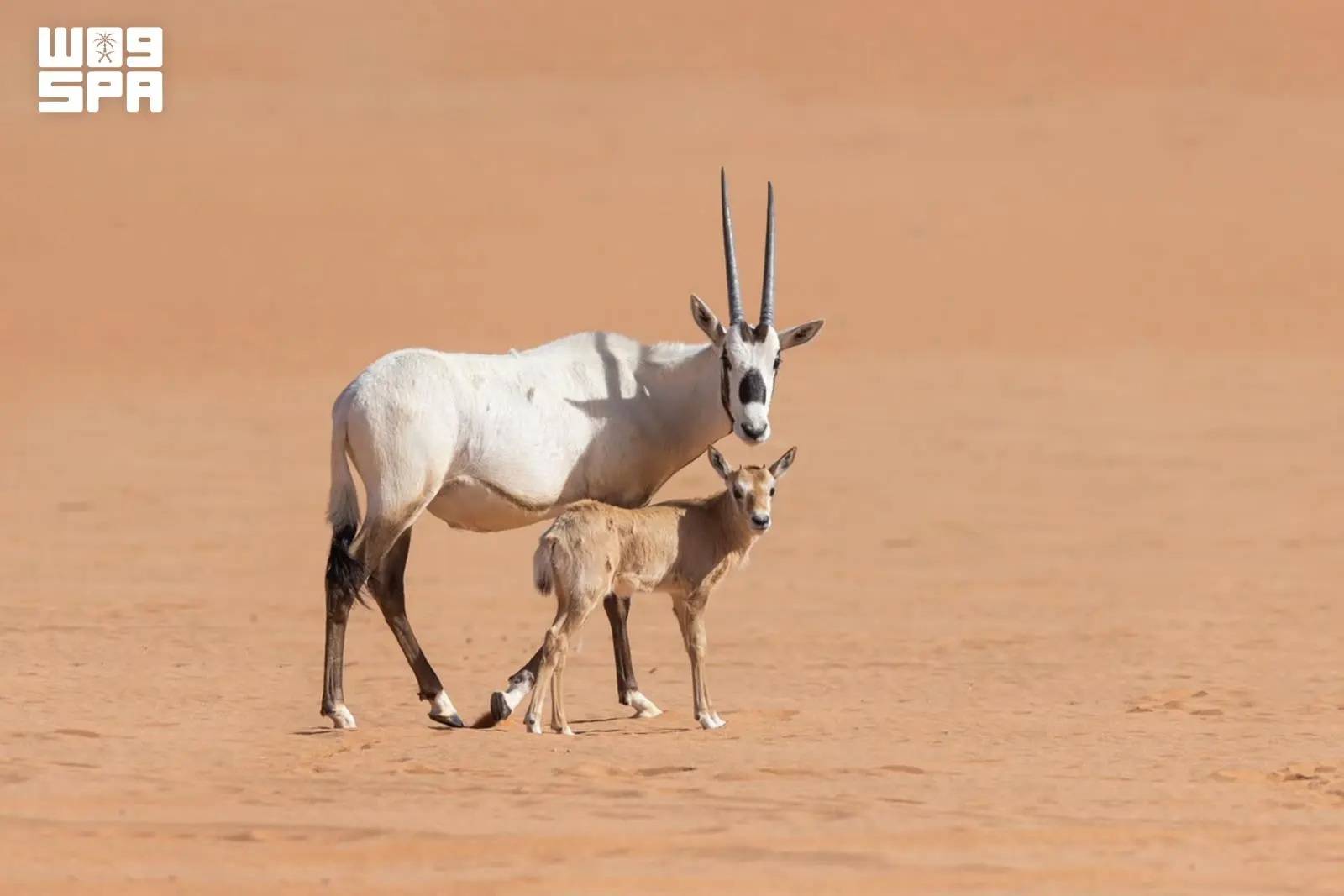
Saudi Arabia's Qassim National Park recorded the birth of an Arabian oryx for the third consecutive year. (SPA)
TT

Saudi Arabia's Qassim National Park Records Third Consecutive Arabian Oryx Births

Saudi Arabia's Qassim National Park recorded the birth of an Arabian oryx for the third consecutive year. (SPA)

Saudi Arabia's Qassim National Park in Buraidah recorded the birth of an Arabian oryx for the third consecutive year, reported the Saudi Press Agency on Monday.

The development is an important environmental milestone that reflect the ongoing success of release and reintroduction programs led by the National Center for Wildlife (NCW), which aims to preserve endangered wild species and boost biodiversity in their natural habitats.

The achievement exemplifies a pioneering collaboration between the NCW and the National Center for Vegetation Cover Development and Combating Desertification through initiatives such as vegetation enhancement, natural habitat rehabilitation, and the creation of suitable conditions for the breeding and sustainability of wild species.

Qassim National Park is one of several national parks implementing afforestation and environmental rehabilitation projects under the Saudi Green Initiative, strengthening the region’s ecological diversity and showcasing the role of national parks as models of successful environmental sustainability programs in the Kingdom.