


No Way Out as Iraq's Dangerous Post-election Impasse Deepens

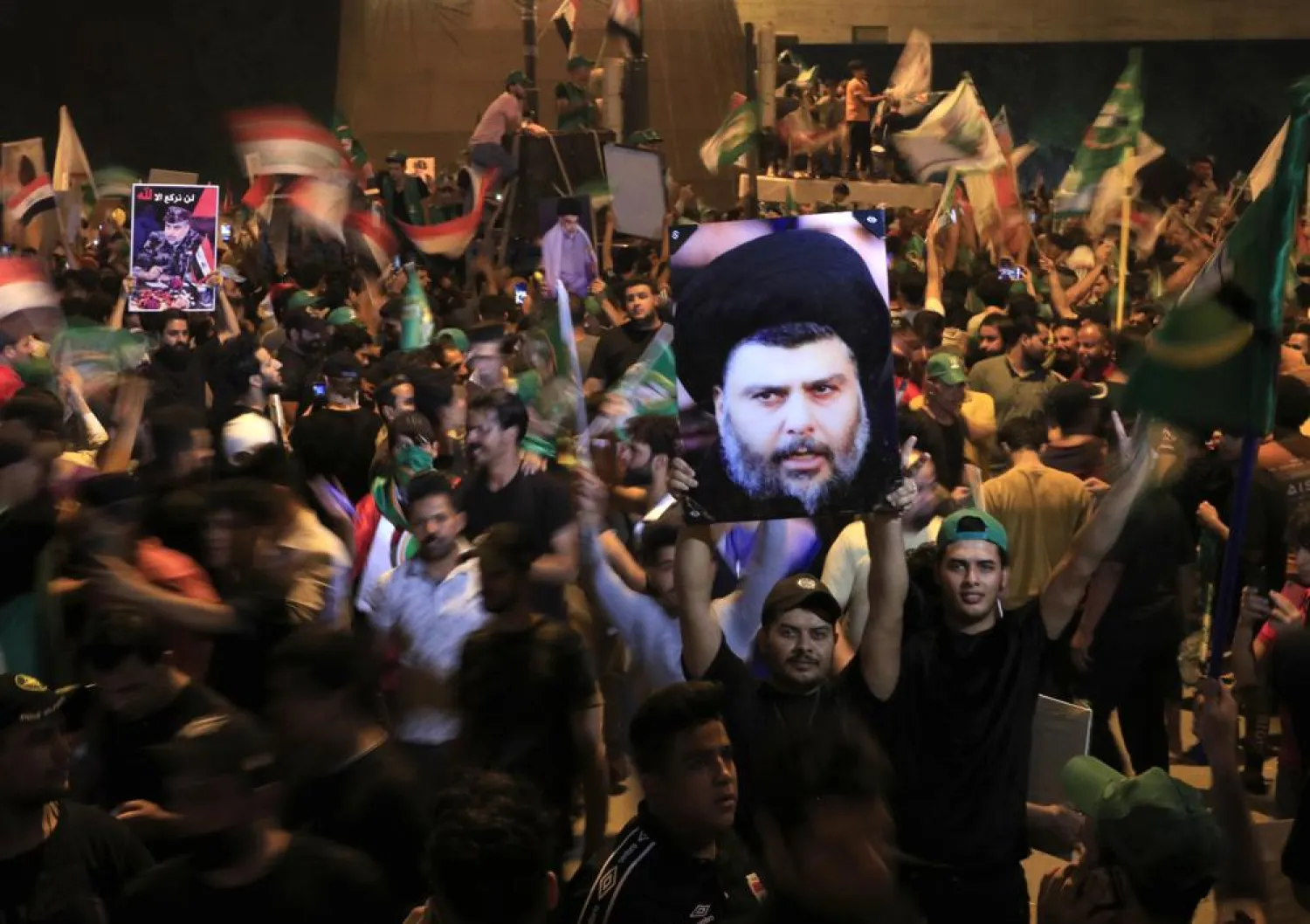
FILE - Followers of Shiite cleric Muqtada al-Sadr, on the poster, celebrate after the announcement of the results of the parliamentary elections in Tahrir Square, Baghdad, Iraq, Monday, Oct. 11, 2021. Eight months after national elections, Iraq still doesn't have a government. Driven by cutthroat competition for power and resources between elites, there is no clear way out of the unprecedented impasse. (AP Photo/Hadi Mizban, File)
TT

No Way Out as Iraq's Dangerous Post-election Impasse Deepens

FILE - Followers of Shiite cleric Muqtada al-Sadr, on the poster, celebrate after the announcement of the results of the parliamentary elections in Tahrir Square, Baghdad, Iraq, Monday, Oct. 11, 2021. Eight months after national elections, Iraq still doesn't have a government. Driven by cutthroat competition for power and resources between elites, there is no clear way out of the unprecedented impasse. (AP Photo/Hadi Mizban, File)

Eight months after national elections, Iraq still doesn’t have a government and there seems to be no clear way out of the dangerous deadlock.

Political elites are embroiled in cutthroat competition for power, even as the country faces growing challenges, including an impending food crisis resulting from severe drought and the war in Ukraine, The Associated Press said.

For ordinary Iraqis, everything is delayed. The caretaker government is unable to make crucial electricity payments or draft plans for badly needed investment ahead of the critical summer months. Investments to upgrade water infrastructure have been paused while unemployment, water shortages and concerns over food security are drawing public anger.

The election was held several months earlier than expected, in response to mass protests that broke out in late 2019 and saw tens of thousands rally against endemic corruption, poor services and unemployment.

The vote brought victory for powerful Shiite cleric Muqtada al-Sadr and was a blow for his Iran-backed Shiite rivals, who lost about two-thirds of their seats and have rejected the results.

Personal vendettas spanning decades underpin the Shiite rivalry, pitting al-Sadr and his Kurdish and Sunni allies on one side against the Coordination Framework, a coalition led by Iran-backed Shiite parties, and their allies on the other. In the middle are the independents, themselves divided amid attempts by rival factions to lure them to either side.

“It’s not about power; it’s about survival,” said Sajad Jiyad, an Iraq-based fellow with The Century Foundation.

Meanwhile, anger among the Iraqi public is growing as food prices soar and electricity cuts worsen.

Last month, caretaker Prime Minister Mustafa al-Kadhimi was forced to leave the Baghdad funeral of a celebrated poet after some mourners began chanting anti-government slogans and pelting the convoys of other government officials.

“Political obstruction impacts the work of the government and the state, and lowers the morale of citizens,” al-Kadhimi told reporters on Tuesday, blaming the impasse for obstructing his reform plans.

The UN envoy for Iraq, Jeanine Hennis-Plasschaert, warned Iraqi political leaders last month that “the streets are about to boil over” and said national interests were “taking a backseat to short-sighted considerations of control over resources.”

Al-Sadr, whose party garnered the most seats in the election, has not been able to corral enough lawmakers to parliament to get the two-thirds majority needed to elect Iraq's next president — a necessary step ahead of naming the next prime minister and selecting a Cabinet.

Al-Sadr's tripartite alliance includes Taqadum, a Sunni party led by Mohammed Halbousi who was elected parliament speaker in January, and the Kurdish Democratic Party lead by Masoud Barzani. The bloc is intent on forming a majority government, which would be a first since a consensus-based power-sharing system was introduced following the 2003 US invasion of Iraq to oust Saddam Hussein.

The government would exclude Iran-backed Shiite rivals of the Coordination Framework, which includes former Prime Minister Nouri al-Maliki’s State of Law and the Kurdish Patriotic Union of Kurdistan party.

Both al-Sadr and al-Maliki, longtime bitter political adversaries, have built up loyalists throughout ministries to advance their political agendas and fear that if in power, the other will use state resources — including the judiciary, anti-corruption committees — to purge institutions of rivals.

Also, al-Sadr and Qais al-Khazali, whose powerful Iranian-backed militia is part of the Framework alliance, are engaged in a deadly feud, with assassination campaigns targeting members of their militias across Iraq’s Shiite southern heartland.

Paradoxically, the current stalemate is in part a consequence of parties moving away from sectarian-oriented groups. In the past, Shiite alliances would form a united front to negotiate with Sunni and Kurdish blocs. But this time, alliances have crossed sectarian lines, inflaming tensions within each sect.

In the absence of an agreement, many fear violent protests by al-Sadr’s large grassroots following and potential clashes with Iran-backed militias.

In a May 16 speech, a visibly frustrated al-Sadr pledged never to strike a deal with his rivals. He also alluded to the capabilities of his own militia, Saraya Salam, which recently opened the doors for recruits in Babylon and Diyala provinces.

Al-Sadr was also angered by a recent Iraqi Supreme Court decision prohibiting the caretaker government from drafting and passing laws. This effectively struck down an emergency food bill needed for the caretaker government to use public funds to pay for food items and buy energy from Iran in the absence of a budget.

Al-Sadr, who had pushed the bill, saw the court's decision as a move leaning toward the Framework. However, in a small win for al-Sadr, Parliament convened late Wednesday and passed the food security bill.

Iraqi militia leaders speak privately of concerns that the stalemate could ignite street protests by supporters of al-Sadr and dissolve into violence between them and rival armed Shiite militias, The Associated Press said.

Iraq has in the past seen protracted political wrangling among rival groups on choosing a new president and prime minister, though the current stalemate in electing a president is the longest yet.

This time, Iran has not been able to mend rifts between Shiite rivals — a role that used to fall to the top Iranian general, Qassem Soleimani, who was killed in a US drone strike in January 2020. At least three trips to Iraq by Soleimani's successor to mediate among Shiites failed to produce a breakthrough.

Recently, Tehran cut 5 million cubic meters of gas exports to Baghdad, citing non-payment issues. Iraq's Electricity Minister Adel Karim told The Associated Press last month he had no idea how Iraq would pay the nearly $1.7 billion in arrears before the scorching summer months.

Meanwhile, the independents — parties drawn from the 2019 protest movement who ran under the so-called Imtidad list and won nine seats in the 329-seat legislature — seem to have lost their way. They had sworn to become a formidable opposition force to represent the protesters' demands in parliament.

The head of the movement, Alaa Rikabi, recently froze his position after members resigned over his vote in favor of electing Halbousi as parliament speaker. The protesters see Halbousi as complicit in the killings of activists during the protests.

A spokesman for Imtidad, Rasoul Al-Saray, said the two Shiite blocs want to use the independents “to cover their failure to form a government.”

Some independents have said they faced threats and fear for their lives; one said he was offered tens of thousands of dollars in way of bribes to side with the anti-Sadrist group. The independents spoke anonymously, fearing for their safety.

With prospects for a consensus government dwindling, some have floated the option of new elections.

But Jiyad, the Century fellow, disagrees.

“It’s starting from zero and a risk to everyone,” he said.


Kurdistan Region Seeks Retroactive Compensation for Crimes Committed Under Saddam Hussein

Kurdish families at a cemetery for victims of the chemical bombardment of the city of Halabja (AFP). 
TT

Kurdistan Region Seeks Retroactive Compensation for Crimes Committed Under Saddam Hussein

Kurdish families at a cemetery for victims of the chemical bombardment of the city of Halabja (AFP). 

The Kurdistan Regional Government (KRG) has renewed a retroactive demand for compensation from Iraq’s federal government for crimes committed by the regime of the late president Saddam Hussein against the Kurds.

The move is widely seen as a calculated bid for leverage as calls grow to scrutinize the region’s revenues and governance.

In a statement issued on Thursday, the KRG said it is seeking $384.6 billion in compensation for the people of the Kurdistan Region for damages resulting from “crimes committed by the Iraqi regime between 1963 and 2003”, the period of Baath Party rule from its coup against the government of Abdul Karim Qasim until the US-led invasion that toppled it.

The claim is not unprecedented. Erbil made the same demand in 2013, according to a statement issued at the time by the KRG’s Ministry of Martyrs and Anfal Affairs.

Why now?

Explaining the timing, Jotiar Adil, head of the KRG’s Department of Media and Information, told Asharq Al-Awsat that “Erbil did not choose the timing; it was imposed by the painful paradox in Baghdad’s dealings with the region.”

Constitutional rights, he said, “do not lapse with time,” adding that reopening the compensation file is meant to remind partners in Baghdad that the people of Kurdistan are owed billions of dollars for widespread destruction and genocide.

Adil argued that subjecting the region to “microscopic scrutiny” over oil and non-oil revenues while ignoring the destruction of 4,500 villages—wiped out during the 1988 military campaign internationally recognized as genocide—was illogical.

“The timing carries a message,” he said. “Before you cut our people’s livelihoods today, remember your historical debts to them.” He rejected suggestions that the move was political maneuvering, describing it instead as “a legal rights case aimed at justice, not at paralyzing Baghdad.”

A dispute over resources

Baghdad has insisted on implementing agreements governing oil revenues and border crossings before releasing the region’s financial entitlements. Technical disputes are often entangled with political negotiations over forming federal governments.

Iraq’s constitution provides for joint management of oil and gas, equitable revenue distribution based on population, and temporary allocations for areas damaged by past conflicts.

For years, the Kurdistan Region exported oil via Türkiye’s Ceyhan port without Baghdad’s approval. Exports were halted in 2023 following an international arbitration ruling requiring sales to be conducted through the state oil marketer, SOMO, exacerbating tensions.

Although an agreement was reached in 2025 on handing over the region’s oil, it has yet to be implemented. Baghdad later cut public-sector salaries in the Kurdistan Region as leverage, a move Erbil condemned as a violation of citizens’ rights.

Adil said the compensation figure was based on international standards similar to those used by the UN Compensation Commission in assessing damages to Kuwait after Iraq’s 1990 invasion, factoring in cumulative harm and present value.

He noted that post-2003 governments honored Saddam-era obligations abroad — paying compensation to Kuwait and settling Paris Club debts — while rejecting comparable responsibility toward victims at home.


Syria Says Busted Hezbollah-Linked Cell Behind Damascus Attacks

A supporter of Hezbollah holds a portrait of Iran's Supreme Leader Ali Khamenei during a rally to show their solidarity with Iran, in the southern suburb of Beirut on January 26, 2026. (AFP)
TT

Syria Says Busted Hezbollah-Linked Cell Behind Damascus Attacks

A supporter of Hezbollah holds a portrait of Iran's Supreme Leader Ali Khamenei during a rally to show their solidarity with Iran, in the southern suburb of Beirut on January 26, 2026. (AFP)

Syria's interior ministry said Sunday that its forces had dismantled a cell that was responsible for recent attacks targeting Damascus's Mazzeh district, saying the weapons came from Lebanon's Hezbollah group.

Security forces carried out operations that "targeted a terrorist cell involved in several attacks on the Mazzeh area and its military airport", a statement said, reporting that the cell was dismantled and its members arrested.

Forces also "seized a number of drones that were prepared for use in terrorist acts", it said.

"Preliminary investigations with those arrested revealed their links to foreign entities, and that the source of the rockets and launch platforms used in the attacks, as well as the seized drones, goes back to Lebanese militia Hezbollah," the statement added.

The Iran-backed Hezbollah played a key role in Syria's civil war, fighting alongside the forces of now ousted leader Bashar al-Assad.

Syria was formerly part of Iran's "axis of resistance" against Israel and enabled the transfer of weapons and money from Iran to Hezbollah, but the new authorities in Damascus have rejected Iranian influence.

Last month, authorities said three rockets hit the Mazzeh area, with one damaging a mosque and another coming down near the military airport, without causing casualties.

The Syrian Observatory for Human Rights monitor said at the time that the mosque was in an area where senior officials from Syria's new authorities live.

And in December, state news agency SANA quoted a military source as saying three projectiles of unknown origin targeted the area near the Mazzeh military airport, without causing damage or casualties.

A month earlier, a woman was hurt in a rocket attack that struck a house in the Mazzeh area, with SANA quoting a military source as saying the attack was carried out "using rockets launched from a mobile platform".


Israel to Terminate MSF Work in Gaza for Failing to Provide Palestinian Staff List

A young boy sits overlooking destroyed buildings at Nuseirat camp for Palestinian refugees in the central Gaza Strip on January 31, 2026. (AFP)
TT

Israel to Terminate MSF Work in Gaza for Failing to Provide Palestinian Staff List

A young boy sits overlooking destroyed buildings at Nuseirat camp for Palestinian refugees in the central Gaza Strip on January 31, 2026. (AFP)

Israel said Sunday it was terminating the humanitarian operations of the international charity Doctors Without Borders in Gaza after the organization failed to provide a list of its Palestinian staff.

"The Ministry of Diaspora Affairs and Combating Antisemitism is moving to terminate the activities of Medecins Sans Frontieres (MSF) in the Gaza Strip," the ministry said.

The decision follows "MSF's failure to submit lists of local employees, a requirement applicable to all humanitarian organizations operating in the region", it added, stating that the group will cease its work and leave Gaza by February 28.

In December, the ministry announced it would prevent 37 aid organizations, including MSF, from operating in Gaza from March 1 for failing to provide detailed information about their Palestinian staff.

It had alleged that two MSF employees had links with Palestinian armed groups Hamas and Islamic Jihad, which the medical charity vehemently denies.

On Sunday, the ministry said MSF had committed in early January that it would share the staff list as required by the Israeli authorities.

"Despite its public commitment, the organization refrained from transferring the lists," the ministry said.

"Subsequently, MSF announced it does not intend to proceed with the registration process at all, contradicting its previous statements and the binding protocol.

"In accordance with the regulations, MSF will cease its operations and depart the Gaza Strip by February 28, 2026," the ministry added.

In a statement posted on its website on Friday, MSF acknowledged that it had, as an "exceptional measure", agreed to share a list of names of its Palestinian and international staff with the Israeli authorities.

"However, despite repeated efforts, it became evident that we were unable to build engagement with Israeli authorities on the concrete assurances required," the charity said.

"These included that any staff information would be used only for its stated administrative purpose and would not be colleagues at risk."

MSF said it had not received assurances on these fronts, so "concluded that we will not share staff information in the current circumstances".
