Ukraine’s Leader Says His Troops Keep Defying Predictions

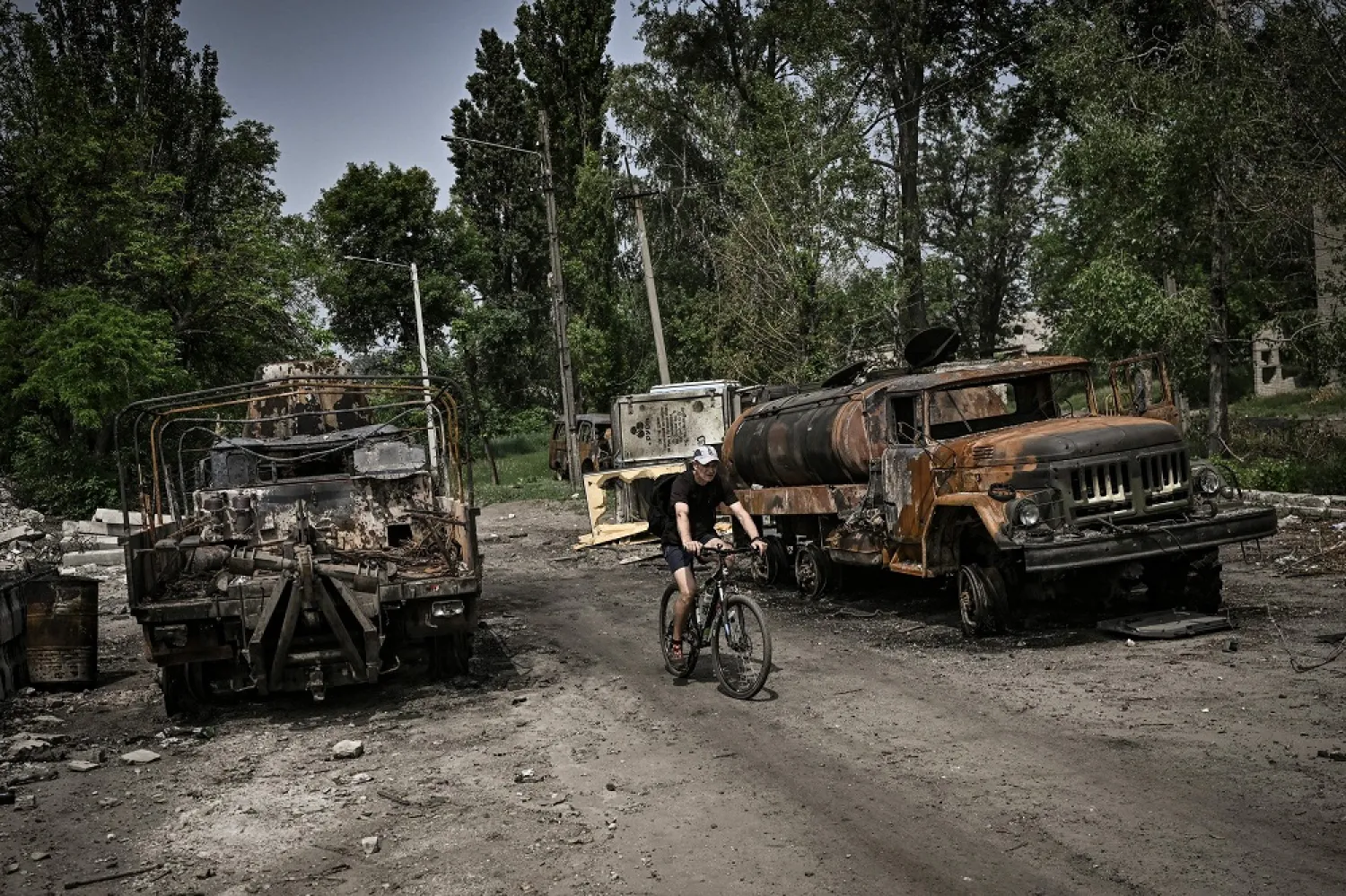
A man rides his bicycle between two destroyed military trucks in the city of Lysychansk, eastern Ukrainian region of Donbas, on June 11, 2022. (AFP)
TT

Ukraine’s Leader Says His Troops Keep Defying Predictions

A man rides his bicycle between two destroyed military trucks in the city of Lysychansk, eastern Ukrainian region of Donbas, on June 11, 2022. (AFP)

Ukrainian President Volodymyr Zelenskyy said no one knows how long the war in his country will last but that Ukrainian forces are defying expectations by preventing Russian troops from overrunning eastern Ukraine, where the fighting has been fiercest for weeks.

In his nightly video address, Zelenskyy said he was proud of the Ukrainian defenders managing to hold back the Russian advance in the Donbas region, which borders Russia and where Moscow-backed separatists have controlled much of the territory for eight years.

"Remember how in Russia, in the beginning of May, they hoped to seize all of the Donbas?" the president said late Saturday. "It’s already the 108th day of the war, already June. Donbas is holding on."

After failing to capture Kyiv, Ukraine's capital, early in the war, Moscow focused on seizing the parts of the largely Russian-speaking Donbas still in Ukrainian hands, as well as the country's southern coast. But instead of securing a swift, decisive takeover, Russian forces were drawn into a long, laborious battle, thanks in part to the Ukrainian military's use of Western-supplied weapons.

Both Ukrainian and Russian authorities said Sievierodonetsk, an eastern city with a prewar population of 100,000, remained contested. The city and neighboring Lysychansk are the last major areas of the Donbas' Luhansk province not under the control of the pro-Russia rebels.

Leonid Pasechnik, the head of the separatist-declared Luhansk People’s Republic, said Ukrainian fighters remained in an industrial area of the city, including a chemical plant where civilians had taken shelter from days of Russian shelling.

"Sievierodonetsk is not completely 100% liberated," Pasechnik said Saturday, alleging that the Ukrainians were shelling the city from the Azot plant. "So it’s impossible to call the situation calm in Sievierodonetsk, that it is completely ours."

Luhansk Gov. Serhii Haidai reported Saturday that a big fire broke out at the plant during hours of Russian shelling.

Elsewhere in Ukraine, a counteroffensive pushed Russians out of parts of the southern Kherson region they took early in the war, according to Zelenskyy. Moscow has installed local authorities in Kherson and other occupied coastal areas, offering residents Russian passports, airing Russian news broadcasts and taking steps to introduce a Russian school curriculum.

Zelenskyy said that while an end to the war was not in sight, Ukraine should do everything it can so the Russians "regret everything that they have done and that they answer for every killing and every strike on our beautiful state."

The Ukrainian leader asserted that Russia has suffered about three times as many military casualties as the number estimated for the Ukrainian side, adding: "For what? What did it get you, Russia?" There are no reliable independent estimates of the war’s death toll so far.

Speaking at a defense conference in Singapore on Sunday, Chinese Defense Minister Gen. Wei Fenghe said Beijing continues to support peace talks between Russia and Ukraine, and hopes the US and its NATO allies have discussions with Russia "to create the conditions for an early ceasefire."

"China will continue to play a constructive role and contribute our share to easing tensions and realizing a political resolution of the crisis," Wei said.

He suggested that nations supplying weapons to Ukraine were hindering peace by "adding fuel to the fire" and stressed that China had not provided any material support to Russia during the war.

"The growth of China-Russia relations is a partnership, not an alliance," Wei said.

The Institute for the Study of War, a think tank based in Washington, said in its latest assessment that Ukrainian intelligence suggested the Russian military was planning "to fight a longer war."

The institute cited the deputy head of Ukraine's national security agency as saying that Moscow had extended its war timeline until October, with adjustments to be made depending on any successes in the Donbas.

The intelligence "likely indicates the Kremlin has, at a minimum, acknowledged it cannot achieve its objectives in Ukraine quickly and is further adjusting its military objectives in an attempt to correct the initial deficiencies in the invasion of Ukraine," the think tank said.

The Luhansk People’s Republic's ambassador to Russia, Rodion Miroshnik, said Saturday that 300 to 400 Ukrainian troops remained blockaded inside the Sievierodonetsk chemical plant along with several hundred civilians.

The Russians established contact with the Ukrainian troops to arrange the evacuation of the civilians, but the the troops will be allowed to leave only if they lay down their arms and surrender, Miroshnik said.

Similar conditions existed for weeks at a steel mill in the southern Ukrainian city of Mariupol before a civilian evacuation was arranged and the defending troops were ordered by Ukrainian military commanders to stand down. The fighters who came out of the Mariupol plant were taken prisoner by the Russians.

Pasechnik, the separatist leader of the unrecognized Luhansk republic, said the Ukrainians making a stand in Sievierodonetsk should save themselves the trouble.

"If if I were them, I would already make a decision (to surrender)," he said. "We will achieve our goal in any case. We will liberate the industrial area in any case. We will liberate Sievierodonetsk in any case. Lysychansk will be ours in any case."


Le Pen Says France Will No Longer Aid Ukraine ‘Financially’ if Elected

Marine Le Pen (C), the far-right National Rally (RN) party's candidate for the 2027 French presidential election, visits the "Made in France" fair at the Porte de Versailles exhibition center in Paris, France, 13 November 2026. (EPA)
TT

Le Pen Says France Will No Longer Aid Ukraine ‘Financially’ if Elected

Marine Le Pen (C), the far-right National Rally (RN) party's candidate for the 2027 French presidential election, visits the "Made in France" fair at the Porte de Versailles exhibition center in Paris, France, 13 November 2026. (EPA)

Marine Le Pen on Monday said that France would provide no further financial aid to Ukraine if she is elected president next year, after a meeting with Kyiv's ambassador in Paris.

"The state of France's public finances would no longer allow the country to provide financial assistance to Ukraine in the coming months," Le Pen said in a statement, while insisting France would honor existing commitments, including toward a 90-billion-euro ($100-billion) European Union loan.

Le Pen is currently ahead in polls in the race to succeed President Emmanuel Macron next year, as the war sparked by Russia's 2022 full-scale invasion of Ukraine grinds towards its fifth anniversary.

She has faced criticism over past links to Russia, which included a 2017 meeting in the Kremlin with President Vladimir Putin and her party taking a loan from a Russian bank that it paid off in full in 2023.

But she has opposed the invasion and, at her talks in Paris with Ukrainian ambassador Vadym Omelchenko, Le Pen made clear her "unwavering support for Ukraine since the beginning of the conflict".

The statement said the talks -- the first such between Le Pen and the Ukrainian ambassador -- were "cordial".

While financial aid would be cut, Le Pen told the ambassador that "France would continue to support Ukraine through donations of equipment, humanitarian aid and much more active diplomacy".

The statement said there was a "frank discussion" on the future of the conflict, with Le Pen stressing that "the pursuit of peace -- though a difficult goal to achieve -- must remain a priority for all".

She also asked the ambassador to tell President Volodymyr Zelensky she is ready to meet in "either Paris or Brussels". However, there was no mention of the candidate making the journey to Kyiv after Zelensky invited her to visit the Ukrainian capital.

Le Pen's opponents have expressed alarm that by emphasizing the importance of ending the war swiftly, she could force Ukraine to capitulate on unfavorable terms.

"If Russia imposes its will on a European nation through brutality, all of Europe is weakened," Macron wrote on Facebook at the weekend.

Taking aim at Le Pen, he said: "Let us be clear: those who seek to limit the resources available to Ukraine are, in effect, pushing for an unjust peace -- one that would leave Ukraine permanently vulnerable, and, by extension, leave Europe vulnerable as well."


Trump Says He Might Meet with North Korea’s Kim Jong Un in China

US President Donald Trump and North Korean leader Kim Jong Un shake hands before their one-on-one chat during the second US-North Korea summit at the Metropole Hotel in Hanoi, Vietnam February 27, 2019. (Reuters)
TT

Trump Says He Might Meet with North Korea’s Kim Jong Un in China

US President Donald Trump and North Korean leader Kim Jong Un shake hands before their one-on-one chat during the second US-North Korea summit at the Metropole Hotel in Hanoi, Vietnam February 27, 2019. (Reuters)

US President Donald Trump said on Monday he might meet with North Korean leader Kim Jong Un in China this week, an announcement that could dramatically reshape his upcoming trip through East Asia if it occurs.

The president, who met the North Korean leader several times during his 2017-2021 term, including once in the Korean Demilitarized Zone, has previously expressed ‌interest in ‌another meeting during his current term. Senior ‌US ⁠officials, however, have previously ⁠said he has no immediate plans to do so.

Moreover, Trump has repeatedly previewed meetings with Kim that never took place, including during a trip to Asia last year. North Korea, whose mission to the United Nations did not immediately respond to a ⁠request for comment, has publicly indicated it ‌has no intention of ‌meeting with the US president at this time.

Trump told reporters ‌while departing the White House en route to ‌the Philippines and China that any meeting would occur in China, and that the North Korean leader's presence was ultimately up to Chinese President Xi Jinping.

"(Xi) was here a ‌month ago, and we're also going to meet with (Russian) President Putin, and we ⁠may ⁠meet with Kim Jong Un also," Trump said.

"So that'll be good. We have a chance to accomplish a lot."

Trump has indicated he will meet with Putin and Xi during his trip, but US officials and analysts have played down the possibility of a meaningful agreement emerging from any trilateral sit-down.

Among the possible topics of conversation, Trump and others have said, are Russia's invasion of Ukraine, counterproliferation and the war in Iran.


Third US Aircraft Carrier Arrives in Middle East

This US Navy handout photograph released by US Naval Forces Central Command on November 4, 2026, shows the Nimitz-class aircraft carrier USS Theodore Roosevelt (CVN 71) sails alongside Royal Australian Navy Supply-class replenishment oiler HMAS Stalwart (A304). (AFP / NAVCENT Public Affairs / US Navy)
TT

Third US Aircraft Carrier Arrives in Middle East

This US Navy handout photograph released by US Naval Forces Central Command on November 4, 2026, shows the Nimitz-class aircraft carrier USS Theodore Roosevelt (CVN 71) sails alongside Royal Australian Navy Supply-class replenishment oiler HMAS Stalwart (A304). (AFP / NAVCENT Public Affairs / US Navy)

The USS Theodore Roosevelt aircraft carrier arrived in the Middle East on Sunday, media reports said, bringing the number of American carrier strike groups in the region to three.

The deployment, which was reported by the National News and Axios journalist Barak Ravid, comes as fighting reignites in the region, with Iran claiming a drone attack on Bahrain on Sunday, ending a lull in strikes in the war.

Iran also fired drones at Bahrain on Friday -- the first strikes since September against countries in the energy-rich Gulf, which has been targeted several times in the conflict that erupted in February.

US President Donald Trump plans to discuss the war at a trilateral meeting with his Chinese and Russian counterparts Xi Jinping and Vladimir Putin this week, an official said Friday.

Months of diplomacy have failed to resolve the war, which began with US-Israeli strikes that killed Iran's supreme leader Ali Khamenei.