

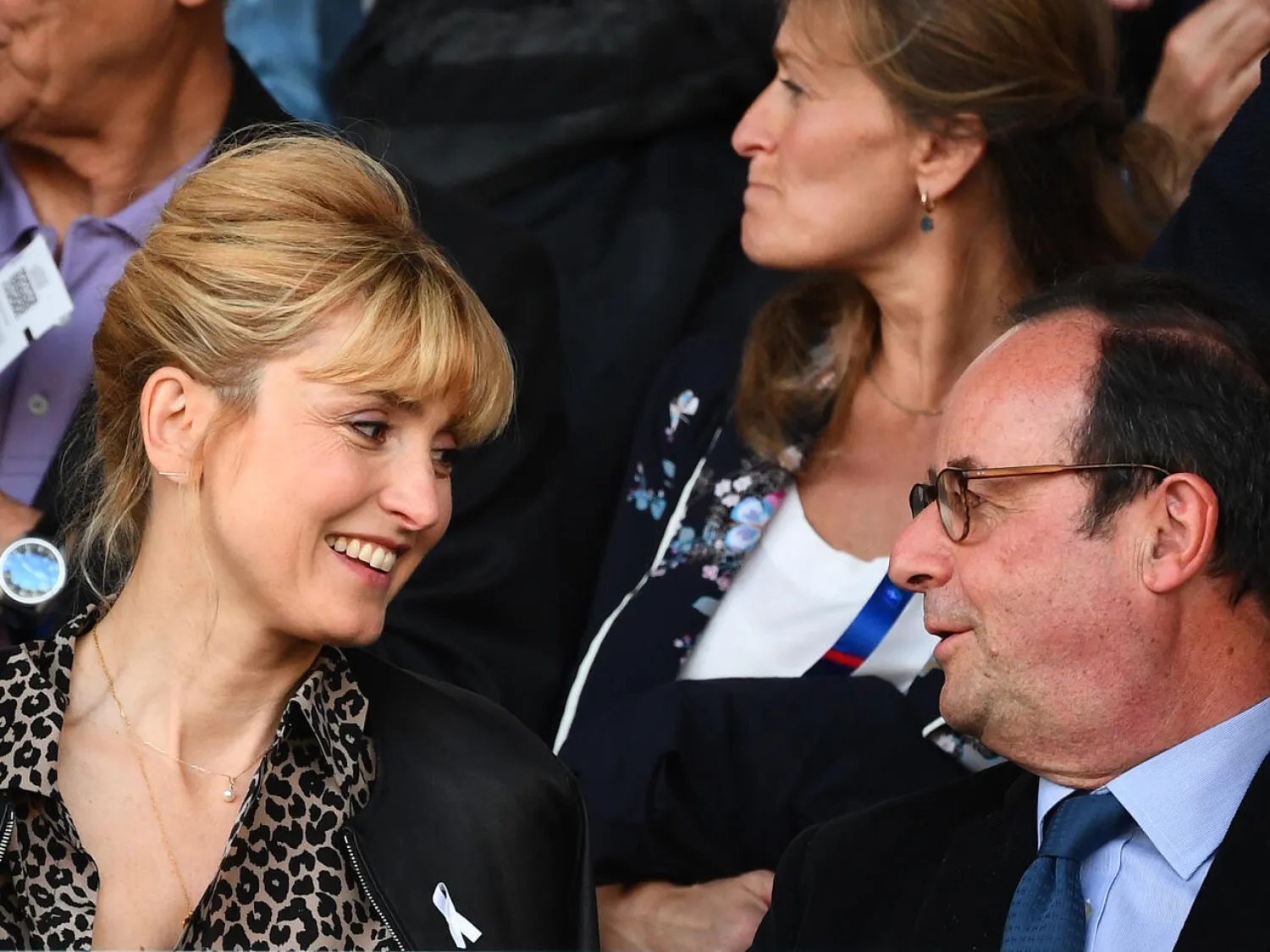

French Ex-president Hollande Weds Actress Julie Gayet

News of Hollande and Gayet's affair in 2014 dealt a severe blow to the credibility of the then president. FRANCK FIFE AFP/File
TT

French Ex-president Hollande Weds Actress Julie Gayet

News of Hollande and Gayet's affair in 2014 dealt a severe blow to the credibility of the then president. FRANCK FIFE AFP/File

After a romance that made headlines around the world when it was revealed in 2014, ex-president Francois Hollande has married actress Julie Gayet at a low-key ceremony in his political fiefdom in central France.

The news was announced to La Montagne newspaper by the mayor of Tulle, Bernard Combes, with a picture of the couple showing the groom in a suit and his bride in a white dress climbing the stairs of the local town hall, AFP said.

They married Saturday "in a private ceremony," the mayor's office in the central Correze region told the paper.

Little was revealed about the guest list beyond the presence of French singer Benjamin Biolay who worked with Gayet on a film in 2021.

Hollande, who has never married before, had an affair with Gayet while president and in a relationship with journalist Valerie Trierweiler, who was France's de facto first lady at the time.

In January 2014, French glossy magazine Closer published bombshell photographs of Hollande arriving for a tryst with Gayet on a scooter at an apartment near his official residence in the heart of Paris.

The images, accompanied by a story replete with salacious details about bodyguards being dispatched to buy croissants for the pair in the morning, dealt a severe blow to Hollande's credibility.

Trierweiler went on to write a best-selling tell-all memoir that recounted how she tried to commit suicide in the presidential bedroom after the media revelations.

Hollande has four children from his relationship with long-term former partner Segolene Royal, a one-time rival in the Socialist party.

Gayet has two sons with former husband Santiago Amigorena, an Argentinian screenwriter and producer she divorced in 2006.

The 50-year-old -- who celebrated her landmark birthday the day before Saturday's wedding -- remained a low-key presence throughout the latter part of Hollande's difficult time in office.

The couple agreed to their first joint photo session only in 2018 once Hollande had left office, having ended his five-year term in power with record low approval ratings.

In a rare interview the same year, she described Hollande's time as leader as a period of "crazy violence" which included a series of jihadist attacks that cost hundreds of lives.

"I tried to give energy to the president, to take care of him, to be there to listen," she told the Journal du Dimanche newspaper.

"Since I met him, it's given me wings," added the star of Netflix drama "The Perfect Mother" who is an increasingly influential film producer. "I love his way of thinking, of being, his humor."



Macron Reappears Wearing Viral Aviator Sunglasses

France's President Emmanuel Macron looks on during a welcoming ceremony for Thailand's King Maha Vajiralongkorn and Queen Suthida (not pictured) in the courtyard of the Hotel des Invalides in Paris on June 29, 2026, as part of an official state visit of the Thai King to France. (AFP)
TT

Macron Reappears Wearing Viral Aviator Sunglasses

France's President Emmanuel Macron looks on during a welcoming ceremony for Thailand's King Maha Vajiralongkorn and Queen Suthida (not pictured) in the courtyard of the Hotel des Invalides in Paris on June 29, 2026, as part of an official state visit of the Thai King to France. (AFP)

French President Emmanuel Macron reappeared on Monday wearing now-iconic aviator sunglasses that caused a stir at the Davos forum when he wore them due to an eye condition during a speech standing up to Donald Trump.

Macron was sporting the blue-tinted shades on the steps of the Elysee Palace as he welcomed the Sultan of Oman, Haitham bin Tariq.

But his eyewear choice wasn't to block the midday sun in Paris, but again because of "an eye problem", staff said, without giving further details.

The president continued to wear his sunglasses during a signing ceremony inside the presidential palace alongside the sultan, and later at a hotel for a Franco-Omani business forum.

Macron's aviators sparked a viral moment when he wore them at the World Economic Forum in Davos in January during a speech standing up to Donald Trump that was punctuated by the English phrase "for sure".

He said Europe needed to stand up to "bullies" and be "much stronger and more autonomous" at a time when tensions were mounting over Trump's designs on Greenland.

Macron embodied the counter-offensive against the US president, symbolized -- albeit unwittingly -- by his sunglasses.

Trump himself fueled the buzz by poking fun at Macron for wearing the aviators, quipping, "I watched him sort of be tough" with those "beautiful sunglasses".

After Davos, demand for the Henry Jullien sunglasses crashed the French eyewear maker's site.

Outgoing UK Prime Minister Keir Starmer jumped on the aviators bandwagon with a mock "Top Gun" poster featuring himself and Macron dressed as fighter pilots.

The French leader -- who speaks excellent if accented English -- quickly shot back, "For sure."


Three Firefighters Die as Blazes Torch Western US

A helicopter drops water on the Cottonwood Fire burning near Beaver, Utah, on Saturday, June 27, 2026. (AP)
TT

Three Firefighters Die as Blazes Torch Western US

A helicopter drops water on the Cottonwood Fire burning near Beaver, Utah, on Saturday, June 27, 2026. (AP)

Three firefighters have died battling fierce blazes along the Utah-Colorado border, driven by high temperatures, strong winds and low humidity.

Dangerous weather conditions are compounding a fire season made worse by historically low snowpack, with more than a dozen blazes burning across hundreds of thousands of acres in the two states.

Five firefighters were trapped in a fire over the weekend, with three losing their lives and two others treated for burn injuries, the US Wildland Fire Service said in a statement.

"Wildfire conditions remain critical for the Southwest and portions of the Great Basin through Monday," the National Weather Service said in an update.

Utah Governor Spencer J. Cox announced a ban on fireworks during the upcoming July 4 Independence Day holiday, while Colorado Governor Jared Polis declared a state of emergency to support fire response efforts.

Human-caused climate change is driving longer fire seasons and more intense blazes, as rising temperatures and increasingly arid conditions create landscapes primed to burn.


Europe’s Deadly Heatwave Scorches Eastern Flank, Takes Aim at Ukraine

People cool themselves with water sprayed from a special sprayer set up on a sidewalk during a hot day in Lviv, Western Ukraine, 29 June 2026. (EPA)
TT

Europe’s Deadly Heatwave Scorches Eastern Flank, Takes Aim at Ukraine

People cool themselves with water sprayed from a special sprayer set up on a sidewalk during a hot day in Lviv, Western Ukraine, 29 June 2026. (EPA)

The most severe heatwave ever recorded in Europe roasted central and eastern parts of the continent on Monday as Ukraine's war-ravaged power grid struggled to cope with the shock of scorching heat.

The heatwave first smothered western Europe last week, sending temperatures to record highs and straining hospitals, transport networks and power grids on a continent where infrastructure was not built to withstand punishing heat and where air conditioning is not widespread.

More than 1,300 excess deaths were recorded in Europe since June 21, according to the UN health agency, including several small children who died in locked cars and youths who drowned as they sought relief from the infernal temperatures in unsupervised swimming spots.

France reported at least 74 drowning deaths since June 18 and Poland said 17 drowned on Sunday alone.

"I'm doing the same thing as everyone -- trying to stay in the shade and drink a lot of water," Susanne, a Vienna resident, told AFP on a bank of a river near the Austrian capital.

"I just hope that the politicians will understand the situation and will begin to set a course in the right direction," she said.

On Monday, the Balkans braced for temperatures of up to 40C, with firefighters in Bosnia battling blazes sparked during the heat.

At least 130 million people in Europe were expected to swelter through temperatures of more than 35C, down from 190 million on Sunday according to an AFP analysis.

This heatwave is the most severe ever recorded in Europe, and would have been "virtually impossible" this early in the summer without climate change, the World Weather Attribution group of scientists said.

All-time temperature records have been broken in Germany, Poland and the Czech Republic, as well as for the month of June in the UK and in Switzerland.

- New shock for Ukraine -

Ukraine's energy network, already pummeled by Russian attacks over more than four years of war, was buckling under the high temperatures on Monday.

In the western Rivne region, authorities introduced emergency power outages to ease pressure on the grid as temperatures passed 36C as of 15:00 (1200 GMT), according to data from the state Hydrometeorological Centre.

The central Khmelnytsky region also announced temporary outages, and five other regions -- from Ivano-Frankivsk in the west to Zaporizhzhia on the front line in the south -- warned households and businesses to be prepared for blackouts on Tuesday.

The state weather service said the country would face "intense heat", with temperatures of 35C-38C expected, though this is some way off the national record of 42C recorded in August 2010.

"The heat is also a serious test for equipment that has been operating under wartime conditions for more than four years and has withstood numerous attacks," Sergii Kovalenko, CEO of the Yasno energy company said over the weekend.

He said that summer was the peak period for repairing the energy network, battered through the winter by repeat Russian attacks, meaning the grid was already "operating at the limit of its capabilities".

- Record temperatures -

Over the weekend, the heat scorched the Czech Republic, Germany and Poland, with the countries setting new temperature records of 41.9C, 41.7C and 40.5C, respectively.

The Berlin police used water cannons to help residents of the capital cool off for a second day running Sunday -- this time at the Olympia venue where singer Bruno Mars was performing.

With temperatures cooling in France, the national weather service said on Sunday evening it was already anticipating the possibility of another heatwave in July.

The scorching heat has sparked lively discussion in some countries about the merits of air-conditioning, which is used far less in Europe than in some parts of the world.

The EU on Monday refused to be drawn into the increasingly politicized debate, with a Brussels spokeswoman saying the bloc did not have "a particular view or position" on the matter.