


SIPRI: World Headed for New Era of Nuclear Rearmament

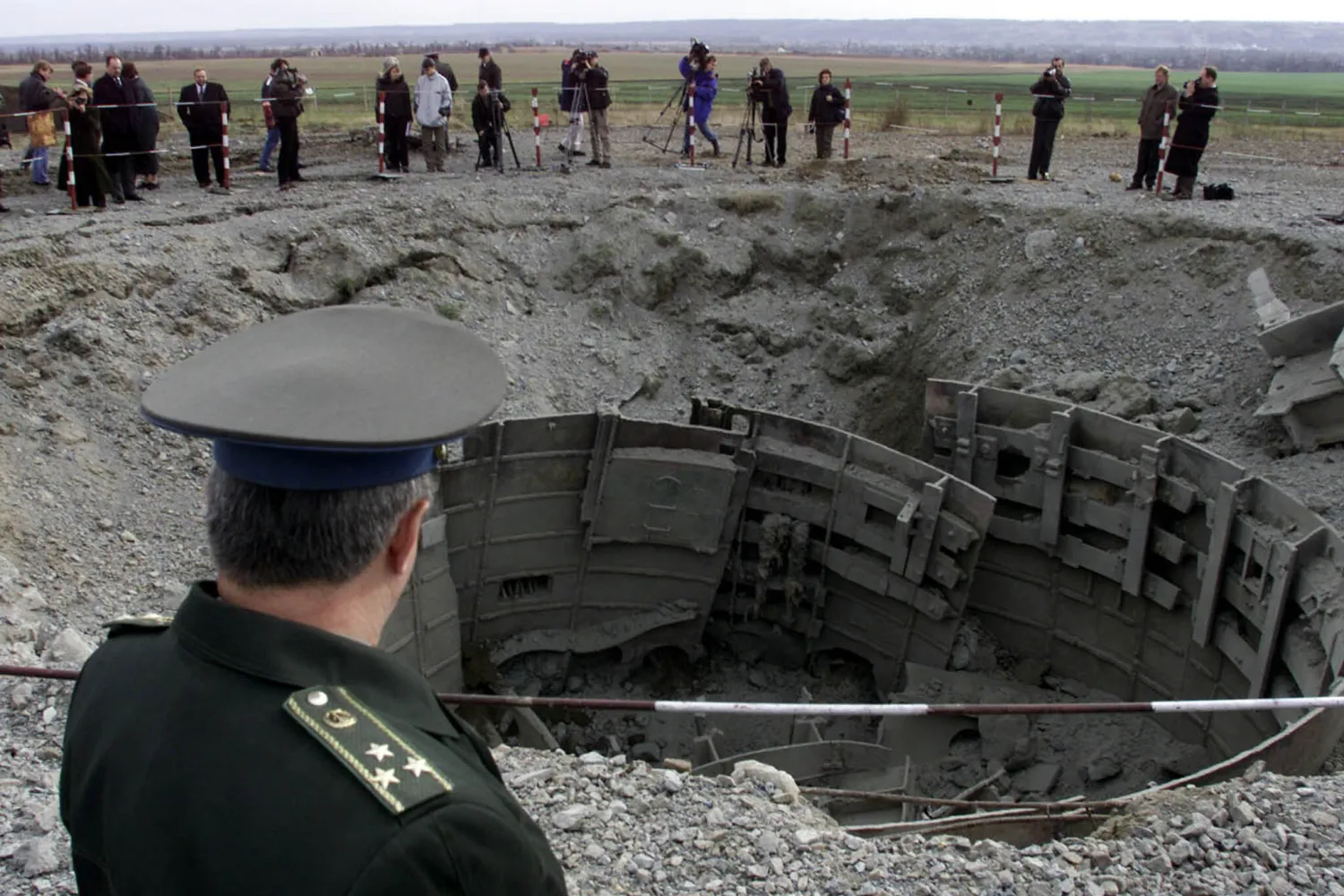
File Photo: A Ukrainian Army officer looking over a destroyed missile silo near Pervomaisk, Ukraine, in 2001.Credit...Gleb Garanich/Reuters
TT

SIPRI: World Headed for New Era of Nuclear Rearmament

File Photo: A Ukrainian Army officer looking over a destroyed missile silo near Pervomaisk, Ukraine, in 2001.Credit...Gleb Garanich/Reuters

The number of nuclear weapons in the world is set to rise in the coming decade after 35 years of decline as global tensions flare amid Russia's war in Ukraine, researchers said Monday.

The nine nuclear powers -- Britain, China, France, India, Israel, North Korea, Pakistan, the United States and Russia -- had 12,705 nuclear warheads in early 2022, or 375 fewer than in early 2021, according to estimates by the Stockholm International Peace Research Institute (SIPRI).

The number has come down from a high of more than 70,000 in 1986, as the US and Russia have gradually reduced their massive arsenals built up during the Cold War, AFP said.

But this era of disarmament appears to be coming to an end and the risk of a nuclear escalation is now at its highest point in the post-Cold War period, SIPRI researchers said.

"Soon, we're going to get to the point where, for the first time since the end of the Cold War, the global number of nuclear weapons in the world could start increasing for the first time", Matt Korda, one of the co-authors of the report, told AFP.

"That is really kind of dangerous territory."

After a "marginal" decrease seen last year, "nuclear arsenals are expected to grow over the coming decade", SIPRI said.

During the war in Ukraine, Russian President Vladimir Putin has on several occasions made reference to the use of nuclear weapons.

Meanwhile several countries, including China and Britain, are either officially or unofficially modernizing or ramping up their arsenals, the research institute said.

"It's going to be very difficult to make progress on disarmament over the coming years because of this war, and because of how Putin is talking about his nuclear weapons", Korda said.

These worrying statements are pushing "a lot of other nuclear armed states to think about their own nuclear strategies", he added.

- 'Nuclear war can't be won' -
Despite the entry into force in early 2021 of the UN nuclear weapon ban treaty and a five-year extension of the US-Russian "New START" treaty, the situation has been deteriorating for some time, according to SIPRI.

Iran's nuclear program and the development of increasingly advanced hypersonic missiles have, among other things, raised concern.

The drop in the overall number of weapons is due to the US and Russia "dismantling retired warheads", SIPRI noted, while the number of operational weapons remains "relatively stable".

Moscow and Washington alone account for 90 percent of the world's nuclear arsenal.

Russia remains the biggest nuclear power, with 5,977 warheads in early 2022, down by 280 from a year ago, either deployed, in stock or waiting to be dismantled, according to the institute.

More than 1,600 of its warheads are believed to be immediately operational, SIPRI said.

The United States meanwhile has 5,428 warheads, 120 fewer than last year, but it has more deployed than Russia, at 1,750.

In terms of overall numbers, China comes third with 350, followed by France with 290, Britain with 225, Pakistan with 165, India with 160 and Israel with 90.

Israel is the only one of the nine that does not officially acknowledge having nuclear weapons.

As for North Korea, SIPRI said for the first time that Kim Jong-Un's Communist regime now has 20 nuclear warheads.

Pyongyang is believed to have enough material to produce around 50.

In early 2022, the five nuclear-armed permanent members of the United Nations Security Council -- Britain, China, France, Russia and the US -- issued a statement that "nuclear war cannot be won and must never be fought".

Nonetheless, SIPRI noted, all five "continue to expand or modernize their nuclear arsenals and appear to be increasing the salience of nuclear weapons in their military strategies."

"China is in the middle of a substantial expansion of its nuclear weapon arsenal, which satellite images indicate includes the construction of over 300 new missile silos", it said.

According to the Pentagon, Beijing could have 700 warheads by 2027.

Britain last year said it would increase the ceiling on its total warhead stockpile, and would no longer publicly disclose figures for the country’s operational nuclear weapons.



Factory Explosion Kills 8 in Northern China

Employees work on an electric vehicle (EV) production line at the Volkswagen Anhui factory in Hefei, Anhui province, China, February 4, 2026. REUTERS/Florence Lo
TT

Factory Explosion Kills 8 in Northern China

Employees work on an electric vehicle (EV) production line at the Volkswagen Anhui factory in Hefei, Anhui province, China, February 4, 2026. REUTERS/Florence Lo

An explosion at a biotech factory in northern China has killed eight people, Chinese state media reported Sunday, increasing the total number of fatalities by one.

State news agency Xinhua had previously reported that seven people died and one person was missing after the Saturday morning explosion at the Jiapeng biotech company in Shanxi province, citing local authorities.

Later, Xinhua said eight were dead, adding that the firm's legal representative had been taken into custody.

The company is located in Shanyin County, about 400 kilometers west of Beijing, AFP reported.

Xinhua said clean-up operations were ongoing, noting that reporters observed dark yellow smoke emanating from the site of the explosion.

Authorities have established a team to investigate the cause of the blast, the report added.

Industrial accidents are common in China due to lax safety standards.
In late January, an explosion at a steel factory in the neighboring province of Inner Mongolia left at least nine people dead.


Iran Warns Will Not Give Up Enrichment Despite US War Threat

Traffic moves through a street in Tehran on February 7, 2026. (Photo by ATTA KENARE / AFP)
TT

Iran Warns Will Not Give Up Enrichment Despite US War Threat

Traffic moves through a street in Tehran on February 7, 2026. (Photo by ATTA KENARE / AFP)

Iran will never surrender the right to enrich uranium, even if war "is imposed on us,” its foreign minister said Sunday, defying pressure from Washington.

"Iran has paid a very heavy price for its peaceful nuclear program and for uranium enrichment," Abbas Araghchi told a forum in Tehran.

"Why do we insist so much on enrichment and refuse to give it up even if a war is imposed on us? Because no one has the right to dictate our behavior," he said, two days after he met US envoy Steve Witkoff in Oman.

The foreign minister also declared that his country was not intimidated by the US naval deployment in the Gulf.

"Their military deployment in the region does not scare us," Araghchi said.


Washington Post Publisher Will Lewis Stepping Down Days after Big Layoffs

A person walks outside The Washington Post headquarters in Washington, DC, USA, 04 February 2026. EPA/JIM LO SCALZO
TT

Washington Post Publisher Will Lewis Stepping Down Days after Big Layoffs

A person walks outside The Washington Post headquarters in Washington, DC, USA, 04 February 2026. EPA/JIM LO SCALZO

Washington Post publisher Will Lewis said Saturday that he’s stepping down, ending a troubled tenure three days after the newspaper said that it was laying off one-third of its staff.

Lewis announced his departure in a two-paragraph email to the newspaper's staff, saying that after two years of transformation, “now is the right time for me to step aside.” The Post's chief financial officer, Jeff D'Onofrio, was appointed temporary publisher, The Associated Press reported.

Neither Lewis nor the newspaper's billionaire owner Jeff Bezos participated in the meeting with staff members announcing the layoffs on Wednesday. While anticipated, the cutbacks were deeper than expected, resulting in the shutdown of the Post's renowned sports section, the elimination of its photography staff and sharp reductions in personnel responsible for coverage of metropolitan Washington and overseas.

They came on top of widespread talent defections in recent years at the newspaper, which lost tens of thousands of subscribers following Bezos' order late in the 2024 presidential campaign pulling back from a planned endorsement of Kamala Harris, and a subsequent reorienting of its opinion section in a more conservative direction.

Martin Baron, the Post’s first editor under Bezos, condemned his former boss this week for attempting to curry favor with President Donald Trump and called what has happened at the newspaper “a case study in near-instant, self-inflicted brand destruction.”

The British-born Lewis was a former top executive at The Wall Street Journal before taking over at The Post in January 2024. His tenure has been rocky from the start, marked by layoffs and a failed reorganization plan that led to the departure of former top editor Sally Buzbee.

His initial choice to take over for Buzbee, Robert Winnett, withdrew from the job after ethical questions were raised about both he and Lewis' actions while working in England. They include paying for information that produced major stories, actions that would be considered unethical in American journalism. The current executive editor, Matt Murray, took over shortly thereafter.

Lewis didn't endear himself to Washington Post journalists with blunt talk about their work, at one point saying in a staff meeting that they needed to make changes because not enough people were reading their work.

This week's layoffs have led to some calls for Bezos to either increase his investment in The Post or sell it to someone who will take a more active role. Lewis, in his note, praised Bezos: “The institution could not have had a better owner,” he said.

“During my tenure, difficult decisions have been taken in order to ensure the sustainable future of The Post so it can for many years ahead publish high-quality nonpartisan news to millions of customers each day,” Lewis said.

The Washington Post Guild, the union representing staff members, called Lewis' exit long overdue.

“His legacy will be the attempted destruction of a great American journalism institution,” the Guild said in a statement. “But it’s not too late to save The Post. Jeff Bezos must immediately rescind these layoffs or sell the paper to someone willing to invest in its future.”

Bezos did not mention Lewis in a statement saying D'Onofrio and his team are positioned to lead The Post into “an exciting and thriving next chapter.”

“The Post has an essential journalistic mission and an extraordinary opportunity,” Bezos said. “Each and every day our readers give us a roadmap to success. The data tells us what is valuable and where to focus.”

D'Onofrio, who joined the paper last June after jobs at the digital ad management company Raptive, Google, Zagat and Major League Baseball, said in a note to staff that "we are ending a hard week of change with more change.

“This is a challenging time across all media organizations, and The Post is unfortunately no exception,” he wrote. “I've had the privilege of helping chart the course of disrupters and cultural stalwarts alike. All faced economic headwinds in changing industry landscapes, and we rose to meet those moments. I have no doubt we will do just that, together.”