

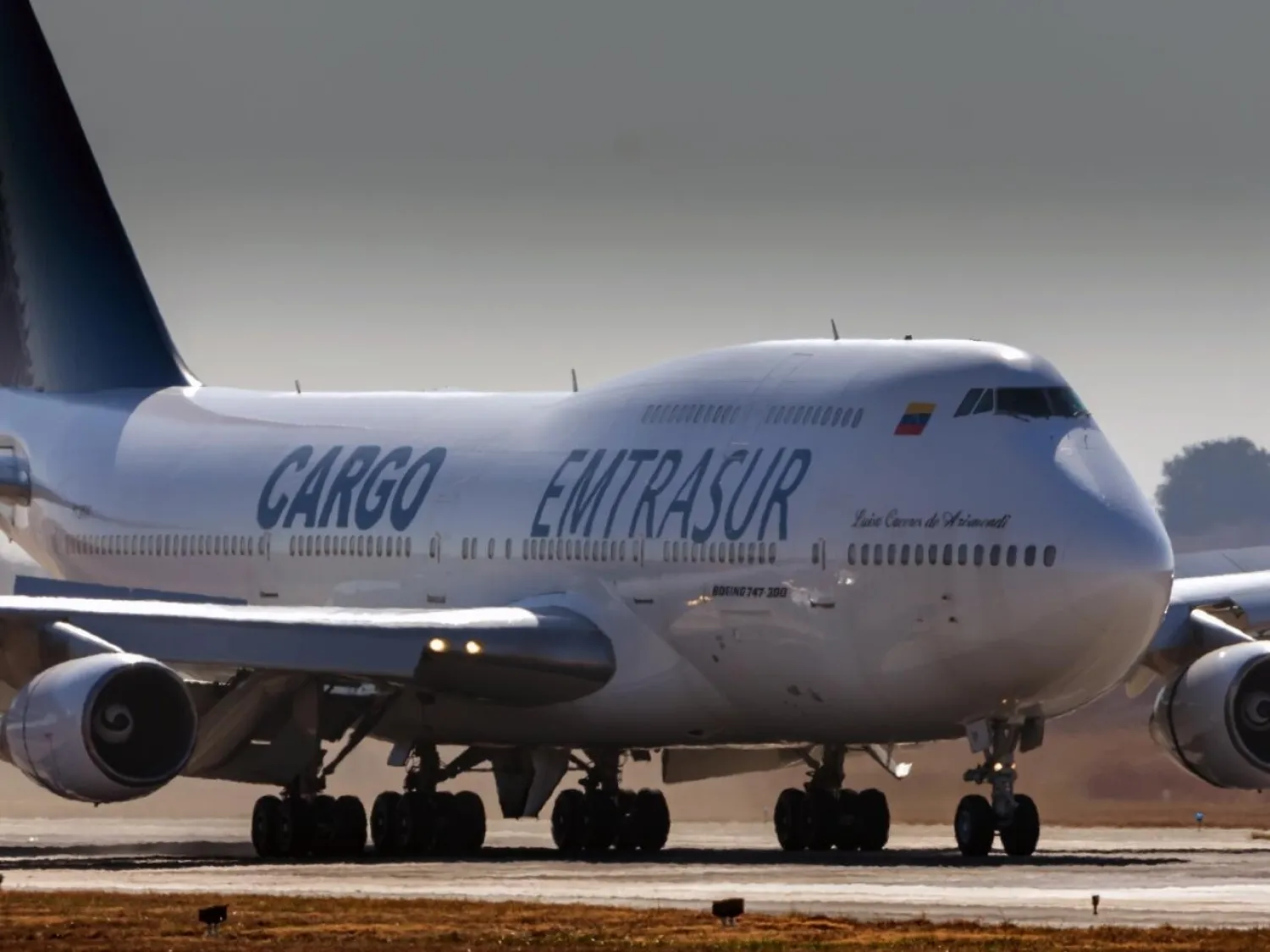

Argentina Seizes Passports of Grounded Plane's Iranian Crew

The Boeing 747 at Cordoba airport in Argentina Sebastian BORSERO AFP/File
TT

Argentina Seizes Passports of Grounded Plane's Iranian Crew

The Boeing 747 at Cordoba airport in Argentina Sebastian BORSERO AFP/File

Five Iranian crew of a cargo plane grounded in Argentina since last week have had their passports temporarily seized pending a probe into possible links to Iran's Revolutionary Guards, officials said Monday.

A judge on Monday ordered their travel documents held for an additional 72 hours after Security Minister Anibal Fernandez said information had been received from "foreign organizations" that some among the crew may be linked to companies with ties to the Guards, AFP reported.

The Revolutionary Guards, Iran's ideological army, is on a US blacklist of foreign "terrorist organizations."

A routine check found "things that were not logical," Fernandez told Perfil radio on Monday.

"They had declared a crew that was smaller than the one that traveled," he said, adding the matter was "still under investigation."

He said the five Iranians were in a hotel.

Officials originally said their passports had been taken but would be returned if they left the country on a scheduled flight while investigations continued into the plane's origins.

The Venezuelan Boeing 747 cargo plane reportedly carrying car parts first landed in Cordoba, Argentina on Monday last week, then tried to travel to neighboring Uruguay, but was denied entry and returned to Ezeiza outside Buenos Aires.

The crew also included 14 Venezuelans, who were free to go.

Neighboring Paraguay had warned of the aircraft's presence in the area, Paraguayan interior minister Federico Gonzalez said.

"The other intelligence services in the region were alerted and, as a result, Argentina and other countries took action," he said.

- 'Propaganda' -
Iran said Monday that Argentina's move was part of a "propaganda" campaign against Tehran amid tensions with Western countries over negotiations to revive a 2015 nuclear deal.

The grounding of the cargo plane came days before Venezuelan President Nicolas Maduro visited Tehran on Saturday for the allies, both subject to US sanctions, to sign a 20-year cooperation pact.

Iran's foreign ministry spokesman Saeed Khatibzadeh told reporters the grounding of the plane was part of efforts seeking to "cause a feeling of insecurity."

"These recent weeks are filled with propaganda, are full of psychological operations, these wars of words that want to infiltrate the minds and composure of the people," said Khatibzadeh.

"This news is one of those."

The plane was sold by Iran's Mahan Air to a Venezuelan company last year, he said.

Mahan Air is accused by the United States of links with Iran's Revolutionary Guards.

Monday's court ruling to hold the crew's passports came after a successful bid by the DAIA organization that represents Argentina's Jewish community to be listed as a plaintiff in the investigation.

Interpol has arrest warrants out for former Iranian leaders suspected of involvement in an attack on a Jewish center in Buenos Aires in 1994 that killed 85 people and injured hundreds.

It remains the deadliest terror attack in the country with South America's largest Jewish population.

The grounding of the plane came as a resolution was adopted by the International Atomic Energy Agency's Board of Governors to censure Iran.

Talks in Vienna, under way since April last year, aim to return the US to a nuclear deal known as the Joint Comprehensive Plan of Action (JCPOA) that it left in 2018.

The deal had given Iran sanctions relief in exchange for curbs on its nuclear program to guarantee that it could not develop a nuclear weapon -- something Tehran has always denied wanting to do.

Iran said Monday that all measures it has taken to roll back on its commitments under the deal are "reversible".



Trump Signs Order Preparing for Tariffs on Iran’s Trade Partners

A man walks past a mural depicting the US Statue of Liberty with the torch-bearing arm broken, painted on the outer walls of the former US embassy, in Tehran on February 6, 2026. (AFP)
TT

Trump Signs Order Preparing for Tariffs on Iran’s Trade Partners

A man walks past a mural depicting the US Statue of Liberty with the torch-bearing arm broken, painted on the outer walls of the former US embassy, in Tehran on February 6, 2026. (AFP)

US President Donald Trump on Friday signed an executive order threatening tariffs on Iran's trade partners, after he pledged a further round of talks with Tehran next week.

The order, effective from Saturday, called for a fresh "imposition of tariffs" on countries still doing business with Iran.

It comes amid heightened tensions between Washington and Tehran, with an American naval group led by an aircraft carrier in Middle Eastern waters and indirect talks held on Tehran's nuclear program in Oman on Friday.

The levies "may be imposed on goods imported into the United States that are products of any country that directly or indirectly purchases, imports, or otherwise acquires any goods or services from Iran", the order said.

Trump issued a threat of 25 percent tariffs on any country trading with Iran last month.

This order establishes a process for his administration to impose tariffs on goods from those countries.

The rate is to be determined by Secretary of State Marco Rubio, although the order specifies that it could be "for example" 25 percent, the level first mentioned by the US president in mid-January.

Tariffs would affect trade with a number of countries including Russia, Germany, Türkiye and the United Arab Emirates.

More than a quarter of Iran's trade is with China, with $18 billion in imports and $14.5 billion in exports in 2024, according to World Trade Organization data.

The talks on Friday in Muscat, mediated by Oman, were the first between the two foes since the United States joined Israel's war with Iran in June with strikes on nuclear sites.

"We likewise had very good talks on Iran," Trump told reporters on board Air Force One en route to his Mar-a-Lago resort in Florida, adding, "we're going to meet again early next week."

Diplomatic relations between Iran and the US broke down with the 1979 revolution that brought the current government into power after hostages were taken at the US embassy in Tehran for 444 days.

Direct engagement has been rare in the decades since.

Iran remains under an internet blackout amid a harsh government crackdown on economic protests that began in December across the country.

The US-based Human Rights Activists News Agency (HRANA) said Friday it has confirmed 6,505 protesters were killed, as well as 214 members of the security forces and 61 bystanders.


Trump Says US Talks with Iran ‘Very Good,’ More Negotiations Expected

US President Donald Trump gaggles with reporters while aboard Air Force One on February 6, 2026 en route to Palm Beach, Florida. (Getty Images via AFP)
TT

Trump Says US Talks with Iran ‘Very Good,’ More Negotiations Expected

US President Donald Trump gaggles with reporters while aboard Air Force One on February 6, 2026 en route to Palm Beach, Florida. (Getty Images via AFP)

US President Donald Trump said Friday Washington held "very good talks" on Iran after the two sides held an indirect dialogue in Oman.

Iran for its part said it expected to hold more negotiations with the United States, hailing a "positive atmosphere" during a day of talks in the Gulf sultanate.

With an American naval group led by an aircraft carrier in Middle Eastern waters, US and Iranian delegations held talks in Muscat mediated by Oman without publicly meeting face-to-face.

Shortly after the talks concluded, the US announced new sanctions against shipping entities and vessels, aimed at curbing Iran's oil exports. But it was not clear if the move was linked to the talks.

The talks were the first between the two foes since the United States joined Israel's war with Iran in June with strikes on nuclear sites.

"We likewise had very good talks on Iran," Trump told reporters on board Air Force One en route to his Mar-a-Lago resort in Florida, adding, "we're going to meet again early next week."

However, as Iran warned against further threats after Washington raised the specter of new military action, Trump said: "If they don't make a deal, the consequences are very steep."

Foreign Minister Abbas Araghchi, who led Iran's delegation in Muscat, said talks "focused exclusively" on the Iranian nuclear program, which the West believes is aimed at making an atomic bomb but Tehran insists is peaceful.

The US delegation, led by Middle East envoy Steve Witkoff and Trump's influential son-in-law Jared Kushner, had also wanted Tehran's backing for militant groups, its ballistic missile program and treatment of protesters on the agenda.

"In a very positive atmosphere, our arguments were exchanged and the views of the other side were shared with us," Araghchi told Iranian state TV, adding that the two sides had "agreed to continue negotiations."

Speaking to the official IRNA news agency, Araghchi expressed hope that Washington would refrain from "threats and pressure" so that "the talks can continue."

- 'Destabilizing power' -

Admiral Brad Cooper, the commander of US Central Command, was present at the talks, according to images published by the Oman News Agency.

Multiple sessions of talks in the morning and afternoon saw both sides shuttling to and from the residence of Omani Foreign Minister Badr Albusaidi.

The foreign ministry of US ally Qatar expressed hope the talks would "lead to a comprehensive agreement that serves the interests of both parties and enhances security and stability in the region."

The White House has made clear it wants the talks to rein in Tehran's ability to make a nuclear bomb, an ambition the country has always denied.

French Foreign Minister Jean-Noel Barrot said on Friday that Iran should stop being a "destabilizing power," citing its nuclear program and support for "terrorist" groups.

Barrot also called on "groups supported by Iran" to exert "the utmost restraint" in the event of any military escalation involving Iran.

- 'Maximum pressure' -

Trump initially threatened military action against Tehran over its crackdown on protesters last month, which rights groups say killed thousands, and even told demonstrators "help is on its way."

Regional powers urged the United States not to intervene, calling on Washington and Tehran to instead return to talks.

The US-based Human Rights Activists News Agency (HRANA) said Friday it has confirmed 6,505 protesters were killed, as well as 214 members of the security forces and 61 bystanders.

Those numbers are expected to climb because the magnitude of the crackdown has masked by the blanket internet shutdown imposed by the authorities for a fortnight, rights groups say.

Almost 51,000 people are also confirmed to have been arrested amid "the growing use of forced confessions," according to HRANA.

Yet Trump's rhetoric in recent days has focused on reining in the Iranian nuclear program and the US has maneuvered a naval group led by aircraft carrier USS Abraham Lincoln into the region.

Iran has repeatedly vowed it will hit back at US bases in the region if attacked.

The new sanctions to curb Iran's oil exports come with Trump "committed to driving down the Iranian regime's illicit oil and petrochemical exports under the administration's maximum pressure campaign," State Department spokesman Tommy Pigott said in a statement.


Zelenskyy Says Ukrainian Air Force Needs to Improve as Russian Drone Barrages Take a Toll

 Ukrainian President Volodymyr Zelenskyy attends a joint news conference with NATO Secretary General Mark Rutte in Kyiv, Ukraine, Tuesday, Feb. 3, 2026. (AP)
Ukrainian President Volodymyr Zelenskyy attends a joint news conference with NATO Secretary General Mark Rutte in Kyiv, Ukraine, Tuesday, Feb. 3, 2026. (AP)
TT

Zelenskyy Says Ukrainian Air Force Needs to Improve as Russian Drone Barrages Take a Toll

 Ukrainian President Volodymyr Zelenskyy attends a joint news conference with NATO Secretary General Mark Rutte in Kyiv, Ukraine, Tuesday, Feb. 3, 2026. (AP)
Ukrainian President Volodymyr Zelenskyy attends a joint news conference with NATO Secretary General Mark Rutte in Kyiv, Ukraine, Tuesday, Feb. 3, 2026. (AP)

Ukrainian President Volodymyr Zelenskyy on Friday described the performance of the air force in parts of the country as “unsatisfactory," and said that steps are being taken to improve the response to large-scale Russian drone barrages of civilian areas.

The repeated Russian aerial assaults have in recent months focused on Ukraine’s power grid, causing blackouts and disrupting the heating and water supply for families during a bitterly cold winter.

With the war about to enter its fifth year later this month following Russia’s all-out invasion of its neighbor, there is no sign of a breakthrough in US-led peace efforts following the latest talks this week. Further US-brokered meetings between Russian and Ukrainian delegations are planned “in the near future, likely in the United States,” Zelenskyy said.

Zelenskyy said Friday he had discussed with his defense minister and the air force commander what new air defense measures Ukraine needs to counter the Russian barrages. He didn’t elaborate on what would be done.

Russia fired 328 drones and seven missiles at Ukraine overnight and in the early morning, the air force said, claiming that air defenses shot down 297 drones.

One person was killed and two others were injured in an overnight Russian attack using drones and powerful glide bombs on the central Dnipropetrovsk region, according to the head of the regional military administration, Oleksandr Hanzha.

A Russian aerial attack on the southern Zaporizhzhia region during early daylight hours injured eight people and damaged 18 apartment blocks, according to regional military administration head Ivan Fedorov.

A dog shelter in the regional capital was also struck, killing 13 dogs, Zaporizhzhia City Council Secretary Rehina Kharchenko said.

Some dogs were rushed to a veterinary clinic, but they could not be saved, she said. Seven other animals were injured and are receiving treatment.

Amid icy conditions in Kyiv, more than 1,200 residential buildings in multiple districts of the capital have had no heating for days due to the Russian bombardment of the power grid, according to Zelenskyy.

The UK defense ministry said Friday that Ukraine’s electricity network “is experiencing its most acute crisis of the winter.”

Mykola Tromza, an 81-year-old pensioner in Kyiv, said he has had his power restored, but recently went without heating and water at home for a week.

“I touched my nose and by God, it was like an icicle,” Tromza said. He said he ran up and down to keep warm.

Russia’s Defense Ministry said that air defenses downed 38 Ukrainian drones overnight, including 26 over the Bryansk region.

Bryansk Gov. Alexander Bogomaz said the attack briefly cut power to several villages in the region.

Another Ukrainian nighttime strike damaged power facilities in the Russian city of Belgorod, disrupting electricity distribution, Gov. Vyacheslav Gladkov said.

Local reports said that Ukrainian missiles hit a power plant and an electrical substation, cutting power to parts of the city.

Fierce fighting has also continued on the front line despite the frigid temperatures.

Ukraine’s Commander in Chief, Col. Gen. Oleksandr Syrskyi, said the front line now measures about 1,200 kilometers (750 miles) in length along eastern and southern parts of Ukraine.

The increasing technological improvements to drones on both sides mean that the so-called “kill zone” where troops are in greatest danger is now up to 20 kilometers (12 miles) deep, he told reporters on Thursday in comments embargoed until Friday.