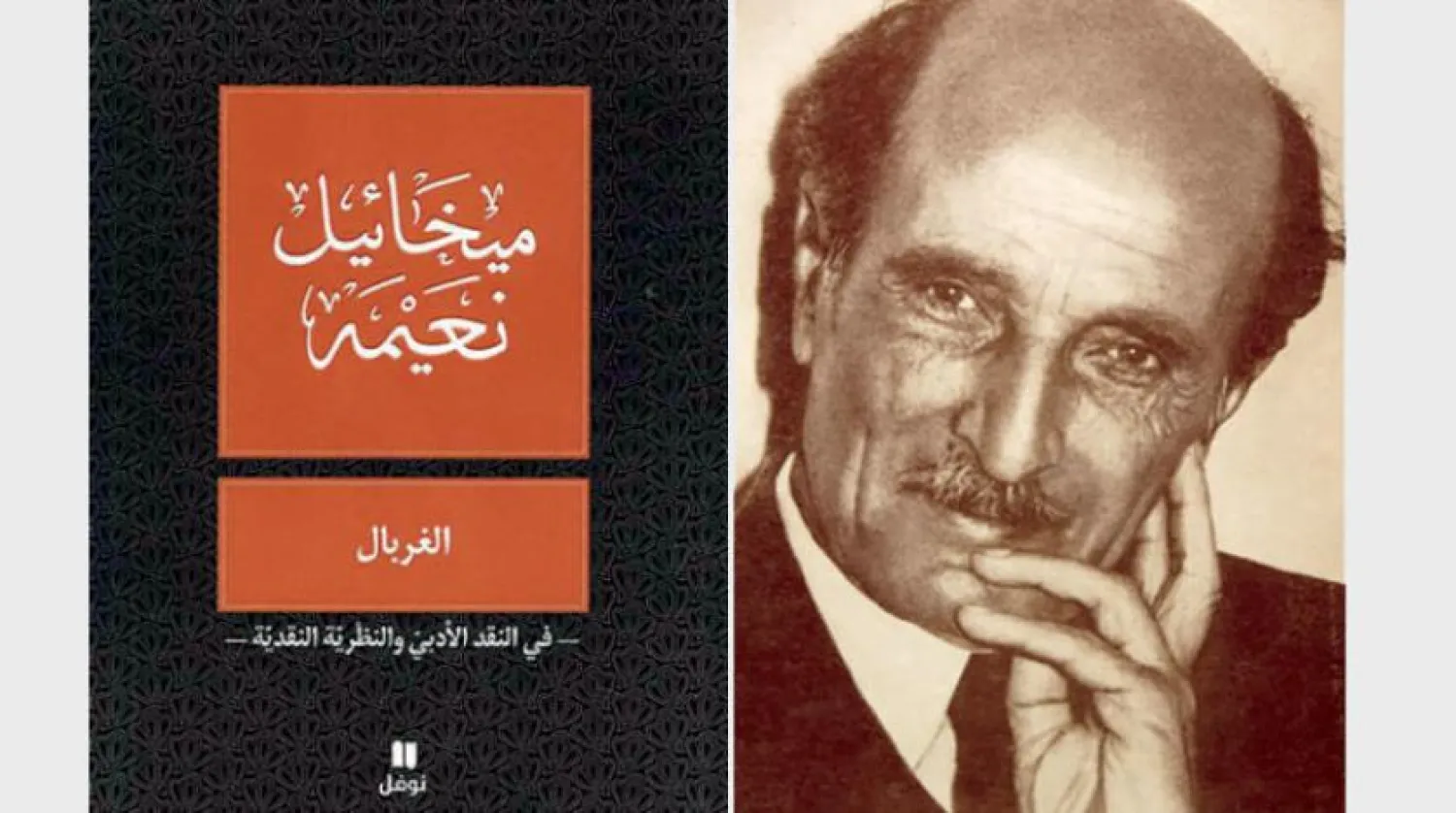

Mikhail Naimy's 'Al-Ghirbal': 'Arabic Literature Could Die If We Listen to the Croaking of Frogs'

Mikhail Naimy's 'Al-Ghirbal': 'Arabic Literature Could Die If We Listen to the Croaking of Frogs'
TT

Mikhail Naimy's 'Al-Ghirbal': 'Arabic Literature Could Die If We Listen to the Croaking of Frogs'

Mikhail Naimy's 'Al-Ghirbal': 'Arabic Literature Could Die If We Listen to the Croaking of Frogs'

Did the "Al-Ghirbal" book age? Did it lose its impact? Did it become obsolete? Yes, maybe in some of its aspects, but not in its essence.

The spirit of the book is still alive and reviving. It is still relevant to our current reality. In a nutshell, when we read the book, we feel that Mikhail Naimy is still living with us, and this is the loudest proof on his value and prominence as an Arabic, progressive, pioneering intellectual.

The book includes a large chapter, the "The Croaking of Frogs: Position of Language in Literature" that is enough to immortalize the book itself and Naimy.

But what does it mean?

It means the frogs of literature paralyze us with their croaks, swamps, and slackness. They paralyze the development of the Arabic language and Arabic life itself. They keep correcting your language: "say this and don’t say that", "this is acceptable and this is forbidden", "this is correct according to Al-Tha'alibi and Al-Asmai, and that is not, be careful", and "don’t you dare to violate the liturgies of inherited language, the Arabic language should remain s it is, as it has been for centuries."

Why don't you write in the correct dictionary language? Otherwise, you would violate literary standards. Let us take Gibran Khalil Gibran's famed "Al-Mawakeb" poem, which was sung by by Fairuz, in which he wrote:

"Have you bathed in its fragrance and dried yourself in its light."

This great poem reminds us of Lebanon’s mountains, creeks, and valleys where you can feel the scent of existence. But the problem in this etherical poem is that it contains a linguistic mistake! The literary frogs or the Arabic language frogs describe it as linguistic mistake, frown upon it, and blame the writer for it.

For them, Gibran committed an unforgivable crime against the Arabic language. But what’s this crime? Where is it? I can’t see it. Why did the poet use the word "Yatahamam" (Arabic for bathe) instead of its legitimate, classic Arabic alternative "istaham"? Can a genius, creative writer commit to the literary language of Al-Tha'alibi and Al-Asmai? Wouldn’t this commitment affect his genius and creativity?

The poet has the right to invent new words, to ignite the language, to practice his freedom.

Without this freedom, there would be no linguistic development, and Arabic literature would die if we listened to the croaking frogs. Instead, we should listen carefully to Naimy, who said: "If the Arabic language frogs saw the history of their language, they would find the greatest proof on this saying. Didn’t they see that the language we use today to write in our magazines and newspapers and to speak on stages is different from the language of Mudar, Tamim, Humair, and Quraysh? Didn’t they notice that if their ancestors managed to control us 2,000 years ago, we wouldn’t have the language we use today?"

Here lies the importance of this great book. It really cares about the Arabic language and seeks to develop and save it, but how? By allowing it to inspire its terms from our life. However, the close-minded linguists want to control and suffocate the language. For example, the French people envy us because they don’t have a feminine form for the word "doctor" and have to use "female doctor"; they don’t have a feminine form for the word "writer" as well, but we do. In fact, they have recently invented a feminine form of the world writer, but it’s ugly. And yet, some Arab writers still find new ways to bring more complexity to our language.

But why all this burden? Let the Arabic language breathe, let it loosen, let it become closer to our daily life language.
Madrasat Addeera Empowers AlUla Youth Through Traditional Crafts

The school focuses on empowering girls, teaching craft skills rooted in ancestral trades and presenting them in modern ways that create sustainable and creative opportunities - SPA
TT

Madrasat Addeera Empowers AlUla Youth Through Traditional Crafts

The school focuses on empowering girls, teaching craft skills rooted in ancestral trades and presenting them in modern ways that create sustainable and creative opportunities - SPA

Madrasat Addeera in AlUla Governorate offers specialized training programs and workshops to develop the skills of local youth in traditional crafts and arts, preserving cultural heritage while connecting it to contemporary life.

The school focuses on empowering girls, teaching craft skills rooted in ancestral trades and presenting them in modern ways that create sustainable and creative opportunities, SPA reported.

Throughout the year, the school contributes to the cultural vibrancy of the governorate by taking part in festivals and exhibitions. Through its workshops, visitors can explore traditional industries such as pottery, weaving, carpets, and natural products.

According to SPA, Madrasat Addeera's programs go beyond training, transforming craft skills into sustainable income, with handcrafted items sold locally and online, all entirely Saudi-made and inspired by AlUla’s culture and environment.

Since its establishment as the first girls’ school in AlUla and as the region’s first center for arts and design, the school has become a hub for nurturing talent, rediscovering heritage crafts, and attracting both local and global expertise.


British Treasury to Cover Bayeux Tapestry for Estimated £800 Million

This photo provided by Bayeux townhall shows a technician inspecting the famed Bayeux tapestry in Bayeux, Normandy, in 8th January, 2020. (Ville de Bayeux via AP/File photo)
TT

British Treasury to Cover Bayeux Tapestry for Estimated £800 Million

This photo provided by Bayeux townhall shows a technician inspecting the famed Bayeux tapestry in Bayeux, Normandy, in 8th January, 2020. (Ville de Bayeux via AP/File photo)

The British Treasury is set to insure the Bayeux Tapestry against damage for an estimated £800 million while it is on loan to the British Museum next year, reported the BBC.

The 70m-long embroidery depicting the Battle of Hastings in 1066 will travel from France to London as part of a deal between the two nations' governments.

The artifact's transit and its time in storage and on display will be covered under the Government Indemnity Scheme (GIS). Indemnity insurance covers situations like loss or damage.

The Treasury said without the long-standing scheme, “public museums and galleries would face a substantial commercial insurance premium, which would be significantly less cost effective.”

There are concerns about the move, as some French art experts have suggested the nearly 1,000-year-old work was in far too a delicate state to be transported - something French officials have denied.

It is understood the Treasury has received an initial valuation for covering the Bayeux Tapestry that has been provisionally approved. The loan will not be formally confirmed until it receives the final valuation.

That final valuation is estimated to be around £800 million.

The Bayeux Tapestry will be displayed in the Sainsbury Exhibitions Gallery of the British Museum from next September until July 2027 while its current home, the Bayeux Museum, undergoes renovations.

Comprising 58 scenes, 626 characters and 202 horses, the huge masterpiece charts a contested time in Anglo-French relations when William The Conqueror took the English throne from Harold Godwinson, becoming the first Norman king of England.

The government's indemnity scheme allows art and cultural objects to be shown publicly in the UK which "might not have been otherwise because the cost of insurance would have been too high".

The scheme - first set up in 1980 - has facilitated numerous high-value loans, including Vincent van Gogh's 1888 work "The Bedroom" to the National Gallery.

In exchange for the Bayeux Tapestry, the British Museum will loan items to France, including the 7th Century Anglo-Saxon artifacts discovered at the Sutton Hoo burial site in Suffolk and the 12th Century Lewis chess pieces.


Kolkata’s Iconic Trams Face Final Stop as Modernization Rolls in

Passengers sit inside a decorated tram during the 152nd anniversary celebrations of trams in Kolkata, India, February 24, 2025. (Reuters)
TT

Kolkata’s Iconic Trams Face Final Stop as Modernization Rolls in

Passengers sit inside a decorated tram during the 152nd anniversary celebrations of trams in Kolkata, India, February 24, 2025. (Reuters)

For more than a century, trams have rumbled past Kolkata's crumbling colonial facades, with their chiming bells contributing to the city's soundtrack as they ferried generations of ​commuters.

Now, Asia's oldest tram network is on the brink of disappearing as authorities consider pulling the plug on a mode of transport that has become more nostalgia than necessity.

The West Bengal government plans to shut down the 152-year-old system, keeping only a short heritage route. The decision has sparked a court battle as residents and heritage advocates fight to keep ‌the trams ‌rolling.

"As children, we would take the ‌trams ⁠for ​fun, ‌but as I grew older it became a necessity," said Abha Maity, 44, recalling rides to school and college. "I can’t imagine Kolkata without them."

Once a highlight of the city's streets, the wobbly trams now struggle for space amid traffic jams - competing with buses and yellow taxis - as Kolkata builds modern infrastructure and seeks faster transport.

Kolkata introduced ⁠horse-drawn trams in 1873 and electrified them in 1902. At its peak, the ‌network boasted more than 340 trams and ‍covered the entire city. Today, ‍only two routes remain, with a fleet of about 10.

"When ‍I joined, more than 340 trams were running. Now it's down to seven or eight," said Bacchu Sidda, a conductor for 36 years who still checks his duty roster pinned on a board ​at the last functioning depot in Gariahat.

The government began selling depots and scrapping cars years ago, prompting a citizens' ⁠group called Calcutta Tram Users Association (CTUA) to take the fight to court. CTUA has campaigned since 2016 to save what remains of the system.

"I love my trams more than myself," said Deep Das, 19, a journalism student and CTUA member. "If they disappear, it will be like a part of my body has left me."

Despite resistance, authorities are pouring billions into upgrading Kolkata's infrastructure, focusing on metro expansion, wider roads and new highways to ease congestion.

For now, the fate of Kolkata's aging trams awaits a ‌court review, as they continue carrying some passengers who view them as living memories of the city's past.