


‘Dead Narrator’ Mourns Human Values

Novel, Salma Mokhtar
TT

‘Dead Narrator’ Mourns Human Values

Novel, Salma Mokhtar

Moroccan writer Salma Mokhtar Amanat Allah recently signed her second novel ‘Omar the Stranger’ at the Rabat International Book Fair. The signing ceremony was followed by a seminar moderated by critic and novelist Hassan Abido, and attended by writer and critic Said Yaktin, and researcher Said al-Fallaq, at the national library.

The character of ‘Omar, the Stranger’ has an exceptional, weird personality combining all human contradictions, oppression, and mental trouble. In this novel, Omar is the dead narrator who showcases a journey full of pain, and human atrocity.

The novel represents a symbolic trial of a society that excludes its members, and depicts the ugliness dominating reality through a protagonist that resembles no one but his self, which is controlled by disturbance, burden, and obsession. The narrator in Salma’s novel is a doctor but narrates as a dead body. This novel simulates the human depths to deliver a human speech in a creative style. Using a dead body for narration, the author probably wanted to denounce the human values swallowed by the digital invasion, and the deterioration of family, and educational and pedagogic institutions; it’s also a condemnation to the mass estrangement that has affected everybody.

During the seminar, speakers lauded the eloquence and romance of the language, and the power of description used by the author.

Writer Said Yaqtin suggested other titles for the book, including ‘Apricot Sandwich’, ‘Orchid Flower’, and ‘Omar Killed me’ to emphasize the state of destruction and nonbelonging that characterizes the personality of Omar. But the author said she preferred her title to express the estrangement state that destroys Omar despite his respected social status as a doctor. The ‘Omar, the Stranger’ novel also reflects an essential idea: the importance of training on death as an ending point, sometimes halting the things we do as living people to correct our path, and practicing mental purification to embark again in life.

“Omar wrote me, I didn’t write him. He’s the real narrator, he recalls his disappointments, collapses, and contradictions without a template,” Salma said. The novel does not include chapters, it’s written with a flowing style and without classifications.

The 273-page novel is released by the Cultural Center of Books. Amanat Allah already published her first novel in 2018, and a story collection titled ‘TGV’ in 2016.



Workshop Held to Develop Cultural Heritage Documentation, Digital Archiving Guide in Saudi Arabia

The workshop brought together representatives from relevant cultural entities, along with stakeholders, experts, and practitioners. SPA
TT

Workshop Held to Develop Cultural Heritage Documentation, Digital Archiving Guide in Saudi Arabia

The workshop brought together representatives from relevant cultural entities, along with stakeholders, experts, and practitioners. SPA

The Saudi Ministry of Culture organized a specialized workshop to review and develop the third edition of the Cultural Heritage Documentation and Digital Archiving Guide in the Kingdom.

The workshop brought together representatives from relevant cultural entities, along with stakeholders, experts, and practitioners, as part of the center’s efforts to standardize methodologies for documenting and archiving cultural heritage and to enhance institutional practices for managing national cultural memory.

The workshop forms part of the Ministry of Culture’s ongoing efforts to establish national standard frameworks for the management and digital documentation of cultural heritage, strengthen integration among entities, and equip practitioners with the necessary tools and methodologies.

These efforts reinforce the role of the Saudi cultural memory center in preserving the Kingdom’s cultural memory and support the objectives of the National Culture Strategy under Saudi Vision 2030.


Makkah Quran Museum Displays Rare ‘Blue Quran’ Manuscript

The Blue Quran is regarded as one of the rarest and most luxurious mushafs in Islamic civilization. (SPA)
TT

Makkah Quran Museum Displays Rare ‘Blue Quran’ Manuscript

The Blue Quran is regarded as one of the rarest and most luxurious mushafs in Islamic civilization. (SPA)

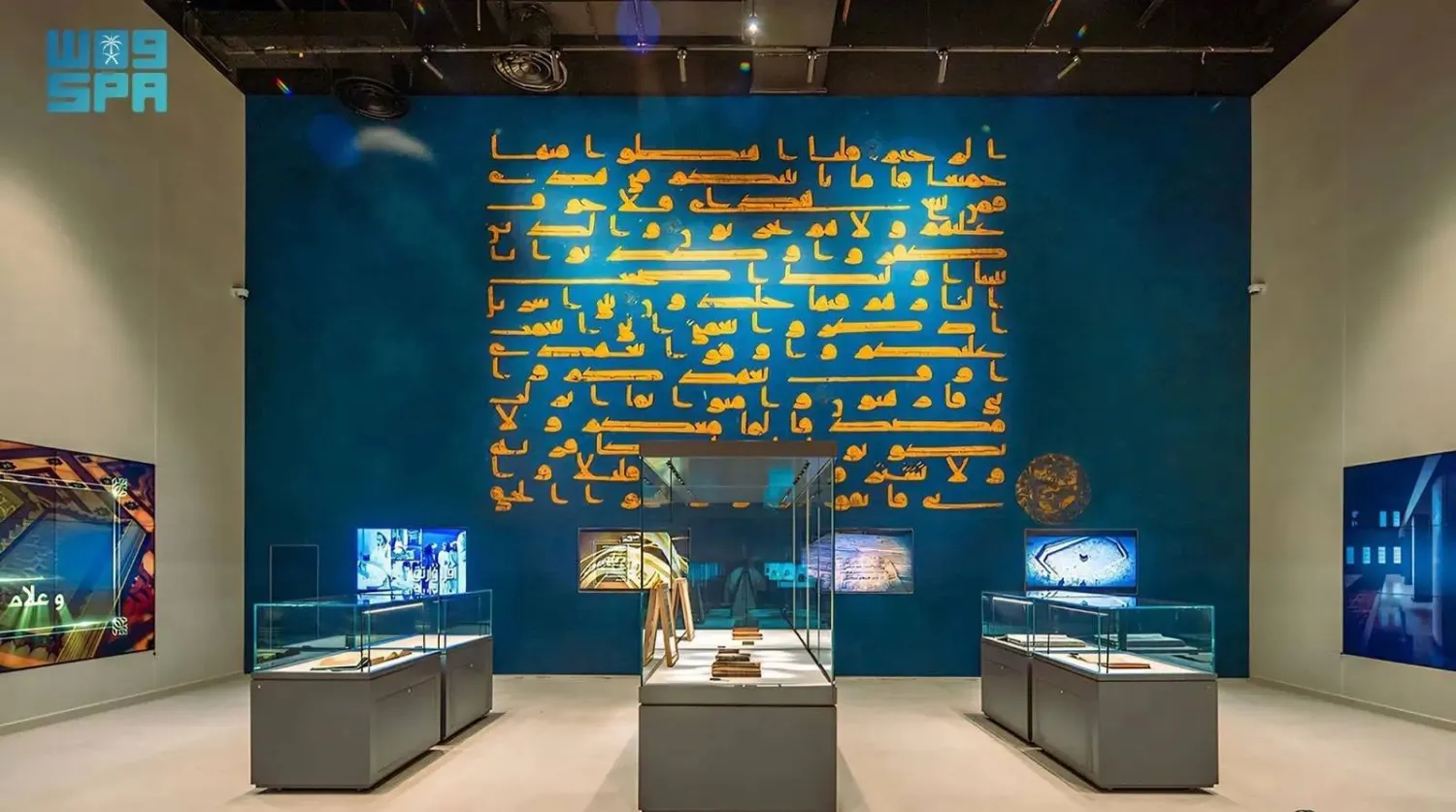
The Holy Quran Museum in the Hira Cultural District in Makkah is displaying a rare folio from the famed “Al-Muṣḥaf Al-Azraq” (Blue Quran), featuring verses from Surah Al-Baqarah, from the end of verse 37 to the beginning of verse 42, reported the Saudi Press Agency on Monday.

The exhibit highlights the richness of Islamic Quranic heritage and its ancient artistic legacy.

The Blue Quran is regarded as one of the rarest and most luxurious mushafs in Islamic civilization. It was written in pure gold ink in early Kufic script on a deep blue background, reflecting a distinctive artistic style that underscores early Muslims’ reverence for the Quranic text and their dedication to the aesthetics of its calligraphy.

Dating back to the 9th century, the manuscript holds exceptional historical and scholarly value. It stands as a testament to the development of Arabic calligraphy and illumination during the early Islamic period.

Surviving pages of the Blue Quran are extremely rare and are now dispersed among a limited number of museums and private collections worldwide.

The display forms part of the museum’s efforts to introduce visitors to the history of the mushaf and the artistic stages of its transcription, offering access to extraordinary examples of Quranic manuscripts.

The initiative aims to deepen cultural awareness and enrich the experience of visitors to the Hira Cultural District from within the Kingdom and abroad.

The Holy Quran Museum serves as a cultural and educational landmark, highlighting the history of the Quran and its journey since the revelation. It houses rare manuscripts and historic copies of the Quran, alongside interactive exhibits and modern technologies that reflect Muslims’ enduring devotion to the Quran throughout the centuries, in a location closely associated with the dawn of the Islamic message.


Riyadh Art Unveils Tuwaiq Sculpture 2026

The exhibition site on Tahlia Street was strategically chosen for its historical legacy of innovation to provide a conceptual framework for the works. SPA
TT

Riyadh Art Unveils Tuwaiq Sculpture 2026

The exhibition site on Tahlia Street was strategically chosen for its historical legacy of innovation to provide a conceptual framework for the works. SPA

The Royal Commission for Riyadh City, via its Riyadh Art program, has launched the Tuwaiq Sculpture 2026 exhibition on Prince Mohammed bin Abdulaziz Street (Tahlia).

Open to the public from February 9 to 22, the exhibition showcases 25 new artworks themed "Traces of What Will Be," exploring transformation and urban renewal.

The sculptures were crafted during a live phase from January 10 to February 5, during which artists from 18 countries used local stone and recycled metals, allowing the public to witness the creative process firsthand.

The exhibition site on Tahlia Street was strategically chosen for its historical legacy of innovation to provide a conceptual framework for the works.

Overseen by a panel of international experts, the exhibition serves as an interactive cultural platform featuring workshops and panel discussions to foster community engagement.

All 2026 pieces will join Riyadh Art's permanent collection, which has hosted over 170 artists since 2019 and already installed more than 60 sculptures across the city to integrate contemporary art into Riyadh's urban fabric.