


Russian Sanctions Hurting Small Italian Fashion Producers

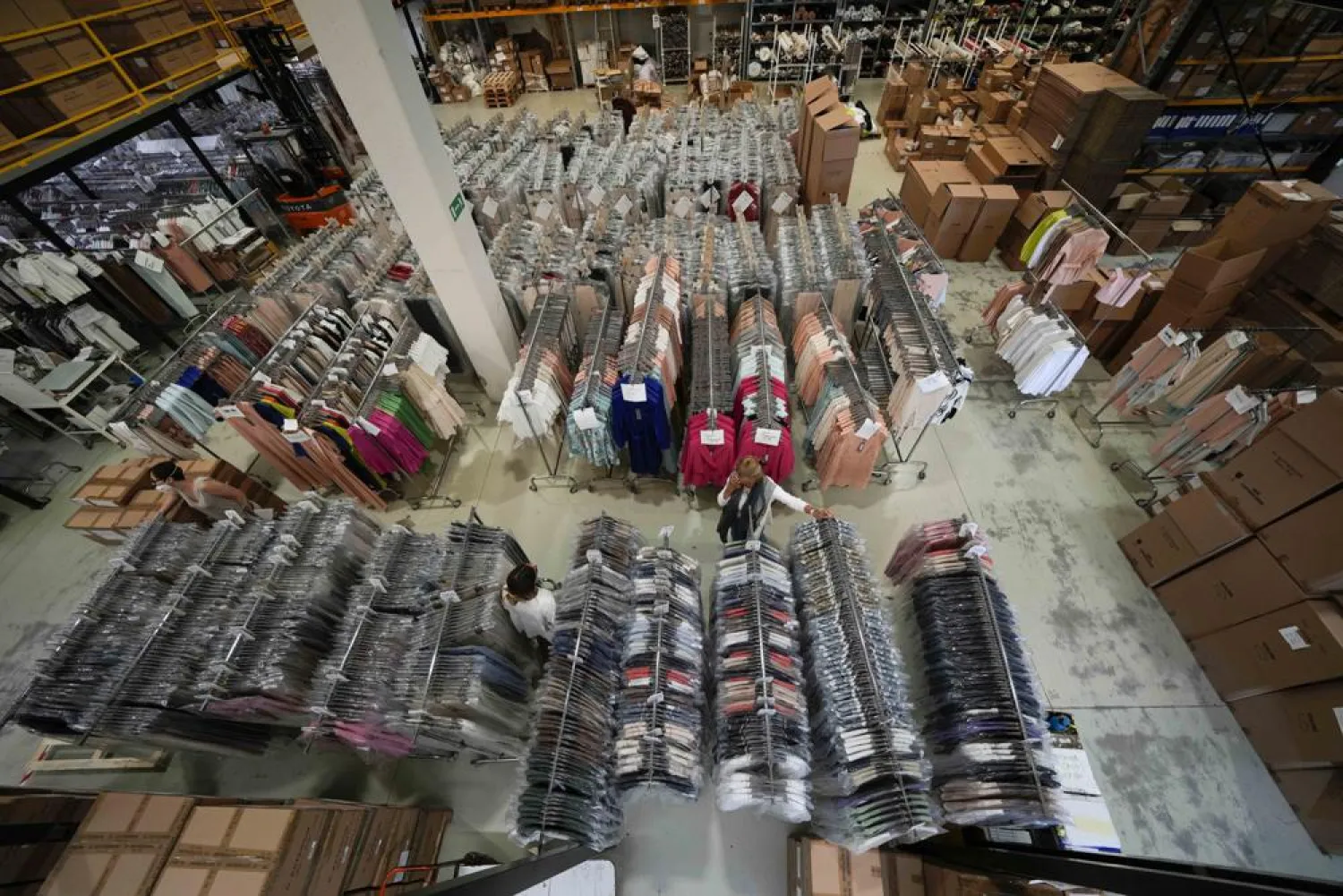
Nadia Zanola, right, chairman of the 'Cose di Maglia' factory, goes through racks of clothing at a warehouse section of unsold clothes, in Brescia, Italy, Tuesday, June 14, 2022. (AP Photo/Luca Bruno)
TT

Russian Sanctions Hurting Small Italian Fashion Producers

Nadia Zanola, right, chairman of the 'Cose di Maglia' factory, goes through racks of clothing at a warehouse section of unsold clothes, in Brescia, Italy, Tuesday, June 14, 2022. (AP Photo/Luca Bruno)

Fine Italian knitwear packed in boxes addressed to retailers in Moscow, St. Petersburg and Kursk sit stacked in a Lombardy warehouse awaiting dispatch. Although not subject to sanctions to punish Russia for invading Ukraine, the garments are not likely to ship any time soon.

Missing payments from the Russian retailers who ordered the garments are piling up due to restrictions tied to the banking sector, putting pressure on small fashion producers like D. Exterior, a high-end knitwear company with 50 workers in the northern city of Brescia, The Associated Press said.

“This is very painful. I have 2 million euros worth of merchandise in the warehouse, and if they cannot pay for it, I will be on my knees,” said D.

Exterior owner Nadia Zanola, surveying the warehouse for the brand she founded in 1997 from the knitwear company created by her parents in 1952.

Italy is the largest producer of global luxury goods in the world, making 40% of high-end apparel, footwear and accessories. While Russia generates just about 3% of Italian luxury’s 97 billion euros ($101 billion) in annual revenue, it is a significant slice of business for some of the 80,000 small and medium companies that make up the backbone of Italian fashion, according to industry officials.

“We are talking about eliminating 80% to 100% of revenues for these companies,’’ said Fabio Pietrella, president of the Confartigianato fashion craftsman federation.

Districts producing footwear in the Marche and Veneto regions, and knitwear makers in Umbria and Emilia-Romagna have grown particularly reliant on Russia.

“These are districts that connect the supply chain, and if it is interrupted, not only is the company that closes harmed, but an entire system that help make this country an economic powerhouse,’’ Pietrella said.

The Italian fashion world is best known for luxury houses like Gucci, Versace and Armani, which unveil their menswear collections in Milan this week. And some of the biggest names appear on a list compiled by Yale University professor Jeffrey Sonnenberg of major companies doing business in Russia since the war in Ukraine began.

“There are companies that kept selling to Nazi Germany after the outbreak of World War II — we don't celebrate them for that,” Sonnenberg said, labeling as “greedy” any enterprise that continues to do business in Russia today.

He also underlined that fashion companies don’t have the grounds to make humanitarian appeals to bypass sanctions, voluntary or otherwise, as has been the case with agricultural firms and pharmaceutical companies.

Among those receiving a failing grade from Sonnenberg is Italy's Benetton, which in a statement condemned the war but said it would continue its commercial activities in Russia, including longstanding commercial and logistic partnerships and a network of stores that sustain 600 families.

French conglomerate LVMH, meanwhile, has temporarily closed 124 stores in Russia, while continuing to pay its 3,500 employees in Russia. The Spanish group Inditex, which owns the fast-fashion chain Zara, also temporarily closed 502 stores in Russia as well as its online sales, accounting for 8.5% of group pre-tax earnings.

Pietrella fears a sort of Russia-phobia is taking hold that is demonizing business owners for trying to keep up ties with a longer-term vision.

He characterized as a “witch-hunt” criticism of some 40 shoe producers from the Marche region on Italy’s Adriatic coast for traveling to Russia for a trade fair during the war.

European Union sanctions against Russia sharpened after the Ukraine invasion, setting a 300-euro wholesale maximum for each item shipped, taking super-luxury items out of circulation but still targeting the upper-middle-class or wealthy Russians.

“Without a doubt, we as the fashion federation have expressed our extreme concern over the aggression in Ukraine,’’ Pietrella said. “From an ethical point of view, it is out of discussion. But we have to think of our companies. Ethics are one thing. The market is another. Workers in a company are paid by the market, not by ethics.”

He said the 300-euro limit on sales was a gambit by European politicians that on paper allows trade with Russia despite accompanying bureaucratic and financial hurdles, while also shielding governments from having to provide bailout funds to the industry. He also dismissed as overly facile government suggestions to find alternative markets to Russia.

“If there was another market, we would be there already,’’ Pietrella said.

At D. Exterior, exposure to Russia grew gradually over the years to now represent 35% to 40% of revenue that hit 22 million euros before the pandemic, a stream that is also under new pressure from higher energy and raw material costs.

The company was already delivering its summer collection and taking orders for winter when Russia invaded on Feb. 24. By March, Russian retailers were having trouble making payments.

Not only is Zanola stuck with some 4,000 spring and summer garments that she has little hope of shipping to Russian clients, she said she was contractually required to keep producing the winter orders, risking 100,000 euros in labor and materials costs if those are unable to ship.

Over the years, her Russian clients have proven to be ideal customers, Zanola said. Not only do they pay on time, but they are appreciative of the workmanship in D. Exterior’s knitwear creations.

After working so hard to build up her Russian customer base, she loathes to give it up and doesn't see a quick long-term replacement.

“If Russia were Putin, I wouldn’t go there. But since Russia is not only Putin, one hopes that the poor Russians manage to raise themselves up,'' she said.



Pieter Mulier Named Creative Director of Versace

(FILES) Pieter Mulier attends the 2025 CFDA Awards at The American Museum of Natural History on November 03, 2025 in New York City. (Photo by Dimitrios Kambouris / GETTY IMAGES NORTH AMERICA / AFP)
TT

Pieter Mulier Named Creative Director of Versace

(FILES) Pieter Mulier attends the 2025 CFDA Awards at The American Museum of Natural History on November 03, 2025 in New York City. (Photo by Dimitrios Kambouris / GETTY IMAGES NORTH AMERICA / AFP)

Belgian fashion designer Pieter Mulier has been named the new creative director of the Milan fashion house Versace starting July 1, according to an announcement on Thursday from the Prada Group, which owns Versace.

Mulier is currently creative director of the French fashion house Alaïa, and was previously the right-hand man of fellow Belgian designer and Prada co-creative director Raf Simons at Calvin Klein, Jil Sander and Dior.

In his new role, Mulier will report to Versace executive chairman Lorenzo Bertelli, the designated successor to manage the family-run Prada Group. Bertelli is the son of Miuccia Prada and Prada Group chairman Patrizio Bertelli.

“We believe that he can truly unlock Versace’s full potential and that he will be able to engage in a fruitful dialogue,’’ The Associated Press quoted Lorenzo Bertelli as saying of Mulier in a statement.

Mulier takes over from Dario Vitale, who departed in December after previewing just one collection during his short-lived Versace stint.

Mulier was honored last fall by supermodel and longtime Alaïa muse Naomi Campbell at the Council of Fashion Designers of America for his work paying tribute to brand founder Azzedine Alaïa. Mulier took the creative helm in 2021, after Alaïa’s death.


Ralph Lauren’s Margin Caution Eclipses Stronger‑than‑expected Quarterly Results

Guests wait after viewing the latest Ralph Lauren collection in New York City, US, April 17, 2025. REUTERS/Caitlin Ochs/File photo
TT

Ralph Lauren’s Margin Caution Eclipses Stronger‑than‑expected Quarterly Results

Guests wait after viewing the latest Ralph Lauren collection in New York City, US, April 17, 2025. REUTERS/Caitlin Ochs/File photo

Ralph Lauren posted third-quarter results above Wall Street estimates on Thursday, but the luxury retailer's warning of margin pressure tied to US tariffs sent its shares down nearly 6.4% in premarket trading.

The company expects fourth-quarter margins, its smallest revenue period, to shrink about 80 to 120 basis points due to higher tariff pressure and marketing spend.

Ralph Lauren, which sources its products from regions such as China, India and Vietnam, has relied on raising prices and reallocating production to regions with lower duty exposure to offset US tariff pressures, Reuters reported.

"Ralph Lauren has been able to raise prices for some time now. There is some limit on how long it can continue to do this. I think (the company's) gross margins are near peak levels," Morningstar analyst David Swartz said.

The company, which sells $148 striped linen shirts and $498 leather handbags, has tightened inventory, lifted full-price sales and refreshed core styles, boosting its appeal among wealthier and younger customers, including Gen Z.

Higher-income households are still splurging on luxury items, travel and restaurant meals, while lower- and middle-income consumers are strained by higher costs for rents and food as well as a softer job market.

The New York City-based company saw quarterly operating costs jump 12% year-on-year as it ramped up brand building efforts through sports-focused brand campaigns such as Wimbledon and the US Open tennis championship.

The luxury retailer said revenue in the quarter ended December 27 rose 12% to $2.41 billion, above analysts' estimates of a 7.9% rise to $2.31 billion, according to data compiled by LSEG.

It earned $6.22 per share, excluding items, compared to expectations of $5.81, aided by a 220 basis points increase in margins and an 18% rise in average unit retail across its direct-to-consumer channel.

Ralph Lauren now expects fiscal 2026 revenue to rise in the high single to low double digits on a constant currency basis, up from its prior forecast of a 5% to 7% growth.


Saudi Fashion Commission, Kering Launch 'Kering Generation Award X MENA'

This year's award builds on the strong success of the 2025 award, which attracted more than 500 applications, shortlisted 21 finalists, and recognized three winners. SPA
TT

Saudi Fashion Commission, Kering Launch 'Kering Generation Award X MENA'

This year's award builds on the strong success of the 2025 award, which attracted more than 500 applications, shortlisted 21 finalists, and recognized three winners. SPA

Saudi Arabia’s Fashion Commission and global luxury group Kering have launched the "Kering Generation Award X MENA" across the Middle East and North Africa (MENA) for 2026.

The announcement was made on Tuesday during the opening of the RLC Global Forum, hosted at the French Embassy in Riyadh.

This year's award builds on the strong success of the 2025 award, which attracted more than 500 applications, shortlisted 21 finalists, and recognized three winners.

Participants benefited from mentorship programs, workshops, and opportunities to strengthen their global presence. Building on this momentum, the 2026 program seeks to expand its impact across the MENA region.

The 2026 award focuses on four key areas of sustainable fashion: innovation in regenerative materials and clean production, circular design and sustainable business models, nature conservation and animal welfare, and consumer awareness and cultural engagement.

The program targets startups across the MENA region that operate in, or positively influence, the sustainable fashion sector, provided they demonstrate innovation capabilities and the ability to deliver measurable sustainability outcomes.