


For Iraqis a Sweltering Summer Has Begun

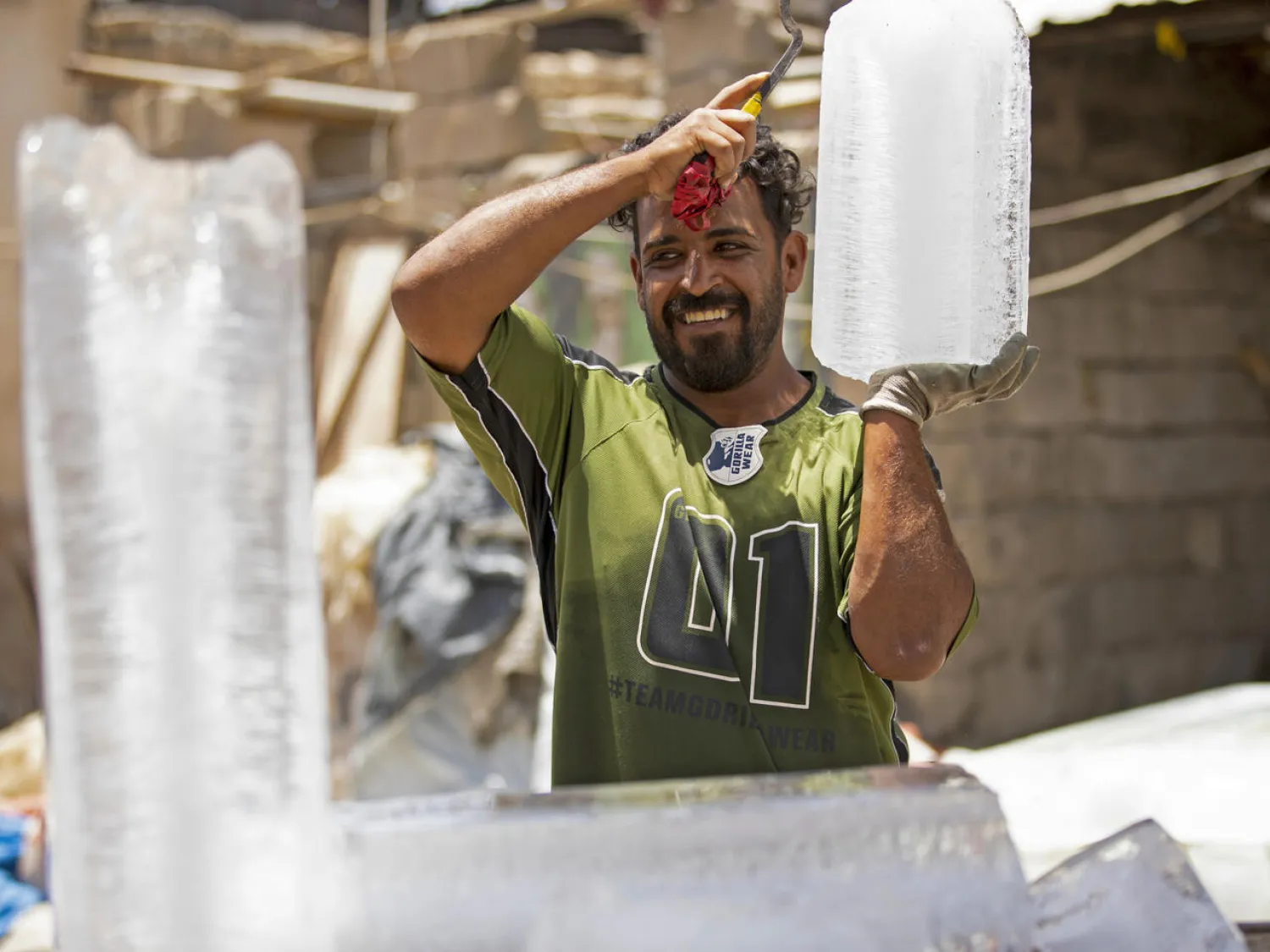
A man carries a block of ice at his stall in Iraq's southern city of Basra. Hussein Faleh AFP
TT

For Iraqis a Sweltering Summer Has Begun

A man carries a block of ice at his stall in Iraq's southern city of Basra. Hussein Faleh AFP

Umm Mohammed, 74, waves a fan back and forth to cool down, but in the blistering heat of Iraq's southern city of Basra there is nothing but stiflingly hot air.

While Basra is used to scorching summers, this year it has started sooner than expected, bringing misery to residents in a city also plagued by chronic electricity shortages, AFP said.

"By God, we are tired," Umm Mohammed said faintly, adding that the heat had woken her up in the middle of the night.

Just days into summer, the temperature in Basra has already soared to around 45 degrees Celsius (113 Fahrenheit).

Umm Mohammed's modest home has a flimsy sheet-metal roof that retains the sweltering heat.

Further north in the capital Baghdad, temperatures have already topped 50 Celsius -- in the shade.

Battered by decades of conflict that has sapped its infrastructure, Iraq is struggling with droughts, repeated sandstorms, desertification and a drop in some river levels.

Chronic power cuts are exacerbated in the summer, and only those who can afford private generators are able to keep their fridges or air conditioning units running.

In Basra, high humidity compounds the oppressive heat.

And with many Iraqis struggling to survive, spending around $105 dollars a month for a private generator is not an option.

The authorities "must help poor people", Umm Mohammed said, decrying their failure to provide an adequate mains supply.

Referring to how the government treats its citizens, she said: "Even God does not agree to that."

- 'It's hell' -
Iraq is the second-largest oil producer in the OPEC cartel.

But the once thriving country has for years bought gas from neighboring Iran, which supplies about one-third of its power sector needs.

US sanctions on Iranian oil and gas have complicated Baghdad's payments for the imports, leaving Iraq in heavy arrears and prompting Tehran to periodically switch off the taps.

The result is longer power cuts for most of Iraq's 41-million-strong population, many of whom blame politicians and endemic corruption for their plight.

Anger over blackouts helped fuel deadly protests from late 2019 to mid-2020, including many in southern Iraq.

Nataq al-Khafaji, who lives in Nasiriyah, just north of Basra, said getting by in the heat without electricity was "very difficult for the children and the elderly".

"It's hell," he added.

During the summer holidays, Khafaji's three children have nowhere to go and little to do.

Stuck in their darkened home, they try as best as they can to escape the suffocating heat outdoors.

Khafaji has bought a battery-operated fan, but expressed worry that it would not be enough during the worst months "when it will be close to 50 degrees".

- 'National priority' -
The United Nations ranks Iraq as one of the top five countries most vulnerable to climate change.

Since mid-April, it has been battered by 10 sandstorms -- a product of intense drought, soil degradation, high temperatures and low rainfall linked to climate change.

President Barham Saleh has warned that tackling climate change "must become a national priority for Iraq as it is an existential threat to the future of our generations to come".

Saleh said desertification affects 39 percent of Iraq, where water supplies are also dwindling drastically and crop yields are declining.

With heat waves and dust storms "expected to increase over the years", so will health issues, said Seif al-Badr, a spokesman for the health ministry.

"We expect to be treating more people for a variety of illnesses linked to climate" change, he told AFP.

But efforts to address such issues appear to have been shelved, as Iraq grapples with political deadlock that has left it without a new government after polls last October.

The World Bank has warned that unless solutions are found, Iraq could lose 20 percent of its water resources by 2050 due to climate change.




US Astronaut to Take her 3-year-old's Cuddly Rabbit Into Space

FILE PHOTO: An evening launch of a SpaceX Falcon 9 rocket carrying 20 Starlink V2 Mini satellites, from Space Launch Complex at Vandenberg Space Force Base is seen over the Pacific Ocean from Encinitas, California, US, June 23, 2024. REUTERS/Mike Blake/File Photo
TT

US Astronaut to Take her 3-year-old's Cuddly Rabbit Into Space

FILE PHOTO: An evening launch of a SpaceX Falcon 9 rocket carrying 20 Starlink V2 Mini satellites, from Space Launch Complex at Vandenberg Space Force Base is seen over the Pacific Ocean from Encinitas, California, US, June 23, 2024. REUTERS/Mike Blake/File Photo

When the next mission to the International Space Station blasts off from Florida next week, a special keepsake will be hitching a ride: a small stuffed rabbit.

American astronaut and mother, Jessica Meir, one of the four-member crew, revealed Sunday that she'll take with her the cuddly toy that belongs to her three-year-old daughter.

It's customary for astronauts to go to the ISS, which orbits 250 miles (400 kilometers) above Earth, to take small personal items to keep close during their months-long stint in space.

"I do have a small stuffed rabbit that belongs to my three-year-old daughter, and she actually has two of these because one was given as a gift," Meir, 48, told an online news conference.

"So one will stay down here with her, and one will be there with us, having adventures all the time, so that we'll keep sending those photos back and forth to my family," AFP quoted her as saying.

US space agency NASA says SpaceX Crew-12 will lift off on a SpaceX Falcon 9 rocket from Cape Canaveral in Florida to the orbiting scientific laboratory early Wednesday.

The mission will be replacing Crew-11, which returned to Earth in January, a month earlier than planned, during the first medical evacuation in the space station's history.

Meir, a marine biologist and physiologist, served as flight engineer on a 2019-2020 expedition to the space station and participated in the first all-female spacewalks.

Since then, she's given birth to her daughter. She reflected Sunday on the challenges of being a parent and what is due to be an eight-month separation from her child.

"It does make it a lot difficult in preparing to leave and thinking about being away from her for that long, especially when she's so young, it's really a large chunk of her life," Meir said.

"But I hope that one day, she will really realize that this absence was a meaningful one, because it was an adventure that she got to share into and that she'll have memories about, and hopefully it will inspire her and other people around the world," Meir added.

When the astronauts finally get on board the ISS, they will be one of the last crews to live on board the football field-sized space station.

Continuously inhabited for the last quarter century, the aging ISS is scheduled to be pushed into Earth's orbit before crashing into an isolated spot in the Pacific Ocean in 2030.

The other Crew-12 astronauts are Jack Hathaway of NASA, European Space Agency astronaut Sophie Adenot, and Russian cosmonaut Andrey Fedyaev.


iRead Marathon Records over 6.5 Million Pages Read

Participants agreed that the number of pages read was not merely a numerical milestone - SPA
TT

iRead Marathon Records over 6.5 Million Pages Read

Participants agreed that the number of pages read was not merely a numerical milestone - SPA

The fifth edition of the iRead Marathon achieved a remarkable milestone, surpassing 6.5 million pages read over three consecutive days, in a cultural setting that reaffirmed reading as a collective practice with impact beyond the moment.

Hosted at the Library of the King Abdulaziz Center for World Culture (Ithra) and held in parallel with 52 libraries across 13 Arab countries, including digital libraries participating for the first time, the marathon reflected the transformation of libraries into open, inclusive spaces that transcend physical boundaries and accommodate diverse readers and formats.

Participants agreed that the number of pages read was not merely a numerical milestone, but a reflection of growing engagement and a deepening belief in reading as a daily, shared activity accessible to all, free from elitism or narrow specialization.

Pages were read in multiple languages and formats, united by a common conviction that reading remains a powerful way to build genuine connections and foster knowledge-based bonds across geographically distant yet intellectually aligned communities, SPA reported.

The marathon also underscored its humanitarian and environmental dimension, as every 100 pages read is linked to the planting of one tree, translating this edition’s outcome into a pledge of more than 65,000 trees. This simple equation connects knowledge with sustainability, turning reading into a tangible, real-world contribution.

The involvement of digital libraries marked a notable development, expanding access, strengthening engagement, and reinforcing the library’s ability to adapt to technological change without compromising its cultural role. Integrating print and digital reading added a contemporary dimension to the marathon while preserving its core spirit of gathering around the book.

With the conclusion of the iRead Marathon, the experience proved to be more than a temporary event, becoming a cultural moment that raised fundamental questions about reading’s role in shaping awareness and the capacity of cultural initiatives to create lasting impact. Three days confirmed that reading, when practiced collectively, can serve as a meeting point and the start of a longer cultural journey.


Imam Turki bin Abdullah Royal Reserve Launches Fifth Beekeeping Season

Jazan’s Annual Honey Festival - File Photo/SPA
TT

Imam Turki bin Abdullah Royal Reserve Launches Fifth Beekeeping Season

Jazan’s Annual Honey Festival - File Photo/SPA

The Imam Turki bin Abdullah Royal Nature Reserve Development Authority launched the fifth annual beekeeping season for 2026 as part of its programs to empower the local community and regulate beekeeping activities within the reserve.

The launch aligns with the authority's objectives of biodiversity conservation, the promotion of sustainable environmental practices, and the generation of economic returns for beekeepers, SPA reported.

The authority explained that this year’s beekeeping season comprises three main periods associated with spring flowers, acacia, and Sidr, with the start date of each period serving as the official deadline for submitting participation applications.

The authority encouraged all interested beekeepers to review the season details and attend the scheduled virtual meetings to ensure organized participation in accordance with the approved regulations and the specified dates for each season.