


Russia Strikes Kyiv as Western Leaders Meet in Europe

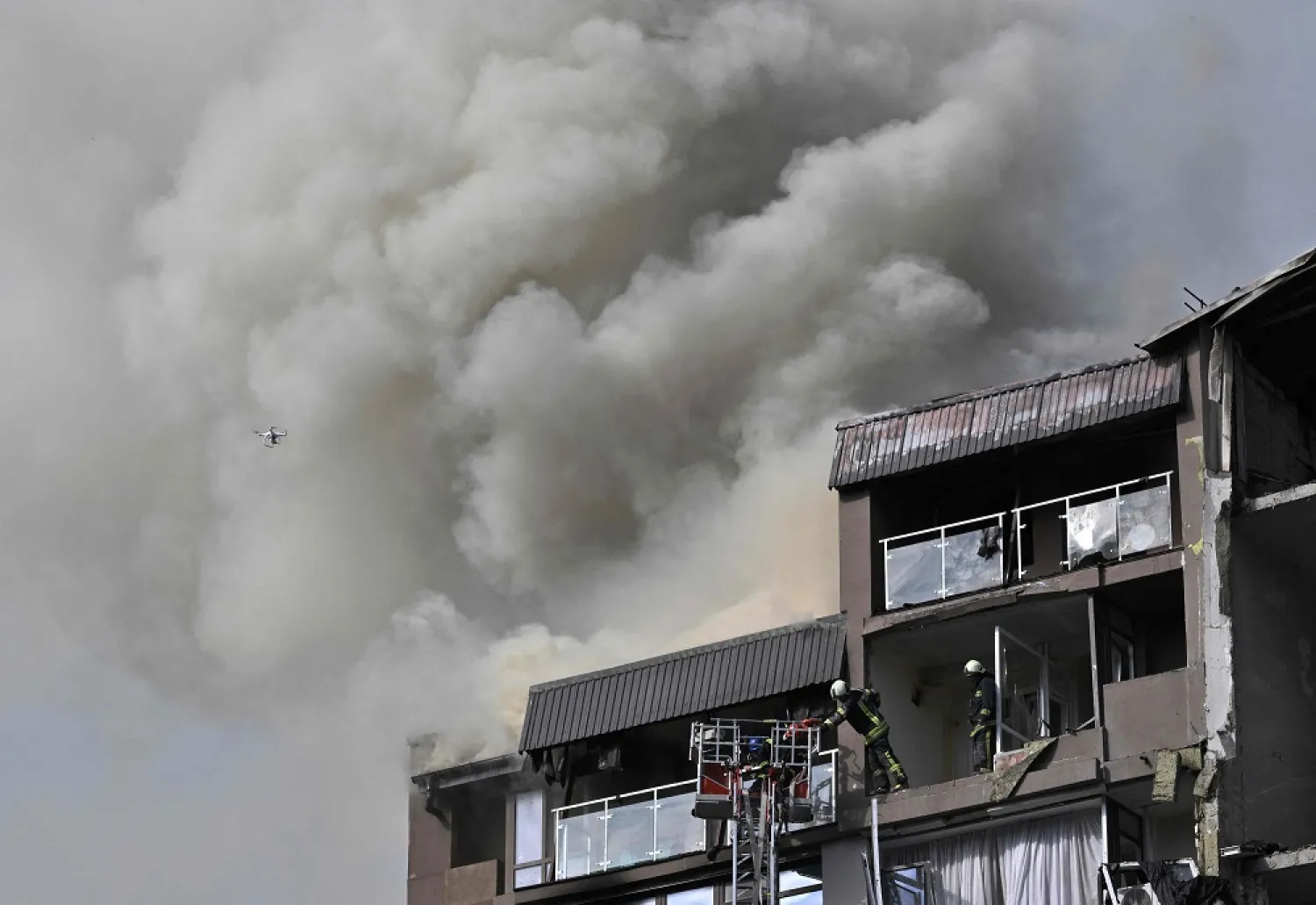
Rescuers and firefighters work in a damaged residential building, hit by Russian missiles in Kyiv on June 26, 2022, amid Russian invasion of Ukraine. (AFP)
TT

Russia Strikes Kyiv as Western Leaders Meet in Europe

Rescuers and firefighters work in a damaged residential building, hit by Russian missiles in Kyiv on June 26, 2022, amid Russian invasion of Ukraine. (AFP)

Russian missiles hit the Ukrainian capital early Sunday, striking at least two residential buildings and killing one person, the mayor of Kyiv said. The attack came as Western leaders meeting in Europe this week prepared to reaffirm their support for Ukraine and condemnation of Russia.

Associated Press journalists in Kyiv saw rescue services battling flames and rescuing civilians. The strikes also damaged a nearby kindergarten, where a crater pocked the courtyard. Ukrainian air force spokesman Yuriy Ignat said the missiles were Kh-101 cruise missiles fired from planes over the Caspian Sea, more than 1,500 kilometers (932 miles) away.

After conflicting early casualty reports, Mayor Vitali Klitschko said one person was killed and six injured, including a 7-year-old girl and her mother, whose condition he described as moderately severe.

Klitschko told journalists that he believed the airstrikes were "maybe a symbolic attack" ahead of a NATO summit in Madrid that starts Tuesday. Leaders of the Group of Seven industrialized nations, including US President Joe Biden, were in Germany on Sunday for a meeting of the world's largest economies.

The leaders were set to announce new bans on imports of Russian gold, the latest in a series of sanctions they hope will further isolate Russia economically. Biden, while standing with German Chancellor Olaf Scholz, the three-day meeting's host, was asked for his reaction to the latest missile strikes on Kyiv.

"It’s more of their barbarism," he replied.

The early morning Russian airstrikes were the first to successfully target the capital since June 5. Two more explosions were later heard in Kyiv, but their cause was not immediately clear.

A member of the Ukrainian parliament, Oleksiy Goncharenko, wrote on the Telegram messaging app that preliminary information indicated that Russia launched 14 missiles toward the capital region and Kyiv itself, suggesting that some were intercepted.

In the city of Cherkasy, about 160 kilometers (100 miles) southeast of Kyiv, one person was killed and five injured in strikes by two Russian rockets, regional governor Ihor Taburets said.

A former commander of US forces in Europe said the strikes on Kyiv were intended to humiliate Western leaders as they gathered for the G-7 and NATO summits.

"Russia is saying, ‘We can do this all day long. You guys are powerless to stop us,’" retired Lt. Gen. Ben Hodges, the former commanding general of US Army forces in Europe, said. "The Russians are humiliating the leaders of the West."

In a phone interview, Hodges said Russia doesn’t have bottomless stocks of precision missiles and that "if they are using them, it’s going to be for a special purpose."

He said it was hard to say with certainty whether apartments buildings were deliberately targeted or whether missiles strayed.

Meanwhile, Russian troops fought to consolidate their gains in the country’s east by battling to swallow up the last remaining Ukrainian stronghold in Luhansk province. Luhansk Gov. Serhiy Haidai said Sunday that Russia was conducting intense airstrikes on the city of Lysychansk, destroying its television tower and seriously damaging a road bridge.

"There’s very much destruction. Lysychansk is almost unrecognizable," he wrote on Facebook.

Lysychansk and the nearby city of Sievierodonetsk have been the focal point of a Russian offensive aimed at capturing all of Ukraine's eastern Donbas region and destroying the Ukrainian troops defending territory not already controlled by Moscow-backed separatists.

Haidai confirmed Saturday that Sievierodonetsk, including a chemical plant where hundreds of Ukrainian troops and civilians were holed up, had fallen to Russian and separatist fighters.

Russian Defense Ministry spokesman Igor Konashenkov said late Saturday that Russian and Moscow-backed separatist forces now control Sievierodonetsk and the villages surrounding it. He said the attempt by Ukrainian forces to turn the Azot plant into a "stubborn center of resistance" had been thwarted.

Capturing Lysychansk would give Russian forces control of every major settlement in the province, a significant step toward Russia’s aim of capturing the entire Donbas. The Russians and separatists control about half of Donetsk, the second province in the Donbas.

On Saturday, Russia also launched dozens of missiles on several areas across the country far from the heart of the eastern battles. Some of the missiles were fired from Russian long-range Tu-22 bombers deployed from Belarus for the first time, Ukraine’s air command said.

The bombardment preceded a meeting between Russian President Vladimir Putin and Belarusian President Alexander Lukashenko, during which Putin announced that Russia planned to supply Belarus with the Iskander-M missile system.



UK PM's Communications Director Quits

British Prime Minister Keir Starmer delivers a speech at Horntye Park Sports Complex in St Leonards, Britain, February 05, 2026. Peter Nicholls/Pool via REUTERS
TT

UK PM's Communications Director Quits

British Prime Minister Keir Starmer delivers a speech at Horntye Park Sports Complex in St Leonards, Britain, February 05, 2026. Peter Nicholls/Pool via REUTERS

British Prime Minister Keir Starmer's director of communications Tim Allan resigned on Monday, a day after Starmer's top aide Morgan McSweeney quit over his role in backing Peter Mandelson over his known links to Jeffrey Epstein.

The loss of two senior aides ⁠in quick succession comes as Starmer tries to draw a line under the crisis in his government resulting from his appointment of Mandelson as ambassador to the ⁠US.

"I have decided to stand down to allow a new No10 team to be built. I wish the PM and his team every success," Allan said in a statement on Monday.

Allan served as an adviser to Tony Blair from ⁠1992 to 1998 and went on to found and lead one of the country’s foremost public affairs consultancies in 2001. In September 2025, he was appointed executive director of communications at Downing Street.


Road Accident in Nigeria Kills at Least 30 People

FILE PHOTO: A police vehicle of Operation Fushin Kada (Anger of Crocodile) is parked on Yakowa Road, as schools across northern Nigeria reopen nearly two months after closing due to security concerns, following the mass abductions of school children, in Kaduna, Nigeria, January 12, 2026. REUTERS/Nuhu Gwamna/File Photo
TT

Road Accident in Nigeria Kills at Least 30 People

FILE PHOTO: A police vehicle of Operation Fushin Kada (Anger of Crocodile) is parked on Yakowa Road, as schools across northern Nigeria reopen nearly two months after closing due to security concerns, following the mass abductions of school children, in Kaduna, Nigeria, January 12, 2026. REUTERS/Nuhu Gwamna/File Photo

At least 30 people have been killed and an unspecified number of people injured in a road accident in northwest Nigeria, authorities said.

The accident occurred Sunday in Kwanar Barde in the Gezawa area of Kano state and was caused by “reckless driving” by the driver of a truck-trailer, Gov. Abba Yusuf said in a statement. He did not specify what other vehicles were involved.

Yusuf described the accident as “heartbreaking and a great loss” to the affected families and the state. He did not provide more details of the accident, said The Associated Press.

Africa’s most populous country recorded 5,421 deaths in 9,570 road accidents in 2024, according to data by the country’s Federal Road Safety Corps.

Experts say a combination of factors including a network of bad roads, lax enforcement of traffic laws and indiscipline by some drivers produce the grim statistics.

In December, boxing heavyweight champion Anthony Joshua was in a deadly car crash that injured him and killed Sina Ghami and Latif “Latz” Ayodele, two of his friends, in southwest Nigeria.

Adeniyi Mobolaji Kayode, Joshua’s driver, was charged with dangerous and reckless driving and his trial is scheduled to begin later this month.

Africa has the highest road fatality rate in the world despite having only about 3% of the world’s vehicles, mainly due to weak enforcement of road laws, poor infrastructure and widespread use of unsafe transport. 


US Vice President Vance Heads to Armenia, Azerbaijan to Push Peace, Trade

US Vice President JD Vance speaks during the Critical Minerals Ministerial at the State Department in Washington, DC, US, February 4, 2026. (Reuters)
TT

US Vice President Vance Heads to Armenia, Azerbaijan to Push Peace, Trade

US Vice President JD Vance speaks during the Critical Minerals Ministerial at the State Department in Washington, DC, US, February 4, 2026. (Reuters)

US Vice President JD Vance will visit Armenia and Azerbaijan this week to push a Washington-brokered peace agreement that could transform energy and trade routes in the strategic South Caucasus region.

His two-day trip to Armenia, which begins later on Monday, comes just six months after the Armenian and Azerbaijani leaders signed an agreement at the White House seen as the first step towards peace after nearly 40 years of war.

Vance, the first US vice president to visit Armenia, is seeking to advance the Trump Route for International Peace and Prosperity (TRIPP), a proposed 43-kilometre (27-mile) corridor that would run across southern Armenia and give Azerbaijan a direct route to its exclave ‌of Nakhchivan ‌and in turn to Türkiye, Baku's close ally.

"Vance's visit should ‌serve ⁠to reaffirm the ‌US's commitment to seeing the Trump Route through," said Joshua Kucera, a senior South Caucasus analyst at Crisis Group.

"In a region like the Caucasus, even a small amount of attention from the US can make a significant impact."

The Armenian government said on Monday that Vance would hold talks with Prime Minister Nikol Pashinyan and that both men would then make statements, without elaborating.

Vance will then visit Azerbaijan on Wednesday and Thursday, the White House has said.

Under the agreement signed last year, ⁠a private US firm, the TRIPP Development Company, has been granted exclusive rights to develop the proposed corridor, with Yerevan ‌retaining full sovereignty over its borders, customs, taxation and security.

The ‍route would better connect Asia to Europe ‍while - crucially for Washington - bypassing Russia and Iran at a time when Western countries are ‍keen on diversifying energy and trade routes away from Russia due to its war in Ukraine.

Russia has traditionally viewed the South Caucasus as part of its sphere of influence but has seen its clout there diminish as it is distracted by the war in Ukraine.

Securing US access to supplies of critical minerals is also likely to be a key focus of Vance's visit.

TRIPP could prove a key transit corridor for the vast mineral wealth of ⁠Central Asia - including uranium, copper, gold and rare earths - to Western markets.

CLOSED BORDERS, BITTER RIVALS

In Soviet times the South Caucasus was criss-crossed by railways and oil pipelines until a series of wars beginning in the 1980s disrupted energy routes and shuttered the border between Armenia and Türkiye, Azerbaijan's key regional ally.

Armenia and Azerbaijan were locked in bitter conflict for nearly four decades, primarily over the mountainous region of Nagorno-Karabakh, an internationally recognized part of Azerbaijan that broke away from Baku's control as the Soviet Union fell apart in 1991.

Azerbaijan and Armenia fought two wars over Karabakh before Baku finally took it back in 2023. Karabakh's entire ethnic Armenian population of around 100,000 people fled to Armenia. The two neighbors have made progress in recent months on normalizing relations, including restarting ‌some energy shipments.

But major hurdles remain to full and lasting peace, including a demand by Azerbaijan that Armenia change its constitution to remove what Baku says contains implicit claims on Azerbaijani territory.