


Tokyo June Heatwave Worst Since 1875 as Power Supply Creaks under Strain

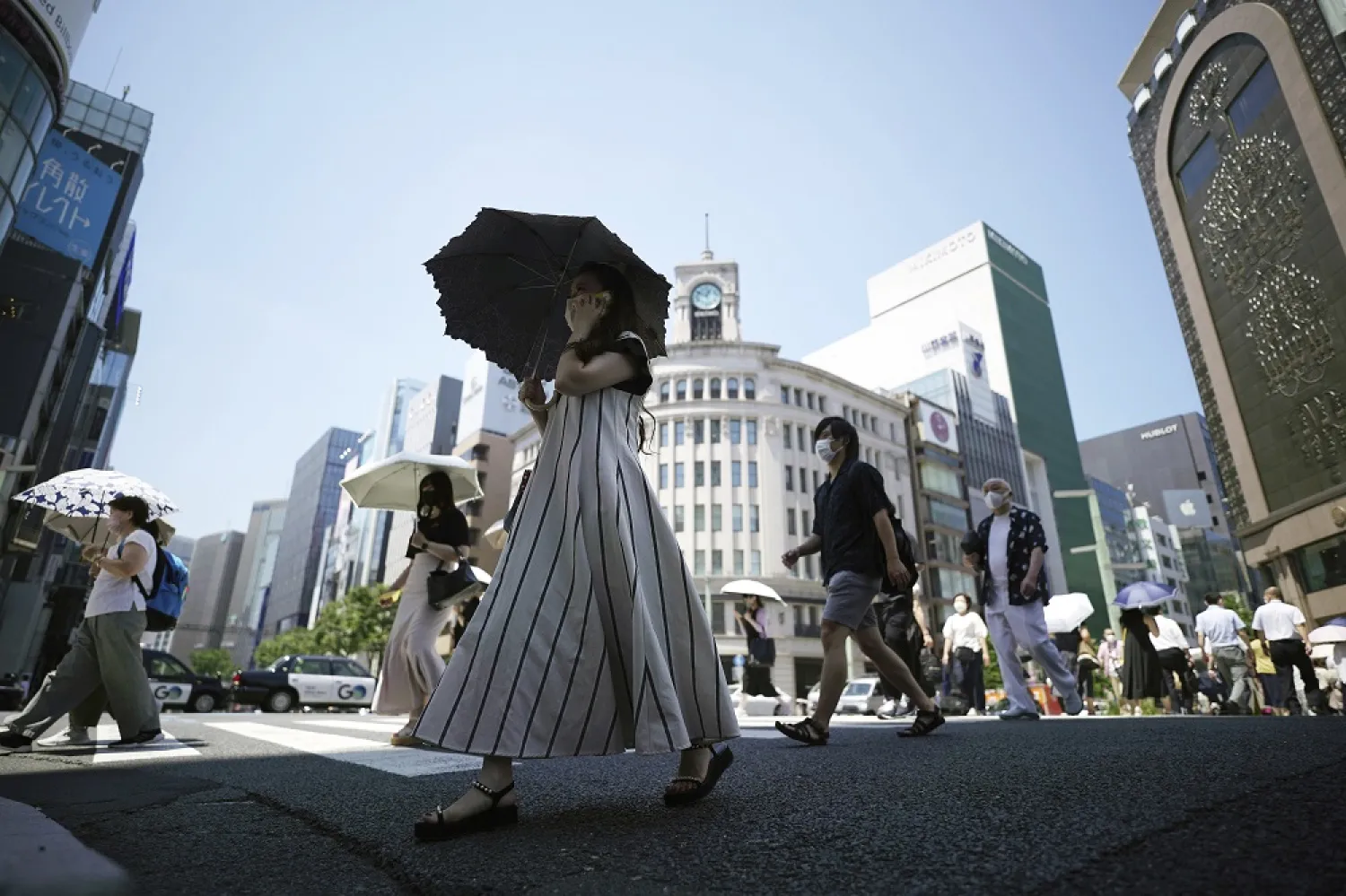
People walk over a pedestrian crossing under an intense sun Tuesday, June 28, 2022, in Tokyo. (AP)
TT

Tokyo June Heatwave Worst Since 1875 as Power Supply Creaks under Strain

People walk over a pedestrian crossing under an intense sun Tuesday, June 28, 2022, in Tokyo. (AP)

Japan baked under scorching temperatures for a fourth successive day on Tuesday, as the capital's heat broke nearly 150-year-old records for June and authorities warned power supply remained tight enough to raise the specter of cuts.

The heatwave comes less than two weeks before a national election in which prices, including the cost of electricity, are among key issues picked by voters in opinion polls that show the government's approval rating slipping - with politicians including Tokyo's governor urging power price cuts.

A high of 34 C was predicted for Tokyo on Tuesday, after three successive days of temperatures topping 35 C - the worst streak of hot weather in June since records began in 1875.

Cases of hospitalization from heatstroke rose early in the day, with many in the capital continue to flout government advice by continuing to wear face masks outdoors - a legacy of more than two years of the COVID-19 pandemic.

For a second day, authorities asked consumers in the Tokyo area to conserve electricity to avoid a looming power cut. The heatwave comes less than two weeks before a national election in which surging prices - including electricity - are rated the top concern for voters in opinion polls that show the government's approval rating slipping.

As of 9 a.m. local time (0000 GMT), 13 people had been taken to hospital with suspected heatstroke, Fuji News Network said. At least two people are believed to have died from heatstroke, media said, prompting authorities to moderate their calls for power saving.

"Apparently there are some elderly people who have turned off their air conditioners because we are asking people to save energy, but please - it's this hot - don't hesitate about cooling off," trade and industry minister Koichi Hagiuda told a news conference.

The reserve ratio for Tokyo during the evening (1630-1700) on Tuesday was expected to fall below 5% as of Monday evening, close to the minimum of 3% that ensures stable supply, in Tokyo and eight surrounding prefectures. Reserve capacity below 3% risks power shortages and blackouts.

On Tuesday, the Ministry of Economy, Trade and Industry (METI) said predictions had improved slightly, but still called for consumers to be economical with power use.

Monday's warning prompted government offices, including METI, to turn off some lights in the afternoon and evening, with METI halting use of 25% of elevators in its building.

Electronics stores took similar steps, shutting off televisions and other goods on sales floors that would normally be kept on to lure buyers, and some Tokyo residents said on social media they were turning off all appliances not in use.

But politicians began to call for further steps.

Tokyo governor Yuriko Koike attended a meeting of Tokyo Electric Power Co (TEPCO) shareholders on Tuesday, later saying she had called for price cuts, Fuji News Network reported. TEPCO provides power to the greater Tokyo region.

Though expected to do well in the July 10 election for the upper house of parliament, Kishida's ruling party faces headwinds from rising prices, worsened by a slide in the value of the yen that makes imports more costly.

The Kishida cabinet's approval came to 50% in a voter survey conducted by public broadcaster NHK on June 24-26, down from 55% last week.

Natsuo Yamaguchi, head of the junior partner in Kishida's coalition government, warned on Monday in a campaign speech that citizens were risking heatstroke by trying to economize on power.

"What I would really like is for the government to tell power companies to lower costs," he was quoted by Kyodo news agency as saying.

"I'd like to contact the prime minister, who's currently visiting Europe," he added - a reference to Kishida's attendance at the G7 summit, meaning the premier is out of the country during an election campaign period, a significant departure from usual practice.



Saudi Scientific Study Develops AI-Powered Detection of Obstructive Sleep Apnea

Sleep apnea affects more than one billion people worldwide. (AFP illustrative photo)
TT

Saudi Scientific Study Develops AI-Powered Detection of Obstructive Sleep Apnea

Sleep apnea affects more than one billion people worldwide. (AFP illustrative photo)

A Saudi scientific study has developed an intelligent model for detecting obstructive sleep apnea (OSA), a condition affecting more than one billion people worldwide, using unidirectional electrocardiography (ECG) signals and artificial intelligence (AI) techniques.

The findings, published in "Frontiers in Artificial Intelligence" and conducted by Dr. Malak Al-Marshad at the University Sleep Medicine and Research Center, College of Medicine, and Medical City at King Saud University, detailed the development of an “attention transformer-based deep learning model” designed to improve the accuracy and speed of diagnosing OSA.

The study noted that the proposed diagnostic approach is more efficient than traditional polysomnography (PSG), which is time-consuming, costly, and requires specialist analysis. The model uses transformer-based AI technology, similar to that in large language models, relying on a single ECG signal and autoencoder-based positional encoding to process raw data without complex preprocessing.

Results showed that the model outperformed previous studies by 13% in F1 score and achieved high temporal accuracy, detecting apnea events with precision down to one second. It offers physicians faster, more affordable, and reliable diagnostic support, even when using noisy real-world data.

The research reflects growing interest in applying AI in sleep medicine. King Saud University ranked 18th globally in sleep medicine research over the past five years, while Professor Ahmed BaHammam of the College of Medicine at King Saud University ranked fifth worldwide among sleep medicine scientists during the same period, according to the 2025 ScholarGPS rankings.


In Sudan's Old Port of Suakin, Dreams of a Tourism Revival

Local officials in the historic Sudanese city of Suakin hope the once-booming transit port turned tourist draw can be revived. Mutawakil ISSA / AFP
TT

In Sudan's Old Port of Suakin, Dreams of a Tourism Revival

Local officials in the historic Sudanese city of Suakin hope the once-booming transit port turned tourist draw can be revived. Mutawakil ISSA / AFP

The mayor of Suakin dreams of a rebirth for his town, an ancient Red Sea port spared by the wars that have marked Sudan's history but reduced to ruins by the ravages of time.

"It was called the 'White City'," for its unique buildings made of coral stone taken from the seabed, said mayor Abu Mohamed El-Amin Artega, who is also the leader of the Artega tribe, part of eastern Sudan's Beja ethnic group.

Now the once-booming port and tourist draw languishes on the water, effectively forgotten for years as Sudan remains mired in a devastating war between the army and paramilitary forces.

But inside the ruins of a mosque, a restoration crew is hard at work rebuilding this piece of Suakin, over a century after the city was abandoned.

"Before the war, a lot of people came, a lot of tourists," said Ahmed Bushra, an engineer with the association Safeguarding Sudan's Living Heritage from Conflict and Climate Change (SSLH).

"We hope in the future, when peace comes to Sudan, they will come and enjoy our beautiful historic buildings here," he told AFP.

Architecture student Doha Abdelaziz Mohamed is part of the crew bringing the mosque back to life with funding from the British Council and support from UNESCO.

"When I came here, I was stunned by the architecture," the 23-year-old said.

The builders "used techniques that are no longer employed today", she told AFP. "We are here to keep our people's heritage."

- Abandoned -

The ancient port -- set on an oval island nestled within a lagoon -- served for centuries as a transit point for merchant caravans, Muslim and Christian pilgrims travelling to Makkah and Jerusalem, according to the Rome-based heritage institute ICCROM.

It became a vibrant crossroads under the Ottoman Empire, said Artega, 55, and its population grew to around 25,000 as a construction boom took off.

"The streets were so crowded that, as our forefathers said, you could hardly move."

Everything changed in 1905, when the British built a deeper commercial port 60 kilometers (37 miles) north, to accommodate increased maritime traffic with the opening of the Suez Canal.

"Merchants and residents moved to Port Sudan," the mayor said, lamenting the decline of what he calls "Sudan's great treasure".

But his Artega tribe, which has administered the city since the sixth century with powers "passed from father to son", refused to leave.

His ancestor, he said, scolded the British: "You found a port as prosperous as a fine hen -- you took its eggs, plucked its feathers and now you spit its bones back at us."

As proof of the Artega's influence, he keeps at home what he says are swords and uniforms gifted to his ancestors by Queen Victoria during the British colonial period.

The rise of Port Sudan spelled disaster for Suakin, whose grand public buildings and elegant coral townhouses were left to decay, slowly eaten away by the humid winds and summer heat.

But the 1990s brought new hope, with the opening of a new passenger port linking Suakin to Jeddah in Saudi Arabia.

Today, the Sudanese transport company Tarco operates daily crossings, carrying around 200 passengers per trip from the modern port of Suakin, within sight of the ancient city and its impoverished environs.

- Lease to Türkiye-

The city's optimism grew in 2017 when then-president Omar al-Bashir granted the old port to his Turkish counterpart, Recep Tayyip Erdogan, under a 99-year lease for touristic development.

A Turkish company restored the old governor's palace, customs house and two mosques, but the project stalled in 2019 after Bashir fell from power in the face of mass protests.

Then, in April 2023, the cruise passengers and scuba divers who once stopped in Suakin completely vanished when fighting erupted between the army and the paramilitary Rapid Support Forces (RSF).

A rusting cargo ship now lies stranded on a sandbank in the blue lagoon, where only a handful of fishing boats float around.

But Bushra, from SSLH, remains optimistic. He hopes to see the mosque, which houses the tomb of a Sufi sheikh, host a traditional music festival when the renovation is complete, "in five months".

"When we finish the restoration, the tourists can come here," he said.


Chinese Cash in Jewellery at Automated Gold Recyclers as Prices Soar

A gold ring is placed in a Smart Gold Store Machine where a customer has brought it to sell in Shanghai on January 29, 2026. (AFP)
TT

Chinese Cash in Jewellery at Automated Gold Recyclers as Prices Soar

A gold ring is placed in a Smart Gold Store Machine where a customer has brought it to sell in Shanghai on January 29, 2026. (AFP)

Dozens of people crowded around an automated gold recycling machine at a Shanghai mall, hoping to melt down family heirlooms for cash as prices of the precious metal hit record highs.

China is the world's largest consumer of gold, which is traditionally purchased by families to mark special occasions like births and weddings.

But as prices soared to a fresh high near $5,600 on Thursday, customers surrounding the bright yellow machine installed by gold trading firm Kinghood Group were looking to sell.

"I never thought prices would rise so dramatically," said 54-year-old Wu, who told AFP she wanted to sell panda-themed gold coins she had purchased after the birth of her daughter in 2002.

She said she had previously sold the machine a ring inherited from her late father, which fetched around 10,000 yuan ($1,400) -- a huge increase from the original 1,000 yuan her mother had paid for the ring decades ago.

"Gold prices hold steady at a historic high, it's the right time to sell gold," an ad on the machine advised customers.

An embedded screen displayed the Shanghai Gold Exchange's fluctuating prices, while a live video feed showed a robotic arm moving gold scraps onto a scale and under a device that used light waves to measure its purity.

Some people told AFP they had waited over an hour for their turn.

An attendant kept track of each seller's position in the queue, and helped to deposit ornate pendants, hammered rings and commemorative coins into an opening in the device.

Wu said her elderly mother was especially excited about soaring gold prices, and saw the recycling machine as a chance to supplement her modest pension.

"Everyone is suddenly talking about (gold), and it has sparked this emotion in her," Wu told AFP.

Customers wait to sell their gold jewelry in a Smart Gold Store Machine placed in a shopping in Shanghai on January 29, 2026. (AFP)

- Old gold -

Zhao, a woman sporting an intricately carved gold medallion on a necklace of jade beads and shimmering bangles on her wrist, brought her late grandfather's ring to the recycling machine.

The ring's surface was adorned with the Chinese character for "luck" and tiny images of traditional gold ingots.

She said she believed her grandfather had purchased the ring sometime between the 1950s and the 1980s, and that her mother had handed it down to her this year.

"If the price is good, I will sell it," she told AFP as she waited for her turn.

Minutes after Zhao deposited the ring into the machine, a message popped up on its screen that said Kinghood would buy the chunk of high-karat gold for over 12,000 yuan.

Satisfied, Zhao clicked "agree" on the terms displayed onscreen and keyed in her full name, ID number and bank account details, while her grandfather's ring was melted down into a smooth puddle on the live video feed.

The attendant promised she would receive the full amount via bank transfer by the end of the day.

"Other places test the gold by burning it slightly, but here they test it directly and it's open and transparent," Zhao said, explaining that she trusted the automated recycler over a traditional human buyer.

In addition to a steady stream of sellers, the machine also drew the attention of bystanders who gawked at the large sums of money changing hands at the unassuming corner of the mall.

"Damn!" said a passerby when she saw that one person was selling their old jewellery for more than 75,000 yuan.

And onlookers crowded around an elderly couple as the machine calculated that their finger-sized gold bar could fetch over 122,000 yuan.