


Ukraine War to Shift to Donetsk after Fall of Luhansk; Russia Claims Major Victory

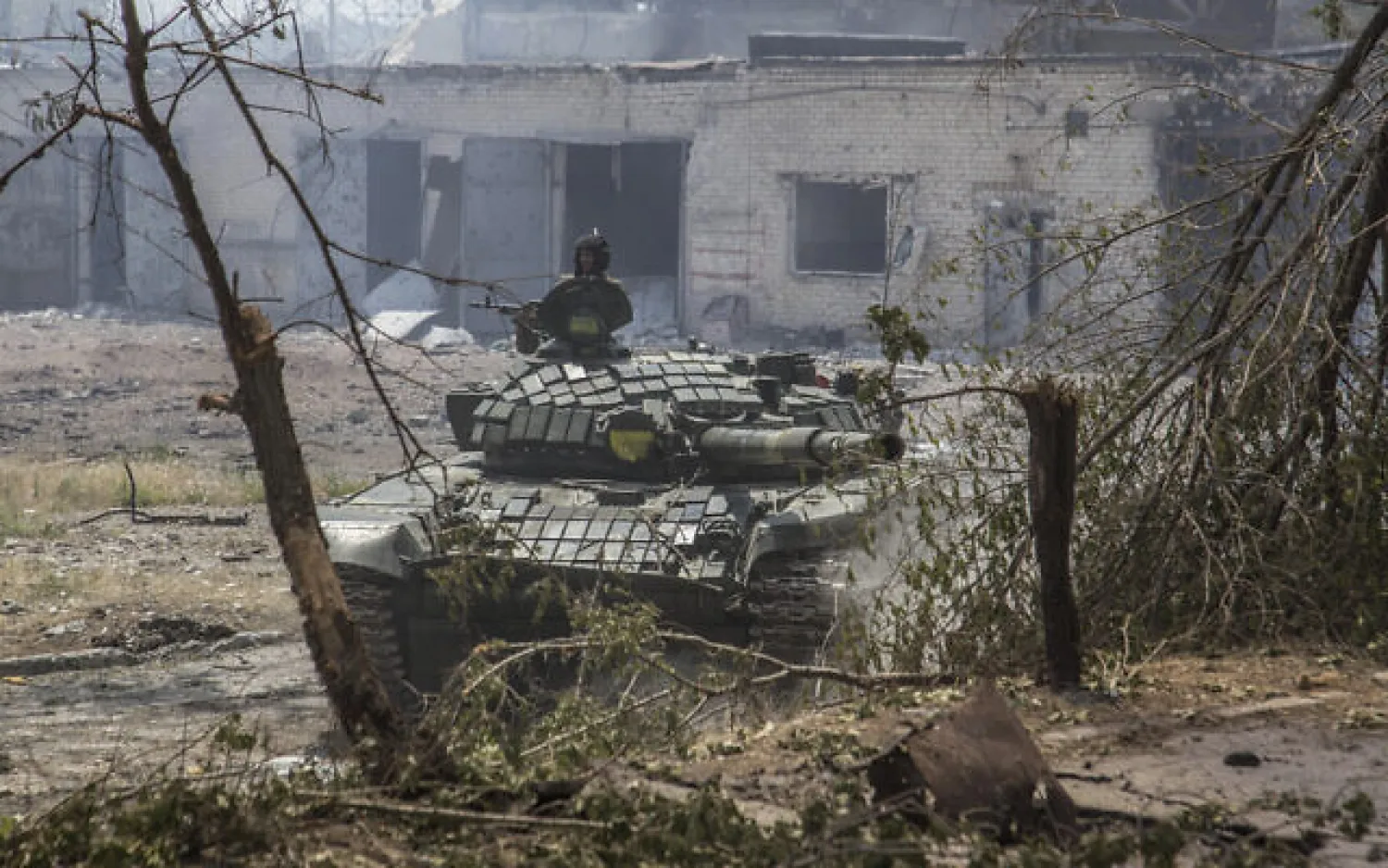
A Ukrainian tank is in position during heavy fighting on the front line in Severodonetsk, the Luhansk region, Ukraine, June 8, 2022. (AP Photo/Oleksandr Ratushniak)
TT

Ukraine War to Shift to Donetsk after Fall of Luhansk; Russia Claims Major Victory

A Ukrainian tank is in position during heavy fighting on the front line in Severodonetsk, the Luhansk region, Ukraine, June 8, 2022. (AP Photo/Oleksandr Ratushniak)

Russian forces in Ukraine will focus on trying to seize all of the Donetsk region, having forced Ukrainian troops to withdraw from the last major city under their control in the neighboring Luhansk region, the governor of Luhansk said on Monday.

After abandoning an assault on Kyiv, the Ukrainian capital, during the early weeks of the war, Russia concentrated its military operation on the industrial Donbas heartland that comprises the Luhansk and Donetsk regions, where Moscow-backed separatist proxies have been fighting Ukraine since 2014.

Russia said it had established full control over the Luhansk region after Ukrainian forces pulled out of the bombed-out city of Lysychansk.

"In terms of the military, it is bad to leave positions, but there is nothing critical (in the loss of Lysychansk). We need to win the war, not the battle for Lysychansk," Governor Serhiy Gaidai told Reuters in an interview.

"It hurts a lot, but it's not losing the war."

He said the withdrawal from Lysychansk had been "centralized", indicating that it had been planned and orderly, but that Ukrainian forces had risked being surrounded.

"Still, for them (Russian forces) goal number 1 is the Donetsk region. Sloviansk and Bakhmut will come under attack - Bakhmut has already started being shelled very hard," he said.

Gaidai said that he expected the city of Sloviansk and the town of Bakhmut in particular to come under attack as Russia tries to take full control of the Donbas in eastern Ukraine.

Moscow said the capture of Lysychansk less than a week after taking neighboring Sievierdonetsk meant it had "liberated" Luhansk, a major Kremlin war goal.

Moscow said it would give the captured territory to the self-proclaimed Russian-backed Luhansk People's Republic whose independence it recognized on the eve of the war.

President Volodymyr Zelenskiy on Sunday night vowed to regain the lost territory with the help of long-range Western weapons.

Zelenskiy said Russia was concentrating its firepower on the Donbas front, but Ukraine would hit back with long-range weapons such as the US-supplied HIMARS rocket launchers.

"The fact that we protect the lives of our soldiers, our people, plays an equally important role. We will rebuild the walls, we will win back the land, and people must be protected above all else," Zelenskiy said in his nightly video address.

In Sloviansk, west of Lysychansk in Donetsk region, Mayor Vadym Lyakh wrote on Facebook that on Sunday fierce shelling had killed at least six people, including a 10-year-old girl.

Costly campaign

Thousands of civilians have been killed and cities leveled since Russia invaded on Feb. 24, with Kyiv accusing Moscow of deliberately targeting civilians. Moscow denies this.

Russia says what it calls a "special military operation" in Ukraine aims to protect Russian speakers from nationalists. Ukraine and its Western allies say this is a baseless pretext for flagrant aggression that aims to seize territory.

The Ukraine war has sparked a global energy and food crisis and Western-led sanctions against Moscow have triggered the worst economic crisis in Russia since the 1991 fall of the Soviet Union.

Germany has warned of gas shortages due to dwindling supplies from Russia. The head of its energy regulator said the 15 billion euros' ($15.64 billion) of government credit to buy gas for storage may not be enough, according to an interview in the WirtschaftsWoche magazine on Monday.

While Russia would try to frame its advance in Luhansk as a significant moment in the war, it came at a high cost to Russia's military, said Neil Melvin of the London-based think tank RUSI.

"Ukraine's position was never that they could defend all of this. What they've been trying to do is to slow down the Russian assault and cause maximum damage, while they build up for a counteroffensive," he said.

Ukraine has repeatedly appealed for an acceleration in weapons supplies from the West, saying its forces are heavily outgunned.

Strikes on Kharkiv

Zelenskiy's office said Russian artillery strikes hit residential and farm buildings in the Kharkiv region.

Russia's defense ministry also said on Sunday it had struck the military infrastructure of Kharkiv, Ukraine's second-largest city in the northeast, where a Reuters reporter said Ukrainian forces had been building fortifications after nightly shelling.

Outside a school in Kharkiv, some residents threw debris into a large crater created by an early morning rocket strike while others got help repairing damaged houses.

"The wife was lucky that she woke up early in the morning because the roof fell exactly where she had been sleeping," one resident, Oleksii Mihulin, told Reuters.

About 70 km (44 miles) from Kharkiv on the Russian side of the border, Russia also reported explosions on Sunday in Belgorod, which it said killed at least three people and destroyed homes.

"The sound was so strong that I jumped up, I woke up, got very scared and started screaming," a Belgorod resident told Reuters, adding the blasts occurred around 3 a.m. (0000 GMT).

Moscow has accused Kyiv of numerous attacks on Belgorod and other areas bordering Ukraine. Kyiv has never claimed responsibility for any of these incidents.

Ukraine said its air force had flown some 15 sorties "in virtually all directions of hostilities", destroying equipment and two ammunition depots.

In the Russian-occupied southern Ukrainian city of Melitopol, Ukrainian forces hit a military logistics base with more than 30 strikes on Sunday, the city's exiled mayor Ivan Fedorov said. A Russian-installed official confirmed that strikes had hit the city.

Reuters could not independently verify the battlefield reports.


UN: Millions May Be Forced to Move as Climate Change Hits South Asia

International Organization for Migration (IOM) chief Amy Pope, seen here in 2023, warned of a lack of urgency globally about the risks that vulnerable communities are facing. Fabrice COFFRINI / AFP
TT

UN: Millions May Be Forced to Move as Climate Change Hits South Asia

International Organization for Migration (IOM) chief Amy Pope, seen here in 2023, warned of a lack of urgency globally about the risks that vulnerable communities are facing. Fabrice COFFRINI / AFP

Climate change is threatening livelihoods and forcing people from their homes across South Asia, but technology and government action could help limit the damage, the UN migration chief told AFP on Friday.

Rising seas, flooding and drought threaten homes and farmland, Amy Pope, Director General of the International Organization for Migration (IOM), said during a visit to New Delhi.

In the Himalayas, she pointed to Nepal's August 26 disaster, when a mountain and glacier collapse triggered deadly flooding, where IOM sent humanitarian aid to help.

In a worst-case scenario, up to 40.5 million people in South Asia may be forced to move by 2050, according to IOM.

"When they can't produce food, when they can't feed their livestock, it increases the likelihood of displacement," said Pope. "The first adaptation is often for people to move."

Pope said climate change was also accelerating urbanization in India.

"As people seek shelter from heat, they're going into urban centers," she said.

- 'Migration as a tool' -

The risks are particularly acute in South Asia, where vast populations and limited resources leave many communities vulnerable.

"There's a lack of urgency globally about the risks that vulnerable communities are facing," Pope said, warning that funding to help residents prepare for climate change remained inadequate.

"The cost of a humanitarian disaster is in the billions. The cost of investing in some of the resilience measures can be far less," she said.

Better data and artificial intelligence could help governments identify communities at risk before disaster strikes, Pope said.

"With the advancements in AI forecasting, you can now better anticipate those communities that are at high risk of displacement," Pope said.

By combining weather forecasts with information about local livelihoods, authorities can identify which communities most need help.

"If you know a community is at risk, we don't need to wait until they're displaced to respond," she said.

Measures could include improving farming methods, training people for other jobs and, where necessary, relocating communities repeatedly hit by floods or drought.

Finding the money for such programs is a major obstacle, Pope said, with governments often struggling to navigate the systems available to fund climate adaptation.

India's investments in early-warning systems, disaster response and technology offer grounds for optimism, she said. But no government can meet the scale of the challenge alone.

International migration can also help people earn a living while filling labor shortages abroad.

South Asia already has established migration routes, offering opportunities to build on existing links.

"Here we have government partners who recognize both the threats to their communities but they're also using migration as a tool for development," Pope said.

She warned that growing demand for workers must be matched by safe, legal routes to employment.

Otherwise, migrants risk exploitation by traffickers and smugglers, including through fraudulent overseas job offers.

India's technological capacity could also help its workers compete internationally as artificial intelligence reshapes employment, Pope said.

AI could threaten some jobs, particularly those involving routine analysis of documents and reports, but other sectors still rely heavily on human labor.

"If we can marry that capacity with the labor mobility, so that the workers are being skilled for those jobs as they're emerging, they will be ahead," Pope said.

"This is a place where I have more optimism than in places where we're dealing with the most acute crises," she said.


Iran President Says Conflict in Mideast Amounts to 'Ecocide'

Iranian President Masoud Pezeshkian visits an exhibition that showcases the defense ministry's latest advancements in defense and space in Tehran. Photo: -/Iranian Presidency/dpa
TT

Iran President Says Conflict in Mideast Amounts to 'Ecocide'

Iranian President Masoud Pezeshkian visits an exhibition that showcases the defense ministry's latest advancements in defense and space in Tehran. Photo: -/Iranian Presidency/dpa

Iran's President Masoud Pezeshkian on Friday urged countries to condemn what he called "ecocide" in the Middle East caused by "wars of aggression".

Pezeshkian said the conflicts in Gaza and the wider Middle East had inflicted a significant toll on nature that extended beyond borders and required "international solutions", AFP said.

"What has occurred in our region as a result of wars of aggression is ecocide, or environmental genocide, and it must be condemned," Pezeshkian told a nature summit in Armenia attended by UN Secretary-General Antonio Guterres.


Rival Sahel Extremists Clash in Intensifying Turf war

A recent report revealed a surge in violent attacks linked to extremist groups in West Africa’s Sahel region. (AFP)
TT

Rival Sahel Extremists Clash in Intensifying Turf war

A recent report revealed a surge in violent attacks linked to extremist groups in West Africa’s Sahel region. (AFP)

Extremists from rival Al-Qaeda and ISIS factions in the Sahel have clashed recently on an unprecedented scale in the borderlands spanning Burkina Faso, Mali and Niger, with claims of hundreds of fighters killed.

The two extremist coalitions, which covet influence over the same areas and control of the same routes and local populations, have repeatedly clashed since 2019.

The rivalry also drives their constant expansion in the Sahel, which the ruling juntas in Ouagadougou, Bamako and Niamey have found difficult to contain, said AFP.

The clashes are "the most intense direct confrontation globally" between an Al-Qaeda branch and an ISIS-linked group, a report by UN experts submitted to the Security Council in early August said.

A semi-arid belt of land that stretches from the Atlantic Ocean along the southern rim of the Sahara desert to the Red Sea, Africa's Sahel has become the ground zero of global extremism.

Extremists have steadily expanded beyond the rural areas where they first took root, killing thousands, roiling governments and sowing terror.

Since September, fighting between ISIS - Sahel Province (ISSP) and the Al-Qaeda-linked group (JNIM) has escalated to unprecedented levels.

On Monday, the ISSP said it had killed more than 400 al-Qaeda fighters, including "several leaders", in clashes four days earlier in the Burkinabe province of Oudalan on the Mali and Niger borders.

"If the claimed death toll is confirmed, then it will be the deadliest single battle recorded between the two groups," Heni Nsaibia, an analyst at conflict monitor ACLED, said.

The toll has yet to be independently confirmed.

But if so, it would surpass the more than 200 deaths claimed by the ISSP in the same area in early September.

- 2,200 deaths since 2019 -

Between 2019 and last month, the two extremist groups fought more than 320 battles, resulting in about 2,200 deaths, Nsaibia said.

The latest clashes between fighters from JNIM and ISIS erupted on October 9 in the tri-border area, according to Wamaps, a collective of west African journalists.

The rivals are fighting over "the same potential living space and the same recruitment pools" in a "race for control of the borders between the three countries", Wassim Nasr, an expert on extremist groups and an associate researcher at The Soufan Center, said in a recent study.

Long confined to Mali and Burkina Faso, the fighting has in recent months spread to western Niger and even northwestern Nigeria, Nsaibia said.

From its Malian stronghold in Menaka, the ISSP has extended its influence into the Nigerien regions of Tahoua, Dosso and Maradi, up to the Nigerian border, Nasr said in the study.

This facilitates the transfer of fighters, equipment and expertise with ISWAP, the ISIS branch active in the Lake Chad basin, he added.

- Competing visions -

Behind the violence lies competing visions of extremism.

While JNIM carries out abuses against civilians, it focuses on developing local roots, building alliances with communities and concentrating attacks on state forces and foreign troops.

The ISIS group adopts a more hardline, transnational approach and does not shy away from targeting civilians who refuse to kowtow to its authority, Sahel specialist Hasret Kargin said.

Such "enduring ideological and strategic tensions" between the two groups are seen in reported defections -- albeit limited in number -- from JNIM to ISSP, the UN experts said in their report.

In July, JNIM claimed it had killed one of its commanders, who had defected to join ISIS.

However, despite the heavy losses the ISIS claims to have inflicted, JNIM remains the leading terror threat in the Sahel, the UN expert report said.

It estimated that its forces number between 7,000 and 8,000 fighters, compared with 2,000 members of ISIS.

"There is significant information indicating that JNIM has shifted substantial reinforcements to the area from other regions," Kargin said.

Given its numbers across the Sahel and its strength compared to the ISIS's Sahel branch, Kargin said he predicted that JNIM would launch "fierce counterattacks in the coming days".
