


Lebanese Govt Ends Official Boycott of Damascus to Facilitate Return of Refugees

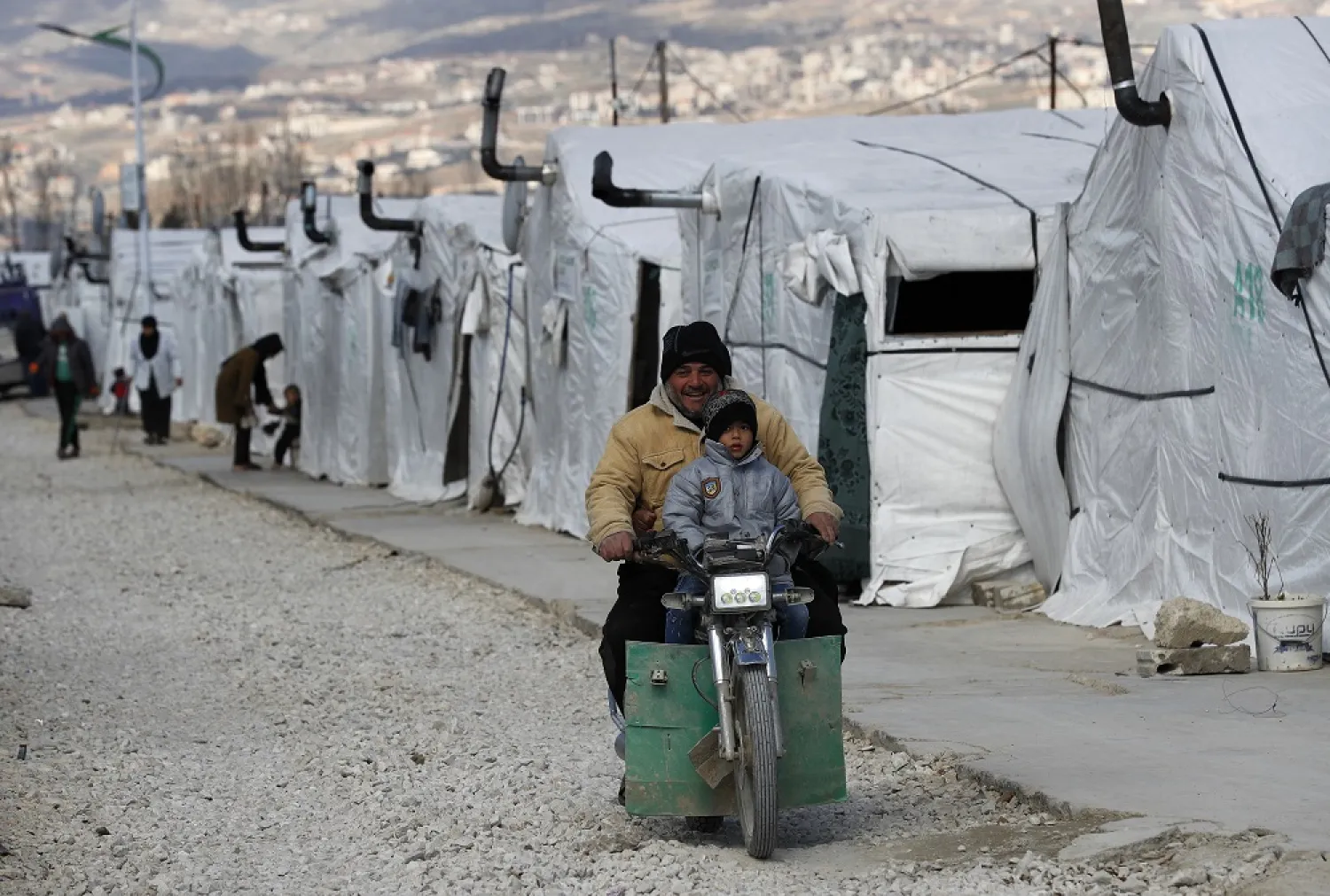
A Syrian displaced man and his son ride a motorcycle, as they drive between the tents at a refugee camp, in Bar Elias, in eastern Lebanon's Bekaa valley, March 5, 2021. (AP)
TT

Lebanese Govt Ends Official Boycott of Damascus to Facilitate Return of Refugees

A Syrian displaced man and his son ride a motorcycle, as they drive between the tents at a refugee camp, in Bar Elias, in eastern Lebanon's Bekaa valley, March 5, 2021. (AP)

Lebanon’s caretaker Minister of the Displaced Issam Sharafeddine is set to visit Damascus after the Eid al-Adha holiday, ending Beirut's official boycott of the regime.

The minister will make the first official visit by a Lebanese official to the war-torn country since 2011.

He will discuss with officials means to return Syrian refugees back to their homes.

Lebanese government officials have paid visits to Damascus after 2011 but only on a “personal” basis. None of the trips had an official character in line with the boycott of the regime.

Sharafeddine has been tasked by President Michel Aoun and caretaker Prime Minister Najib Mikati to travel to Damascus to discuss with officials a Lebanese plan on repatriating the refugees.

A committee consisting of Mikati, Sharafeddine, six other ministers and the country’s General Security organization had been working on the proposal since March to gradually return some 1.5 million Syrian refugees from Lebanon.

Sharafeddine told Asharq Al-Awsat the talks in Damascus aim to discuss a mechanism through which they can be returned. He will also address the Syrian government’s ability to take in refugees and secure the necessary conditions for them once they return.

Lebanon has one of the world's highest numbers of refugees per capita and currently hosts over 1 million Syrians who fled the decade-old conflict. Officials say the influx has cost Lebanon billions of dollars and further damaged its crippled infrastructure while it struggles with a financial meltdown.

The Lebanese government's plan would entail sending back 15,000 Syrian refugees every month.

Human rights organizations in recent reports have documented cases of arbitrary detention, enforced disappearances, and a host of human rights violations against returning refugees.

In remarks to The Associated Press, Sharafeddine rejected these reports as a "fear campaign" and said the Syrian government has agreed to drop charges against former opposition fighters and political opposition.

The United Nations estimates that 90% of Syrian refugee households live in extreme poverty. But since late 2019, poverty has worsened for both Lebanese and Syrians as the Mediterranean country continues to struggle with crippling economic crisis. Sky-rocketing fuel prices coupled with a currency collapse has meant many essential commodities are now out of reach.

In recent months, a surge of Lebanese, Syrians, and Palestinians have tried to flee cash-strapped Lebanon by sea to Europe.

"We have statistics from the Interior Ministry of the names of the displaced, where they live, and where they’re originally from, and so we would return them by neighborhood," Sharafeddine said.

He said Lebanon is willing to repatriate refugees in larger numbers if the Syrian government is able to receive them "at a later stage".



Yemeni Forces Consolidate West Coast Gains, Reinforce Bab al-Mandab Positions

 Yemeni government fighters sit in the back of a vehicle near Dhubab, Taiz Governorate, Yemen, in this still image taken from video released October 5, 2026.    Southern Giants Brigades/Handout via REUTERS
Yemeni government fighters sit in the back of a vehicle near Dhubab, Taiz Governorate, Yemen, in this still image taken from video released October 5, 2026. Southern Giants Brigades/Handout via REUTERS
TT

Yemeni Forces Consolidate West Coast Gains, Reinforce Bab al-Mandab Positions

 Yemeni government fighters sit in the back of a vehicle near Dhubab, Taiz Governorate, Yemen, in this still image taken from video released October 5, 2026.    Southern Giants Brigades/Handout via REUTERS
Yemeni government fighters sit in the back of a vehicle near Dhubab, Taiz Governorate, Yemen, in this still image taken from video released October 5, 2026. Southern Giants Brigades/Handout via REUTERS

Yemeni armed forces consolidated gains along the western coast and reinforced positions overlooking the Bab al-Mandab Strait as they pushed ahead in al-Wazi'iyah district in western Taiz province under Operation “Dawn of Yemen.” Fighting with the Houthis continued in the southern Taiz countryside and on fronts around the city.

The armed forces said they had neutralized more than 1,800 Houthi fighters in recent hours. Army figures put Houthi losses at nearly 10,000 killed or wounded over two weeks of air and ground strikes across multiple fronts.

Nation Shield forces, the Giants Brigades and the Joint Forces took full control of the Kahboub front, according to Yemeni military media. The advance strengthens government forces’ hold on heights overlooking Bab al-Mandab and boosts their ability to secure the strategic corridor as operations continue along the western coast.

Taiz province’s emergency committee suspended classes at public, community and private schools, institutes, colleges and universities in districts that have come under Houthi control. It also placed government employees there on temporary leave, citing exceptional security conditions.

The United Nations warned of a worsening humanitarian situation in Taiz as Houthi attacks spread, displacement rises and aid access faces growing restrictions. Major roads remain closed, adding to pressure on services and limited resources.

The eastern road into Taiz city remains closed, the United Nations said in a recent report. Road closures between Aden and Taiz have disrupted a major supply route from warehouses in Aden, hampering aid agencies’ ability to reach those affected and meet growing needs.


Iraq Rejects Syrian Request to Repatriate 4,000 Suspected ISIS Detainees

Members of the Iraqi border forces patrol along a concrete wall on the Iraqi-Syrian border, in the town of al-Baghuz in the Al-Qaim district of western Iraq, on January 21, 2026. (AFP)
TT

Iraq Rejects Syrian Request to Repatriate 4,000 Suspected ISIS Detainees

Members of the Iraqi border forces patrol along a concrete wall on the Iraqi-Syrian border, in the town of al-Baghuz in the Al-Qaim district of western Iraq, on January 21, 2026. (AFP)

Iraq has rejected Syria's request to repatriate thousands of suspected ISIS members transferred from Syrian detention centers to Iraqi custody earlier this year, a senior Iraqi security official said on Wednesday.

Iraqi National Security Advisor Qasim al-Aboudi said that a meeting had been held recently between Syria, Iraq and the United States to discuss the fate of the prisoners.

Al-Aboudi said Syria had requested that the 4,000 Syrian prisoners be handed over to be tried in Syria, but Iraq refused. Iraq has repatriated about 50 Syrian detainees who were determined not to be ISIS members, he told The Associated Press, while the Syrian prisoners remaining in Iraq include about 400 who are believed to be high-level members of the extremist group.

“Iraq is conducting investigations, and anyone proved to have committed crimes in Iraq will be tried under Iraqi law,” he said.

Some prisoners could later be transferred to their home countries to complete their sentences, he said.

Syria did not immediately respond to requests for comment.

More than 5,700 prisoners with alleged ISIS ties — including some 4,000 Syrians — were transferred from northeast Syria to Iraq after fighting broke out in January between Syrian government forces and the Kurdish-led Syrian Democratic Forces, which had long guarded the detention centers where they were held.

Some ISIS-linked prisoners managed to flee during the chaos of the clashes, and there were fears that a larger-scale escape would take place. While the extremist group lost control of the territory it once seized in Iraq and Syria years ago, its cells still periodically carry out attacks in both countries.

The discussions about the prisoners' fate come as the United States has ended a 12-year mission to fight ISIS in Iraq, with the last US troops withdrawing from the country last month.

Al-Aboudi said Iraq has asked for financial support from the US and other countries taking part in the global coalition against ISIS to help with the costs of housing the prisoners.

“Iraq asked for an allocation of $500 million. The coalition promised support, but Iraq is still waiting,” he said.

A US defense official and the office of Tom Barrack, the US envoy to Syria and Iraq, referred questions about the prisoners to Iraqi and Syrian authorities.

Many of the prisoners transferred to Iraq had been held in Syria for years without charges. Rights groups have raised concerns about detention conditions in both countries.


Arab Parliament President Stresses Houthi Attacks on Saudi Arabia Pose Direct Threat to Regional Security

Arab Parliament President Stresses Houthi Attacks on Saudi Arabia Pose Direct Threat to Regional Security
TT

Arab Parliament President Stresses Houthi Attacks on Saudi Arabia Pose Direct Threat to Regional Security

Arab Parliament President Stresses Houthi Attacks on Saudi Arabia Pose Direct Threat to Regional Security

President of the Arab Parliament Mohammed bin Ahmed Al-Yamahi stressed that repeated terrorist attacks by the Houthi militia against Saudi Arabia and its civilian and oil facilities pose a direct threat to regional security.

During his speech at the 153rd Assembly of the Inter-Parliamentary Union in Arusha, United Republic of Tanzania, Al-Yamahi addressed Iranian attacks that targeted several Arab countries and threatened civilians, infrastructure, and vital facilities, SPA reported.

He also discussed regional escalation and related threats to the security of Arab countries. He called on the international community to move beyond condemnation and take measures to protect states and their sovereignty and compel the parties to respect international law.