

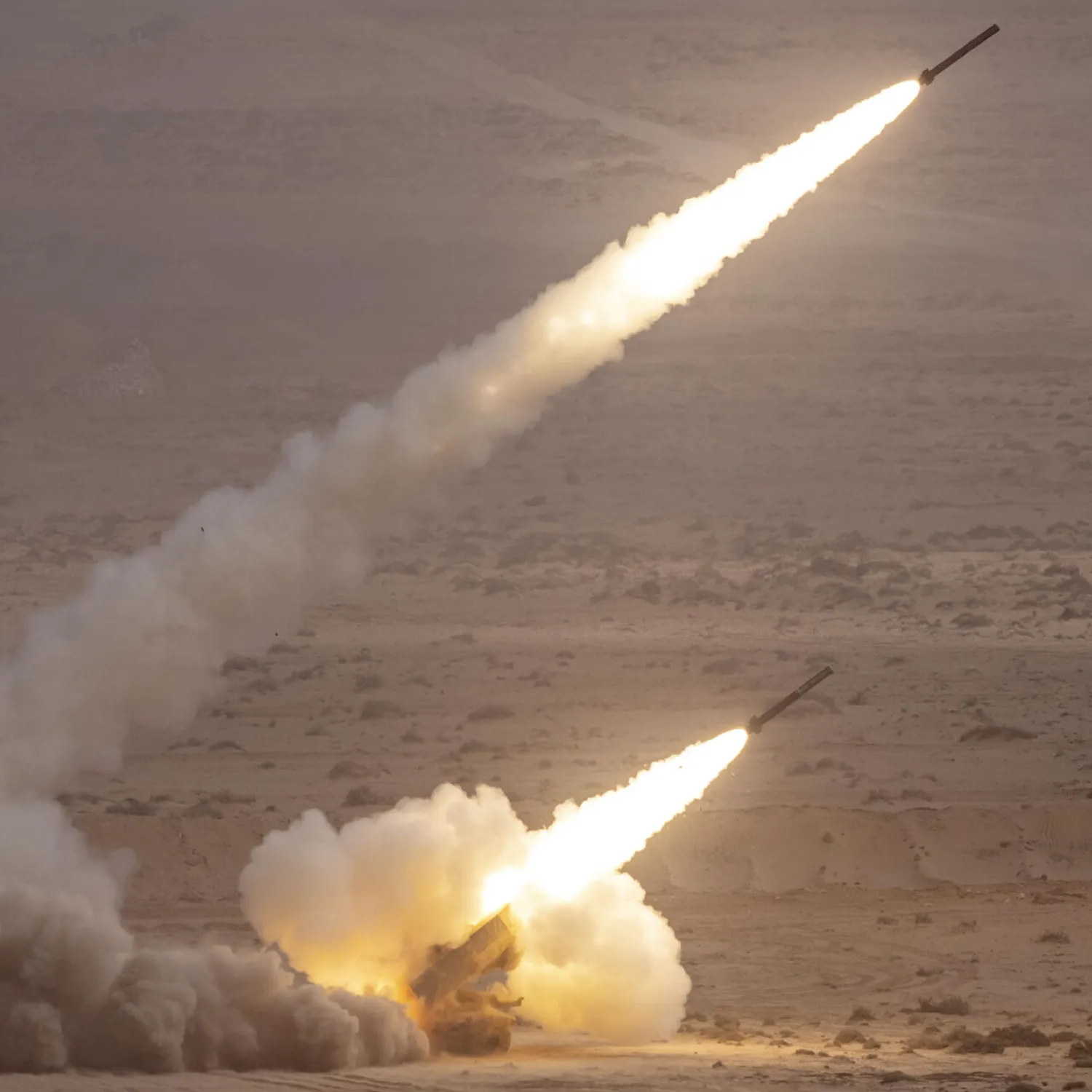

Himars Precision Rockets Shift the Balance in Ukraine

File Photo: Rockets from a US M142 High Mobility Artillery Rocket System (HIMARS) fired during military exercises in Morocco. FADEL SENNA AFP
TT

Himars Precision Rockets Shift the Balance in Ukraine

File Photo: Rockets from a US M142 High Mobility Artillery Rocket System (HIMARS) fired during military exercises in Morocco. FADEL SENNA AFP

US-made precision rockets have given Ukraine forces a major battlefield boost since they were introduced in June, tilting the balance against the Russians and possibly forcing Moscow to pause its offensive, experts said.

Since mid-June, using the Himars missile systems, Ukraine has destroyed more than 20 major Russian ammunition depots and command posts that were previously too far behind the front lines to be reached by traditional artillery, AFP said.

Videos posted on social media have shown spectacular prolonged eruptions at ammo dumps in Russian-controlled Lugansk, Nova Kakhovka, and elsewhere, attesting to the power and precision of the US missiles.

"The occupiers have already felt very well what modern artillery is. They will not have a safe rear anywhere on our land," Ukraine's President Volodymyr Zelensky said.

But experts also caution that the new weapons are no panacea, and that the country needs more weapons and radars systems to use in combination to defeat the Russians.

Christopher Dougherty, a defense analyst at the Center for New American Security in Washington, said the Himars success is as good as could have been hoped.

Still, he said, "The thing by itself, it's not a game changer."

- Precision advantage -
The M142 High Mobility Artillery Rocket System is an agile wheel-mounted launcher of 227 mm GPS-guided missiles with a range of around 80 kilometers (50 miles).

Unlike other multiple launch rocket systems that both sides have used in the war, Himars missiles can be directed precisely on targets, meaning they can be used sparingly and reliably.

The first four launchers, which can carry 6 rockets at a time, were delivered in June; now the Ukrainians have 12, with hundreds of rockets to use between them.

They have more advantages than precision. The rockets fly low enough and fast enough that Russian air defenses can't intercept them easily. Because the vehicles are so mobile, it is hard for the Russians to find and target them.

"Himars is changing the character of the fight in Ukraine. It is allowing the Ukrainians to target the Russians at greater distance and in areas that have been denied to them because of Russian air defense systems," Mick Ryan, a retired Australian general and military analyst, wrote this week on Twitter.

It's not only Himars; since June Ukraine has had powerful high-precision artillery from other allies, like France's Caesar howitzer, and last week the US announced it would be providing 1,000 new precision-guided artillery rounds.

Ryan said Ukraine is using them against Russian weak points: the tendency to store munitions close to railway depots and in towns relatively near the front.

While that raises the risk for Ukrainians of hitting population centers, the precision targeting helps to reduce civilian casualties.

Dougherty said he was surprised that the Russians didn't plan for the Himars.

"It's not like a secret that these things were going to show up," he said. "It's another instance in which the Russians have been really slow to adapt to what are, frankly, rather obvious battlefield issues."

- Russian truck shortage -
Eventually the Russians will adapt and disperse their supply depots, and move some much further away from the front lines, analysts said.

But that will make their battlefield logistics tougher.

"Each time you distribute anything, it takes more trucks to get to the same amount of stuff to the people who need it," said Dougherty.

On top of that, he said, the Russian military's truck fleet has been significantly diminished by the war.

Phillips O'Brien, professor of strategic studies at the University of St Andrews, Scotland, said the Himars are not an end to themselves, but part of broader strategy to damage Russian logistics and push back its air defenses.

Doing so would leave the frontline artillery that is the mainstay of the Russian offensive less protected from Ukraine air and ground forces.

- Longer range missiles? -
Kyiv is meanwhile pressuring Washington for ATACMS missiles which can be launched by the Himars and have a 300-kilometer range.

"At all levels, our authorities are negotiating with US representatives regarding the need to provide us with longer-range Himars missiles," Fedir Venislavskyi, a senior Ukrainian lawmaker, said on Wednesday.

So far the White House has refused, worried such weapons would be used by Ukraine against targets on Russian territory.

That, the administration of President Joe Biden fears, risks drawing the US and NATO directly into war with Russia.

Dougherty said the US really does not have many ATACMS in stock and production stopped years ago.

O'Brien said that, in addition to the Himars, Ukraine really needs more protection from Russia attacks from the air.

"Getting Ukraine more and better anti-air capabilities should be as high priority as getting it better-ranged weapons," O'Brien wrote on Twitter.

Ukraine Regains Control of Frontline Areas in Southeast and East, Army Chief Says

 A serviceman of the 154th Brigade of the Ukrainian Armed Forces attends a military exercise between combat missions, amid Russia's attack on Ukraine, in Zaporizhzhia region, Ukraine April 4, 2026. (Reuters)
A serviceman of the 154th Brigade of the Ukrainian Armed Forces attends a military exercise between combat missions, amid Russia's attack on Ukraine, in Zaporizhzhia region, Ukraine April 4, 2026. (Reuters)
TT

Ukraine Regains Control of Frontline Areas in Southeast and East, Army Chief Says

 A serviceman of the 154th Brigade of the Ukrainian Armed Forces attends a military exercise between combat missions, amid Russia's attack on Ukraine, in Zaporizhzhia region, Ukraine April 4, 2026. (Reuters)
A serviceman of the 154th Brigade of the Ukrainian Armed Forces attends a military exercise between combat missions, amid Russia's attack on Ukraine, in Zaporizhzhia region, Ukraine April 4, 2026. (Reuters)

Ukraine has regained control of ‌480 sq. km (185 sq. miles) of territory in the southeastern and eastern parts of the front since late January, its army chief Oleksandr Syrskyi said, adding that Russia was continuing its spring offensive.

After visiting the frontline, Syrskyi said that Ukraine had returned control over eight settlements in the Dnipropetrovsk region in the east and four settlements in the southeastern Zaporizhzhia region.

Despite Ukraine's successes, Russian troops were pressing ahead with a spring offensive, he said.

"Russian troops are not abandoning their plans for further offensive operations and are ‌regrouping their available ‌forces and equipment," Syrskyi said on the Telegram ‌app ⁠late on Sunday. "Despite ⁠significant losses in personnel and military equipment, the invaders aim to seize more Ukrainian territory and establish a ‘buffer zone’ in the Dnipropetrovsk region."

The Ukrainian troops maintained defense lines, he said.

Ukrainian President Volodymyr Zelenskiy said last week that the frontline situation for Ukraine was the best since the middle of last year.

KYIV COUNTER ATTACKS ⁠DISRUPT RUSSIAN PLANS

Military analysts said that Ukrainian ‌counter attacks in the southeast of ‌the country were helping to disrupt Russian efforts around Pokrovsk in the ‌eastern Donetsk region, and overall, the Russian spring offensive along ‌more than 1,200 kilometers of the frontline.

"Ukrainian counter attacks in the Hulyaipole and Oleksandrivka directions continue to present the Russian military command with dilemmas that overstretched Russian forces appear challenged to meet," the Washington-based non-profit Institute for ‌the Study of War said in a daily report on Monday.

Russian troops continued to gain ⁠ground in ⁠the eastern Donetsk region, pressing on in the north of Pokrovsk, a key logistics hub, Russian state media quoted Russia's defense ministry as saying last week.

The battle for Pokrovsk has raged on since mid-2024 as Russia seeks to consolidate its control of the Donetsk region.

Syrskyi said he also visited the Pokrovsk area and ordered additional ammunition and other supplies to strengthen the Ukrainian troops there.

With the diplomatic efforts to end the war stalled, Ukraine has also intensified its long-range strike campaign against Russian oil infrastructure. Over the past two weeks, Ukrainian troops targeted Russian Baltic sea ports and oil infrastructure in the Leningrad region.


US-Israeli Strikes Kill Iran Guards Intelligence Chief

An Iranian youth sits at the Pardisan Park in Tehran on April 5, 2026. (Photo by ATTA KENARE / AFP)
TT

US-Israeli Strikes Kill Iran Guards Intelligence Chief

An Iranian youth sits at the Pardisan Park in Tehran on April 5, 2026. (Photo by ATTA KENARE / AFP)

US-Israeli strikes killed on Monday the intelligence chief of Iran's Revolutionary Guards, the Guards said.

"Major General Majid Khademi, the powerful and educated head of the Intelligence Organization of the Islamic Revolutionary Guard Corps, was martyred in the criminal terrorist attack by the American-Zionist enemy... at dawn today," said the Guards in a post on their Telegram channel.

The Guards did not elaborate on where Khademi was killed. However, multiple airstrikes targeted residential areas around Iran’s capital, Tehran, early Monday morning.

Israel and the United States carried out a wave of attacks Monday that killed more than 25 people in Iran.


Iran, US Receive Draft Proposal for 45-day War Ceasefire

A truck loaded with logs and other vehicles drive along a road toward Tehran near the Turkish border on the outskirts of Razi, northwestern Iran, Saturday, April 4, 2026. (AP Photo/Francisco Seco)
TT

Iran, US Receive Draft Proposal for 45-day War Ceasefire

A truck loaded with logs and other vehicles drive along a road toward Tehran near the Turkish border on the outskirts of Razi, northwestern Iran, Saturday, April 4, 2026. (AP Photo/Francisco Seco)

Iran and the United States have received a draft proposal that calls for a 45-day ceasefire and the reopening of the Strait of Hormuz to try and find a way to end the war, two Mideast officials have told The Associated Press.

The proposal comes from Egyptian, Pakistani and Turkish mediators working to halt the fighting, the two officials said. They hope the 45-day window would provide enough time for extensive talks between the countries to reach a permanent ceasefire.

Iran and the US have not responded to the proposal, sent late Sunday night to both Iranian Foreign Minister Abbas Araghchi and US Mideast envoy Steve Witkoff, the officials said.

The officials spoke on condition of anonymity to discuss the private negotiations.

It remains unclear whether the sides would agree to such terms. Iran has insisted it will keep fighting until it receives financial reparations and a promise that it won’t be attacked again. US President Donald Trump has threatened to bomb Iranian bridges and power stations this week.

The news website Axios first reported on terms of the proposal.