US Congress Supports Sudanese in their Democratic Aspirations

US Ambassador to Sudan John Godfrey (Asharq Al-Awsat)
TT

US Congress Supports Sudanese in their Democratic Aspirations

US Ambassador to Sudan John Godfrey (Asharq Al-Awsat)

The US House passed a resolution condemning last October’s military coup in Sudan and calling for restoring the country’s constitutional leaders.

The bill was unanimously approved in the Senate and House of Representatives.

Democratic Representative Kathy Manning said the Sudanese junta has aligned itself with the Kremlin and given Russian President Vladimir Putin free access to the drilling sector when Russia is seeking to wage its brutal war in Ukraine.

Manning said Congress needs to send a unified message to the Military Council by condemning the October 25 coup and reaffirming the support of the Sudanese people.

She pointed out that this bill, which calls for holding the leaders of the Military Council to account, is a step in the right direction.

Republican Representative Young Kim said military leaders favored power over the people's will, noting that Congress would send an important and united message to condemn the coup.

Kim waved the binding sanctions bill she had put in the House of Representatives, calling on the Biden administration to use all its sanctions powers to demand accountability.

She also called for a review of any aid to Sudan under the leadership of the Military Council.

In detail, the bill stands with the people of Sudan in their democratic aspirations and calls for Sudan’s “military junta to immediately release all civilian government officials, civil society members, and other individuals detained in connection with the coup.”

It also calls for ensuring that “security forces respect the right to peaceful protest and hold those who used excessive force and committed other abuses accountable in a transparent, credible process.”

It urges the Military Council to cease all attempts to change the civilian composition of the cabinet, Sovereign Council, and other government bodies.

The text of the resolution calls on the US Secretary of State to “immediately identify coup leaders, their accomplices, and enablers for consideration for targeted sanctions” and coordinate with the “Administrator of the United States Agency for International Development and other Federal Government agencies to pause all non-humanitarian bilateral assistance to Sudan until the restoration of the transitional constitutional order.”

It also urges the US allies and the Troika countries to join them in imposing "targeted sanctions on the junta and other accomplices to the coup, monitor, discourage, and deter any effort by external parties to support the junta, and urge junta leaders to return to the rule of law as set forth by the transitional constitution,” in addition to suspending Sudan’s participation in all regional multilateral organizations until Sudan is returned to constitutional rule under the transitional constitution.

Meanwhile, the Senate approved the US President's nominee for the ambassador to Sudan, John Godfrey, paving the way for his official takeover of the position in the coming days, making him the first US envoy to Khartoum since 1996.

Godfrey, who speaks fluent Arabic, served as the Acting Coordinator of Counterterrorism and Acting Special Envoy for the Global Coalition to Counter ISIS in the State Department's Bureau of Counterterrorism. He also worked as a political advisor at the US Embassy in Riyadh and as a political official at the US Embassy in Damascus.

Salam Concludes Visit to South Lebanon: Region Must Return to State Authority

Lebanon's Prime Minister Nawaf Salam (L) holds bouquets of flower as he stands next to the mayor of the heavily-damaged southern village of Kfar Shouba, near the border with Israel, during his visit on February 8, 2026. (AFP)
TT

Salam Concludes Visit to South Lebanon: Region Must Return to State Authority

Lebanon's Prime Minister Nawaf Salam (L) holds bouquets of flower as he stands next to the mayor of the heavily-damaged southern village of Kfar Shouba, near the border with Israel, during his visit on February 8, 2026. (AFP)

Lebanese Prime Minister Nawaf Salam vowed on Sunday to work on rebuilding infrastructure in southern villages that were destroyed by Israel during its last war with Hezbollah.

On the second day of a tour of the South, he declared: “We want the region to return to the authority of the state.”

He was warmly received by the locals as he toured a number of border villages that were destroyed by Israel during the conflict. His visit included Kfar Kila, Marjeyoun, Kfar Shouba and Kfar Hamam. He kicked off his tour on Saturday by visiting Tyre and Bint Jbeil.

The visit went above the differences between the government and Hezbollah, which has long held sway over the South. Throughout the tour, Salam was greeted by representatives of the “Shiite duo” of Hezbollah and its ally the Amal movement, as well as MPs from the Change bloc and others opposed to Hezbollah.

In Kfar Kila, the locals raised a banner in welcome of the PM, also offering him flowers and an olive branch. The town was the worst hit during the war with Israel, which destroyed nearly 90 percent of its buildings and its forces regularly carrying out incursions there.

Salam said the town was “suffering more than others because of the daily violations and its close proximity to the border.”

He added that its residents cannot return to their homes without the reconstruction of its infrastructure, which should kick off “within the coming weeks.”

“Our visit underlines that the state and all of its agencies stand by the ruined border villages,” he stressed.

“The government will continue to make Israel commit” to the ceasefire agreement, he vowed. “This does not mean that we will wait until its full withdrawal from occupied areas before working on rehabilitating infrastructure.”

Amal MP Ali Hassan Khalil noted that the people cannot return to their town because it has been razed to the ground by Israel and is still coming under its attacks.

In Marjeyoun, Salam said the “state has long been absent from the South. Today, however, the army has been deployed and we want it to remain so that it can carry out its duties.”

“The state is not limited to the army, but includes laws, institutions, social welfare and services,” he went on to say.

Reconstruction in Marjeyoun will cover roads and electricity and water infrastructure. The process will take months, he revealed, adding: “The state is serious about restoring its authority.”

“We want this region to return to the fold of the state.”

MP Elias Jarade said the government “must regain the trust of the southerners. This begins with the state embracing and defending its people,” and protecting Lebanon’s sovereignty.

MP Firas Hamdan said the PM’s visit reflects his keenness on relations with the South.

Ali Murad, a candidate who ran against Hezbollah and Amal in Marjeyoun, said the warm welcome accorded to Salam demonstrates that the “state needs the South as much as the people of the South need the state.”

“We will always count on the state,” he vowed.

Hezbollah MP Hussein Jishi welcomed Salam’s visit, hoping “it would bolster the southerners’ trust in the state.”

Kataeb leader MP Sami Gemayel remarked that the warm welcome accorded to the PM proves that the people of the South “want the state and its sovereignty. They want legitimate institutions that impose their authority throughout Lebanon, without exception.”


Three Dead After Flooding Hits Northwest Syria

A child watches as civil defense teams open flooded roads in Idlib. (SANA)
TT

Three Dead After Flooding Hits Northwest Syria

A child watches as civil defense teams open flooded roads in Idlib. (SANA)

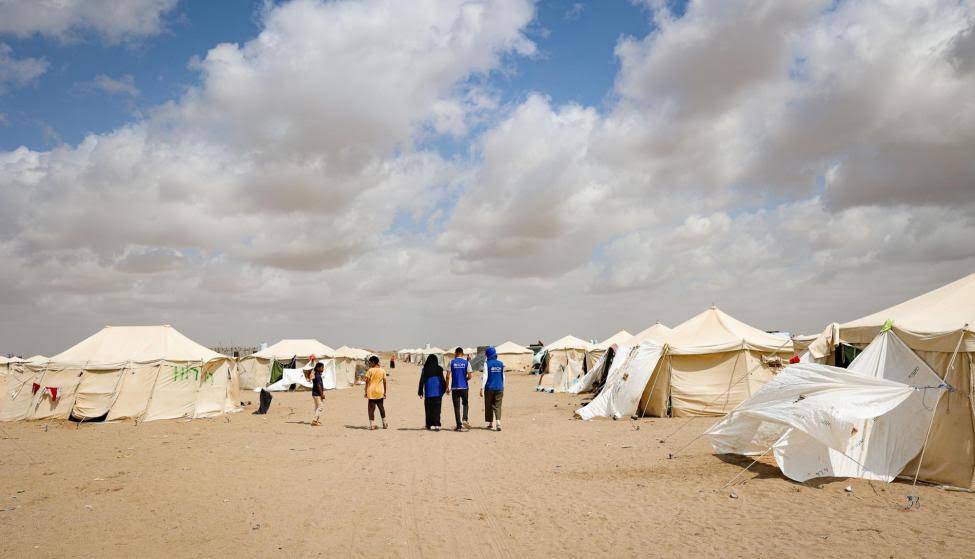
Two children and a Syrian Red Crescent volunteer have died as a result of flooding in the country's northwest, state media said on Sunday.

The heavy rains in Syria's Idlib region and the coastal province of Latakia have also wreaked havoc in displacement camps, according to authorities, who have launched rescue operations and set up shelters in the areas.

State news agency SANA reported "the death of a Syrian Arab Red Crescent volunteer and the injury of four others as they carried out their humanitarian duties" in Latakia province.

The Syrian Red Crescent said in a statement that the "a mission vehicle veered into a valley", killing a female volunteer and injuring four others, as they went to rescue people stranded by flash floods.

"A fifth volunteer was injured while attempting to rescue a child trapped by the floodwaters," it added.

SANA said two children died on Saturday "due to heavy flooding that swept through the Ain Issa area" in the north of Latakia province.

Authorities said Sunday they were working to clear roads in displacement camps in flooded parts of Idlib province.

The emergencies and disaster management ministry said 14 displacement camps in part of Idlib province were affected, with tents swamped, belongings swept away and around 300 families directly impacted.

Around seven million people remain internally displaced in Syria, according to the United Nations refugee agency, some 1.4 million of them living in camps and sites in the country's northwest and northeast.

The December 2024 ouster of longtime ruler Bashar al-Assad after more than 13 years of civil war revived hopes for many to return home, but the destruction of housing and a lack of basic infrastructure in heavily damaged areas has been a major barrier.


Hamas’s Meshal Rejects Disarmament or 'Foreign Rule'

Boys walk past the rubble of destroyed buildings in the Jabalia camp for Palestinian refugees in the northern Gaza Strip on February 8, 2026. (Photo by Omar AL-QATTAA / AFP)
TT

Hamas’s Meshal Rejects Disarmament or 'Foreign Rule'

Boys walk past the rubble of destroyed buildings in the Jabalia camp for Palestinian refugees in the northern Gaza Strip on February 8, 2026. (Photo by Omar AL-QATTAA / AFP)

A senior Hamas leader said Sunday that the Palestinian movement would not surrender its weapons nor accept foreign intervention in Gaza, pushing back against US and Israeli demands.

"Criminalizing the resistance, its weapons, and those who carried it out is something we should not accept," Khaled Meshal said at a conference in Doha.

"As long as there is occupation, there is resistance. Resistance is a right of peoples under occupation ... something nations take pride in," said Meshal, who previously headed the group.

A US-brokered ceasefire in Gaza is in its second phase, which foresees that demilitarization of the territory -- including the disarmament of Hamas -- along with a gradual withdrawal of Israeli forces.

Hamas has repeatedly said that disarmament is a red line, although it has indicated it could consider handing over its weapons to a future Palestinian governing authority.

Israeli officials say that Hamas still has around 20,000 fighters and about 60,000 Kalashnikovs in Gaza.

A Palestinian technocratic committee has been set up with a goal of taking over the day-to-day governance in the battered Gaza Strip, but it remains unclear whether, or how, it will address the issue of demilitarization.

The committee operates under the so-called "Board of Peace," an initiative launched by US President Donald Trump.

Originally conceived to oversee the Gaza truce and post-war reconstruction, the board's mandate has since expanded, prompting concerns among critics that it could evolve into a rival to the United Nations.

Trump unveiled the board at the World Economic Forum in the Swiss ski resort of Davos last month, where leaders and officials from nearly two dozen countries joined him in signing its founding charter.

Alongside the Board of Peace, Trump also created a Gaza Executive Board - an advisory panel to the Palestinian technocratic committee - comprising international figures including US envoys Steve Witkoff and Jared Kushner, as well as former British prime minister Tony Blair.

On Sunday, Meshal urged the Board of Peace to adopt what he called a "balanced approach" that would allow for Gaza's reconstruction and the flow of aid to its roughly 2.2 million residents, while warning that Hamas would "not accept foreign rule" over Palestinian territory.

"We adhere to our national principles and reject the logic of guardianship, external intervention, or the return of a mandate in any form," Meshal said.
"Palestinians are to govern Palestinians. Gaza belongs to the people of Gaza and to Palestine. We will not accept foreign rule," he added.