


South China Authorities Apologize Over COVID-19 Break-ins

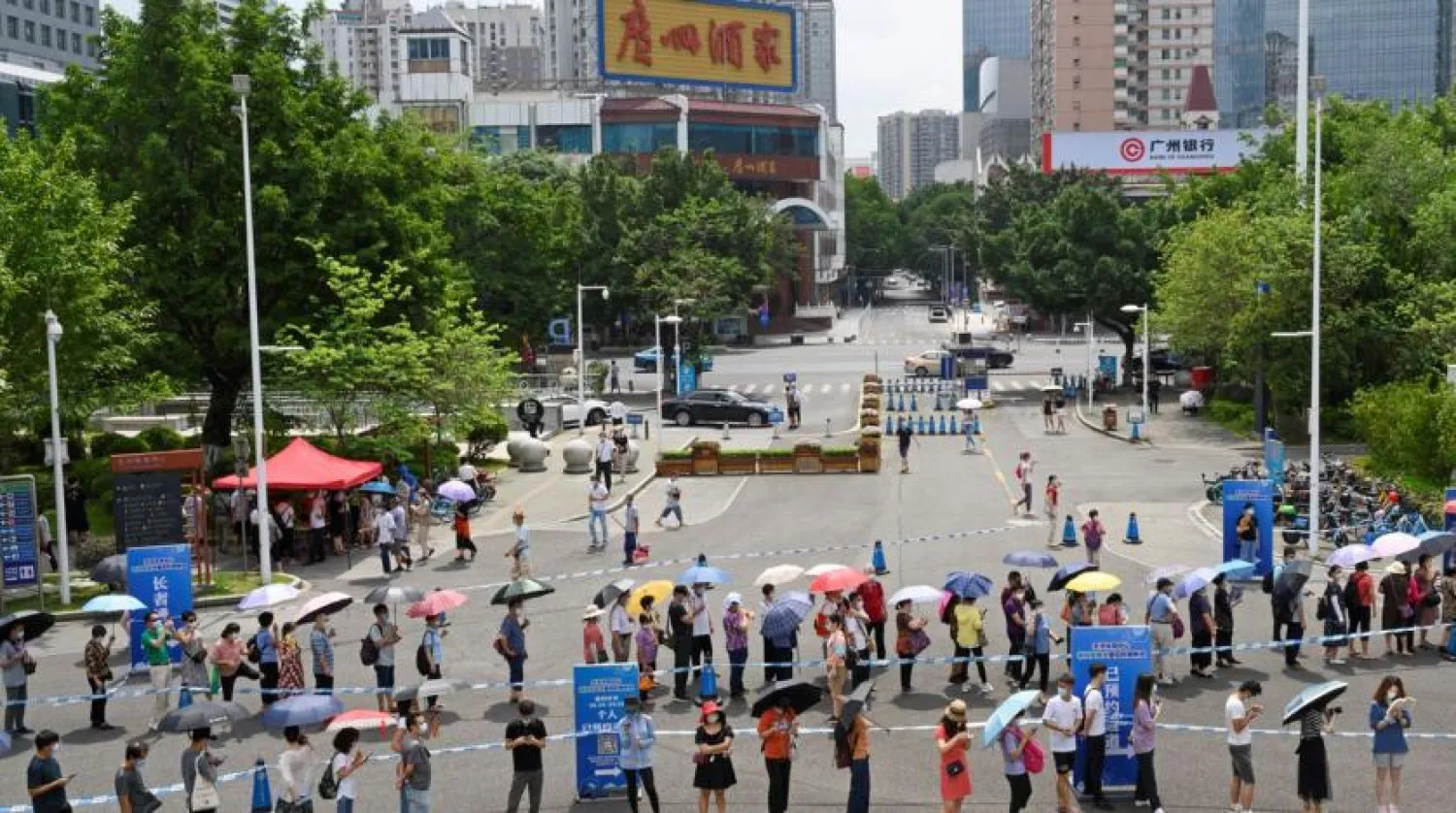
People line up to receive the coronavirus vaccine in Guangzhou, China. Reuters file photo
TT

South China Authorities Apologize Over COVID-19 Break-ins

People line up to receive the coronavirus vaccine in Guangzhou, China. Reuters file photo

Authorities in southern China apologized for breaking into the homes of people quarantined for being suspected of contracting COVID-19 in the latest example of heavy-handed measures that have sparked a rare public backlash.

The Communist Party newspaper Global Times reported Tuesday that 84 homes of people sent for isolation in Guangzhou city’s Liwan district were opened in an effort to find close contacts remaining inside and to disinfect the premises.

The doors were later sealed and new locks installed, the paper reported, according to The Associated Press.

The district government apologized for such “oversimplified and violent” behavior, the paper said. An investigation team has been set up to investigate and “relevant people" will be severely punished, it said.

China's leadership has maintained its hard-line “zero-COVID” policy despite the mounting economic costs and disruption to the lives of ordinary citizens, who continue to be subjected to routine testing and quarantines, even while the rest of the world has opened up to living with the disease.

Numerous cases of police and health workers breaking into homes around China in the name of anti-COVID-19 measures have been documented on social media. In some, doors have been broken down and residents threatened with punishment, even when they tested negative for the virus. Authorities have demanded keys to lock in residents of apartment buildings where cases have been detected, steel barriers erected to prevent them leaving their compounds and iron bars welded over doors.

China's Communist leaders exert stringent control over the government, police and levers of social control. Most citizens are inured to a lack of privacy and restrictions on free speech and the right to assembly.

However, the strict anti-COVID-19 measures have tested that tolerance, particularly in Shanghai, where a ruthless and often chaotic lockdown spurred protests online and in person among those unable to access food, health care and basic necessities.

Authorities in Beijing have taken a gentler approach, concerned with prompting unrest in the capital ahead of a key party congress later this year at which president and party leader Xi Jinping is expected to receive a third five-year term amid radically slower economic growth and high unemployment among college graduates and migrant workers. A requirement that only vaccinated people could enter public spaces was swiftly canceled last week after city residents denounced it as having been announced without warning and unfair to those who have not had their shots.

“Zero-COVID” has been justified as necessary to avoid a wider outbreak among a population that has had relatively little exposure to the virus and less natural immunity. Although China's vaccination rate hovers at around 90%, it is considerably lower among the elderly, while questions have been raised about the efficacy of China's domestically produced vaccines.

Although China's Fosun Pharma reached an agreement to distribute, and eventually manufacture, the mRNA vaccine made by Pfizer and BioNTech, it still has not been cleared for use in mainland China, despite being authorized for use by separate authorities in Hong Kong and Macao.

Studies have consistently shown that inoculation with mRNA vaccines offers the best protection against hospitalization and death from COVID-19. Chinese vaccines made with older technology proved fairly effective against the original strain of the virus, but much less so against more recent variants.

Now health experts say the delay in approving mRNA vaccines — a consequence of placing politics and national pride above public health — could lead to avoidable coronavirus deaths and deeper economic losses.

China's national borders remain largely closed and although domestic tourism has picked up, travel around the country remains subject to an array of regulations, with quarantine restrictions constantly in flux.

In one recent incident, some 2,000 visitors to the southern tourist hub of Beihai have been forced to prolong their stays after more than 500 cases were found and they were barred from leaving.

The local government was struggling to find hotel rooms for those who had already prepared to return home, while hotels and airlines were providing refunds for those who had booked holidays to the city that had to be canceled.

China regulates travel and access to public places through a health code app on citizens' smartphones that must be updated with regular testing. The app tracks a person's movements as a form of contact tracing, allowing a further imposition of public monitoring.

The measures remain in place despite relatively low rates of infection. The National Health Commission on Tuesday announced just 699 new cases of domestic transmission detected over the previous 24 hours, the bulk of which were asymptomatic.



Israeli Minister Suggests Türkiye Take in Hamas Members from Gaza

FILED - 20 February 2025, Palestinian Territories, Khan Younis: Fighters of the Ezz al-Din Al-Qassam brigade, the military wing of Hamas, stand guard during the hand over of the bodies of four Israeli hostages in Khan Yunis. Photo: Abed Rahim Khatib/dpa
TT

Israeli Minister Suggests Türkiye Take in Hamas Members from Gaza

FILED - 20 February 2025, Palestinian Territories, Khan Younis: Fighters of the Ezz al-Din Al-Qassam brigade, the military wing of Hamas, stand guard during the hand over of the bodies of four Israeli hostages in Khan Yunis. Photo: Abed Rahim Khatib/dpa

Israel's defense minister suggested on Thursday that Türkiye take in Hamas members from Gaza, as he called for the full-scale removal of the war-torn territory's two million people.

The comments by Israel Katz, who is known for his outspoken remarks, came after an increase in tensions between Türkiye and Israel.

"Israel will continue to act to complete its security objectives and ensure that the threat of October 7 cannot return," Katz wrote on X, referring to Hamas's bloody 2023 attack on Israel, which sparked the war in Gaza.

Katz added that if Turkish President Recep Tayyip Erdogan "wants to help his brothers in creed and path in Gaza -- let him invite them to move to Antalya. A lot of space has opened up there in the absence of Israeli tourists".

Antalya, a beach town at the heart of Türkiye's tourism industry, was a top destination for Israelis before relations deteriorated.

Türkiye was the first Muslim-majority nation to recognize Israel but Erdogan is a fierce critic and has allowed Hamas leaders in Istanbul.

In August, Israel bombed an air base in northern Syria and Prime Minister Benjamin Netanyahu accused Türkiye of looking to establish a military presence there.

Türkiye in turn said it had sought an Interpol alert for Netanyahu, accusing him of "genocide".

On Wednesday, Katz said 70 percent of Gaza had already been emptied of its population and that the Israeli military was ready to "finish the job so that we can also implement the migration plan".

Earlier this month, he said Israel was prepared to remove Palestinians from Gaza by land and sea but was waiting for a decision from the United States, which he said was discussing where the two million people would go.

Katz had described the migration plan as voluntary.


Fewer Migrants but More Deaths on European Sea Route, Says UN

Some of the immigrants rescued at sea, after arrival at the dock of Arrecife, Lanzarote island, Spain, 16 September 2026.  EPA/Adriel Perdomo
Some of the immigrants rescued at sea, after arrival at the dock of Arrecife, Lanzarote island, Spain, 16 September 2026. EPA/Adriel Perdomo
TT

Fewer Migrants but More Deaths on European Sea Route, Says UN

Some of the immigrants rescued at sea, after arrival at the dock of Arrecife, Lanzarote island, Spain, 16 September 2026.  EPA/Adriel Perdomo
Some of the immigrants rescued at sea, after arrival at the dock of Arrecife, Lanzarote island, Spain, 16 September 2026. EPA/Adriel Perdomo

Fewer migrants and refugees have tried to make the journey to Europe by sea this year but more have died in the attempt, the UN warned Thursday.

The International Organization for Migration (IOM) said 60,000 people had tried to get to Europe by boat so far this year, down 39 percent on the same period last year, AFP reported.

But 2,292 had died, up from 1,999 last year.

"Nearly every death and disappearance at sea is preventable," said IOM Director General Amy Pope, adding that the figures showed people were taking increasingly dangerous journeys.

"The consequences continue long after. Human remains go unidentified, leaving families searching across borders for answers, often for years."

The sharpest drop in arrivals was recorded on the central Mediterranean route to Italy, where the figure of 21,393 was less than half last year's number.

But that route was the most deadly, with fatalities rising from 844 to 996.

The route to Spain via the Atlantic and western Mediterranean was the next most deadly, with 879 people killed.

The IOM warned that the data was likely to be an undercount as shipwrecks and disappearances are often not recorded.


India, Pakistan Trade Blame and Protests over Navy Collision

Pakistan and India (file photo)
TT

India, Pakistan Trade Blame and Protests over Navy Collision

Pakistan and India (file photo)

Arch-rivals India and Pakistan traded blame on Wednesday for a collision at sea between two vessels operated by their navies, summoning each other's top diplomats to lodge "strong" protests.

Pakistan's foreign ministry said the incident took place on Tuesday while its navy was conducting a biennial exercise in its exclusive economic zone (EEZ).

New Delhi meanwhile noted the incident occurred in international waters and "did not cause any major damage".

A senior Indian official said that the incident happened late Tuesday in the north of the Arabian Sea.

"A Pakistan naval ship closed in on a frontline Indian naval warship on a routine surveillance mission...at high speed, maneuvering in a unprofessional and unsafe manner," the official told AFP.

Islamabad meanwhile said that "the Indian vessel carried out aggressive maneuvers in dangerously close proximity of Pakistani naval ship, resulting in contact between the two vessels".

Both countries said they had summoned each other's charge d'affaires.

"A strong protest was lodged with him over the unacceptable and unprofessional conduct of Pakistani naval units at sea that led to a collision with a unit of the Indian Navy," New Delhi's foreign ministry said in a statement.

For its part, the Pakistani foreign ministry asked India's representative "to convey...that Pakistan strongly rejects this belligerent Indian action."

"Pakistan urges the international community to call upon India to abandon its belligerent posture and refrain from irresponsible actions that could further destabilize South Asia," the foreign ministry said.

Nuclear-armed India and Pakistan share a deep distrust and have fought multiple wars since gaining independence in 1947, primarily over Muslim-majority region of Kashmir, which both countries claim.

They also have tens of thousands of heavily-armed soldiers deployed all along their long and militarized border.

In May 2025, the two countries fought a deadly four-day conflict after armed gunmen killed over two dozen tourists, mostly Hindus, in Kashmir.

New Delhi blamed Islamabad for the attack, a charge Pakistan denied.