


Don McLean Looks Back at His Masterpiece, ‘American Pie’

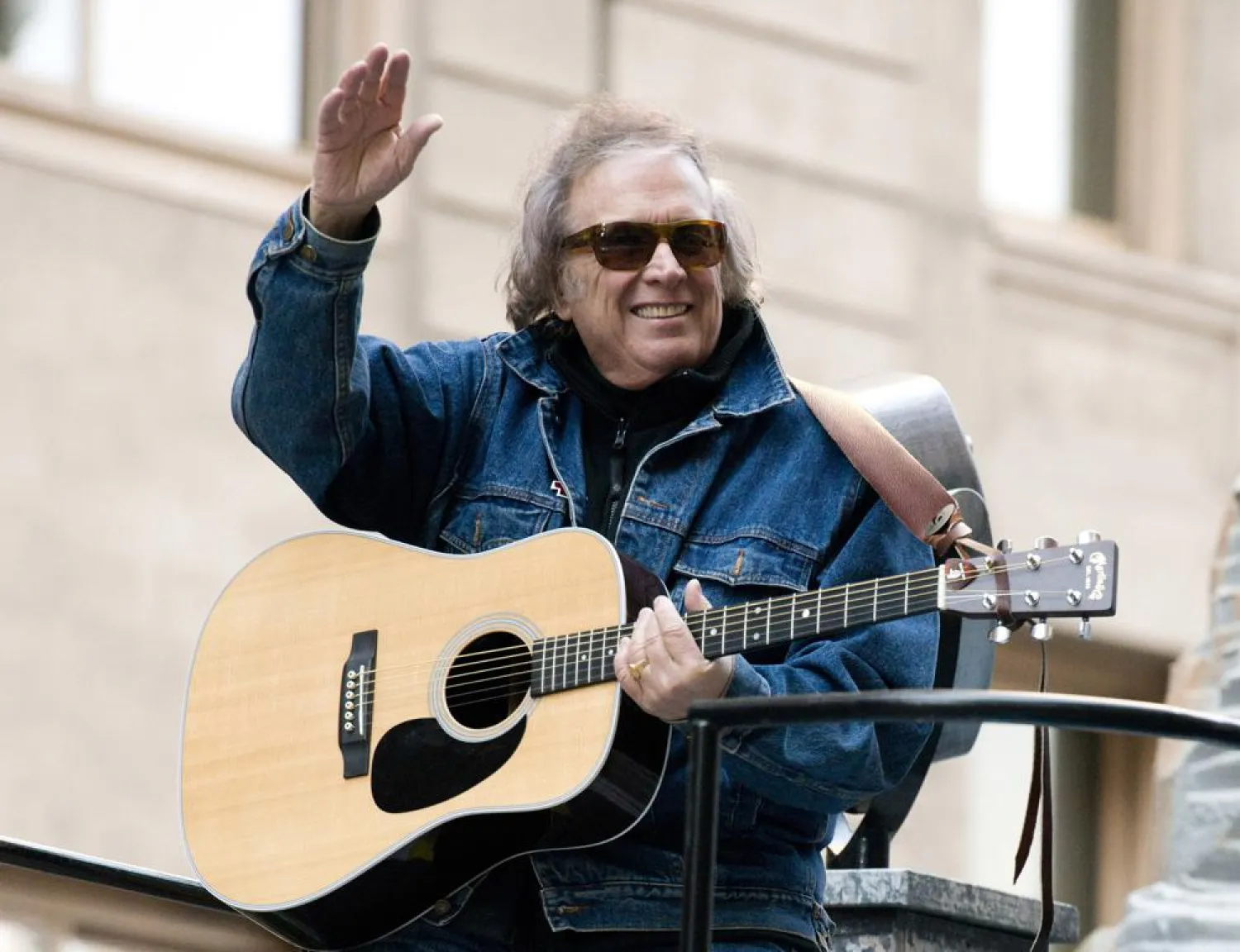
Don McLean rides a float in the Macy's Thanksgiving Day Parade in New York. Feb. 22, 2019. (AP)
TT

Don McLean Looks Back at His Masterpiece, ‘American Pie’

Don McLean rides a float in the Macy's Thanksgiving Day Parade in New York. Feb. 22, 2019. (AP)

Don McLean has listened for decades as people belted out his classic song “American Pie” at last call or at karaoke — and applauds you for the effort.

“I’ve heard whole bars burst into this song when I’ve been across the room,” McLean tells The Associated Press from a tour bus heading to Des Moines, Iowa. “And they’re so happy singing it that I realized, ‘You don’t really have to worry about how well you sing this song anymore. Even sung badly, people are really happy with it.’”

Happy might be a bit of an understatement. “American Pie” is considered a masterpiece, voted among the top five Songs of the Century compiled by the Recording Industry Association of America and the National Endowment for the Arts.

McLean — and his singular tune about “the day the music died” — are now the subject of a full-length feature documentary, “The Day the Music Died: The Story of Don McLean’s ‘American Pie,’” airing Tuesday on Paramount+.

It’s mandatory viewing for McLean fans or anyone who has marveled at his sonic treasure. It also represents an elegant film blueprint for future deep dives into a song and its wider cultural relevance.

For those fans who have wondered about the lyrics they are singing loudly in bars and cars, McLean shares the secrets. “That was the fun of writing the song,” he tells the AP. “I was up at night, smiling and thinking about what I’m going to do with this.”

The documentary starts when a single-engine plane carrying Buddy Holly, Ritchie Valens and Jiles P. Richardson, the “Big Bopper,” plunged into a cornfield north of Clear Lake, Iowa, on Feb. 3, 1959, killing the three stars and their pilot.

McLean was 13, living in a suburban, middle class home in New Rochelle, New York, when the crash occurred. He had bronchial asthma, prompting the description of him in “American Pie” as “a lonely teenage broncin’ buck.” The “sacred store” he sings about was the House of Music on Main Street, where he bought records and his first guitar.

Young McLean was a paperboy — “every paper I’d deliver” — and adored Elvis, Gene Vincent, Bo Diddley but especially Holly, whose death deeply affected him. “I was in absolute shock. I may have actually cried,” he says in the film. “You can’t intellectualize it. It hurt me.”

Years later, McLean would plumb that pain in “American Pie,” baking in his own grief at his father’s passing and writing an eulogy for the American dream. He was creating his second album in 1971 while the nation was racked by assassinations, anti-war protests and civil right marches. He thought he “needed a big song about America.” The first verse and melody seemed to just tumble out. “A long, long, time ago...”

It climaxed in the huge sing-along-chorus: “We were singin’, ‘Bye-bye, Miss American pie’/Drove my Chevy to the levee, but the levee was dry/Them good old boys were drinkin’ whiskey ‘n rye/And singin’, “This’ll be the day that I die.”

“I said, ’Wow, that is something. I don’t know what it is, but it’s exactly what I’ve been wanting to try to get ahold of — that feeling about Buddy Holly — for all these years and that plane crash,” McLean tells the AP. “I always feel a tug inside me whenever I think about Buddy.”

The 90-minute documentary incorporates news footage of the ’70s and uses actors in recreations. Cameras capture McLean visiting the hallowed Surf Ballroom in Clear Lake, the last place Holly and his fellow musicians played before their fatal flight in 1959.

There are interviews with musicians — Garth Brooks, “Weird Al” Yankovich and Brian Wilson, among them — as well as Valens’ sister, Connie, and actor Peter Gallagher, whose character’s death on “Zoey’s Extraordinary Playlist” promoted an onscreen performance of “American Pie.” The British singer Jade Bird, Cuban-born producer Rudy Perez and Spanish-language singer Jencarlos Canela speak to how the song has resonated far past America.

The documentary reveals that recording the album was not exactly a smooth process. Producer Ed Freeman was unimpressed with McLean’s clutch of songs and didn’t think McLean was up to playing rhythm guitar on “American Pie.” He eventually relented.

McLean — along with a few session musicians — rehearsed for two weeks without nailing the song, getting increasingly frustrated. The addition of pianist Paul Griffin at the last minute was a “Hail Mary” stroke of genius that made the whole tune click.

But recording the song was just the beginning of trouble ahead. At over 8 minutes, radio stations balked at playing it, and McLean’s record label, Media Arts, went bust just as it was to release the album “American Pie.”

After seeing the documentary, McLean was struck by a common strand in his career: “What I noticed was that I had to fight so many battles to get this thing done, to get everything. I’ve been fighting everybody my whole life,” he says. “I’m not difficult. I just want things the way I want them.”

“American Pie” is packed with cultural references, from Chevrolet to nursery rhymes, while namechecking The Byrds, John Lennon, Charles Manson and James Dean. The lyrics — dreamlike and impressionistic — have been pored over for decades, dissected for meaning.

The documentary answers some questions, but not all. McLean reveals that his oblique references to a king and a jester have nothing to do with Elvis or Bob Dylan, but he’s open to other interpretations. He explains that the “marching band” means the military-industrial complex and “sweet perfume” is tear gas.

The line in the chorus “This’ll be the day that I die” comes from the John Wayne film “The Searchers” and the farewell is a riff off “Bye Bye, My Roseanna,” a song his friend Pete Seeger sang. McLean was going to use “Miss American apple pie” but dropped the fruit.

“He was glad to open up because he and his manager thought it was the time to do it and this was the platform to do it in,” says music producer and songwriter Spencer Proffer, CEO of media production company Meteor 17, which helped make the film. “My hat’s off to Don for writing something this magnificent. My job was to bring it to life.”

For McLean, the song is a blueprint of his mind at the time and a homage to his musical influences, but also a roadmap for future students of history:

“If it starts young people thinking about Buddy Holly, about rock ‘n’ roll and that music, and then it teaches them maybe about what else happened in the country, maybe look at a little history, maybe ask why John Kennedy was shot and who did it, maybe ask why all our leaders were shot in the 1960s and who did it, maybe start to look at war and the stupidity of it — if that can happen, then the song really is serving a wonderful purpose and a positive purpose.”



‘Avatar: The Last Airbender’ Expands with New Prequel Series ‘Avatar Kuruk: Wave of Chaos’

Michael Dante DiMartino and Bryan Konietzko. (Getty Images)
TT

‘Avatar: The Last Airbender’ Expands with New Prequel Series ‘Avatar Kuruk: Wave of Chaos’

Michael Dante DiMartino and Bryan Konietzko. (Getty Images)

The world of successful TV franchise "Avatar: The Last Airbender" is expanding once again, with a new prequel series that will follow the story of a rebellious teenager Avatar — a being who controls the elements.

Franchise co-creators Michael Dante DiMartino and Bryan Konietzko announced the animated TV series, titled "Avatar Kuruk: Wave of Chaos," on ‌Friday at ‌New York Comic Con, ‌with attendees ⁠getting a first ⁠look at Kuruk and his pet, Nikik.

Kuruk aims to stay "one step ahead of his angry teacher, rowdy pirates, and chaotic spirits, all while helping the world in his own unique ways," ⁠said a statement from Skydance.

The ‌series is set ‌to stream on Paramount+. No release date has ‌been announced.

The Asian-inspired "Avatar: The Last Airbender" ‌franchise follows a world divided into four elemental nations, where the Avatar alone can control water, fire, earth and air to maintain balance.

The ‌original TV series has spawned two sequels, "The Legend of Korra," and "Avatar: ⁠Seven ⁠Havens."

"Seven Havens" has been renewed for two additional seasons, the statement from Skydance said.

DiMartino and Konietzko were involved in developing a live-action adaptation of the original "Avatar" series for Netflix before parting ways with the streamer in 2020, citing "creative differences."

In 2021, they teamed with Nickelodeon to launch Avatar Studios, focused on expanding the universe of the original series through new films and television projects.


US Actor Keegan Allen Says He Was Victim of Armed Robbery

Keegan Allen attends the Los Angeles premiere of Netflix’s “The Umbrella Academy” held at ArcLight Hollywood on February 12, 2019 in Hollywood. (Getty Images)
TT

US Actor Keegan Allen Says He Was Victim of Armed Robbery

Keegan Allen attends the Los Angeles premiere of Netflix’s “The Umbrella Academy” held at ArcLight Hollywood on February 12, 2019 in Hollywood. (Getty Images)

American actor Keegan Allen said he was violently robbed outside a Los Angeles grocery store, an attack he recounted in a graphic video on social media posted overnight Thursday.

"Robbed at gunpoint and knifepoint by two young men that threatened to KILL me over my watch and would have! God said no tonight. My life for a watch," posted the actor who appeared in the hit television series "Pretty Little Liars."

His post included a video of himself, visibly shaken, describing the episode, blood streaming down his face.

The Los Angeles County Sheriff's Department said in a statement that they responded to an alleged armed robbery, without naming Allen.

"According to the victim, one suspect pointed a silver handgun at him while the second suspect brandished a knife. The suspects demanded the victim's watch and bracelet," read the statement.

Officers said the victim was struck in the face with a handgun, leaving a laceration on his forehead, before fleeing in a vehicle with the watch.

Allen's video post included grainy video from an apparent security camera, footage that showed two people wearing black who appeared to threaten the 37-year-old actor, who removes his watch before one of the hooded people pistol whips him.


'Mad Dream': New Showcase for African Film Opens in London

Nigerian film director and media mogul Mo Abudu poses ahead of the opening the UK's first cinema dedicated exclusively to African and black films. Justin TALLIS / AFP
TT

'Mad Dream': New Showcase for African Film Opens in London

Nigerian film director and media mogul Mo Abudu poses ahead of the opening the UK's first cinema dedicated exclusively to African and black films. Justin TALLIS / AFP

Nigerian producer and media mogul Mo Abudu has realized a "mad dream" by opening a unique cultural center in London complete with a cinema dedicated to African film and black culture.

Close to the Houses of Parliament and its Big Ben clock, a massive concrete facade conceals the venue, which opens to the public this weekend - the first of its kind in Britain and Europe.

A small sign reads "EbonyLife Place London".

While the name may mean little to many passers-by, film lovers will recognize the reference to EbonyLife, a leading African production company and a major player in Nollywood, Nigeria's film industry.

Mosunmola "Mo" Abudu, 62, heads a media empire that stretches far beyond Nigeria's borders.

In 2025, Forbes ranked her among the world's 100 most influential women.

"It's time to tell our own stories," she told AFP. "I want to showcase the best of who we are, celebrate who we are. Let them see us at our very best."

Abudu, who was born in London, is pursuing that ambition in the British capital through the cultural center, which she describes as both "literally a blank canvas" and "a bit of a mad dream".

"We have to make the journey because the thing is that we have consumed so much of the world. How much of the world has consumed us?" she asked.

She recalled that growing up in England: "I could never go anywhere during my youth and watch a black movie."

So she decided to act.

"I'm not waiting anymore for anyone to take a six-hour trip from London to understand what it is to watch a Nigerian film or to see Nigerian fashion and so on and so forth. It's right here in London."

- 'Open to everyone' -

The two-storey venue includes a bar, a lounge called "Fehinti" -- a Yoruba word meaning to lean back and rest -- a restaurant and a boutique showcasing designers from Africa and its diaspora. Paintings by artists from across the continent line the walls.

Its centerpiece, however, is the new cinema, fitted with red seats, wood paneling and soft lighting. It has been named "Amani", meaning peace and harmony in Swahili.

The project, financed almost entirely by Abudu's media group, mirrors the upscale lifestyle complex she launched in Lagos in 2019.

Abudu, who is widely credited with helping usher in the era of Nollywood blockbusters, said African creatives should stop asking others to make room for them and instead "take responsibility for creating our own spaces".

Describing the center as a "safe space", she said it would be a place where "you can shop our fashion, you can view our art, you can listen to our music, and we can tell our stories".

Access will be through a membership scheme, details of which have yet to be announced. Such systems are common in Britain, particularly among cultural institutions.

There will be no ethnic or nationality restrictions. "Membership is open to everyone," she insisted.

The cinema's program is still being finalized. But here too, the objective is clear.

"We will have films from all parts of Africa. Everything should be on the table. We would show movies that celebrate black actors, black storytelling; that is why we are here," Abudu said.

Will audiences be able to see films by Senegalese director Ousmane Sembene or by Algerian filmmaker Mohammed Lakhdar-Hamina, the only African director ever to win the Cannes Palme d'Or? Her answer was an emphatic "yes".

The center will also showcase its own productions and films with black actors, including the next in the "Black Panther" series. Opening week will feature Nigerian filmmakers including Nwani Orire and Ifeyinwa Arinze.

And after London?

"I would love to do the same thing in Paris, perhaps through a partnership. I'm always open to collaborating with others," Abudu said.