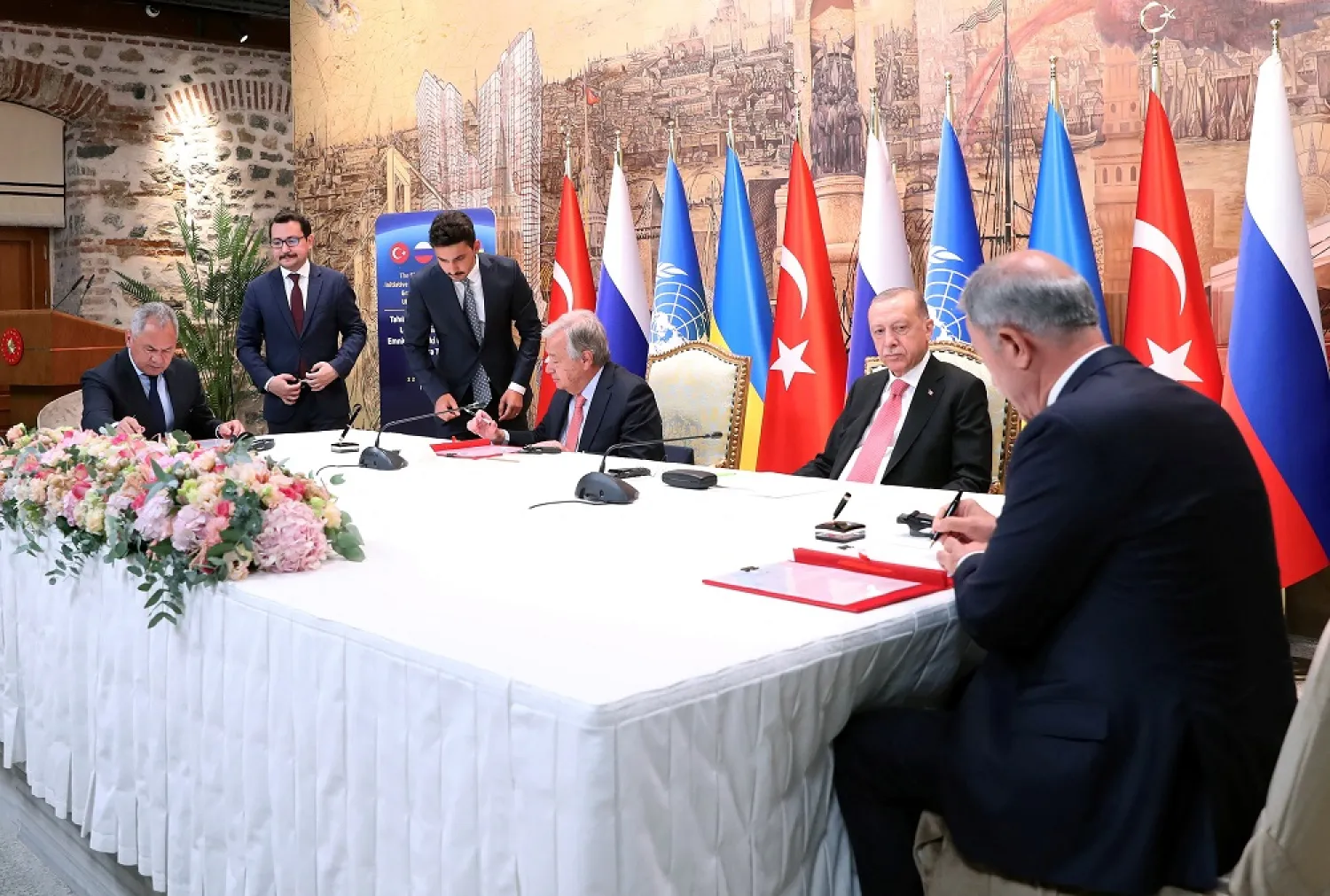
Ukraine, Russia Sign UN Deal to Export Grain on Black Sea

Russia's Defense Minister Sergei Shoigu, UN Secretary-General Antonio Guterres, Turkish President Recep Tayyip Erdogan and Turkish Defense Minister Hulusi Akar attend the signing ceremony in Istanbul, Turkey July 22, 2022. (Murat Cetinmuhurdar/Handout via Reuters)
TT

Ukraine, Russia Sign UN Deal to Export Grain on Black Sea

Russia's Defense Minister Sergei Shoigu, UN Secretary-General Antonio Guterres, Turkish President Recep Tayyip Erdogan and Turkish Defense Minister Hulusi Akar attend the signing ceremony in Istanbul, Turkey July 22, 2022. (Murat Cetinmuhurdar/Handout via Reuters)

Russia and Ukraine signed separate agreements Friday with Turkey and the United Nations clearing the way for exporting millions of tons of desperately needed Ukrainian grain — as well as Russian grain and fertilizer — ending a wartime standoff that had threatened food security around the globe.

The deal will enable Ukraine — one of the world's key breadbaskets — to export 22 million tons of grain and other agricultural products that have been stuck in Black Sea ports due to Russia's invasion.

UN Secretary General Antonio Guterres called it “a beacon of hope” for millions of hungry people who have faced huge increases in food costs.

“A deal that allows grain to leave Black Sea ports is nothing short of lifesaving for people across the world who are struggling to feed their families," said Red Cross Director-General Robert Mardini, who noted that over the past six months prices for food staples have risen 187% in Sudan, 86% in Syria, 60% in Yemen and 54% in Ethiopia.

Russian Defense Minister Sergei Shoigu and Ukrainian Infrastructure Minister Oleksandr Kubrakov signed separate, identical deals with Guterres and Turkish Defense Minister Hulusi Akar at a ceremony in Istanbul that was witnessed by Turkish President Recep Tayyip Erdogan.

“Today, there is a beacon on the Black Sea,” Guterres said. “A beacon of hope, a beacon of possibility, a beacon of relief in a world that needs it more than ever.”

“You have overcome obstacles and put aside differences to pave the way for an initiative that will serve the common interests of all,” he said, addressing the Russian and Ukrainian envoys.

The European Union immediately welcomed the agreements.

“This is a critical step forward in efforts to overcome the global food insecurity caused by Russia’s aggression against Ukraine,” said EU foreign policy chief Josep Borrell. “Its success will depend on the swift and good faith implementation of today’s agreement.”

Ukraine is one of the world’s largest exporters of wheat, corn and sunflower oil, but Russia’s invasion of the country and naval blockade of its ports have halted shipments. Some Ukrainian grain is being transported through Europe by rail, road and river, but the prices of vital commodities like wheat and barley have soared during the nearly five-month war.

Guterres said the plan known as the Black Sea Initiative opens a path for significant volumes of commercial food exports from three key Ukrainian ports: Odessa, Chernomorsk and Yuzhny.

“It will help stabilize global food prices, which were already at record levels even before the war – a true nightmare for developing countries,” Guterres added.

The deal makes provisions for the safe passage of ships through the heavily mined waters. A coordination center will be established in Istanbul, staffed by UN, Turkish, Russian and Ukrainian officials, to monitor the ships and run the process through specific corridors. Ships would undergo inspections to ensure they are not carrying weapons.

A senior UN official said cargo ships would use “safe channels” identified by Ukraine as they sail in and out of ports and would be guided by Ukrainian pilots. The plan does not foresee a further demining of Ukraine's territorial waters, which would have delayed the process.

No military ships would be used as escorts but a minesweeper would be on standby in case the safe channels “need occasional verification,” the official said.

Ships entering the Ukrainian ports would be scrutinized by inspection teams that would include representatives of all parties involved to make sure there are no weapons on board. The unloading of grain onto the vessels will also be monitored.

A key element of the deal is an agreement by both Russia and Ukraine that there will be no attacks on any of the vessels, according to the official.

It will take a few weeks before the deal is fully working, the official noted, saying Ukraine needs about 10 days to get the ports ready and also needs time to “identify and be clear about those safe corridors.”

An initial movement of ships could be possible before then “just to show that they can work,” the official said.

The aim is to export about 5 million tons of grains per month to empty Ukraine's silos in time for the new harvest, according to the UN official. The agreement is for a renewable 120-day period.

Guterres first raised the critical need to get Ukraine’s agricultural production and Russia’s grain and fertilizer back into world markets in late April during meetings with Russian President Vladimir Putin in Moscow and Ukrainian President Volodymyr Zelenskyy in Kyiv.

He proposed a package deal in early June amid fears that the war was endangering food supplies for many developing nations and could worsen hunger for up to 181 million people.

On Friday, Guterres described the deal as an unprecedented agreement between two parties engaged in a bloody conflict. Erdogan said he hoped the initiative would be “a new turning point that will revive hopes for peace.”

Before the deal, Russian and Ukrainian officials blamed each other for the blocked grain shipments. Moscow accused Ukraine of failing to remove sea mines at the ports to allow safe shipping and insisted on its right to check incoming ships for weapons. Ukraine argued that Russia's port blockade and launching of missiles from the Black Sea made any safe shipments impossible.

Ukraine has sought international guarantees that the Kremlin wouldn’t use the safe corridors to attack the key Black Sea port of Odesa. Ukrainian authorities have also accused Russia of stealing grain from eastern Ukraine and deliberately shelling Ukrainian fields to set them on fire.

Volodymyr Sidenko, an expert with the Kyiv-based Razumkov Center think-tank, noted that Ukraine had not raised the issue of grain stolen from the occupied territories in the talks.

“Apparently, it was part of a deal: Kyiv doesn’t raise the issue of stolen grain and Moscow doesn’t insist on checking Ukrainian ships. Kyiv and Moscow were forced to make a deal and compromise on many differences,” he said.

The deal was also important for Russia's geopolitical relations, the analyst noted.

“Russia decided not to fuel a new crisis in Africa and provoke a hunger and government changes there,” Sidenko said. “The African Union asked Putin to quickly ease the crisis with grain supplies and put the pressure on the Kremlin, which has its interests in Africa.”


Le Pen Says France Will No Longer Aid Ukraine ‘Financially’ if Elected

Marine Le Pen (C), the far-right National Rally (RN) party's candidate for the 2027 French presidential election, visits the "Made in France" fair at the Porte de Versailles exhibition center in Paris, France, 13 November 2026. (EPA)
TT

Le Pen Says France Will No Longer Aid Ukraine ‘Financially’ if Elected

Marine Le Pen (C), the far-right National Rally (RN) party's candidate for the 2027 French presidential election, visits the "Made in France" fair at the Porte de Versailles exhibition center in Paris, France, 13 November 2026. (EPA)

Marine Le Pen on Monday said that France would provide no further financial aid to Ukraine if she is elected president next year, after a meeting with Kyiv's ambassador in Paris.

"The state of France's public finances would no longer allow the country to provide financial assistance to Ukraine in the coming months," Le Pen said in a statement, while insisting France would honor existing commitments, including toward a 90-billion-euro ($100-billion) European Union loan.

Le Pen is currently ahead in polls in the race to succeed President Emmanuel Macron next year, as the war sparked by Russia's 2022 full-scale invasion of Ukraine grinds towards its fifth anniversary.

She has faced criticism over past links to Russia, which included a 2017 meeting in the Kremlin with President Vladimir Putin and her party taking a loan from a Russian bank that it paid off in full in 2023.

But she has opposed the invasion and, at her talks in Paris with Ukrainian ambassador Vadym Omelchenko, Le Pen made clear her "unwavering support for Ukraine since the beginning of the conflict".

The statement said the talks -- the first such between Le Pen and the Ukrainian ambassador -- were "cordial".

While financial aid would be cut, Le Pen told the ambassador that "France would continue to support Ukraine through donations of equipment, humanitarian aid and much more active diplomacy".

The statement said there was a "frank discussion" on the future of the conflict, with Le Pen stressing that "the pursuit of peace -- though a difficult goal to achieve -- must remain a priority for all".

She also asked the ambassador to tell President Volodymyr Zelensky she is ready to meet in "either Paris or Brussels". However, there was no mention of the candidate making the journey to Kyiv after Zelensky invited her to visit the Ukrainian capital.

Le Pen's opponents have expressed alarm that by emphasizing the importance of ending the war swiftly, she could force Ukraine to capitulate on unfavorable terms.

"If Russia imposes its will on a European nation through brutality, all of Europe is weakened," Macron wrote on Facebook at the weekend.

Taking aim at Le Pen, he said: "Let us be clear: those who seek to limit the resources available to Ukraine are, in effect, pushing for an unjust peace -- one that would leave Ukraine permanently vulnerable, and, by extension, leave Europe vulnerable as well."


Trump Says He Might Meet with North Korea’s Kim Jong Un in China

US President Donald Trump and North Korean leader Kim Jong Un shake hands before their one-on-one chat during the second US-North Korea summit at the Metropole Hotel in Hanoi, Vietnam February 27, 2019. (Reuters)
TT

Trump Says He Might Meet with North Korea’s Kim Jong Un in China

US President Donald Trump and North Korean leader Kim Jong Un shake hands before their one-on-one chat during the second US-North Korea summit at the Metropole Hotel in Hanoi, Vietnam February 27, 2019. (Reuters)

US President Donald Trump said on Monday he might meet with North Korean leader Kim Jong Un in China this week, an announcement that could dramatically reshape his upcoming trip through East Asia if it occurs.

The president, who met the North Korean leader several times during his 2017-2021 term, including once in the Korean Demilitarized Zone, has previously expressed ‌interest in ‌another meeting during his current term. Senior ‌US ⁠officials, however, have previously ⁠said he has no immediate plans to do so.

Moreover, Trump has repeatedly previewed meetings with Kim that never took place, including during a trip to Asia last year. North Korea, whose mission to the United Nations did not immediately respond to a ⁠request for comment, has publicly indicated it ‌has no intention of ‌meeting with the US president at this time.

Trump told reporters ‌while departing the White House en route to ‌the Philippines and China that any meeting would occur in China, and that the North Korean leader's presence was ultimately up to Chinese President Xi Jinping.

"(Xi) was here a ‌month ago, and we're also going to meet with (Russian) President Putin, and we ⁠may ⁠meet with Kim Jong Un also," Trump said.

"So that'll be good. We have a chance to accomplish a lot."

Trump has indicated he will meet with Putin and Xi during his trip, but US officials and analysts have played down the possibility of a meaningful agreement emerging from any trilateral sit-down.

Among the possible topics of conversation, Trump and others have said, are Russia's invasion of Ukraine, counterproliferation and the war in Iran.


Third US Aircraft Carrier Arrives in Middle East

This US Navy handout photograph released by US Naval Forces Central Command on November 4, 2026, shows the Nimitz-class aircraft carrier USS Theodore Roosevelt (CVN 71) sails alongside Royal Australian Navy Supply-class replenishment oiler HMAS Stalwart (A304). (AFP / NAVCENT Public Affairs / US Navy)
TT

Third US Aircraft Carrier Arrives in Middle East

This US Navy handout photograph released by US Naval Forces Central Command on November 4, 2026, shows the Nimitz-class aircraft carrier USS Theodore Roosevelt (CVN 71) sails alongside Royal Australian Navy Supply-class replenishment oiler HMAS Stalwart (A304). (AFP / NAVCENT Public Affairs / US Navy)

The USS Theodore Roosevelt aircraft carrier arrived in the Middle East on Sunday, media reports said, bringing the number of American carrier strike groups in the region to three.

The deployment, which was reported by the National News and Axios journalist Barak Ravid, comes as fighting reignites in the region, with Iran claiming a drone attack on Bahrain on Sunday, ending a lull in strikes in the war.

Iran also fired drones at Bahrain on Friday -- the first strikes since September against countries in the energy-rich Gulf, which has been targeted several times in the conflict that erupted in February.

US President Donald Trump plans to discuss the war at a trilateral meeting with his Chinese and Russian counterparts Xi Jinping and Vladimir Putin this week, an official said Friday.

Months of diplomacy have failed to resolve the war, which began with US-Israeli strikes that killed Iran's supreme leader Ali Khamenei.