

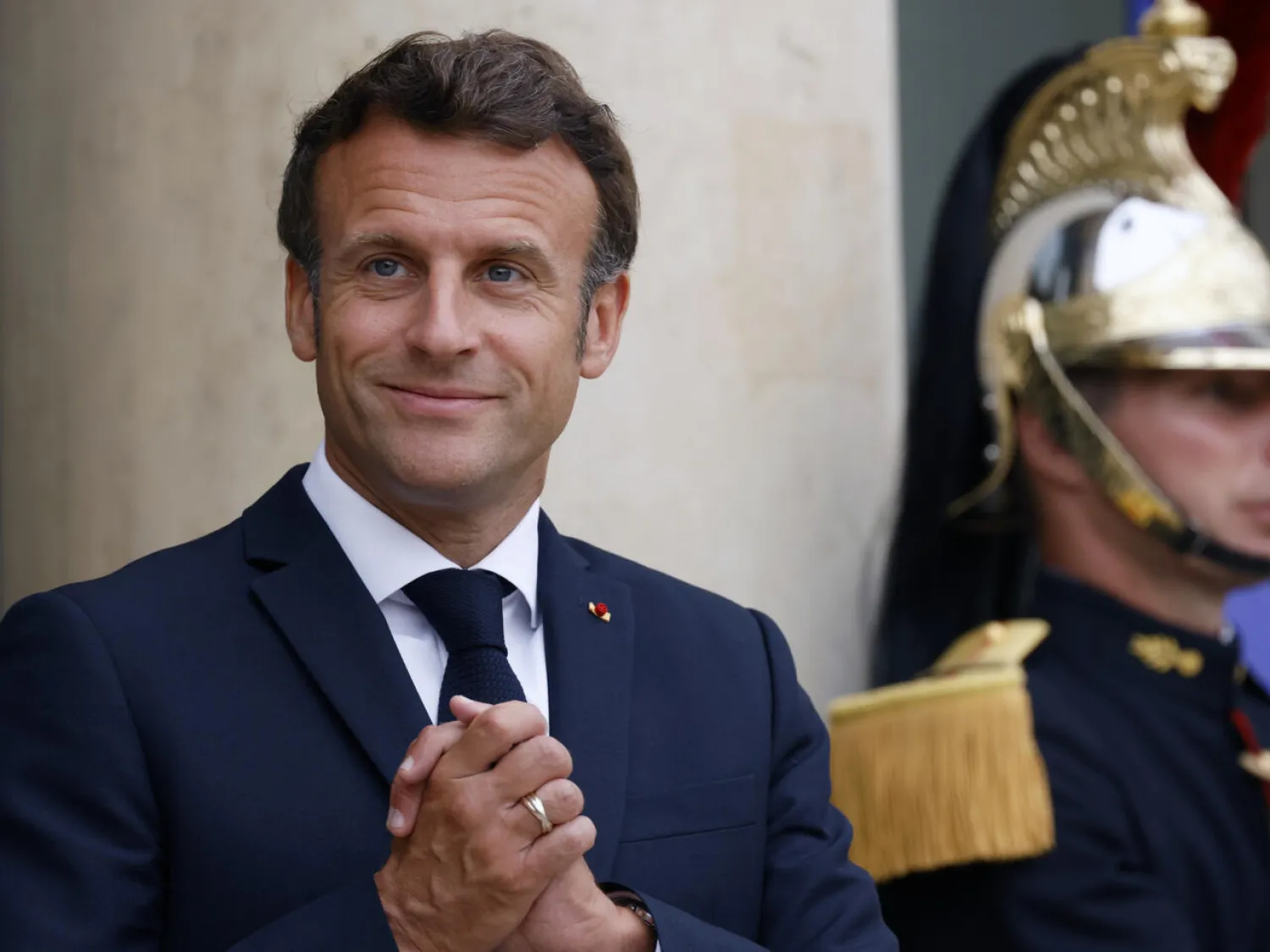

Macron Embarks on First Africa Trip of New Term

Macron will begin his July 25-28 tour with a visit to Cameroon, before moving on to Benin and then finishing the trip in Guinea-Bissau Ludovic MARIN AFP
TT

Macron Embarks on First Africa Trip of New Term

Macron will begin his July 25-28 tour with a visit to Cameroon, before moving on to Benin and then finishing the trip in Guinea-Bissau Ludovic MARIN AFP

President Emmanuel Macron on Monday begins a three-nation tour of western African states in the first trip to Africa of his new term as he seeks to reboot France's post-colonial relationship with the continent.

Macron will begin his July 25-28 tour, also the first venture outside Europe of his new mandate, with a visit to Cameroon, before moving on to Benin and then finishing the trip in Guinea-Bissau.

Top of the agenda in the talks will be food supply issues, with African nations fearing shortages especially of grain due to Russia's invasion of Ukraine.

But security will also loom large as France prepares to complete its pullout from Mali this year, with all countries in the region seeking to head off fears of extremist insurgencies.

The trip to three countries which rarely feature on the itinerary of global leaders comes with Macron, who won a new term in April, pledging to keep up his bid for a new relationship between France and Africa.

France has also followed with concern the emergence of other powers seeking a foothold in an area Paris still considers parts of its sphere of influence, notably Turkey under President Recep Tayyip Erdogan but also increasingly China and Russia.

- 'Political priority' -
The tour "will show the commitment of the president in the process of renewing the relationship with the African continent", said a French presidential official, who asked not to be named.

It will signal that the African continent is a "political priority" of his presidency.

In Cameroon, which has been riven by ethnic violence and an insurgency by anglophone separatists, Macron will meet President Paul Biya, 89, who has ruled the country for almost 40 years and is the longest-serving non-royal leader in the world.

Biya has run the country with an iron fist, refusing demands for federalism and cracking down on the rebellion by separatists.

Macron will move on Wednesday to Benin, a neighbor of Africa's most populous nation Nigeria. The north of the country has faced more deadly attacks, with the jihadist threat now spreading from the Sahel to Gulf of Guinea nations.

He is likely to be lauded for championing the return in November of 26 historic treasures which were stolen in 1892 by French colonial forces from Abomey, capital of the former Dahomey kingdom located in the south of modern-day Benin.

Benin was long praised for its thriving multi-party democracy. But critics say its democracy has steadily eroded under President Patrice Talon over the last half decade. Opposition leader Reckya Madougou was sentenced in 2021 to 20 years in prison on terrorism charges.

On Thursday, Macron will finish his tour in Guinea-Bissau, which has been riven by political crisis at a time when its President Umaro Sissoco Embalo is preparing to take the helm of the Economic Community of West African States (ECOWAS).

- Rethink strategy -
With all the countries criticized by activists over their rights records, the Elysee has insisted that governance and rights issues will be raised, albeit "without media noise but in the form of direct exchanges between the heads of states".

Macron's first term was marked by visits to non-francophone African countries including regional powerhouses Nigeria and South Africa as he sought to engage with the entire continent and not just former French possessions.

Benin is a former French colony, but Guinea-Bissau was once a Portuguese colony while Cameroon's colonial heritage is a mixture of British and German as well as French.

Macron meanwhile has insisted France's military presence in the region will adapt rather than disappear once the pullout from Mali is complete.

He announced last week that a rethink of France's presence would be complete by autumn, saying the military should be "less exposed" in the future but their deployment still a "strategic necessity".

The pullout from Mali follows a breakdown in relations with the country's ruling junta, which Western states accuse of relying on Russian Wagner mercenaries rather than European allies to fight an extremist insurgency



Iran’s President Says Answer to Attack Would Be Harsh in Apparent Response to Trump Warning

Masoud Pezeshkian, the President of Iran, attends the United Nations General Assembly at United Nations headquarters, on Sept. 25, 2025. (AP)
TT

Iran’s President Says Answer to Attack Would Be Harsh in Apparent Response to Trump Warning

Masoud Pezeshkian, the President of Iran, attends the United Nations General Assembly at United Nations headquarters, on Sept. 25, 2025. (AP)

Iranian President Masoud Pezeshkian on Tuesday said his country’s answer to an attack would be harsh, which appeared to be in response to a warning by US President Donald Trump over reconstruction of Iran’s nuclear program.

Iran’s answer “to any cruel aggression will be harsh and discouraging,” Pezeshkian said on the social media platform X.

Pezeshkian did not elaborate, but his statement came a day after Trump suggested the US could carry out military strikes if Iran attempts to reconstitute its nuclear program. Trump made the comment during wide-ranging talks with Israeli Prime Minister Benjamin Netanyahu at Trump's Mar-a-Lago estate in Florida.

“Now I hear that Iran is trying to build up again,” Trump said during a news conference with Netanyahu after their meeting. “And if they are, we’re going to have to knock them down. We’ll knock them down. We’ll knock the hell out of them. But hopefully that’s not happening.”

The two leaders discussed the possibility of renewed military action against Tehran months after a 12-day air war in June that killed nearly 1,100 Iranians including senior military commanders and scientists. Iran’s retaliatory missile barrage killed 28 people in Israel.

Trump suggested Monday that he could order another US strike against Iran.

“If it’s confirmed, they know the consequences, and the consequences will be very powerful, maybe more powerful than the last time,” Trump said.

Pezeshkian said Saturday that tensions between the sides already had risen.

“We are in a full-scale war with the US, Israel and Europe; they don’t want our country to remain stable,” he said.

Iran has insisted it is no longer enriching uranium at any site in the country, trying to signal to the West that it remains open to potential negotiations over its atomic program.

US intelligence agencies and the International Atomic Energy Agency assessed Iran last had an organized nuclear weapons program in 2003, though Tehran had been enriching uranium up to 60%, which is a short, technical step away from weapons-grade levels of 90%.

Meanwhile, some of the largest protests in three years entered a third day Tuesday after the country’s currency plummeted to a record low against the US dollar. The head of the Central Bank resigned on Monday.

According to witnesses and videos on social media, rallies took place in Tehran and other cities and towns. Police fired tear gas in some places. Near a market in downtown Tehran, footage showed people pushing back police and security forces and throwing stones at them.

University students also rallied inside campuses on Tehran University and other major universities, witnesses said.

Pezeshkian met a group of businessmen to listen to their demands, media reported.

"The administration will not spare any effort for solving problems and improving situation of the society,” Pezeshkian said. He also assigned Interior Minister Eskandar Momeni for talks with protesters.

The head of the country’s tax department, Mohammad Hadi Sobhanian, also said the government will revise its tax arrangement in favor of businesses, dropping penalties for delay in paying taxes.

The government announced the closure of offices and banks on Wednesday for managing energy consumption during the winter days, to be followed by weekly holidays on Thursday and Friday. Saturday also is a religious holiday in the country.


Ukraine Says No Evidence It Attacked Putin Residence

28 December 2025, US, Palm Beach: Ukraine's President Volodymyr Zelensky attends a joint press conference with US President Donald Trump following their talks at the Mar-a-Lago club in Palm Beach. (Ukrainian Presidency/dpa)
TT

Ukraine Says No Evidence It Attacked Putin Residence

28 December 2025, US, Palm Beach: Ukraine's President Volodymyr Zelensky attends a joint press conference with US President Donald Trump following their talks at the Mar-a-Lago club in Palm Beach. (Ukrainian Presidency/dpa)

Ukraine said Tuesday there was no "plausible" evidence it launched a drone attack on one of Russian President Vladimir Putin's residences, accusing Moscow of peddling falsehoods to manipulate talks on ending the war.

Ukraine's allies have expressed skepticism about Russia's claim.

German Chancellor Friedrich Merz called for "transparency", while a French presidential source described the Kremlin's statements as an "act of defiance" against US President Donald Trump's efforts to broker peace.

Ukrainian President Volodymyr Zelensky, who has called Russia's claim a "complete fabrication", said he would meet with leaders of Kyiv's allies on January 6 in France in a bid to renew peace efforts.

In comments to journalists on Tuesday, the Ukrainian leader repeated his assertion that the attack was faked and called on partners to verify this.

"Our negotiating team connected with the American team, they went through the details, and we understand that it's fake," he said.

The Kremlin said Tuesday it considered the alleged drone attack on Putin's secluded residence in the Novgorod region to be a "terrorist act" and a "personal attack against Putin".

But it said it could not provide evidence for its claim as the drones were "all shot down".

It also said the Russian army had chosen "how, when and where" to retaliate against Ukraine, and that Moscow would now "toughen" its negotiating position in talks to end Europe's worst conflict since World War Two.

Russia has hit Ukraine with an almost daily barrage of drones and missiles for almost four years, killing thousands.

- European leaders rally around Ukraine -

European leaders rallied around Ukraine following Moscow's allegation. Zelensky said a summit of the so-called "coalition of the willing" -- a group of Western countries that have pledged further support for Ukraine -- would take place on January 6 in France.

The summit would be preceded by a meeting of security advisors from the allied countries, Zelensky said on X, adding: "We are planning it for January 3 in Ukraine."

Germany's Merz said on social media that Kyiv's allies were "moving the peace process forward. Transparency and honesty are now required from everyone -- including Russia."

But US President Donald Trump -- who spoke to Putin on Monday -- directed criticism at Kyiv on Monday, despite Ukraine calling the incident staged.

"You know who told me about it? President Putin, early in the morning, he said he was attacked. It's no good," Trump said.

"It's one thing to be offensive because they're offensive. It's another thing to attack his house," the US leader said.

Moscow has not said where Putin was at the time.

The longtime Russian leader's residences are shrouded in secrecy in Russia -- as is much of his private life.

- Secretive residence -

The late Russian opposition leader Alexei Navalny, who died in an Arctic prison last year, had published investigations into Putin's luxury lake-side residence in the Novgorod region.

Putin had been increasingly using the residence since the Ukraine war began, as it is more secluded and better protected by air defense installations, according to an investigation by RFE/RL.

Moscow's allegation comes at a pivotal moment for diplomacy to end the war.

Ukraine has said it has agreed to 90 percent of a US-drafted peace plan, but Russia has been hesitant to accept a deal that does not meet its maximalist demands.

Putin has repeatedly said that Russia intends to seize the rest of Ukrainian land he has proclaimed as Russian if diplomacy fails.

Russia's advance in eastern Ukraine picked up pace in autumn, with Moscow's troops seizing more villages with every week since.

Ukraine's navy on Tuesday blamed Russia for drone attacks on two civilian vessels in the Odesa region that Russia has been battering with strikes in the past weeks.

Ukraine on Tuesday also ordered the mandatory evacuation of several villages in the northern Chernigiv region, which borders Moscow-allied Belarus, due to intense Russian shelling.


Thousands of Somalis Protest Israeli Recognition of Somaliland

This picture taken on November 7, 2024 shows a general view of the city of Hargeisa, capital and largest city of the self-proclaimed Republic of Somaliland. (Photo by LUIS TATO / AFP)
TT

Thousands of Somalis Protest Israeli Recognition of Somaliland

This picture taken on November 7, 2024 shows a general view of the city of Hargeisa, capital and largest city of the self-proclaimed Republic of Somaliland. (Photo by LUIS TATO / AFP)

Large protests broke out in several towns and cities across Somalia on Tuesday in opposition to Israel's recognition of the breakaway region of Somaliland.

Israel announced on Friday that it viewed Somaliland -- which declared independence in 1991 but has never been recognized by any other country -- as an "independent and sovereign state".

Somali President Hassan Sheikh Mohamud has condemned the move as a threat to stability in the Horn of Africa. He travelled Tuesday to Türkiye, a close ally, to discuss the situation, AFP reported.

Thousands of protesters marched through the streets of Somali capital Mogadishu and gathered at a stadium, waving placards with anti-Israeli slogans alongside Somali and Palestinian flags.

"We will never allow anyone to violate our sovereignty," one attendee, Adan Muhidin, told AFP, adding that Israel's move was "a blatant violation of international law".

Demonstrations also took place in Lascanod in the northeast, Guriceel in central Somalia, and Baidoa in the southwest.

"There is nothing we have in common with Israel. We say to the people of Somaliland, don't bring them close to you," said Sheikh Ahmed Moalim, a local religious leader, in Guriceel.

Somaliland has long been a haven of stability and democracy in the conflict-scarred country, with its own money, passport and army.

It also has a strategic position on the Gulf of Aden that makes it an attractive trade and military partner for regional and international allies.

But Israel's decision to recognize its statehood has brought rebukes from across the Muslim and African world, with many fearing it will stoke conflict and division.

There have been celebrations in Somaliland's capital Hargeisa, with the rare sight of Israeli flags being waved in a Muslim-majority nation.