


Ukraine Says Russian Attacks Hit Kharkiv, Mykolaiv

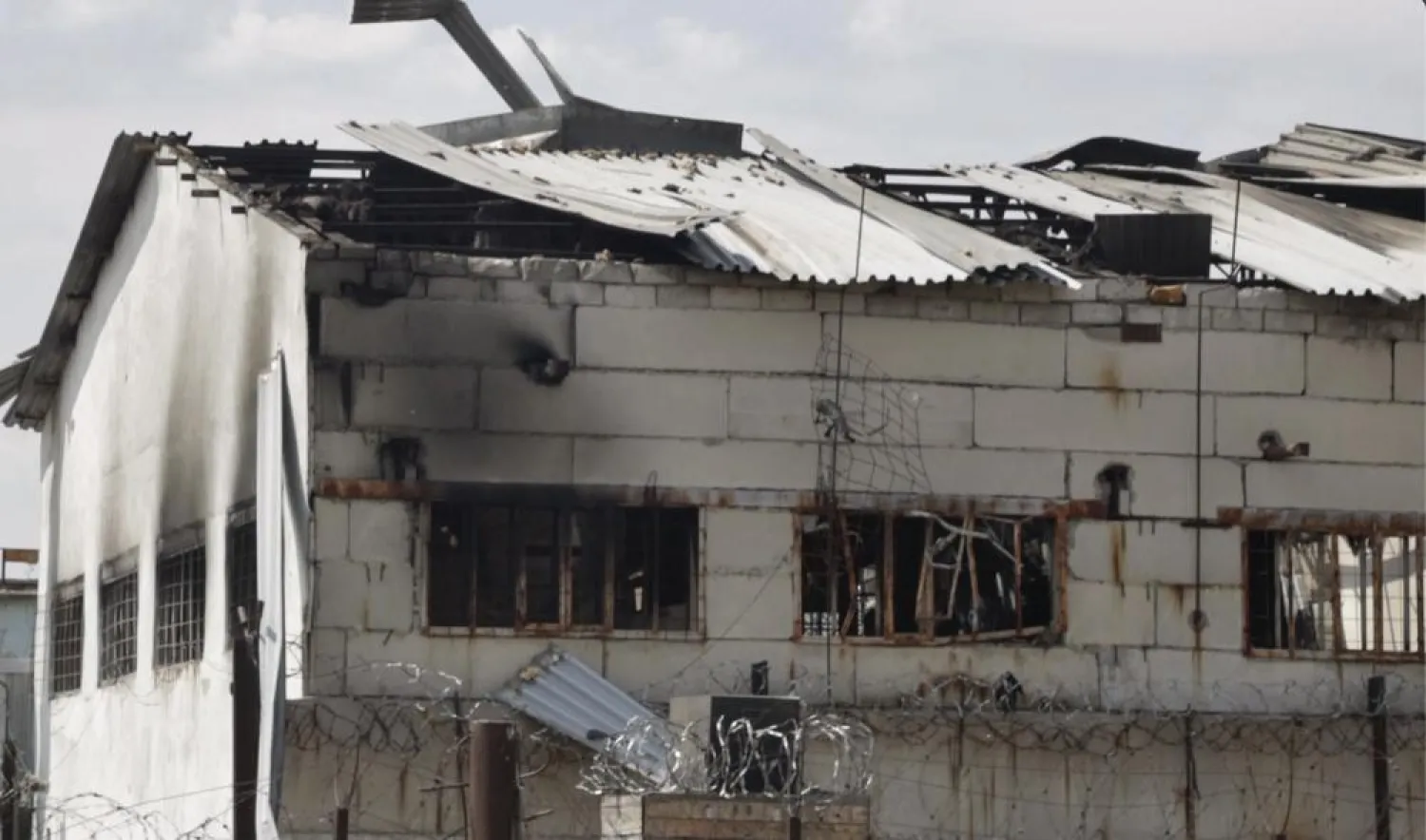
In this photo taken from video a view of a destroyed barrack at a prison in Olenivka, in an area controlled by Russian-backed separatist forces, eastern Ukraine, Friday, July 29, 2022.  (AP Photo)
In this photo taken from video a view of a destroyed barrack at a prison in Olenivka, in an area controlled by Russian-backed separatist forces, eastern Ukraine, Friday, July 29, 2022. (AP Photo)
TT

Ukraine Says Russian Attacks Hit Kharkiv, Mykolaiv

In this photo taken from video a view of a destroyed barrack at a prison in Olenivka, in an area controlled by Russian-backed separatist forces, eastern Ukraine, Friday, July 29, 2022.  (AP Photo)
In this photo taken from video a view of a destroyed barrack at a prison in Olenivka, in an area controlled by Russian-backed separatist forces, eastern Ukraine, Friday, July 29, 2022. (AP Photo)

Russia launched nighttime attacks on several cities in Ukraine, Ukrainian officials said Saturday as they and officials in Moscow blamed each other for the deaths of dozens of Ukrainian prisoners of war in a separatist-controlled area of the country's east.

Ukrainian President Volodymyr Zelenskyy said the United Nations and the International Committee of the Red Cross have a duty to react after shelling of a prison complex in Donetsk province killed the POWS.

“It was a deliberate Russian war crime, a deliberate mass murder of Ukrainian prisoners of war,” Zelenskyy said in a video address late Friday. “There should be a clear legal recognition of Russia as a state sponsor of terrorism.”

Both sides alleged the attack on the prison was premeditated and intended to silence the Ukrainian prisoners and to destroy evidence, including of possible atrocities, The Associated Press reported.

Russia claimed Ukraine’s military used US-supplied precision rocket launchers to target the prison in Olenivka, a settlement controlled by the Moscow-backed Donetsk People’s Republic.

Separatist authorities and Russian officials said the attack killed 53 Ukrainian POWs and wounded another 75.

The International Committee of the Red Cross, which has organized civilian evacuations in the war and worked to monitor the treatment of POWS held by Russia and Ukraine, said it has requested access to the prison “to determine the health and condition of all the people present on-site at the time of the attack.”

“Our priority right now is making sure that the wounded receive life-saving treatment and that the bodies of those who lost their lives are dealt with in a dignified manner,” the Red Cross said in a statement.

Elsewhere in eastern Ukraine, Russian rockets hit a school building in Kharkiv, the country's second-largest city, overnight, and another attack occurred about an hour later, Mayor Ihor Terekhov said Saturday. There were no immediate reports of injuries.

The bus station in the city of Sloviansk also was hit, according to Mayor Vadim Lyakh. Sloviansk is near the front line of fighting as Russian and separatist forces try to take full control of the Donetsk region, one of two eastern provinces that Russia has recognized as sovereign states.

In southern Ukraine, one person was killed and six injured in shelling that hit a residential area in Mykolaiv, a significant port city, the region's administration said Saturday on Facebook.

Friday's attack on the prison reportedly killed Ukrainian soldiers who were captured in May after the fall of Mariupol, another port city where troops famously held out against a monthslong Russian siege.
Moscow opened a probe into the attack, sending a team to the site from Russia’s Investigative Committee, the country’s main criminal investigation agency. The state RIA Novosti agency reported that fragments of U.S.-supplied precision High Mobility Artillery Rocket System rockets were found at the site.

The Ukrainian military denied making any rocket or artillery strikes in Olenivka, and it accused the Russians of shelling the prison to cover up the alleged torture and execution of Ukrainians there.

The Institute for the Study of War, a think tank based in Washington, said the competing claims and limited information prevented assigning responsibility for the attack but that the “available visual evidence appears to support the Ukrainian claim more than the Russian.”



Trump Says Not Putting US Troops in Region Amid Iran War

Plumes of smoke rise from the site of a strike in Tehran on March 16, 2026. (AFP)
TT

Trump Says Not Putting US Troops in Region Amid Iran War

Plumes of smoke rise from the site of a strike in Tehran on March 16, 2026. (AFP)

US President Donald Trump on Thursday suggested he was not looking at deploying more soldiers to the Middle East amid the Iran war.

"I'm not putting ‌troops anywhere," ‌Trump said, ‌asked ⁠by a reporter whether ⁠he was planning to send more service members to the region. "If I were, I certainly wouldn't tell ⁠you. But I'm not ‌putting ‌troops. We will do whatever ‌is necessary to ‌keep the price."

Trump spoke at the White House during an Oval Office meeting with ‌Japanese Prime Minister Sanae Takaichi.

Reuters reported on ⁠Wednesday ⁠that the Trump administration is considering deploying thousands of US troops to reinforce the Iran operation, citing a US official and three people familiar with the matter.


Pentagon Seeks $200 Billion in Additional Funds for the Iran War

US Secretary of Defense Pete Hegseth holds a briefing with Chairman of the Joint Chiefs of Staff General Dan Caine, amid the US-Israeli war on Iran, at the Pentagon in Washington, D.C., US, March 19, 2026. REUTERS/Evan Vucci
TT

Pentagon Seeks $200 Billion in Additional Funds for the Iran War

US Secretary of Defense Pete Hegseth holds a briefing with Chairman of the Joint Chiefs of Staff General Dan Caine, amid the US-Israeli war on Iran, at the Pentagon in Washington, D.C., US, March 19, 2026. REUTERS/Evan Vucci

The Pentagon is seeking $200 billion in additional funds for the Iran war, a senior administration official says.

The department sent the request to the White House, according to the official, who spoke on condition of anonymity to discuss the private information.

It’s an extraordinarily high number and comes on top of extra funding the Defense Department already received last year in President Donald Trump’s big tax cuts bill, The AP news reported.

Congress is bracing for a new spending request but it is not clear the White House has transmitted the request for consideration. It is unclear the spending request would have support.

The new funding request was first reported by The Washington Post. Asked about the figure at a press conference Thursday, Defense Secretary Pete Hegseth did not directly confirm the figure, saying it could change. But he said “we’re going back to Congress and our folks there to to ensure that we’re properly funded.”

“It takes money to kill bad guys,” Hegseth said.


What Cargo Ships are Passing Hormuz Strait?

Commercial vessels offshore in Dubai last week © - / AFP/File
TT

What Cargo Ships are Passing Hormuz Strait?

Commercial vessels offshore in Dubai last week © - / AFP/File

Just a trickle of cargo ships and tankers -- most of them Iranian -- have made it through the Strait of Hormuz since Iranian forces blocked the crucial trade route in the Middle East war.

Here are facts and figures about vessels that have passed through the 167-kilometre (104-mile) long strait since the war broke out with US-Israeli strikes on Iran on February 28, according to AFP.

- 95% shipping drop -

From March 1 to 19, commodities carriers made just 114 crossings, according to analytics firm Kpler -- a decrease of 95 percent from peacetime.

Of these, 69 crossings were by oil tankers and more than half were loaded, Kpler data showed, with most travelling east out of the strait.

Traffic "is being led mostly by bulk carriers, tankers and container ships," said Richard Meade, editor of leading shipping intelligence journal Lloyd's List, in a briefing on Thursday.

"But we have seen a bit of an uptick in gas carriers moving over the last week."

- Iranian, Greek, Chinese ships -

Most of the ships passing the strait are owned or flagged in Iran, said Bridget Diakun, an analyst at data company Lloyd's List Intelligence.

After that, Greek ships accounted for 18 percent of crossings and Chinese ones 10 percent in recent days, she said.

"Although Iran is continuing to control the Strait and exit its own oil, everything else is largely still at a standstill," said Meade.

- 35 sanctioned ships -

Overall since the war started, around a third of the ships transiting the strait were under US, EU or UK sanctions, according to an AFP analysis of passage data.

Of the oil and gas tankers, more than half were under sanctions.

Since March 16 "anything heading westbound has been shadow fleet, gas carriers or tankers... they absolutely dominate the traffic going through," Diakun told the Lloyds briefing.

- Oil to China -

Commodities analysts at JPMorgan bank said in a report released Monday that most of the oil passing through the strait was headed for Asia, principally China.

Data in the report indicated it was receiving more than a million barrels day from Hormuz -- far below the pre-war level of nearly five million.

Cichen Shen, Asia Pacific editor at Lloyd's List, said there were indications online that Chinese authorities were working on "some sort of exit plan" for their big tankers stuck in the region.

- 1.3 mn barrels of Iran oil -

The JPMorgan analysts said overall 98 percent of the observable oil traffic through the strait was Iranian, averaging 1.3 million barrels a day "in early March".

A fifth of the world's oil and liquefied natural gas passes through the strait in peacetime.

- Indian, Pakistani ships -

"There are indications that some ships are transiting under Iranian 'approval', with some vessels following a route through the Strait closer to the Iranian coastline than normal," including Indian and Pakistani vessels, marine consultancy Clarksons said in a note.

Meade of Lloyds List added: "Several governments, including China, but (also) India, Pakistan, Iraq, Malaysia, they're all in direct talks with Tehran, coordinating vessel transits" with Iran's Revolutionary Guards.

- Alternative routes surge -

Shipping companies are carving out other ways to get their cargos through the region. Major shipping firm CMA CGM said it was moving freight across Gulf countries by rail and road to avoid the strait.

"Gulf maritime traffic patterns indicate early signs of global rebalancing," said marine intelligence group Windward in a report.

In recent days transit volumes through the Bab el-Mandeb strait off east Africa surged 280 percent, and 70 percent through the Suez Canal, it said, indicating that "shipping is adapting through alternative corridors."