

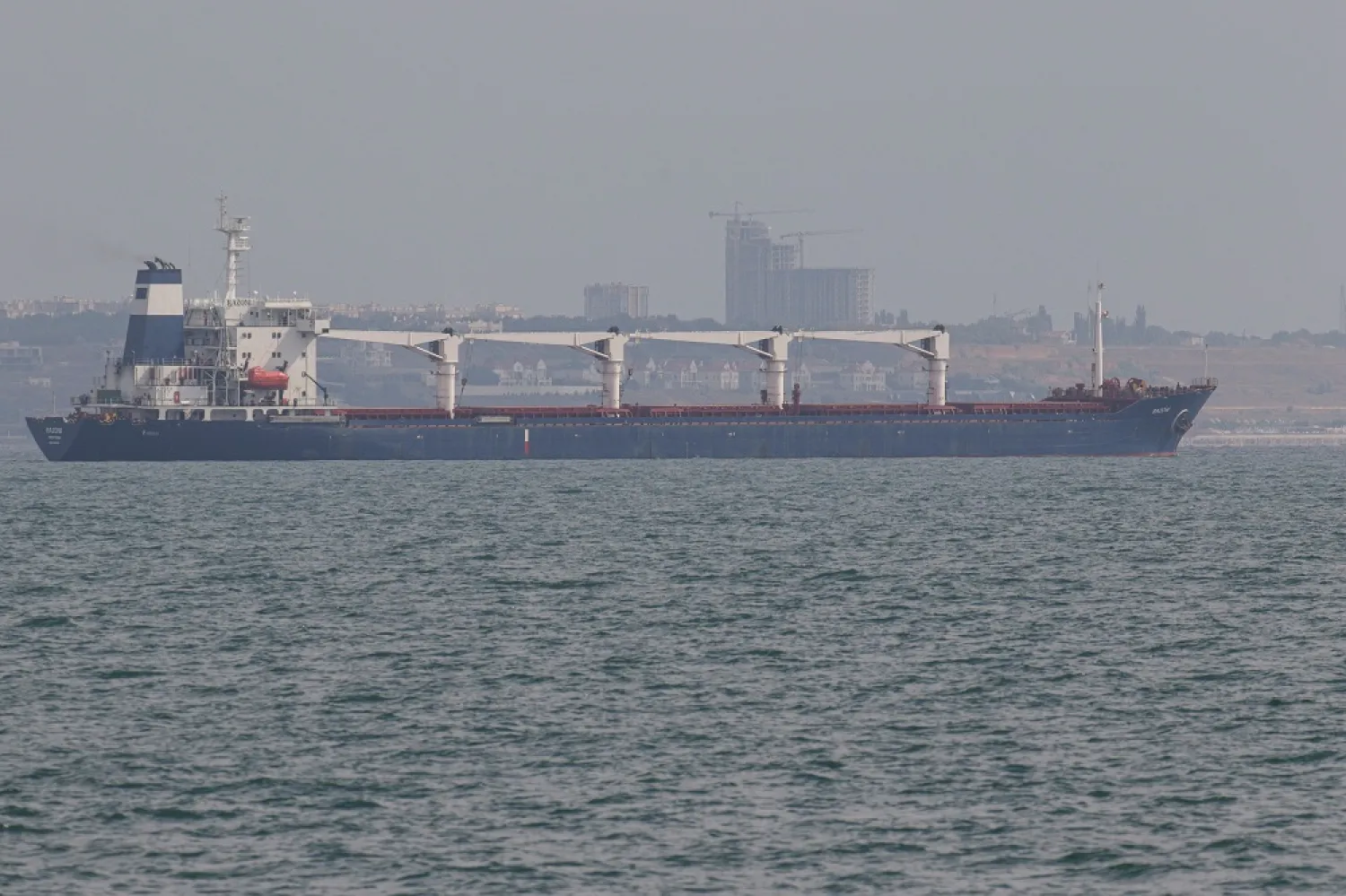

1st Ship Carrying Ukrainian Grain Leaves the Port of Odesa

The Sierra Leone-flagged ship Razoni leaves the sea port in Odesa after restarting grain export, amid Russia's attack on Ukraine, Ukraine August 1, 2022. (Reuters)
TT

1st Ship Carrying Ukrainian Grain Leaves the Port of Odesa

The Sierra Leone-flagged ship Razoni leaves the sea port in Odesa after restarting grain export, amid Russia's attack on Ukraine, Ukraine August 1, 2022. (Reuters)

The first ship carrying Ukrainian grain set out Monday from the port of Odesa under an internationally brokered deal to unblock the embattled country's agricultural exports and ease the growing global food crisis.

The Sierra Leone-flagged cargo ship Razoni sounded its horn as it slowly departed with over 26,000 tons of corn destined for Lebanon.

"The first grain ship since Russian aggression has left port," Ukrainian Minister of Infrastructure Oleksandr Kubrakov declared on Twitter.

Russia and Ukraine signed agreements in Istanbul with Turkey and the UN on July 22, clearing the way for Ukraine to export 22 million tons of grain and other agricultural products that have been stuck in Black Sea ports because of Russia’s invasion of Ukraine more than five months ago. The deals also allow Russia to export grain and fertilizer.

As part of the agreements, safe corridors through the mined waters outside Ukraine's ports were established.

Ukraine and Russia are major global suppliers of wheat, barley, corn and sunflower oil, with the fertile Black Sea region long known as the breadbasket of Europe. The holdup of food shipments because of the war has worsened rising food prices worldwide and threatened hunger and political instability in developing nations.

"Today Ukraine, together with partners, takes another step to prevent world hunger," Kubrakov said.

In Moscow, Kremlin spokesman Dmitry Peskov hailed the ship's departure as "very positive," saying it would help test the "efficiency of the mechanisms that were agreed to during the talks in Istanbul."

Under the agreements, ships going in and out of Ukrainian ports will be subject to inspection to make sure that incoming vessels are not carrying weapons and that outgoing ones are bearing only grain, fertilizer or related food items, not any other commodities.

The Razoni was expected to dock early Wednesday in Istanbul, where teams of Russian, Ukrainian, Turkish and UN officials were set to board it for inspection.

More ships are expected to leave from Ukraine’s ports through the safe corridors. At Odesa, 16 more vessels, all blocked since Russia’s invasion on Feb. 24, were waiting their turn, with others to follow, Ukrainian authorities said.

But some shipping companies are not yet rushing to export food across the Black Sea as they assess the danger of mines and the risk of Russian rockets hitting grain warehouses and ports.

UN Secretary-General Antonio Guterres, who proposed the grain deal in April, said the Razoni was "loaded with two commodities in short supply: corn and hope."

"Hope for millions of people around the world who depend on the smooth running of Ukraine’s ports to feed their families," he said.

In an interview with Turkey’s state-run Anadolu Agency, Turkish Defense Minister Hulusi Akar warned that the global food crisis threatens to trigger "a serious wave of migration from Africa to Europe and to Turkey."

Lebanon, the corn’s destination, is in the grip of a severe financial crisis. A 2020 explosion at its main port in Beirut shattered its capital city and destroyed grain silos. Lebanon mostly imports wheat from Ukraine but also buys its corn to make cooking oil and produce animal feed.

Kubrakov said the shipments will also help Ukraine’s war-shattered economy.

"Unlocking ports will provide at least $1 billion in foreign exchange revenue to the economy and an opportunity for the agricultural sector to plan for next year," he said.

Hearing the ship sound its horn as it left port delighted Olena Vitalievna, an Odesa resident.

"Finally, life begins to move forward and there are some changes in a positive direction," she said. "In general, the port should live its own life because Odesa is a port city. We live here. We want everything to work for us, everything to bustle."

Yet the resumption of the grain shipments came as fighting raged elsewhere in Ukraine, with Russia pressing its offensive in the east while Ukraine tries to retake territory in the Russian-occupied south.

Ukraine’s presidential office said at least three civilians were killed and 16 wounded by Russian shelling in the Donetsk region over the past 24 hours.

Donetsk Gov. Pavlo Kyrylenko repeated a call for all residents to evacuate, emphasizing the need to remove about 52,000 children still in the region.

In Kharkiv, two people were wounded by a Russian strike in the morning. One was struck while waiting for a bus, the other when a Russian shell exploded near an apartment building.

The southern city of Mykolaiv also faced shelling that ruined a building at a hospital and damaged ambulances, according to regional Gov. Vitaliy Kim. Three civilians were wounded elsewhere in the city, he said.

Soon after the grain shipment deal was signed, a Russian missile targeted Odesa. Analysts warned that the continuing fighting could still upend the grain deal.

"The departure of the first vessel doesn’t solve the food crisis; it’s just the first step that could also be the last if Russia decides to continue attacks in the south," said Volodymyr Sidenko, an expert with the Kyiv-based Razumkov Center think tank.

In other developments, Russia announced sanctions against dozens of British public figures, accusing them of supporting the "demonization" and international isolation of Moscow.

The 39 politicians, businesspeople and journalists barred from entering Russia include former Prime Minister David Cameron, senior government ministers, and columnists for newspapers including The Times and The Guardian.



EU to Slash Asylum Cases from 7 Nations Deemed Safe

FILE - A convoy of buses carry Syrian refugees who return home from Lebanon, arrive at the Syrian border crossing point, in Jdeidet Yabous, Syria, Tuesday, July 29, 2025. (AP Photo/Omar Sanadiki, File)
TT

EU to Slash Asylum Cases from 7 Nations Deemed Safe

FILE - A convoy of buses carry Syrian refugees who return home from Lebanon, arrive at the Syrian border crossing point, in Jdeidet Yabous, Syria, Tuesday, July 29, 2025. (AP Photo/Omar Sanadiki, File)

The European Union on Thursday said it would drastically reduce asylum claims from seven nations in Africa, the Middle East and Asia by considering them safe countries of origin, prompting widespread outrage from human rights groups on International Migrants' Day.

An agreement between European Parliament and the European Council, or the group of the 27 EU heads of state, said that the countries would be considered safe if they lack “relevant circumstances, such as indiscriminate violence in the context of an armed conflict.”

Asylum requests by people from Bangladesh, Colombia, Egypt, Kosovo, India, Morocco and Tunisia will be "fast-tracked, with applicants having to prove that this provision should not apply to them,” read the announcement of the agreement. “The list can be expanded in the future under the EU’s ordinary legislative procedure.”

In 2024, EU nations endorsed sweeping reforms to the bloc’s failed asylum system. The rules were meant to resolve the issues that have divided the 27 countries since well over 1 million migrants swept into Europe in 2015, most fleeing war in Syria and Iraq.

Under the Pact on Migration and Asylum, which goes into force in June 2026, people can be sent to countries deemed safe, but not to those where they face the risk of physical harm or persecution.

According to The Associated Press, Amnesty International EU advocate Olivia Sundberg Diez said the new measures were “a shameless attempt to sidestep international legal obligations" and would endanger migrants.

French MEP Mélissa Camara said the safe countries of origins concept and others agreed to by the Council and Parliament “opens the door to return hubs outside the EU’s borders, where third-country nationals are sometimes subjected to inhumane treatment with almost no monitoring” and “undoubtedly places thousands of people in exile in situations of danger.”

Céline Mias, the EU director of the Danish Refugee Council said that "we are deeply worried that this fast-track system will fail to protect people in need of protection, including activists, journalists and marginalized groups in places where human rights are clearly under attack.”

Alessandro Ciriani, an Italian MEP with the European Conservatives and Reformists group, said the designation sends a firm message that the EU has toughened its borders.

“Europe wants enforceable rules and shared responsibility. Now this commitment must become operational: effective returns, structured cooperation with third countries and real measures to support EU member states,” he said.

He said that clear delineations of safe and unsafe nations would rid the EU of “excessive interpretative uncertainty” that led to a kind of paralysis for national decision makers over border controls.

The measures also allows individual nations within the bloc to designate other countries safe for their own immigration purposes.


Rubio Says US Sanctioning ICC Judges for Targeting Israel

US Secretary of State Marco Rubio speaks to traveling journalists at the John C. Munro Hamilton International Airport in Hamilton, Ontario, on November 12, 2025 after the G7 foreign ministers meeting. (Photo by Mandel NGAN / POOL / AFP)
TT

Rubio Says US Sanctioning ICC Judges for Targeting Israel

US Secretary of State Marco Rubio speaks to traveling journalists at the John C. Munro Hamilton International Airport in Hamilton, Ontario, on November 12, 2025 after the G7 foreign ministers meeting. (Photo by Mandel NGAN / POOL / AFP)

US Secretary of State Marco Rubio said on Thursday that the US was sanctioning two judges of the International Criminal Court for targeting Israel.

"Today, I am designating two International Criminal Court (ICC) judges, Gocha Lordkipanidze of Georgia and Erdenebalsuren Damdin of Mongolia, pursuant to Executive Order 14203," Rubio said in a statement, referring to the order President Donald Trump signed in February sanctioning the ICC, Reuters reported.

"These individuals have directly engaged in efforts by the ICC to investigate, arrest, detain, or prosecute Israeli nationals, without Israel's consent," he said.

The United States and Israel are not members of the ICC.

The US sanctions in February include freezing any US assets of those designated and barring them and their families from visiting the United States.


US Imposes Sanctions on Vessels Linked to Iran, Treasury Website Says

A crew member raises the Iranian flag on Iranian oil tanker Adrian Darya 1, previously named Grace 1, as it sits anchored after the Supreme Court of the British territory lifted its detention order, in the Strait of Gibraltar, Spain, August 18, 2019. REUTERS/Jon Nazca
TT

US Imposes Sanctions on Vessels Linked to Iran, Treasury Website Says

A crew member raises the Iranian flag on Iranian oil tanker Adrian Darya 1, previously named Grace 1, as it sits anchored after the Supreme Court of the British territory lifted its detention order, in the Strait of Gibraltar, Spain, August 18, 2019. REUTERS/Jon Nazca

The United States imposed sanctions on Thursday on 29 vessels and their management firms, the Treasury Department said, as Washington continues targeting Tehran's "shadow fleet" it says exports Iranian petroleum and petroleum products, Reuters reported.

The targeted vessels and companies have transported hundreds of millions of dollars of the products through deceptive shipping practices, Treasury said.

Thursday's action also targets businessman Hatem Elsaid Farid Ibrahim Sakr, whose companies are associated with seven of the vessels cited, as well as multiple shipping companies.