


Crisis in Iraq Tests its Stability and Iran’s Sway

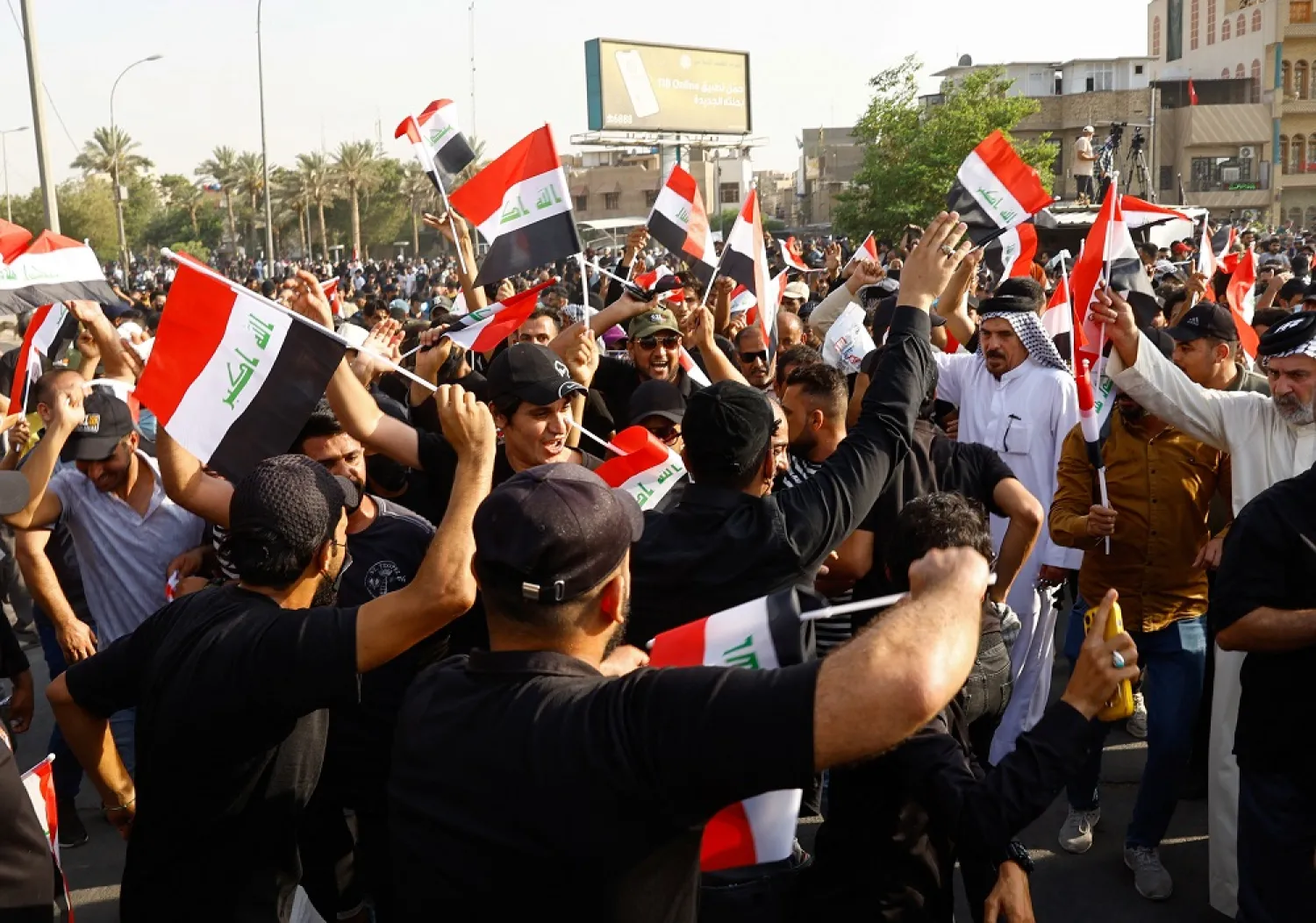
Supporters of the Coordination Framework, a grouping of Shiite parties, gather during a protest, amid a political crisis, near Green Zone, in Baghdad, Iraq August 1, 2022. (Reuters)
TT

Crisis in Iraq Tests its Stability and Iran’s Sway

Supporters of the Coordination Framework, a grouping of Shiite parties, gather during a protest, amid a political crisis, near Green Zone, in Baghdad, Iraq August 1, 2022. (Reuters)

A power struggle in Iraq between the Shiite cleric Moqtada al-Sadr and rivals aligned with Iran is testing Tehran's ability to stave off a conflict that could damage its interests and further destabilize the oil-rich country.

With Sadr supporters camped out in parliament and his opponents protesting in the streets, the tussle over a new government has put fresh strain on a political system that has been buffeted by crises since US-led forces toppled Saddam Hussein two decades ago.

It adds another destabilizing factor to a belt of fragile Arab states between Iran and the Mediterranean - Iraq, Syria and Lebanon - all of which fall within Iran's sphere of influence and have suffered major conflict or crisis over the last decade, including the battle with ISIS.

So far, neither side seems ready to give ground in the 10-month-old standoff, which began when Sadr emerged victorious from an October election and sought to form a government on his terms, only to be stymied by his foes.

For now, the sides - both heavily armed - appear to be avoiding violence, aware of the impact this would have on Iraq and the Shiite majority that was empowered by the political system the United States built after ousting Saddam.

But amid dramatic scenes in Baghdad, where Sadr supporters overran the fortified Green Zone that houses state buildings and embassies at the weekend, many Iraqis are concerned about possible violence.

In a sign of Iran's concern, head of the Revolutionary Guards’ Quds Force Brigadier General Esmail Ghaani, visited Baghdad in recent days in an effort to keep tensions from escalating, a Western diplomat said.

An Iraqi official in the Coordination Framework, an alliance of Iran-aligned factions, confirmed the visit but said Ghaani didn't appear to have succeeded, without giving details.

Iran's embassy in Baghdad didn't respond to a request for comment.

Ghaani has struggled to wield the influence of his predecessor, Qassem Soleimani, killed by a US attack in 2020.

"Iranian influence has had its ups and downs and has been waning to some extent," said Renad Mansour of Chatham House, a think tank. "This election and government formation process has exposed fragmentation ... among the political parties which makes it very complicated for Iran."

The crisis comes at a difficult moment for Iran elsewhere. The heavily armed Hezbollah and its allies lost a parliamentary majority in Lebanon in a May, though they still have big sway.

‘No revolutionary’

Sadr, heir to a prominent clerical dynasty who fought US forces after the invasion, has long opposed foreign influence.

He raised the stakes in June when he instructed his lawmakers to quit parliament, ceding dozens of seats to the Iran-aligned factions. Their subsequent moves towards forming a government without Sadr prompted the parliament takeover.

Sadr's recent call for unspecified changes to the constitution may indicate he wants to upend the entire system.

But some analysts question how much he really wants to change a system that has served him well: Sadr dominates much of the state which employs many of his followers.

"Sadr is no revolutionary. He wants the system to go on but with him in a more dominant position," said Toby Dodge, a London School of Economics professor.

Dodge described the standoff as "a squabble within an increasingly unpopular elite" in a country where poor governance and corruption has inflicted power and water cuts, poverty and unemployment on Iraqis, despite enormous oil wealth.

Those same conditions fueled mass protests across Baghdad and southern Iraq in 2019 in which security forces killed hundreds of protesters.

"There could be miscalculations and mistakes. But it seems to me that in every stage in this process, either one side or the other has taken steps to avoid violence," Dodge said.

A game changer?

The United States maintains around 2,000 troops in Iraq to fight ISIS remnants, far fewer than the 170,000 US troops there at the height of the occupation.

Once involved in backroom dealings over Iraqi government formations, US officials have largely stayed out of such contacts in recent years, according to Iraqi officials.

Vali Nasr, a Middle East expert at the Johns Hopkins School of Advanced International Studies in Washington, said Iraq did not appear to be a big US priority.

"It (Iraq) was not treated as a game-changer for the region, which it could end up being if Iraq loses the modicum of stability it had," he said.

"It is too soon to call this a loss for Iran, it may end up being a loss for everybody, and then the question becomes who picks up the pieces afterwards," he said.

The US State Department did not immediately respond to questions for this story.

The US embassy has urged calm and for Iraqi parties to avoid violence and work peacefully to resolve their differences.

Hamdi Malik of the Washington Institute think tank noted signs of restraint by both sides, but said conflict was a risk.

"Any civil war between Shiite groups will have a profound impact not only on ... people in Iraq, but the wider region and even other parts of the world, not least because of the possible disruption in oil supplies, as much of Iraq's oil wealth is located in predominantly Shiite parts of the country," he said.



Ukraine’s New Defense Minister Reveals Scale of Desertions as Millions Avoid the Draft

Ukraine's newly appointed Defense Minister Mykhailo Fedorov attends a parliamentary session in Kyiv, Ukraine, 14 January 2026. (EPA)
TT

Ukraine’s New Defense Minister Reveals Scale of Desertions as Millions Avoid the Draft

Ukraine's newly appointed Defense Minister Mykhailo Fedorov attends a parliamentary session in Kyiv, Ukraine, 14 January 2026. (EPA)

Wide-scale desertions and 2 million draft-dodgers are among a raft of challenges facing Ukraine's military as Russia presses on with its invasion of its neighbor after almost four years of fighting, the new defense minister said Wednesday.

Mykhailo Fedorov told Ukraine's parliament that other problems facing Ukraine’s armed forces include excessive bureaucracy, a Soviet-style approach to management, and disruptions in the supply of equipment to troops along the about 1,000-kilometer (600-mile) front line.

“We cannot fight a war with new technologies but an old organizational structure,” Fedorov said.

He said the military had faced some 200,000 troop desertions and draft-dodging by around 2 million people.

President Volodymyr Zelenskyy appointed 34-year-old Fedorov at the start of the year. The former head of Ukraine’s digital transformation policies is credited with spearheading the army's drone technology and introducing several successful e-government platforms.

His appointment was part of a broad government reshuffle that the Ukrainian leader said aimed to sharpen the focus on security, defense development and diplomacy amid a new US-led push to find a peace settlement.

Fedorov said the defense ministry is facing a shortfall of 300 billion hryvnia ($6.9 billion) in funding needs.

The European Union will dedicate most of a massive new loan program to help fund Ukraine’s military and economy over the next two years, European Commission President Ursula von der Leyen said Wednesday.

Fedorov said Ukraine’s defense sector has expanded significantly since Russia’s full-scale invasion in February 2022. At the start of the war, he said, the country had seven private drone companies and two firms developing electronic warfare systems. Today, he said, there are nearly 500 drone manufacturers and about 200 electronic warfare companies in Ukraine.

He added that some sectors have emerged from scratch, including private missile producers, which now number about 20, and more than 100 companies manufacturing ground-based robotic systems.


France Explores Sending Eutelsat Terminals to Iran Amid Internet Blackout

 Protesters hold up placards with pictures of victims as they demonstrate in support of anti-government protests in Iran, outside Downing Street, in London, Wednesday, Jan. 14, 2026. (AP)
Protesters hold up placards with pictures of victims as they demonstrate in support of anti-government protests in Iran, outside Downing Street, in London, Wednesday, Jan. 14, 2026. (AP)
TT

France Explores Sending Eutelsat Terminals to Iran Amid Internet Blackout

 Protesters hold up placards with pictures of victims as they demonstrate in support of anti-government protests in Iran, outside Downing Street, in London, Wednesday, Jan. 14, 2026. (AP)
Protesters hold up placards with pictures of victims as they demonstrate in support of anti-government protests in Iran, outside Downing Street, in London, Wednesday, Jan. 14, 2026. (AP)

France is looking into sending Eutelsat satellite terminals to Iran to help citizens after Iranian authorities imposed a blackout of internet services in a bid to quell the country's most violent domestic unrest in decades.

"We are exploring all options, and the one you have mentioned is among them," French Foreign Minister Jean-Noel Barrot said on Wednesday in ‌the lower house ‌after a lawmaker asked whether France ‌would ⁠send Eutelsat ‌gear to Iran.

Backed by the French and British governments, Eutelsat owns OneWeb, the only low Earth orbit constellation, or group of satellites, besides Elon Musk's Starlink.

The satellites are used to beam internet service from space, providing broadband connectivity to businesses, governments and consumers in underserved areas.

Iranian authorities in recent days have ⁠launched a deadly crackdown that has reportedly killed thousands during protests against clerical rule, ‌and imposed a near-complete shutdown of internet ‍service.

Still, some Iranians have ‍managed to connect to Starlink satellite internet service, three people ‍inside the country said.

Even Starlink service appears to be reduced, Alp Toker, founder of internet monitoring group NetBlocks said earlier this week.

Eutelsat declined to comment when asked by Reuters about Barrot's remarks and its activities in Iran.

Starlink’s more than 9,000 satellites allow higher speeds than Eutelsat's fleet of over 600, ⁠and its terminals connecting users to the network are cheaper and easier to install.

Eutelsat also provides internet access to Ukraine's military, which has relied on Starlink to maintain battlefield connectivity throughout the war with Russia.

Independent satellite communications adviser Carlos Placido said OneWeb terminals are bulkier than Starlink’s and easier to jam.

"The sheer scale of the Starlink constellation makes jamming more challenging, though certainly not impossible," Placido said. "With OneWeb it is much easier to predict which satellite will become online over a given ‌location at a given time."


China Says It Opposes Outside Interference in Iran’s Internal Affairs

Iranians walk next to a billboard reading "Iran is our Homeland" at Enqelab Square in Tehran, Iran, 13 January 2026. (EPA)
TT

China Says It Opposes Outside Interference in Iran’s Internal Affairs

Iranians walk next to a billboard reading "Iran is our Homeland" at Enqelab Square in Tehran, Iran, 13 January 2026. (EPA)

China opposes any outside interference in Iran's ​internal affairs, the Chinese foreign ministry said on Wednesday, after US President Donald Trump warned that Washington ‌would take "very ‌strong action" ‌against Tehran.

China ⁠does ​not ‌condone the use or the threat of force in international relations, Mao Ning, spokesperson at ⁠the Chinese foreign ministry, said ‌at a ‍regular ‍news conference when ‍asked about China's position following Trump's comments.

Trump told CBS News in ​an interview that the United States would take "very ⁠strong action" if Iran starts hanging protesters.

Trump also urged protesters to keep protesting and said that help was on the way.