

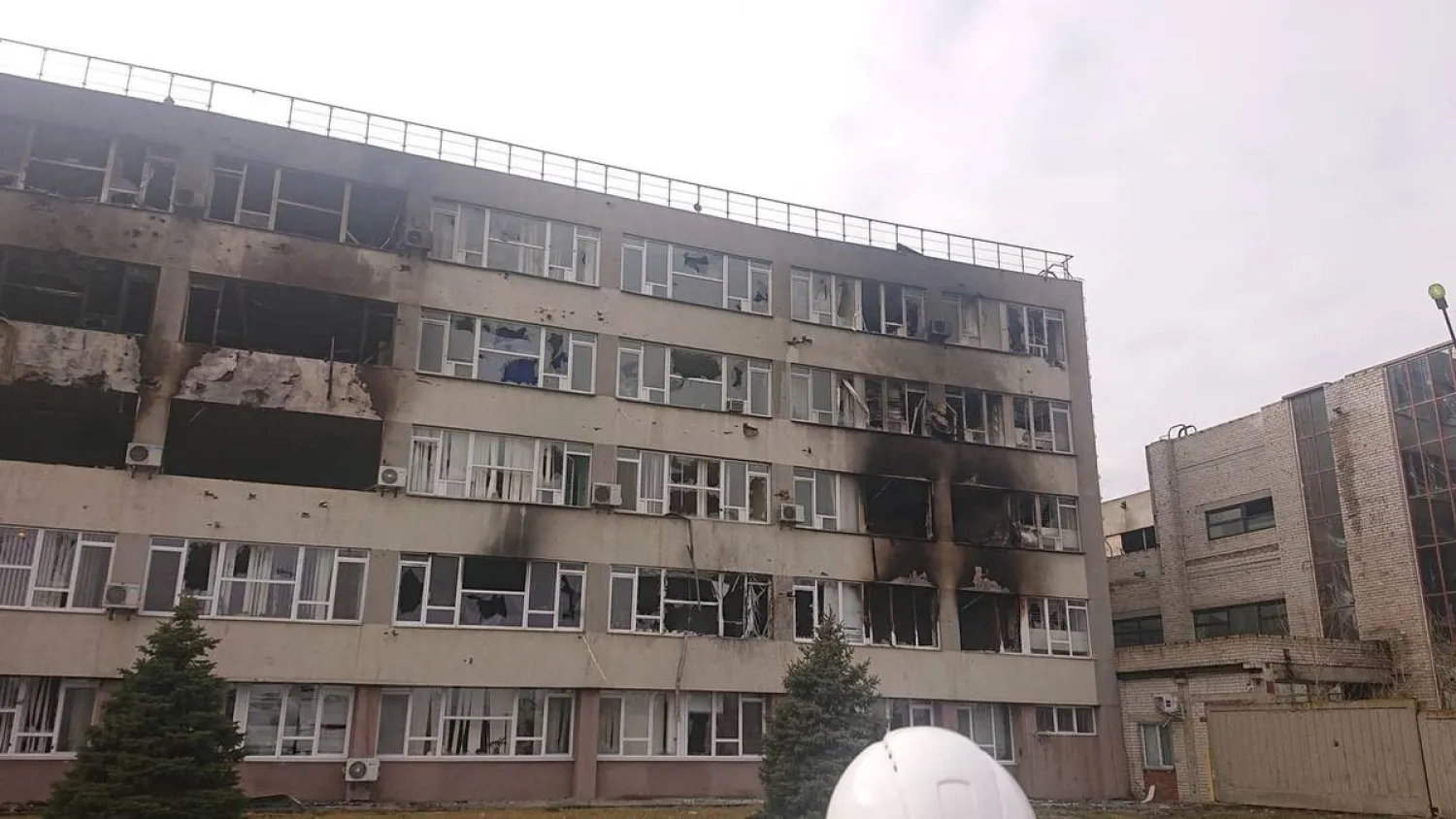

UN Nuclear Chief: Ukraine Nuclear Plant Is ‘Out of Control’

A view shows a damaged building at the Zaporizhzhya Nuclear Power Plant compound, amid Russia's invasion of Ukraine, in Enerhodar, Zaporizhzhya region, Ukraine, in this handout picture released March 17, 2022. (Press service of National Nuclear Energy Generating Company Energoatom/Handout via Reuters)
TT

UN Nuclear Chief: Ukraine Nuclear Plant Is ‘Out of Control’

A view shows a damaged building at the Zaporizhzhya Nuclear Power Plant compound, amid Russia's invasion of Ukraine, in Enerhodar, Zaporizhzhya region, Ukraine, in this handout picture released March 17, 2022. (Press service of National Nuclear Energy Generating Company Energoatom/Handout via Reuters)

The UN nuclear chief warned that Europe’s largest nuclear power plant in Ukraine “is completely out of control” and issued an urgent plea to Russia and Ukraine to quickly allow experts to visit the sprawling complex to stabilize the situation and avoid a nuclear accident.

Rafael Grossi, director general of the International Atomic Energy Agency, said in an interview Tuesday with The Associated Press that the situation is getting more perilous every day at the Zaporizhzhya plant in the southeastern city of Enerhodar, which Russian troops seized in early March, soon after their Feb. 24. invasion of Ukraine.

“Every principle of nuclear safety has been violated” at the plant, he said. “What is at stake is extremely serious and extremely grave and dangerous.”

Grossi cited many violations of the plant’s safety, adding that it is “in a place where active war is ongoing,” near Russian-controlled territory.

The physical integrity of the plant hasn’t been respected, he said, citing shelling at the beginning of the war when it was taken over and continuing information from Ukraine and Russia accusing each other of attacks at Zaporizhzhya.

There is “a paradoxical situation” in which the plant is controlled by Russia, but its Ukrainian staff continues to run its nuclear operations, leading to inevitable moments of friction and alleged violence, he said. While the IAEA has some contacts with staff, they are “faulty” and “patchy,” he said.

Grossi said the supply chain of equipment and spare parts has been interrupted, “so we are not sure the plant is getting all it needs.” The IAEA also needs to perform very important inspections to ensure that nuclear material is being safeguarded, “and there is a lot of nuclear material there to be inspected,” he said.

“When you put this together, you have a catalog of things that should never be happening in any nuclear facility,” Grossi said. “And this is why I have been insisting from day one that we have to be able to go there to perform this safety and security evaluation, to do the repairs and to assist as we already did in Chernobyl.”

The Russian capture of Zaporizhzhya renewed fears that the largest of Ukraine’s 15 nuclear reactors could be damaged, setting off another emergency like the 1986 Chernobyl accident, the world’s worst nuclear disaster, which happened about 110 kilometers (65 miles) north of the capital Kyiv.

Russian forces occupied the heavily contaminated site soon after the invasion but handed control back to the Ukrainians at the end of March. Grossi visited Chernobyl on April 27 and tweeted that the level of safety was “like a ‘red light’ blinking.” But he said Tuesday that the IAEA set up “an assistance mission” at Chernobyl at that time “that has been very, very successful so far.”

The IAEA needs to go to Zaporizhzhya, as it did to Chernobyl, to ascertain the facts of what is actually happening there, to carry out repairs and inspections, and “to prevent a nuclear accident from happening,” Grossi said.

The IAEA chief said he and his team need protection to get to the plant and the urgent cooperation of Russia and Ukraine.

Each side wants this international mission to go from different sites, which is understandable in light of territorial integrity and political considerations, he said, but there’s something more urgent and that is getting the IAEA team to Zaporizhzhya.

“The IAEA, by its presence, will be a deterrent to any act of violence against this nuclear power plant,” Grossi said. “So I’m pleading as an international civil servant, as the head of an international organization, I’m pleading to both sides to let this mission proceed.”

Grossi was in New York to deliver a keynote speech at Monday’s opening of the long-delayed high-level meeting to review the landmark 50-year-old Nuclear Nonproliferation Treaty aimed at preventing the spread of nuclear weapons and eventually achieving a nuclear-free world.

In the interview, the IAEA chief also spoke about efforts to revive the 2015 nuclear deal between Iran and major powers that the Trump administration abandoned in 2018 and the Biden administration has been working to renew.

Grossi said there is “an ongoing effort to try to go for yet another meeting or round to explore possibilities to come to an agreement.” He said he heard the meeting “could be soon.”

US Secretary of State Antony Blinken told the NPT review conference on Monday that Iran “has either been unwilling or unable” to accept a deal to return to the 2015 agreement aimed at reining in its nuclear program.

Grossi said “there are important differences among the negotiating parties” and important verification issues related to past activities that Iran needs to address. “It’s not impossible, it’s complex,” he said.

If the nuclear agreement, known as the JCPOA, is not extended, he said some IAEA inspections will continue. But the JCPOA provides for additional transparency and inspections “which I deem as extremely important, very necessary, because of the breadth and depth of the nuclear program in Iran,” he said.

Grossi stressed that cooperating with the IAEA, answering its questions, allowing its inspectors to go wherever they need to be, is essential for Iran to build trust and confidence. “Promises and good words will not do,” he said.

On another issue, Grossi said last September's deal in which the United States and Britain will provide Australia with nuclear reactors to power its submarines requires an agreement with the IAEA to ensure that the amount of nuclear material in the vessel when it leaves port is there when it returns.

He said Australia hasn’t decided what type of vessel it will be getting, so while there have been preparatory talks, substantive talks can’t begin.

Because it’s a military vessel, Grossi said, “there are lots of confidential and protection of information measures that need to be embedded into any such agreement, so it’s very complex technologically.”



Top Trump Iran Negotiator Says Visits US Aircraft Carrier in Middle East

US Special Envoy Steve Witkoff delivers a press conference upon the signing of the declaration on deploying post-ceasefire force in Ukraine, during the so-called "Coalition of the Willing" summit, at the Elysee Palace in Paris, France, January 6, 2026. (Reuters)
TT

Top Trump Iran Negotiator Says Visits US Aircraft Carrier in Middle East

US Special Envoy Steve Witkoff delivers a press conference upon the signing of the declaration on deploying post-ceasefire force in Ukraine, during the so-called "Coalition of the Willing" summit, at the Elysee Palace in Paris, France, January 6, 2026. (Reuters)

US President Donald Trump's lead Iran negotiator Steve Witkoff on Saturday said he visited the USS Abraham Lincoln aircraft carrier currently in the Arabian Sea, with Washington and Tehran due to hold further talks soon.

"Today, Adm. Brad Cooper, Commander of US Naval Forces Central Command, Jared Kushner, and I met with the brave sailors and Marines aboard the USS Abraham Lincoln, her strike group, and Carrier Air Wing 9 who are keeping us safe and upholding President Trump's message of peace through strength," said Witkoff in a social media post.

Iranian Foreign Minister Abbas Araghchi said on Saturday he hoped talks with the United States would resume soon, while reiterating Tehran's red lines and warning against any American attack.


Israel’s Netanyahu Expected to Meet Trump in US on Wednesday and Discuss Iran

Israeli Prime Minister Benjamin Netanyahu delivers a speech during a special session to mark the 77th anniversary of the Knesset's establishment and the 60th anniversary of the dedication of the current building at the Knesset, the Israeli parliament, in Jerusalem, 02 February 2026. (EPA)
TT

Israel’s Netanyahu Expected to Meet Trump in US on Wednesday and Discuss Iran

Israeli Prime Minister Benjamin Netanyahu delivers a speech during a special session to mark the 77th anniversary of the Knesset's establishment and the 60th anniversary of the dedication of the current building at the Knesset, the Israeli parliament, in Jerusalem, 02 February 2026. (EPA)

Israeli Prime Minister Benjamin Netanyahu is expected to meet US President Donald Trump on Wednesday in Washington, where they will discuss negotiations with Iran, Netanyahu's office said on Saturday.

Iranian and US officials held indirect nuclear ‌talks in the ‌Omani capital ‌Muscat ⁠on Friday. ‌Both sides said more talks were expected to be held again soon.

A regional diplomat briefed by Tehran on the talks told Reuters Iran insisted ⁠on its "right to enrich uranium" ‌during the negotiations with ‍the US, ‍and that Tehran's missile capabilities ‍were not raised in the discussions.

Iranian officials have ruled out putting Iran's missiles - one of the largest such arsenals in the region - up ⁠for discussion, and have said Tehran wants recognition of its right to enrich uranium.

"The Prime Minister believes that any negotiations must include limiting ballistic missiles and halting support for the Iranian axis," Netanyahu's office said in a ‌statement.


Italy FM Rules Out Joining Trump’s ‘Board of Peace’

Italy's Minister for Foreign Affairs Antonio Tajani speaks to the press during the EPP Leaders’ meeting, in Zagreb, Croatia, 30 January 2026. (EPA)
TT

Italy FM Rules Out Joining Trump’s ‘Board of Peace’

Italy's Minister for Foreign Affairs Antonio Tajani speaks to the press during the EPP Leaders’ meeting, in Zagreb, Croatia, 30 January 2026. (EPA)

Italy will not take part in US President Donald Trump's "Board of Peace", Italian Foreign Minister Antonio Tajani said Saturday, citing "insurmountable" constitutional issues.

Trump launched his "Board of Peace" at the World Economic Forum in Davos in January and some 19 countries have signed its founding charter.

But Italy's constitution bars the country from joining an organization led by a single foreign leader.

Prime Minister Giorgia Meloni, a Trump ally, last month noted "constitutional problems" with joining, but suggested Trump could perhaps reopen the framework "to meet the needs not only of Italy, but also of other European countries".

Tajani appeared Saturday to rule that out.

"We cannot participate in the Board of Peace because there is a constitutional limit," he told the ANSA news agency.

"This is insurmountable from a legal standpoint," he said, the day after meeting US Secretary of State Marco Rubio and US Vice President JD Vance at the Olympics in Milan.

Although originally meant to oversee Gaza's rebuilding, the board's charter does not limit its role to the Palestinian territory and appears to want to rival the United Nations.