


Lebanon Clears Ship Accused of Carrying Stolen Ukrainian Grain for Departure

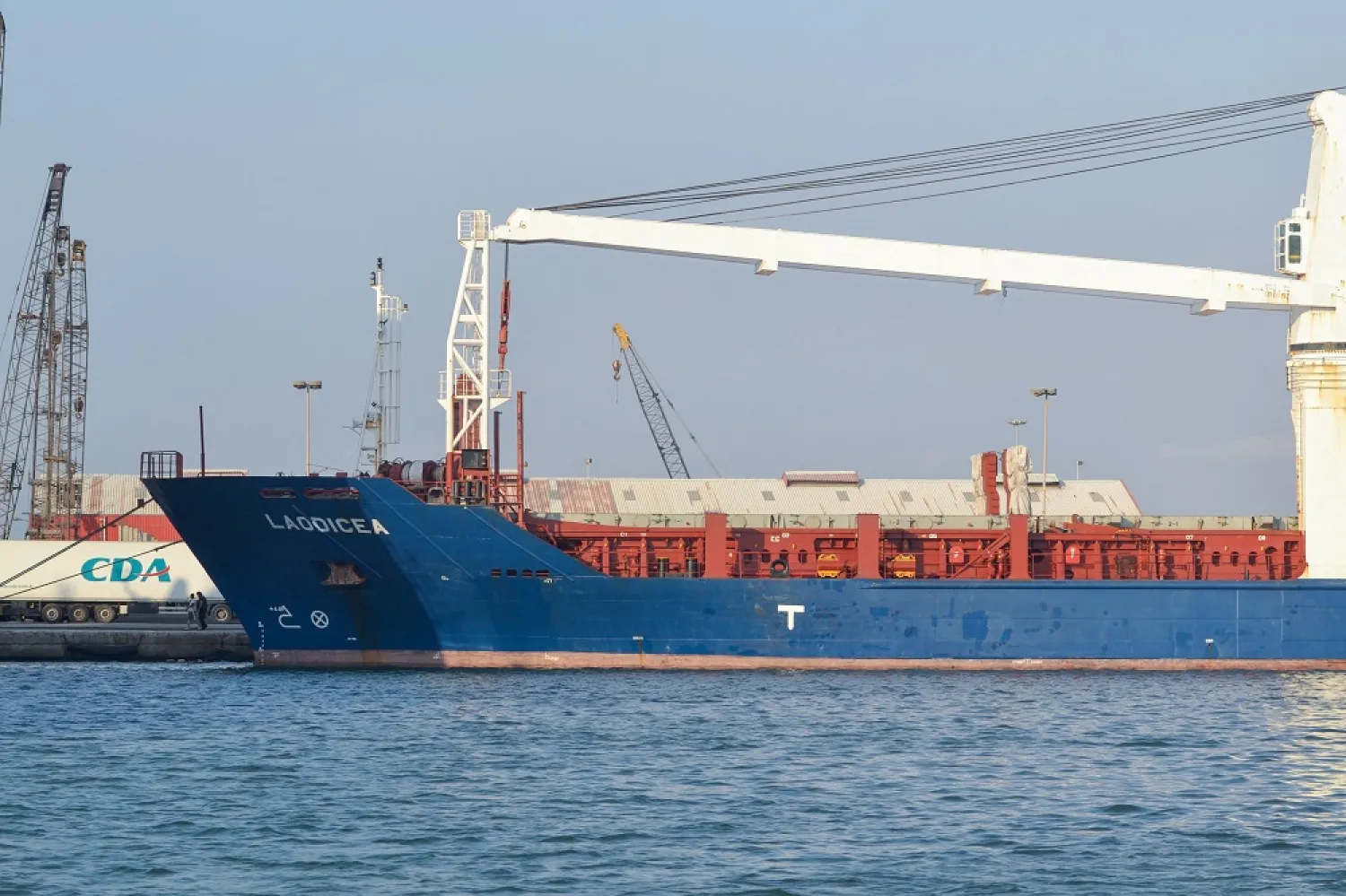
A picture shows a view of the bow of the grain-laden Syrian-flagged ship Laodicea, docked in Lebanon's northern port of Tripoli, on July 30, 2022. (AFP)
TT

Lebanon Clears Ship Accused of Carrying Stolen Ukrainian Grain for Departure

A picture shows a view of the bow of the grain-laden Syrian-flagged ship Laodicea, docked in Lebanon's northern port of Tripoli, on July 30, 2022. (AFP)

Transport authorities have allowed a ship Ukraine accuses of carrying stolen grain to depart Lebanon despite the Ukrainian embassy asking Beirut to reopen a probe into the matter after presenting what it said was new evidence.

Lebanese Transport Minister Ali Hamie told Reuters on Wednesday afternoon that port authorities in the northern city of Tripoli had cleared the ship to depart.

A tweet from his account said the decision was "in accordance with Lebanese legal principles, based on our sovereignty over our land, sea and sky."

Earlier on Wednesday, Ukraine had asked Lebanon's top prosecutor to reopen a probe into the Syrian-flagged ship, the Laodicea, which it says is carrying some 10,000 tons of flour and barley plundered by Russia following its February invasion.

Ukraine's ambassador to Lebanon, Ihor Ostash, told a news conference at the embassy near Beirut that the request to investigate further was based on new evidence gathered by a Ukrainian judge and handed over to Lebanon on Monday.

The Lebanese prosecutor, Ghassan Oueidat, lifted a first seizure order on the Laodicea, issued last week, on Tuesday after finding no criminal offence committed.

A judge in Tripoli told Reuters that a second 72-hour seizure order issued on Monday was no longer in place and the ship could now depart.

Moscow has previously denied stealing grain. Russia's Embassy in Lebanon said it had no information on the vessel or the cargo, which was shipped to Lebanon by a private company.

An official from the company that owns the cargo has also denied it was stolen and said the ship was bound for nearby Syria.

Ukrainian authorities say the Laodicea travelled to a port in Russian-occupied Crimea closed to international shipping, taking on cargo before sailing to Lebanon.

Among the new information presented by Ukraine's embassy, satellite imagery - also provided to Reuters - shows the Laodicea in the Crimean port of Feodosia on July 14. Photos, again seen by Reuters, show the ship in the same spot from July 9 to July 20.

During that period, its load line - which indicates the depth to which it can be safely loaded with cargo - sinks to water-level, indicating it has taken on a heavy load.

The ship arrived in Lebanon on July 27, where open-source information showed it remained on Wednesday night.

Ukraine's embassy also noted that the Russian cargo manifest states that the Laodicea, which has a maximum draft of eight meters, sailed from the Russian port of Kavkaz, but open-source shipping information, independently checked by Reuters, indicates Kavkaz can only accept ships with a maximum draught of five meters.

An image of a sack of wheat flour aboard the Laodicea the embassy said it had obtained on Wednesday indicated a Crimea-based company is the manufacturer.

The shipping company that owns the ship could not immediately be reached for comment.

Ostash said Ukraine had offered to sell Lebanon the Laodicea's entire cargo at around half its international price, should Lebanon seize it.

He added that a ship carrying 26,000 tons of corn, the first carrying Ukrainian grain to leave its Black Sea ports with cargo for international markets since Russia's invasion, would arrive in Lebanon within four to five days.

He said Ukraine remained committed to supporting Lebanon with grain shipments as Lebanon deals with shortages of basic goods including wheat amid a three-year financial collapse.

Ukraine accuses Russia of stealing around half a million tons of grain from areas it has occupied, and says it has traced 78 vessels involved in the transfer of the stolen grain.



Hezbollah Overhaul Gives Qassem Tighter Administrative Control

Wafiq Safa, head of Hezbollah’s Liaison and Coordination Unit, speaks to the media at the site of the killing of Hassan Nasrallah, Hezbollah’s secretary-general, in Beirut’s southern suburbs last year (Social media)
TT

Hezbollah Overhaul Gives Qassem Tighter Administrative Control

Wafiq Safa, head of Hezbollah’s Liaison and Coordination Unit, speaks to the media at the site of the killing of Hassan Nasrallah, Hezbollah’s secretary-general, in Beirut’s southern suburbs last year (Social media)

The resignation of Wafiq Safa, head of Hezbollah’s Liaison and Coordination Unit, a move that bore the hallmarks of a dismissal, has lifted the lid on a far-reaching internal shake-up of the group’s organizational structure after the heaviest blows it has suffered in its history.

The restructuring follows Hezbollah’s latest war with Israel, which decimated the group’s senior leadership, killing its long-time secretary-general Hassan Nasrallah, his designated successor Hashem Safieddine, a third potential successor Nabil Qaouq, along with much of its military command.

Well-informed Lebanese sources told Asharq Al-Awsat that Safa’s exit marks only the visible edge of bigger changes underway as the group moves to overhaul its leadership, security, and political apparatus in response to the unprecedented damage inflicted by the war.

Previously, that post led the organization without delving into the executive council's responsibilities, which function as a government-like body within the party.

Another key shift is the growing role of political figures in decision-making at the expense of clerics who had dominated the leadership in the previous phase.

New figures have also entered the decision-making circle, including individuals who worked with Qassem in the Islamic Daawa Party and Islamic committees before joining Hezbollah after its founding.

Raad seen as deputy secretary-general

The picture becomes clearer with the entry of Mohammad Raad, head of Hezbollah’s parliamentary bloc Loyalty to the Resistance, into the party’s decision-making core. There is a clear trend toward appointing him deputy secretary-general.

However, the decision is unlikely to be announced before parliamentary elections. MP Hassan Fadlallah is expected to assume leadership of the bloc after the latest elections.

Fneish to lead the party’s executive council

Sources told Asharq Al-Awsat that former minister and MP Mohammad Fneish has taken over responsibility for Hezbollah’s executive council, where he is tasked with reorganizing the party’s administrative and institutional structure. Sheikh Ali Daamoush is handling operational and organizational duties within the council.

Internal organizational measures

Opposition sources familiar with Hezbollah’s internal affairs said Safa was among the first officials affected by internal organizational decisions that curtailed media activity. A directive from the secretary-general’s office barred him from making statements without prior approval from the party’s media relations department.

The same sources said the measures went beyond media restrictions and were accompanied by a noticeable reduction in Safa’s political role, including contacts with political forces and involvement in elections and nominations. According to this account, he has had no public presence in recent months as a political envoy, neither to allies nor rivals.

Redistribution of roles

Sources explained that the unit, previously known in practice as the Security Committee, had handled internal security disputes and field tensions within Hezbollah’s environment or with other parties, intervening directly before coordinating with relevant actors and later with Lebanese state institutions, including security and judicial bodies. It also followed detainee cases and brokered reconciliations.

They added that the unit’s head benefited from growing influence within the party, particularly after being pushed to the forefront in sensitive files such as indirect negotiations and prisoner exchanges, enabling him to build political and international networks, including external channels.

Limiting political authority

Sources tracking the organizational file said the expansion of this role eventually led the unit to exceed its strictly security mandate by performing political functions, including receiving delegations and relaying messages.

They said that after the current leadership took charge, clear instructions were issued to restrict the Liaison and Coordination Unit’s role to security and technical coordination only, barring it from any political, negotiating, or media activity.

According to sources, all political decisions and contacts are now confined to the party’s political leadership, specifically to Secretary-General Naim Qassem, parliamentary bloc head Mohammad Raad, or the secretary-general’s political aide, Hussein Khalil. The security unit’s role is limited to technical coordination with Lebanese security agencies.

Broader structural shifts

Observers link these changes to broader transformations within Hezbollah since Qassem assumed leadership. They note that the previous phase saw prominent roles for clerical figures in the second and third ranks, such as Hashem Safieddine and Nabil Qaouq, who Israel killed in the recent war.

The current scene, by contrast, is marked by the rise of non-clerical political figures, including Mohammad Raad, Mahmoud Qmati, and Ibrahim Mousawi, signaling a gradual shift toward reinforcing the party’s political character.

The sources said media affairs have been centralized under a single administration overseen by MP Ibrahim Mousawi, with direct coordination with the leadership, as part of a policy aimed at unifying messaging and restricting public statements to authorized figures.

War fallout behind Safa’s removal

Political analyst Ali al-Amin told Asharq Al-Awsat that Safa’s sidelining comes amid the fallout from the war and its direct repercussions on Hezbollah, as well as the impact of Iran’s retrenchment and ongoing US-Iran negotiations. He said the party has come to realize that what was possible in the past is no longer sustainable.

Al-Amin said the decision affects a body with both personal and institutional dimensions, noting that Safa is subject to US sanctions, making the move a clear signal that Hezbollah no longer enjoys the same level of control over security bodies amid US pressure and Lebanese state demands to dismantle the apparatus.

He said Hezbollah is trying to adapt to new realities, adding that acceptance of this path will depend on how the party handles implementation of the principle of exclusive state control over weapons.

He noted that recent statements by Mohammad Raad had a tone that could appear positive about weapons exclusivity but fell short of complete clarity. He described the current step as an initial practical measure whose impact will be assessed later, both at the Lebanese official level and by US officials closely following the Lebanese file.

Al-Amin said Hezbollah will continue, whenever possible, to present itself as a political party, even if only superficially, in an effort to project a peaceful, civilian image and show alignment with state institutions.

He added that any progress or disruption in US-Iran negotiations would be reflected in greater flexibility in the party’s domestic behavior, unless a decisive international decision is taken to end Hezbollah’s current status.

In this context, reports have circulated that Hussein Abdallah has been tasked with heading the Liaison and Coordination Unit. Abdallah previously served as Hezbollah’s security chief in southern Lebanon and is considered close to Naim Qassem. Responsibility for contacts with the state and abroad has reportedly been assigned to his deputy, Ahmed Mahna.

Party-aligned account

A source close to Hezbollah offered a different account, telling Asharq Al-Awsat that the measures affecting Safa are part of an organizational restructuring the party has pursued since the end of the war as part of a comprehensive internal review affecting multiple positions and officials.

The source stressed that Safa remains within Hezbollah’s organizational structure.

By contrast, Al-Jadeed television reported that Safa submitted his resignation as head of the Liaison and Coordination Unit with internal approval, citing deep disagreements with Secretary-General Naim Qassem, Shura Council member and parliamentary bloc head Mohammad Raad, and the curtailment of his powers.


Iraqi Guards Threatened by ISIS Prisoners

US military vehicles move along a road in a convoy transporting ISIS detainees being transferred to Iraq from Syria, on the outskirts of Qahtaniyah in Syria's northeastern Hasakah province on February 7, 2026. (Photo by Delil SOULEIMAN / AFP)
TT

Iraqi Guards Threatened by ISIS Prisoners

US military vehicles move along a road in a convoy transporting ISIS detainees being transferred to Iraq from Syria, on the outskirts of Qahtaniyah in Syria's northeastern Hasakah province on February 7, 2026. (Photo by Delil SOULEIMAN / AFP)

Iraq is continuing to transfer prisoners believed to be mostly ISIS members to its own detention facilities under a previous arrangement with Washington and the US-led coalition fighting the group, Iraqi security sources said.

The move is aimed at preventing jailbreaks following unrest last month in parts of northeastern Syria, which host camps and prisons holding thousands of ISIS fighters and their families.

Iraqi security officials said some detainees threatened Iraqi soldiers and guards during the transfer process, telling them, “We will kill you when we escape from prison,” an indication that the group’s violent ideology persists even while its members are in custody.

Iraq formally agreed last month to receive thousands of ISIS detainees held in northeastern Syria under the control of the Syrian Democratic Forces, a step the government described as preemptive to protect national security and prevent escapes, particularly given the fragile security situation in the area.

At the end of January, Iraq’s National Security Ministerial Council approved the formation of a high-level security committee to fully oversee the transfer process and the handling of detainees, including security, judicial, and logistical aspects.

Prosecutions

The Security Media Cell said on Saturday that Iraq had received 2,250 militants from the Syrian side and had begun judicial classification procedures “in accordance with Iraqi laws in force related to counterterrorism.”

The head of the Security Media Cell, Lt. Gen. Saad Maan, told the state news agency that Iraq had received the 2,250 militants by land and air in coordination with the international coalition, following extensive efforts by the security forces, and that they were being held in tightly secured official facilities.

Maan said the government and security forces were fully prepared to deal with the numbers “to avert danger not only from Iraq, but globally,” adding that specialized teams had started initial investigations and classifying the detainees according to their level of risk, as well as recording their confessions under direct judicial supervision.

He said all those involved in crimes against Iraq and affiliated with ISIS would be tried before competent Iraqi courts, noting that the foreign ministry was in continuous contact with several countries regarding detainees of other nationalities.

He added that the process of handing over militants to their home countries would begin once legal requirements were completed. At the same time, security agencies continued their field and investigative duties in the case.

In the same context, the Supreme Judicial Council announced last week the opening of investigation procedures into 1,387 ISIS members who were recently received from Syrian territory.

Former judge Rahim al-Uqaili previously told Asharq Al-Awsat that detainees transferred from Syria could be tried before Iraqi criminal courts if they were charged with committing crimes outside Iraq that affected internal or external state security, among other offenses.

He expressed doubt, however, about the possibility of obtaining conclusive evidence in some cases.

Tight transfer measures

Security sources told Asharq Al-Awsat that most detainees transferred from Syria were being held in prisons and detention centers in Baghdad and Hilla, both of which host highly fortified facilities.

They said the Counter Terrorism Service was supervising the transport and distribution process, adding that detainees’ hands and feet were bound and their faces covered. Some hurled insults and direct death threats at guards if they managed to escape, while others remained silent.

The sources said security personnel had strict orders not to speak with or interact with detainees, and that most guards were unaware of the detainees' nationalities, as part of measures aimed at reducing risks and preventing communication or security breaches.


Head of Arab World Institute in Paris Resigns over Epstein-linked tax Fraud Probe

(FILES) France's former culture minister and president of Paris's famed Arab World Institute (AWI), Jack Lang, poses on January 28, 2013 in Paris. (Photo by Martin BUREAU / AFP)
TT

Head of Arab World Institute in Paris Resigns over Epstein-linked tax Fraud Probe

(FILES) France's former culture minister and president of Paris's famed Arab World Institute (AWI), Jack Lang, poses on January 28, 2013 in Paris. (Photo by Martin BUREAU / AFP)

France’s former Culture Minister Jack Lang has resigned as head of a Paris cultural center over alleged past financial links to convicted sex offender Jeffrey Epstein that prompted a tax investigation.

Lang was summoned to appear at the French Foreign Ministry, which oversees the Arab World Institute, on Sunday, but he submitted his resignation.

He is the highest-profile figure in France impacted by the release of Epstein files on Jan. 30 by the US Department of Justice, known for his role as a culture minister under Socialist President François Mitterrand in the 1980s and 1990s.

The Foreign Ministry confirmed his resignation Saturday evening.

The financial prosecutors' office said it had opened an investigation into Lang and his daughter, Caroline, over alleged “aggravated tax fraud laundering.”

French investigative news website Mediapart reported last week on alleged financial and business ties between the Lang family and Jeffrey Epstein through an offshore company based in the US Virgin Islands in the Caribbean Sea.

Jack Lang's name was mentioned more than 600 times in the Epstein files, showing intermittent correspondence between 2012 and 2019. His daughter was also in the released files.

Foreign Minister Jean-Noël Barrot has “taken note” of Lang's resignation and began the process to look for his successor, the foreign ministry said.
Lang headed the Arab World Institute since 2013.