Pelosi: China Cannot Stop US Officials from Visiting Taiwan

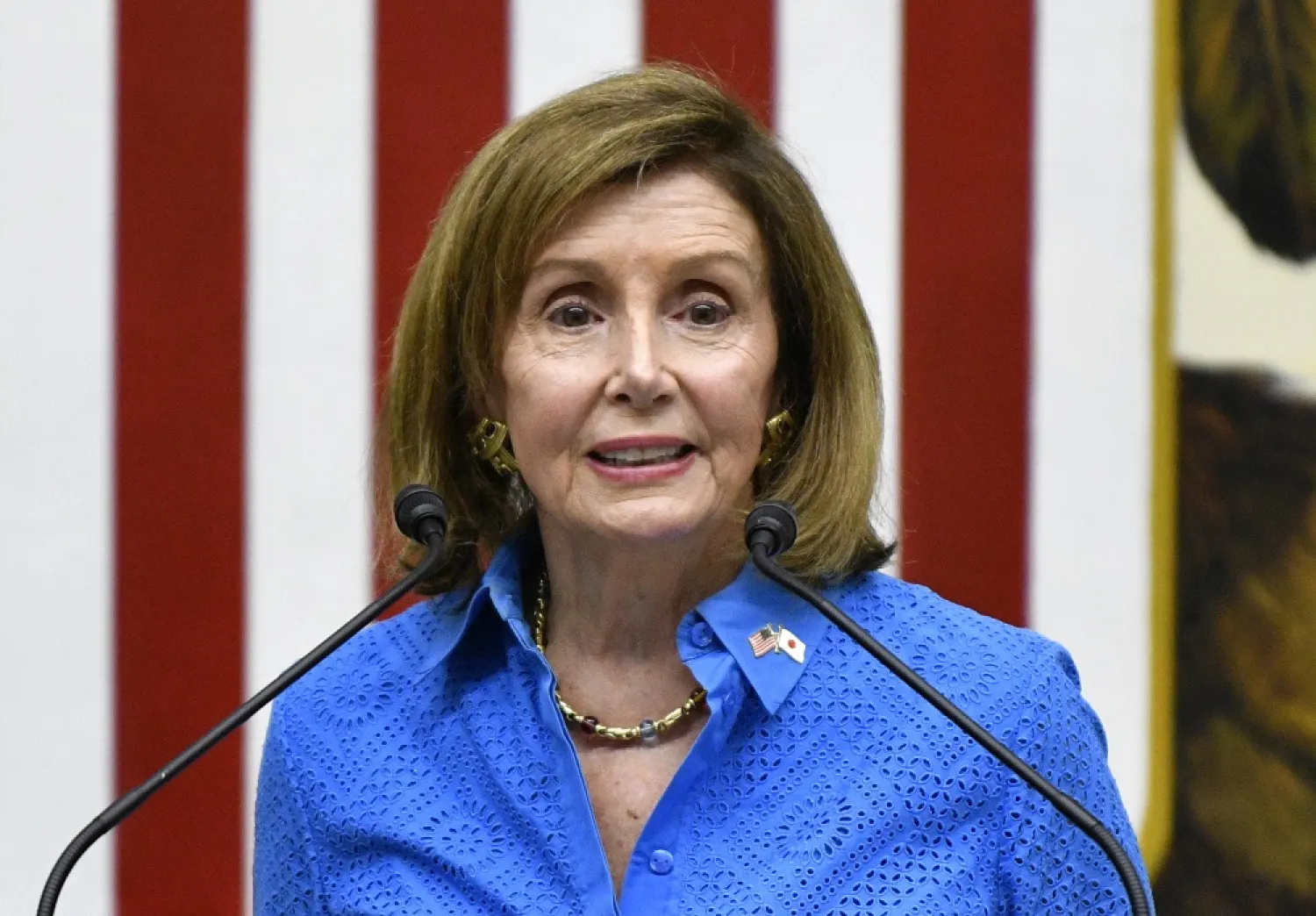
Nancy Pelosi speaks during a press conference at the US Embassy in Tokyo, Japan, 05 August 2022, after she had a breakfast meeting with Japanese Prime Minister Fumio Kishida. Pelosi is in Japan after she visited Singapore, Malaysia, Taiwan and South Korea with a congressional delegation. (EPA)
TT

Pelosi: China Cannot Stop US Officials from Visiting Taiwan

Nancy Pelosi speaks during a press conference at the US Embassy in Tokyo, Japan, 05 August 2022, after she had a breakfast meeting with Japanese Prime Minister Fumio Kishida. Pelosi is in Japan after she visited Singapore, Malaysia, Taiwan and South Korea with a congressional delegation. (EPA)

US House Speaker Nancy Pelosi said Friday that China will not isolate Taiwan by preventing US officials from traveling there.

She made the remarks in Tokyo on the final leg of an Asia tour highlighted by a visit to Taiwan that infuriated China.

The Chinese have tried to isolate Taiwan, Pelosi said, including most recently by preventing it from joining the World Health Organization.

“They may try to keep Taiwan from visiting or participating in other places, but they will not isolate Taiwan by preventing us to travel there,” she said.

Pelosi said her trip to Taiwan was not intended to change the status quo for the island but to maintain peace in the Taiwan Strait. She also praised Taiwan's hard-fought democracy, including its progress in diversity and success in technology and business, and criticized China's violations of trade agreements, proliferation of weapons and human rights problems.

Pelosi, the first House speaker to visit Taiwan in 25 years, said Wednesday in Taipei that the US commitment to democracy in the self-governing island and elsewhere “remains ironclad.”

Pelosi and five other members of Congress arrived in Tokyo late Thursday after visiting Singapore, Malaysia, Taiwan and South Korea.

China, which claims Taiwan and has threatened to annex it by force if necessary, called her visit to the island a provocation and on Thursday began military drills, including missile strike training, in six zones surrounding Taiwan, in what could be its biggest since the mid-1990s.

Earlier Friday, Japanese Prime Minister Fumio Kishida said that China's military exercises aimed at Taiwan represent a “grave problem” that threatens regional peace and security after five ballistic missiles launched as part of the drills landed in Japan's exclusive economic zone.

Kishida, speaking after breakfast with Pelosi and her congressional delegation, said the missile launches need to be “stopped immediately.”

In Taipei on Wednesday, Pelosi said the American commitment to democracy in Taiwan and elsewhere “remains ironclad.” She became the first House speaker to visit the island in 25 years.

Japanese Defense Minister Nobuo Kishi said five missiles landed on Thursday in Japan’s exclusive economic zone off Hateruma, an island far south of Japan’s main islands. He said Japan protested to China, saying the missiles “threatened Japan’s national security and the lives of the Japanese people, which we strongly condemn.”

Japanese Foreign Minister Yoshimasa Hayashi, attending a regional meeting in Cambodia, said China’s actions are “severely impacting peace and stability in the region and the international community, and we demand the immediate suspension of the military exercises.”

Japan has in recent years bolstered its defense capability and troop presence in southwestern Japan and remote islands, including Okinawa, which is about 700 kilometers (420 miles) northeast of Taiwan. Many residents say they worry their island will be quickly embroiled in any Taiwan conflict. Okinawa is home to the majority of about 50,000 American troops based in Japan under a bilateral security pact.

At the breakfast earlier Friday, Pelosi and her congressional delegation also discussed their shared security concern over China, North Korea and Russia, and pledged their commitment to working toward peace and stability in Taiwan, Kishida said. Pelosi was also to hold talks with her Japanese counterpart, lower house Speaker Hiroyuki Hosoda.

Japan and its key ally, the US, have been pushing for new security and economic frameworks with other democracies in the Indo-Pacific region and Europe as a counter to China’s growing influence amid rising tensions between Beijing and Taipei.

Days before Pelosi’s Taiwan visit, a group of senior Japanese lawmakers, including former Defense Minister Shigeru Ishiba, visited the island and discussed regional security with Taiwanese President Tsai Ing-wen. Ishiba said Japan, while working with the United States to prevent conflict in the Indo-Pacific, wants a defense agreement with Taiwan.

On Thursday, the foreign ministers of the Group of Seven industrialized nations issued a statement saying “there is no justification to use a visit as pretext for aggressive military activity in the Taiwan Strait.” It said China’s “escalatory response risks increasing tensions and destabilizing the region.”

China cited its displeasure over the statement for the last-minute cancellation of talks between the Chinese and Japanese foreign ministers on the sidelines of the Association of Southeast Asian Nations meeting in Cambodia on Thursday.

Pelosi held talks on Thursday in South Korea, also a key US ally, which stayed away from the Taiwan issue, apparently to avoid upsetting China, focusing instead on North Korea’s increasing nuclear threat.

In recent years, South Korea has been struggling to strike a balance between the United States and China as their rivalry has deepened.

The Chinese military exercises launched Thursday involve its navy, air force and other departments and are to last until Sunday. They include missile strikes on targets in the seas north and south of the island in an echo of the last major Chinese military drills in 1995 and 1996 aimed at intimidating Taiwan’s leaders and voters.

Taiwan has put its military on alert and staged civil defense drills, while the US has numerous naval assets in the area.

China also flew war planes toward Taiwan and blocked imports of its citrus and fish.

China sees the island as a breakaway province and considers visits to Taiwan by foreign officials as recognizing its sovereignty.

The Biden administration and Pelosi have said the United States remains committed to the so-called one-China policy, which recognizes Beijing as the government of China but allows informal relations and defense ties with Taipei. The administration discouraged but did not prevent Pelosi from visiting.

Pelosi has been a long-time advocate of human rights in China. She, along with other lawmakers, visited Beijing’s Tiananmen Square in 1991 to support democracy two years after a bloody military crackdown on protesters at the square.

As leader of the House of Representatives, Pelosi’s trip has heightened US-China tensions more than visits by other members of Congress. The last House speaker to visit Taiwan was Newt Gingrich in 1997.

China and Taiwan, which split in 1949 after a civil war, have no official relations but multibillion-dollar business ties.


Trump Says He Might Meet with North Korea’s Kim Jong Un in China

US President Donald Trump and North Korean leader Kim Jong Un shake hands before their one-on-one chat during the second US-North Korea summit at the Metropole Hotel in Hanoi, Vietnam February 27, 2019. (Reuters)
TT

Trump Says He Might Meet with North Korea’s Kim Jong Un in China

US President Donald Trump and North Korean leader Kim Jong Un shake hands before their one-on-one chat during the second US-North Korea summit at the Metropole Hotel in Hanoi, Vietnam February 27, 2019. (Reuters)

US President Donald Trump said on Monday he might meet with North Korean leader Kim Jong Un in China this week, an announcement that could dramatically reshape his upcoming trip through East Asia if it occurs.

The president, who met the North Korean leader several times during his 2017-2021 term, including once in the Korean Demilitarized Zone, has previously expressed ‌interest in ‌another meeting during his current term. Senior ‌US ⁠officials, however, have previously ⁠said he has no immediate plans to do so.

Moreover, Trump has repeatedly previewed meetings with Kim that never took place, including during a trip to Asia last year. North Korea, whose mission to the United Nations did not immediately respond to a ⁠request for comment, has publicly indicated it ‌has no intention of ‌meeting with the US president at this time.

Trump told reporters ‌while departing the White House en route to ‌the Philippines and China that any meeting would occur in China, and that the North Korean leader's presence was ultimately up to Chinese President Xi Jinping.

"(Xi) was here a ‌month ago, and we're also going to meet with (Russian) President Putin, and we ⁠may ⁠meet with Kim Jong Un also," Trump said.

"So that'll be good. We have a chance to accomplish a lot."

Trump has indicated he will meet with Putin and Xi during his trip, but US officials and analysts have played down the possibility of a meaningful agreement emerging from any trilateral sit-down.

Among the possible topics of conversation, Trump and others have said, are Russia's invasion of Ukraine, counterproliferation and the war in Iran.


Third US Aircraft Carrier Arrives in Middle East

This US Navy handout photograph released by US Naval Forces Central Command on November 4, 2026, shows the Nimitz-class aircraft carrier USS Theodore Roosevelt (CVN 71) sails alongside Royal Australian Navy Supply-class replenishment oiler HMAS Stalwart (A304). (AFP / NAVCENT Public Affairs / US Navy)
TT

Third US Aircraft Carrier Arrives in Middle East

This US Navy handout photograph released by US Naval Forces Central Command on November 4, 2026, shows the Nimitz-class aircraft carrier USS Theodore Roosevelt (CVN 71) sails alongside Royal Australian Navy Supply-class replenishment oiler HMAS Stalwart (A304). (AFP / NAVCENT Public Affairs / US Navy)

The USS Theodore Roosevelt aircraft carrier arrived in the Middle East on Sunday, media reports said, bringing the number of American carrier strike groups in the region to three.

The deployment, which was reported by the National News and Axios journalist Barak Ravid, comes as fighting reignites in the region, with Iran claiming a drone attack on Bahrain on Sunday, ending a lull in strikes in the war.

Iran also fired drones at Bahrain on Friday -- the first strikes since September against countries in the energy-rich Gulf, which has been targeted several times in the conflict that erupted in February.

US President Donald Trump plans to discuss the war at a trilateral meeting with his Chinese and Russian counterparts Xi Jinping and Vladimir Putin this week, an official said Friday.

Months of diplomacy have failed to resolve the war, which began with US-Israeli strikes that killed Iran's supreme leader Ali Khamenei.


US Airports Slowly Return to Normal After Three Days of Disruption

Passengers wait at Ronald Reagan Washington National Airport (DCA), in Arlington, Virginia, just outside Washington, DC, on November 14, 2026. (AFP)
TT

US Airports Slowly Return to Normal After Three Days of Disruption

Passengers wait at Ronald Reagan Washington National Airport (DCA), in Arlington, Virginia, just outside Washington, DC, on November 14, 2026. (AFP)

US air travel was slowly returning to normal on Monday after three days of widespread disruption following an extraordinary no-takeoff order issued by US aviation authorities.

The ground stop issued Friday afternoon was only the second time such a directive had been issued nationwide in the busy US airspace since planes were grounded following the 9/11 attacks, and was blamed by the Trump administration on a faulty upgrade to communications equipment.

On Monday morning, more than 250 US-related flights -- those traveling within, into or out of the United States -- scheduled for the same day were cancelled, according to industry tracker FlightAware.

That marked a dramatic shift from the more than 2,300 flights cancelled on Sunday.

There were delays to more than 700 US-related flights scheduled for Monday, compared to more than 10,000 the previous day.

The Trump administration sought to reassure weary flyers as questions remained over how such chaos could unfold in the world's largest economy, a country that prides itself on its technological prowess.

Throughout the weekend, stranded passengers wandered through chaotic airports and sat on floors, waiting for updates or to be rebooked.

Officials blamed Friday's colossal snafu on faulty work to upgrade air traffic control communication cables.

President Donald Trump on Sunday ended uncharacteristic days of silence on the ground stop, but only to blame his predecessor Joe Biden for the debacle.

Trump insisted he inherited a mess from the Biden administration and said Congress, which his party has controlled for two years, must approve funds to upgrade America's outdated air traffic control system.

"The Biden Administration was an FAA disaster," Trump said, referring to the Federal Aviation Administration.

"Everything they touched turned bad. Big money spent unwisely, making an old and broken system worse than when they began," Trump said.

FAA chief Bryan Bedford said Saturday that air travel for millions of Americans stranded at airports would return to normal by the close of business on Sunday.

But Transportation Secretary Sean Duffy said Sunday morning it will actually take longer to get planes, crews and travelers to where they need to be.

"We're going to see things come back to normal today, but probably fully normal tomorrow," Duffy said on ABC News.

"We had airplanes and crews out of position because of Friday, so it takes a little bit of time to do that."

- 'I'm the secretary' -

Duffy also rejected calls for his resignation over the travel chaos, insisting he inherited woefully outdated air traffic control infrastructure such as radar equipment that dates back to the 1960s.

"So when we do work and things go wrong, of course I'm the secretary. But I also have to acknowledge what was delivered to me," Duffy said in an interview on CNN.

The ground stop not only plunged US air travel into chaos, but it also raised serious concerns about the country's aging infrastructure.

Duffy has appealed for $50 billion in funds to upgrade and modernize the air traffic control system, and called for Congress, which controls the purse strings of the US government, to "meet this moment."

But Democrats quickly pounced to say Congress under Trump's Republicans could already have done this.