
Lebanon-Bound Ship Brings Hope, Not Solution to Food Crisis

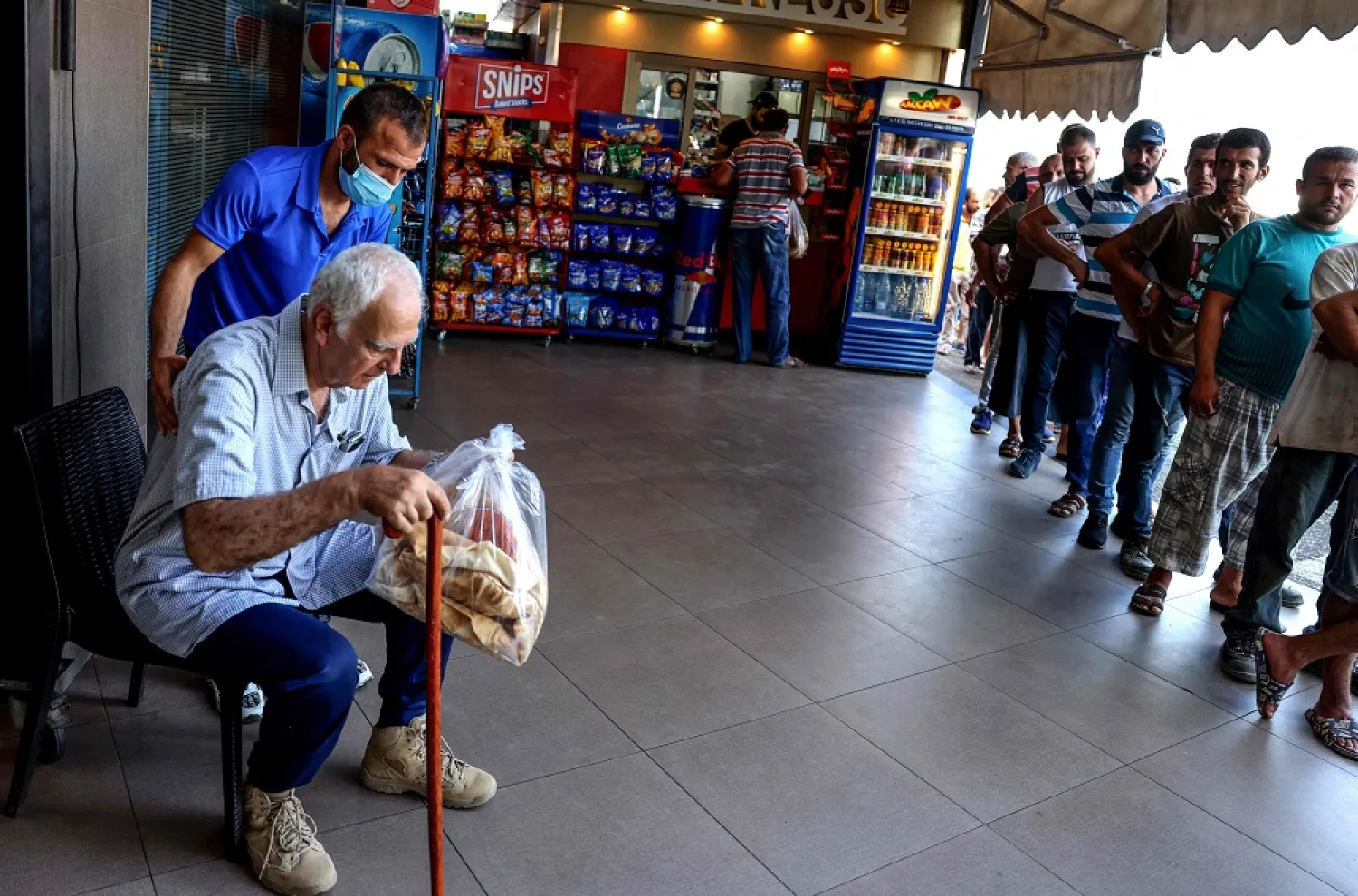
An elderly man rests outside after buying a bag of subsidized flatbread, as others continue to wait in a queue, in the Lebanese capital Beirut on July 29, 2022, amid a shortage of wheat supplies. (AFP)
TT

Lebanon-Bound Ship Brings Hope, Not Solution to Food Crisis

An elderly man rests outside after buying a bag of subsidized flatbread, as others continue to wait in a queue, in the Lebanese capital Beirut on July 29, 2022, amid a shortage of wheat supplies. (AFP)

A ship bringing corn to Lebanon’s northern port of Tripoli normally would not cause a stir. But it's getting attention because of where it came from: Ukraine’s Black Sea port of Odesa.

The Razoni, loaded with more than 26,000 tons of corn for chicken feed, is emerging from the edges of a Russian war that has threatened food supplies in countries like Lebanon, which has the world's highest rate of food inflation — a staggering 122% — and depends on the Black Sea region for nearly all of its wheat.

The fighting has trapped 20 million tons of grains inside Ukraine, and the Razoni's departure Monday marked a first major step toward extracting those food supplies and getting them to farms and bakeries to feed millions of impoverished people who are going hungry in Africa, the Middle East and parts of Asia.

“Actually seeing the shipment move is a big deal,” said Jonathan Haines, senior analyst at data and analytics firm Gro Intelligence. “This 26,000 tons in the scale of the 20 million tons that are locked up is nothing, absolutely nothing ... but if we start seeing this, every shipment that goes is going to increase confidence.”

The small scale means the initial shipments leaving the world's breadbasket will not draw down food prices or ease a global food crisis anytime soon. Plus, most of the trapped grain is for animal feed, not for people to eat, experts say. That will extend the war's ripple effects for the world’s most vulnerable people thousands of miles away in countries like Somalia and Afghanistan, where hunger could soon turn to famine and where inflation has pushed the cost of food and energy out of reach for many.

To farmers in Lebanon, the shipment expected this weekend is a sign that grains might become more available again, even if at a higher price, said Ibrahim Tarchichi, head of the Bekaa Farmers Association.

But he said it won’t make a dent in his country, where years of endemic corruption and political divides have upended life. Since 2019, the economy has contracted by at least 58%, with the currency depreciating so severely that half the population now lives in poverty.

“I think the crisis will continue as long as operating costs continue to soar and purchasing power falls,” Tarchichi said.

The strife was on sharp display this week when a section of Beirut’s massive port grain silos collapsed in a huge cloud of dust, two years after a massive explosion killed more than 200 people and wounded thousands of others.

While symbolic, the shipments have done little to cool market concerns. Drought and high fertilizer costs have kept grain prices more than 50% higher than early 2020, before the COVID-19 pandemic. And while Ukraine is a top supplier of wheat, barley, corn and sunflower oil to developing countries, it represents just 10% of the international wheat trade.

There’s also little to suggest that the world’s poorest who rely on Ukrainian wheat distributed through UN agencies like the World Food Program will be able to access them anytime soon. Before the war, half of the grain the World Food Program purchased for distribution came from Ukraine.

The Razoni's safe passage was guaranteed by a four-month-long deal brokered by the UN and Turkey with Ukraine and Russia two weeks ago. The grain corridor through the Black Sea is 111 nautical miles long and 3 nautical miles wide, with waters strewn with drifting explosive mines, slowing the work.

Three more ships departed Friday, heading to Turkey, Ireland and the United Kingdom. All the ships that have departed so far had been stuck there since the war began nearly six months ago.

Under the deal, some — not all — of the food exported will go to countries experiencing food insecurity. That means it could take weeks for people in Africa to see grain from the new shipments and even longer to see the effects on high food prices, said Shaun Ferris, a Kenya-based adviser on agriculture and markets for Catholic Relief Services, a partner in World Food Program distributions.

In East Africa, thousands of people have died as Somalia and neighboring Ethiopia and Kenya face the worst drought in four decades. Survivors have described burying their children as they fled to camps where little assistance could be found.

After Russia invaded Ukraine, Somalia and other African countries turned to non-traditional grain partners like India, Turkey and Brazil, but at higher prices. Prices of critical foods could start to go down in two or three months as markets for imported food adjust and local harvests progress, Ferris said.

Deciding who is first in line for the grain from Ukraine could be affected by humanitarian needs but could also come down to existing business arrangements and commercial interests, including who is willing to pay the most, Ferris said.

“Ukraine is not a charity,” he said. “It will be looking to get the best deals on the market” to maintain its own fragile economy.

The WFP said this week it’s planning to buy, load and ship 30,000 tons of wheat out of Ukraine on a UN-chartered vessel. It did not say where the vessel would go or when that voyage might happen.

In Lebanon, where Mercy Corps says the price of wheat flour has risen by more than 200% since the start of Russia’s war, people stood in long, often tense lines outside bakeries for subsidized bread in recent days.

The government green-lit a $150 million World Bank loan to import wheat, a temporary solution of six to nine months before it could be forced to lift subsidies on bread altogether.

While the situation is hard for millions of Lebanese, the country’s roughly 1 million Syrian refugees who fled a war across the border face stigmatization and discrimination trying to buy bread.

A Syrian living in northern Lebanon said it often takes him three to four visits to bakeries before he finds someone willing to sell him bread, with priority given to Lebanese. He described lines of 100 people waiting and only a handful being allowed in every half-hour to buy a small bundle of loaves.

“We get all sorts of rude comments because we’re Syrian, which we usually just ignore, but sometimes it gets too much and we decide to go home empty-handed,” he said, speaking on condition of anonymity for fear of reprisal.

In 'Big Trouble'? The Factors Determining Iran's Future

In this frame grab from video taken by an individual not employed by The Associated Press and obtained by the AP outside Iran shows people blocking an intersection during a protest in Tehran, Iran, Thursday Jan. 8, 2026. (UGC via AP)
TT

In 'Big Trouble'? The Factors Determining Iran's Future

In this frame grab from video taken by an individual not employed by The Associated Press and obtained by the AP outside Iran shows people blocking an intersection during a protest in Tehran, Iran, Thursday Jan. 8, 2026. (UGC via AP)

Over two weeks of protests mark the most serious challenge in years to Iran's theocratic leadership in their scale and nature but it is too early to predict the immediate demise of the Iranian republic, analysts say.

The demonstrations moved from protesting economic grievances to demanding a wholesale change from the clerical system that has ruled Iran since the 1979 revolution that ousted the shah.

The authorities have unleashed a crackdown that, according to rights groups, has left hundreds dead while the rule of supreme leader Ali Khamenei, now 86, remains intact.

"These protests arguably represent the most serious challenge to Iran in years, both in scale and in their increasingly explicit political demands," Nicole Grajewski, professor at the Sciences Po Centre for International Studies in Paris told AFP.

She said it was unclear if the protests would unseat the leadership, pointing to "the sheer depth and resilience of Iran's repressive apparatus".

The Iranian authorities have called their own counter rallies, with thousands attending on Monday.

Thomas Juneau, professor at the University of Ottawa, said: "At this point, I still don't assess that the fall of the regime is imminent. That said, I am less confident in this assessment than in the past."

These are the key factors seen by analysts as determining whether Iran’s leadership will hold on to power.

- Sustained protests -

A key factor is "simply the size of protests; they are growing, but have not reached the critical mass that would represent a point of no return," said Juneau.

The protest movement began with strikes at the Tehran bazaar on December 28 but erupted into a full-scale challenge with mass rallies in the capital and other cities from Thursday.

The last major protests were the 2022-2023 demonstrations sparked by the death in custody of Mahsa Amini who had been arrested for allegedly violating the dress code for women. In 2009, mass rallies took place after disputed elections.

But a multi-day internet shutdown imposed by Iranian authorities has hampered the ability to determine the magnitude of the current demonstrations, with fewer videos emerging.

Arash Azizi, a lecturer at Yale University, said "the protesters still suffer from not having durable organized networks that can withstand oppression".

He said one option would be to "organize strikes in a strategic sector" but this required leadership that was still lacking.

- Cohesion in the elite -

While the situation on the streets is of paramount importance, analysts say there is little chance of a change without cracks and defections in the security forces and leadership.

So far there has been no sign of this, with all the pillars of Iran from parliament to the president to the Revolutionary Guards (IRGC) lining up behind Khamenei's defiant line expressed in a speech on Friday.

"At present, there are no clear signs of military defections or high-level elite splits within the regime. Historically, those are critical indicators of whether a protest movement can translate into regime collapse," said Sciences Po's Grajewski.

Jason Brodsky, policy director at US-based group United Against Nuclear Iran, said the protests were "historic".

But he added: "It's going to take a few different ingredients for the regime to fall," including "defections in the security services and cracks in the Islamic republic's political elite".

Israeli or US military intervention

US President Donald Trump, who has threatened military retaliation over the crackdown, announced 25 percent tariffs on Monday against Iran's trading partners.

The White House said Trump was prioritizing a diplomatic response, and has not ruled out strikes, after having briefly joined Israel's 12-day war against Iran in June.

That war resulted in the killing of several top Iranian security officials, forced Khamenei to go into hiding and revealed Israel's deep intelligence penetration of Iran.

US strikes would upend the situation, analysts say.

The Iranian foreign ministry said on Monday it has channels of communication open with Washington despite the lack of diplomatic relations.

"A direct US military intervention would fundamentally alter the trajectory of the crisis," said Grajewski.

Juneau added: "The regime is more vulnerable than it has been, domestically and geopolitically, since the worst years of the Iran-Iraq war" that lasted from 1980-1988.

- Organized opposition -

The US-based son of the ousted shah, Reza Pahlavi, has taken a major role in calling for protests and pro-monarchy slogans have been common chants.

But with no real political opposition remaining inside Iran, the diaspora remains critically divided between political factions known for fighting each other as much as the Iranian republic.

"There needs to be a leadership coalition that truly represents a broad swathe of Iranians and not just one political faction," said Azizi.

- Khamenei's health -

Khamenei has now been in power since 1989 when he became supreme leader, a post for life, following the death of revolutionary founder Khomeini.

He survived the war with Israel and appeared in public on Friday to denounce the protests in typically defiant style.

But uncertainty has long reigned over who could succeed him, with options including his shadowy but powerful son Mojtaba or power gravitating to a committee rather than an individual.

Such a scenario between the status quo and a complete change could see "a more or less formal takeover by the Revolutionary Guards", said Juneau.


What to Know about the Protests Shaking Iran as Govt Shuts Down Internet and Phone Networks

Mourners carry coffins during a funeral procession for members of security forces and civilians said to be killed in protests on Sunday, amid evolving anti-government unrest, in Tehran, Iran, in this screengrab from a video released on January 11, 2026.  IRIB/Handout via REUTERS
Mourners carry coffins during a funeral procession for members of security forces and civilians said to be killed in protests on Sunday, amid evolving anti-government unrest, in Tehran, Iran, in this screengrab from a video released on January 11, 2026. IRIB/Handout via REUTERS
TT

What to Know about the Protests Shaking Iran as Govt Shuts Down Internet and Phone Networks

Mourners carry coffins during a funeral procession for members of security forces and civilians said to be killed in protests on Sunday, amid evolving anti-government unrest, in Tehran, Iran, in this screengrab from a video released on January 11, 2026.  IRIB/Handout via REUTERS
Mourners carry coffins during a funeral procession for members of security forces and civilians said to be killed in protests on Sunday, amid evolving anti-government unrest, in Tehran, Iran, in this screengrab from a video released on January 11, 2026. IRIB/Handout via REUTERS

Nationwide protests in Iran sparked by the country’s ailing economy are putting new pressure on its theocracy as it has shut down the internet and telephone networks.

Tehran is still reeling from a 12-day war launched by Israel in June that saw the United States bomb nuclear sites in Iran. Economic pressure, which has intensified since September when the United Nations reimposed sanctions on the country over its atomic program, has sent Iran's rial currency into a free fall, now trading at over 1.4 million to $1.

Meanwhile, Iran's self-described “Axis of Resistance” — a coalition of countries and militant groups backed by Tehran — has been decimated since the start of the Israel-Hamas war in 2023.

A threat by US President Donald Trump warning Iran that if Tehran “violently kills peaceful protesters” the US “will come to their rescue," has taken on new meaning after American troops captured Venezuela's Nicolás Maduro, a longtime ally of Tehran.

“We're watching it very closely,” Trump has warned. “If they start killing people like they have in the past, I think they're going to get hit very hard by the United States.”

Here's what to know about the protests and the challenges facing Iran's government.

How widespread the protests are

More than 500 protests have taken place across all of Iran’s 31 provinces, the US-based Human Rights Activists News Agency reported early Monday. The death toll had reached at least 544, it said, with more than 10,600 arrests. The group relies on an activist network inside of Iran for its reporting and has been accurate in past unrest.

The Iranian government has not offered overall casualty figures for the demonstrations. The Associated Press has been unable to independently assess the toll, given that internet and international phone calls are now blocked in Iran.

Understanding the scale of the protests has been difficult. Iranian state media has provided little information about the demonstrations. Online videos offer only brief, shaky glimpses of people in the streets or the sound of gunfire. Journalists in general in Iran also face limits on reporting such as requiring permission to travel around the country, as well as the threat of harassment or arrest by authorities. The internet shutdown has further complicated the situation.

But the protests do not appear to be stopping, even after Supreme Leader Ali Khamenei said “rioters must be put in their place.”

Why the demonstrations started

The collapse of the rial has led to a widening economic crisis in Iran. Prices are up on meat, rice and other staples of the Iranian dinner table. The nation has been struggling with an annual inflation rate of some 40%.

In December, Iran introduced a new pricing tier for its nationally subsidized gasoline, raising the price of some of the world’s cheapest gas and further pressuring the population. Tehran may seek steeper price increases in the future, as the government now will review prices every three months.

Meanwhile, food prizes are expected to spike after Iran’s Central Bank in recent days ended a preferential, subsidized dollar-rial exchange rate for all products except medicine and wheat.

The protests began in late December with merchants in Tehran before spreading. While initially focused on economic issues, the demonstrations soon saw protesters chanting anti-government statements as well. Anger has been simmering over the years, particularly after the 2022 death of 22-year-old Mahsa Amini in police custody that triggered nationwide demonstrations.

Some have chanted in support of Iran's exiled Crown Prince Reza Pahlavi, who called for protests Thursday and Friday night.

Iran's alliances are weakened

Iran's “Axis of Resistance," which grew in prominence in the years after the 2003 US-led invasion and subsequent occupation of Iraq, is reeling.

Israel has crushed Hamas in the devastating war in the Gaza Strip. Hezbollah, the Shiite militant group in Lebanon, has seen its top leadership killed by Israel and has been struggling since. A lightning offensive in December 2024 overthrew Iran’s longtime stalwart ally and client in Syria, President Bashar Assad, after years of war there. Yemen's Iranian-backed Houthis also have been pounded by Israeli and US airstrikes.

China meanwhile has remained a major buyer of Iranian crude oil, but hasn't provided overt military support. Neither has Russia, which has relied on Iranian drones in its war on Ukraine.

The West worries about Iran’s nuclear program Iran has insisted for decades that its nuclear program is peaceful. However, its officials have increasingly threatened to pursue a nuclear weapon. Iran had been enriching uranium to near weapons-grade levels before the US attack in June, making it the only country in the world without a nuclear weapons program to do so.

Tehran also increasingly cut back its cooperation with the International Atomic Energy Agency, the UN's nuclear watchdog, as tensions increased over its nuclear program in recent years. The IAEA's director-general has warned Iran could build as many as 10 nuclear bombs, should it decide to weaponize its program.

US intelligence agencies have assessed that Iran has yet to begin a weapons program, but has “undertaken activities that better position it to produce a nuclear device, if it chooses to do so.”

Iran recently said it was no longer enriching uranium at any site in the country, trying to signal to the West that it remains open to potential negotiations over its atomic program to ease sanctions. But there's been no significant talks in the months since the June war.

Why relations between Iran and the US are so tense

Iran decades ago was one of the United States’ top allies in the Mideast under Shah Mohammad Reza Pahlavi, who purchased American military weapons and allowed CIA technicians to run secret listening posts monitoring the neighboring Soviet Union. The CIA fomented a 1953 coup that cemented the shah’s rule.

But in January 1979, the shah fled Iran as mass demonstrations swelled against his rule. Then came the Iranian Revolution led by Khomeini, which created Iran’s theocratic government.

Later that year, university students overran the US Embassy in Tehran, seeking the shah’s extradition and sparking the 444-day hostage crisis that saw diplomatic relations between Iran and the US severed.

During the Iran-Iraq war of the 1980s, the US backed Saddam Hussein. During that conflict, the US launched a one-day assault that crippled Iran at sea as part of the so-called “Tanker War,” and later shot down an Iranian commercial airliner that the US military said it mistook for a warplane.

Iran and the US have seesawed between enmity and grudging diplomacy in the years since. Relations peaked with the 2015 nuclear deal, which saw Iran greatly limit its program in exchange for the lifting of sanctions. But Trump unilaterally withdrew America from the accord in 2018, sparking tensions in the Mideast that intensified after Hamas' Oct. 7, 2023, attack on Israel.


How the US Could Take Over Greenland and the Potential Challenges

05 February 2025, Greenland, Nuuk: Greenlandic flags fly in front of the Inatsisartut parliament in the capital Nuuk. (dpa)
TT

How the US Could Take Over Greenland and the Potential Challenges

05 February 2025, Greenland, Nuuk: Greenlandic flags fly in front of the Inatsisartut parliament in the capital Nuuk. (dpa)

US President Donald Trump wants to own Greenland. He has repeatedly said the United States must take control of the strategically located and mineral-rich island, which is a semiautonomous region that's part of NATO ally Denmark.

Officials from Denmark, Greenland and the United States met Thursday in Washington and will meet again next week to discuss a renewed push by the White House, which is considering a range of options, including using military force, to acquire the island.

Trump said Friday he is going to do “something on Greenland, whether they like it or not.”

If it's not done “the easy way, we're going to do it the hard way," he said without elaborating what that could entail. In an interview Thursday, he told The New York Times that he wants to own Greenland because “ownership gives you things and elements that you can’t get from just signing a document.”

Danish Prime Minister Mette Frederiksen has warned that an American takeover of Greenland would mark the end of NATO, and Greenlanders say they don't want to become part of the US.

This is a look at some of the ways the US could take control of Greenland and the potential challenges.

Military action could alter global relations

Trump and his officials have indicated they want to control Greenland to enhance American security and explore business and mining deals. But Imran Bayoumi, an associate director at the Atlantic Council’s Scowcroft Center for Strategy and Security, said the sudden focus on Greenland is also the result of decades of neglect by several US presidents towards Washington's position in the Arctic.

The current fixation is partly down to “the realization we need to increase our presence in the Arctic, and we don’t yet have the right strategy or vision to do so,” he said.

If the US took control of Greenland by force, it would plunge NATO into a crisis, possibly an existential one.

While Greenland is the largest island in the world, it has a population of around 57,000 and doesn't have its own military. Defense is provided by Denmark, whose military is dwarfed by that of the US.

It's unclear how the remaining members of NATO would respond if the US decided to forcibly take control of the island or if they would come to Denmark's aid.

“If the United States chooses to attack another NATO country militarily, then everything stops,” Frederiksen has said.

Trump said he needs control of the island to guarantee American security, citing the threat from Russian and Chinese ships in the region, but “it's not true” said Lin Mortensgaard, an expert on the international politics of the Arctic at the Danish Institute for International Studies, or DIIS.

While there are probably Russian submarines — as there are across the Arctic region — there are no surface vessels, Mortensgaard said. China has research vessels in the Central Arctic Ocean, and while the Chinese and Russian militaries have done joint military exercises in the Arctic, they have taken place closer to Alaska, she said.

Bayoumi, of the Atlantic Council, said he doubted Trump would take control of Greenland by force because it’s unpopular with both Democratic and Republican lawmakers, and would likely “fundamentally alter” US relationships with allies worldwide.

The US already has access to Greenland under a 1951 defense agreement, and Denmark and Greenland would be “quite happy” to accommodate a beefed-up American military presence, Mortensgaard said.

For that reason, “blowing up the NATO alliance” for something Trump has already, doesn’t make sense, said Ulrik Pram Gad, an expert on Greenland at DIIS.

Bilateral agreements may assist effort

US Secretary of State Marco Rubio told a select group of US lawmakers this week that it was the Republican administration’s intention to eventually purchase Greenland, as opposed to using military force. Danish and Greenlandic officials have previously said the island isn't for sale.

It's not clear how much buying the island could cost, or if the US would be buying it from Denmark or Greenland.

Washington also could boost its military presence in Greenland “through cooperation and diplomacy,” without taking it over, Bayoumi said.

One option could be for the US to get a veto over security decisions made by the Greenlandic government, as it has in islands in the Pacific Ocean, Gad said.

Palau, Micronesia and the Marshall Islands have a Compact of Free Association, or COFA, with the US.

That would give Washington the right to operate military bases and make decisions about the islands’ security in exchange for US security guarantees and around $7 billion of yearly economic assistance, according to the Congressional Research Service.

It's not clear how much that would improve upon Washington's current security strategy. The US already operates the remote Pituffik Space Base in northwestern Greenland and can bring as many troops as it wants under existing agreements.

Influence operations expected to fail

Greenlandic politician Aaja Chemnitz told The Associated Press that Greenlanders want more rights, including independence, but don't want to become part of the US.

Gad suggested influence operations to persuade Greenlanders to join the US would likely fail. He said that is because the community on the island is small and the language is “inaccessible.”

Danish Foreign Minister Lars Løkke Rasmussen summoned the top US official in Denmark in August to complain that “foreign actors” were seeking to influence the country’s future. Danish media reported that at least three people with connections to Trump carried out covert influence operations in Greenland.

Even if the US managed to take control of Greenland, it would likely come with a large bill, Gad said. That’s because Greenlanders currently have Danish citizenship and access to the Danish welfare system, including free health care and schooling.

To match that, “Trump would have to build a welfare state for Greenlanders that he doesn’t want for his own citizens,” Gad said.

Disagreement unlikely to be resolved

Since 1945, the American military presence in Greenland has decreased from thousands of soldiers over 17 bases and installations to 200 at the remote Pituffik Space Base in the northwest of the island, Rasmussen said last year. The base supports missile warning, missile defense and space surveillance operations for the US and NATO.

US Vice President JD Vance told Fox News on Thursday that Denmark has neglected its missile defense obligations in Greenland, but Mortensgaard said that it makes “little sense to criticize Denmark,” because the main reason why the US operates the Pituffik base in the north of the island is to provide early detection of missiles.

The best outcome for Denmark would be to update the defense agreement, which allows the US to have a military presence on the island and have Trump sign it with a “gold-plated signature,” Gad said.

But he suggested that's unlikely because Greenland is “handy” to the US president.

When Trump wants to change the news agenda — including distracting from domestic political problems — “he can just say the word ‘Greenland’ and this starts all over again,” Gad said.