Erdogan Says Putin Asked Him to Cooperate with Assad Regime https://english.aawsat.com/home/article/3802451/erdogan-says-putin-asked-him-cooperate-assad-regime
Erdogan Says Putin Asked Him to Cooperate with Assad Regime
Turkish President Recep Tayyip Erdogan and Russian counterpart Vladimir Putin... Close Relations and Coordination in Syria (DPA)
Turkish President Recep Tayyip Erdogan said Saturday that his Russian counterpart Vladimir Putin asked him to cooperate with Bashar al-Assad’s regime to resolve the Syrian crisis.
He assured Putin that the Turkish intelligence service is cooperating with the Syrian intelligence in this regard, but what is important is the outcome of this coordination.
“As long as the two intelligence services are working on the matter, we need Russia’s support, and there are agreements and understandings between the two countries in this regard.”
Erdogan made the remarks from the plane on his way back to Turkey, a day after the two leaders met at the Russian Black Sea resort of Sochi.
The meeting reaffirmed the divergence of positions between the two sides and underscored Moscow’s rejection of a possible Turkish military operation in northern Syria.
Erdogan said Putin adheres to a “fair approach” to Turkey on the Syrian issue and supports Ankara in the fight against terrorism.
The Turkish leader said he discussed with his Russian counterpart the possibility of carrying out a cross-border operation in Syria.
He pointed to their discussion on steps to be taken against terrorist organizations in Syria and agreed to take necessary actions to protect the country’s territorial integrity.
“We agreed on the decision to grant Turkey the right to respond to attacks on its security forces and squadrons of killers who attack civilian citizens,” Erdogan stressed.
In a statement issued after the talks that lasted four hours, Putin and Erdogan underlined the “key importance of sincere, frank and trusting ties between Russia and Turkey for regional and global stability.”
Since May, Erdogan has been talking about Turkey’s plans to launch a new military operation in Syria against the Syrian Kurdish People's Protection Units (YPG) in an effort to link up two areas already under Turkish control in the northern region near the Turkish border.
Erdogan said the aim is to create a 30-km safe zone along the Turkish border with Syria.
Ankara sees the YPG as the Syrian offshoot of the Kurdistan Workers' Party (PKK), listed as a terrorist organization by Turkey, the US, and the EU. The PKK has been rebelling against the Turkish government for over 30 years.
However, the United States and European countries rejected such step, and so did Russia and Iran, which support the Syrian regime.
Israel Will ‘Finish Job’ in Gaza and Remove Palestinians, Says Defense Ministerhttps://english.aawsat.com/arab-world/5318859-israel-will-%E2%80%98finish-job%E2%80%99-gaza-and-remove-palestinians-says-defense-minister
People gather as Civil Defense workers attempt to rescue those who are trapped beneath the rubble of a residential building that had been damaged in an earlier Israeli strike during the war and collapsed on Wednesday, in Gaza City, September 16, 2026. (Reuters)
TT
TT
Israel Will ‘Finish Job’ in Gaza and Remove Palestinians, Says Defense Minister
People gather as Civil Defense workers attempt to rescue those who are trapped beneath the rubble of a residential building that had been damaged in an earlier Israeli strike during the war and collapsed on Wednesday, in Gaza City, September 16, 2026. (Reuters)
Israel's defense minister said Wednesday it was only a matter of time before the country resumes full-scale war in Gaza and moves to force out its two million Palestinians.
Israel Katz, who is known for outspoken remarks, was responding to criticism from another right-wing contender ahead of October 27 elections.
Katz said 70 percent of Gaza had already been emptied of its population in the Israeli offensive launched after the October 7, 2023 attack by Hamas.
He said that an October 2025 ceasefire announced by US President Donald Trump had "supreme value for all Israelis" by leading to the return of remaining hostages and ensuring "a commitment by the United States" to disarming Hamas.
"We all understand that this is not going to happen -- and the army is prepared, once given the directive to eliminate Hamas, to finish the job so that we can also implement the migration plan," Katz said in a statement.
He said earlier this month that Israel was ready to remove Palestinians from Gaza by sea and land but was waiting for the United States, which he said was discussing where the two million people would go.
US Ambassador Mike Huckabee has denied any plan to "displace people out of Gaza against their will".
Katz had described the migration plan as voluntary, saying most Palestinians wanted to leave.
Nearly all of Gaza's population has been internally displaced and most of the territory lies in rubble after the war.
The Hamas-led attack of October 7, 2023 killed 1,221 people, according to an AFP tally based on Israeli official figures, the deadliest attack ever against Israel.
Gunmen also took 251 hostages to Gaza.
Israel's retaliatory military campaign in Gaza has killed more than 73,700 people, according to the territory's health ministry, which operates under Hamas authority and does not distinguish between combatants and civilians, and whose figures are considered reliable by the United Nations.
While the 11-month-old ceasefire has reduced the level of violence, Israel has still regularly carried out strikes in Gaza.
A total of 1,375 Palestinians have been killed since the ceasefire came into effect, according to the Gaza health ministry.
Hamas said in late July that it was ready to disarm, in what Trump hailed as a breakthrough.
Israeli Prime Minister Benjamin Netanyahu has rejected the latest stage of the plan and said there would be no Israeli withdrawal from Gaza until Hamas verifiably decommissions all weapons.
Lebanese President Aiming for Achievements in Negotiations, Deals Cautiously with De-Escalation in Southhttps://english.aawsat.com/arab-world/5318852-lebanese-president-aiming-achievements-negotiations-deals-cautiously-de
A handout photo made available by the Lebanese Presidency press office shows Lebanese President Joseph Aoun (4-L) during a visit to southern Lebanon, 12 September 2026. (Lebanese Presidency press office)
Lebanese President Aiming for Achievements in Negotiations, Deals Cautiously with De-Escalation in South
A handout photo made available by the Lebanese Presidency press office shows Lebanese President Joseph Aoun (4-L) during a visit to southern Lebanon, 12 September 2026. (Lebanese Presidency press office)
Lebanese authorities are cautiously approaching Israeli leaks that its forces are going to withdraw from some areas in southern Lebanon. However, the American mediator has not conveyed any confirmed information about this to Beirut.
A senior official Lebanese source said the discrepancy between the political and military powers in Israel about remaining in Lebanon “does not mean things are running smoothly, given the ongoing stalemate on the negotiation track.”
The source explained that Israel's failure to facilitate the negotiation process has downgraded the talks to the ambassador level, as is currently happening in Washington. Consequently, there is no party capable of lending credibility to any contrary indicators on the ground.
Meanwhile, Israeli attacks around the Ali al-Taher region have continued, with decreased intensity, after the detonation of its tunnel network. This coincided with Israeli leaks by Channel 12, which is close to military and security circles, about Tel Aviv's readiness to withdraw toward a “gray line.”
The leaks were followed by Israeli Defense Minister Israel Katz saying that the withdrawal from southern Lebanon should be preceded with the disarmament of Hezbollah.
However, the developments on the ground seem to contradict his words. Field sources in the South told Asharq Al-Awsat that Israeli forces have left the Ali al-Taher ridge area and kept their troops at the Beaufort Castle.
The sources said the town of Kfar Tebnit, strategically located between Ali al-Taher and the castle, has also become clear of any Israeli presence. The forces have also completed a military road connecting Beaufort Castle to Israeli positions south of the Litani River, bypassing other Lebanese villages north of the river where Israeli forces are currently present.
The sources go even further, noting that the situation on the ground “does not indicate, as of yet, any Israeli intention for a larger escalation around Nabatieh, judging by the size of the forces Israel is mobilizing in the area and its field operations.”
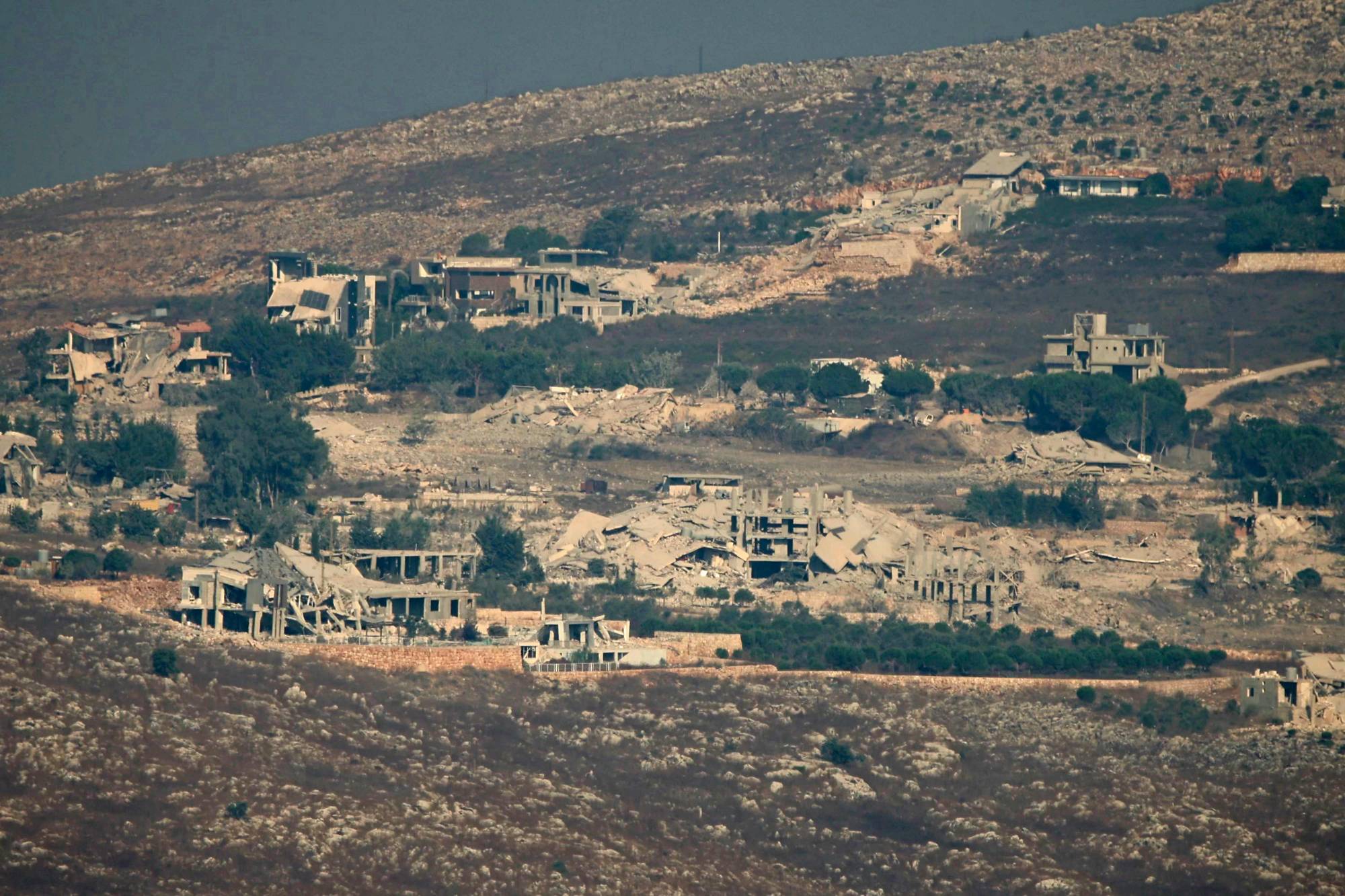
A picture shows destroyed houses in the southern Lebanese village of Kfar Tebnit on September 11, 2026, following an Israeli demolition on the Ali al-Taher ridge. (AFP)
Ali al-Taher and negotiations
After the Ali al-Taher detonation, Lebanese Army Commander Rodolphe Haykal contacted officials at the US Central Command to declare that the military was ready to deploy in the area, an official Lebanese source told Asharq Al-Awsat.
The Americans then relayed the information to the Israeli Northern Command, which said that it would prefer that the issue be addressed at the next round of political negotiations between Beirut and Tel Aviv, revealed the source.
The talks are set for early October after Lebanese President Joseph Aoun requested from the Americans that they be postponed from mid-September.
The source said he asked for the delay because the Israelis were not receptive to Lebanese demands and due to their military escalation, the latest of which was the detonation at Ali al-Taher.
Aoun demanded a specific agenda that allows for actual progress in the negotiations, because he considers that there is no point in “negotiating merely for a photo-op.”
He revealed that Aoun had instructed Lebanese Ambassador to the US Nada Moawad, who will meet with her Israeli counterpart in Washington on Wednesday, to urge progress in consolidating the ceasefire and completing the release of Lebanese prisoners.
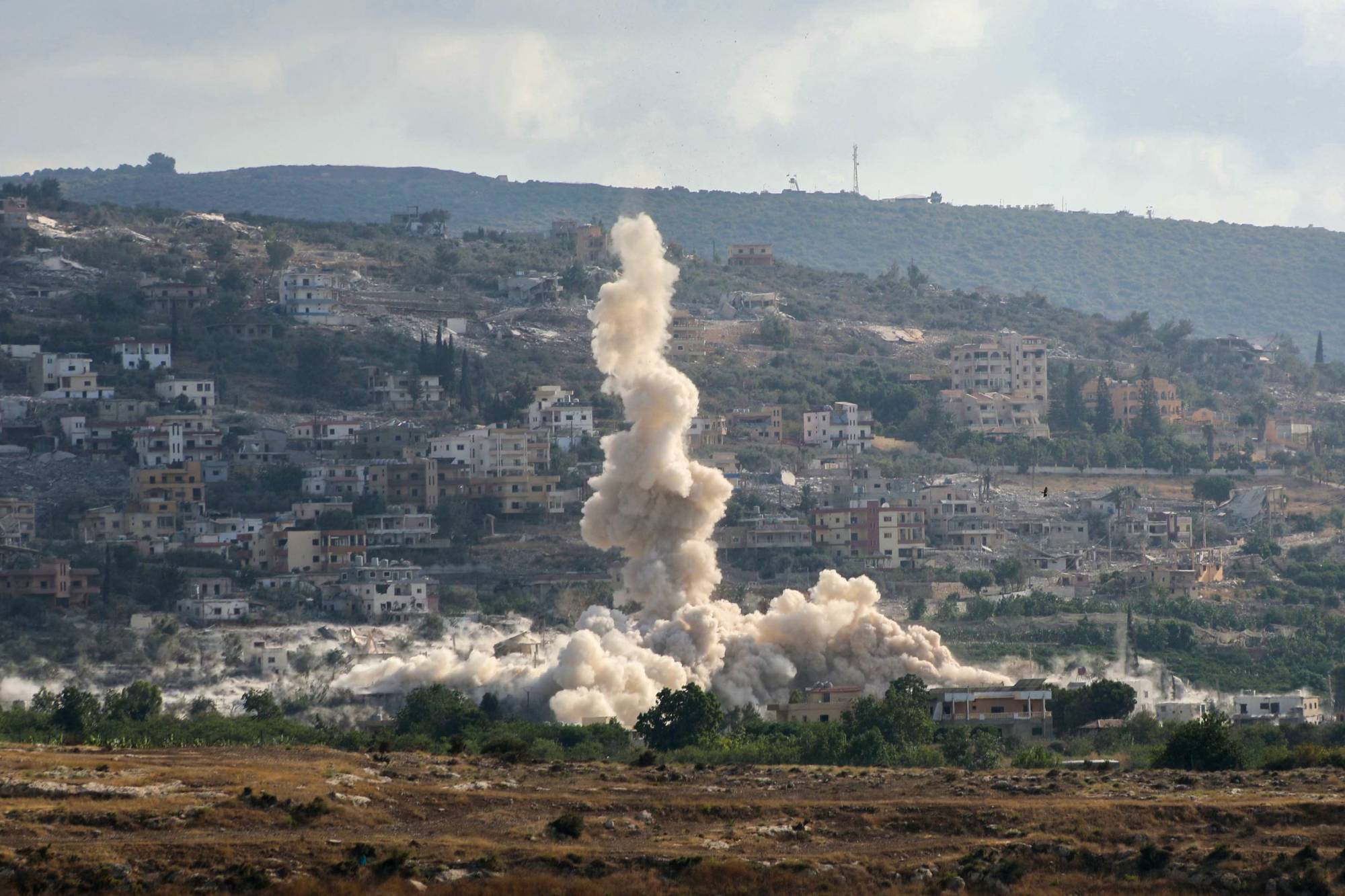
This photograph taken from the southern Lebanese village of al Hanniyeh shows smoke as it rises from the site of an Israeli-controlled explosion in the nearby village of Al-Mansouri on September 6, 2026. (AFP)
Tyre visit
The source said that Aoun’s recent visit to Nabatieh will be followed by one to the coastal city of Tyre.
It said that Aoun was “deeply pained” at the sight of the destruction in Nabatieh despite knowing what to expect. He then urged official circles to intensify their efforts and restore state institutions in the city and other southern regions.
He requested the relevant ministries to intensify their work in the city to support the steadfastness of its residents, who “want nothing but safety, security, and a decent life in their homes.”
Aoun requested the acceleration of the reconstruction process for the government building in the city following the destruction it sustained. He requested speeding up the disbursement of the $3 million allocated by the government for this purpose, out of concern that administrative red tape might delay it longer than necessary, said the source.
Additionally, he requested the Ministry of Finance to allocate a piece of land it owns in the city to rebuild a center for the State Security apparatus, as an alternative to a center that was also destroyed by Israeli airstrikes.
Aoun believes that the return of the state to the South “must be effective, and across all sectors, not just security.”
Ties with Hezbollah remain severed
Ties between Aoun and Hezbollah remain severed as demonstrated by the party boycotting the president’s visit and later slandering it.
The party criticizes Aoun for not being “considerate enough” of the Shiite community, Hezbollah’s main support base, that has paid heavily in the war.
Aoun's relationship with Hezbollah, since he was the army commander, has been based on “advice” and warnings that the party has not heeded. This began with the Al-Aqsa Flood Operation in Gaza in 2023, the party's decision to open a “support front” in solidarity with Hamas a day later and its decision in March to open another front, this time in support of Iran in the US-Israel war against it.
On both occasions, Aoun urged Hezbollah against engaging in the war, but the party ignored him.
On Ali al-Taher, Aoun managed to acquire through US Secretary of State Marco Rubio Israel’s approval that its forces will not advance on it, in exchange for the Lebanese army to deploy there instead. Hezbollah, through a mediator, initially agreed to the proposal, but later announced that neither the Lebanese nor Israeli forces would be allowed to enter the tunnels.
As of yet, Aoun has not understood why Hezbollah would prefer to hand over the position to the Israelis rather than the Lebanese army, knowing that the Lebanese choice would protect Nabatieh and the surrounding areas.
Iraq Reaffirms Ongoing Hunt for Those Behind Attacks on Saudi Arabiahttps://english.aawsat.com/arab-world/5318840-iraq-reaffirms-ongoing-hunt-those-behind-attacks-saudi-arabia
Iraq Reaffirms Ongoing Hunt for Those Behind Attacks on Saudi Arabia
Civilians and security personnel on the Iraqi side of the Shalamja border crossing. (AFP)
Iraqi security authorities on Tuesday reiterated that they would continue pursuing those who launched explosive-laden drones against neighboring countries, saying investigations were ongoing to identify those behind attacks on Saudi territory.
Lt. Gen. Saad Maan, head of Iraq’s Security Media Cell, said an intelligence committee had located the launch site inside Iraq.
“The investigation is ongoing, with the use of intelligence and technical capabilities, forensic evidence, fingerprints and other details needed to complete the investigation and identify those who committed this act,” Maan told the state news agency.
Prime Minister Ali al-Zaidi had relieved the commander of operations in the southern province of Maysan of his duties and dismissed the provincial police chief and other security officials after it was established that the attacks targeting Saudi Arabia had been launched from a site in the province.
Maan said the priority was to identify the perpetrators, stressing that Iraq would not allow attacks on countries in the region. He said Baghdad had contacted Saudi authorities to explain the measures taken by the government.
Iran later formally asked Iraq to participate in the investigation, a request Zaidi approved, according to the government’s military spokesman.
Talabani-Araghchi Talks
Separately, Patriotic Union of Kurdistan President Bafel Talabani held a series of meetings with Iranian leaders during a visit to Tehran on Tuesday, beginning with Foreign Minister Abbas Araghchi.
Iranian Foreign Ministry spokesman Esmaeil Baghaei said the visit, made at Araghchi’s invitation, was part of Iran’s continuing consultations with the Iraqi government and the Kurdistan Regional Government to expand bilateral relations and strengthen regional peace and stability, economic cooperation and border security.
Talabani’s visit came a day after several areas of Sulaymaniyah, the PUK’s stronghold, were hit by five missiles believed to be Iranian, leading sources and observers to suggest that the visit would focus on security.
A PUK statement said Talabani and Araghchi discussed the latest developments in the region.
A senior Kurdish source said Talabani was expected to raise a broad range of security, political and economic issues.
The source said security remained a priority because of repeated attacks by Iran and its allied factions in Iraq on the Kurdistan Region, ostensibly over the presence of Iranian Kurdish parties there.
At least six Iranian Kurdish opposition parties operate in Iraqi Kurdistan, including the Kurdistan Democratic Party of Iran, the Party for a Free Life in Kurdistan (PJAK) and Komala. They agreed earlier this year to coordinate under the Coalition of Political Forces of Iranian Kurdistan.
The source said Talabani could ask Tehran to press its factions and allies in Iraq to reduce pressure and attacks on the region.
Baghdad and Tehran signed a security agreement in 2023 aimed at securing their shared border and neutralizing Iranian opposition groups in Iraqi Kurdistan, including by closing and relocating their bases about 50 kilometers from the Iranian border. Those measures, however, have not prevented continued Iranian attacks on the Kurdistan Region.
لم تشترك بعد
انشئ حساباً خاصاً بك لتحصل على أخبار مخصصة لك ولتتمتع بخاصية حفظ المقالات وتتلقى نشراتنا البريدية المتنوعة