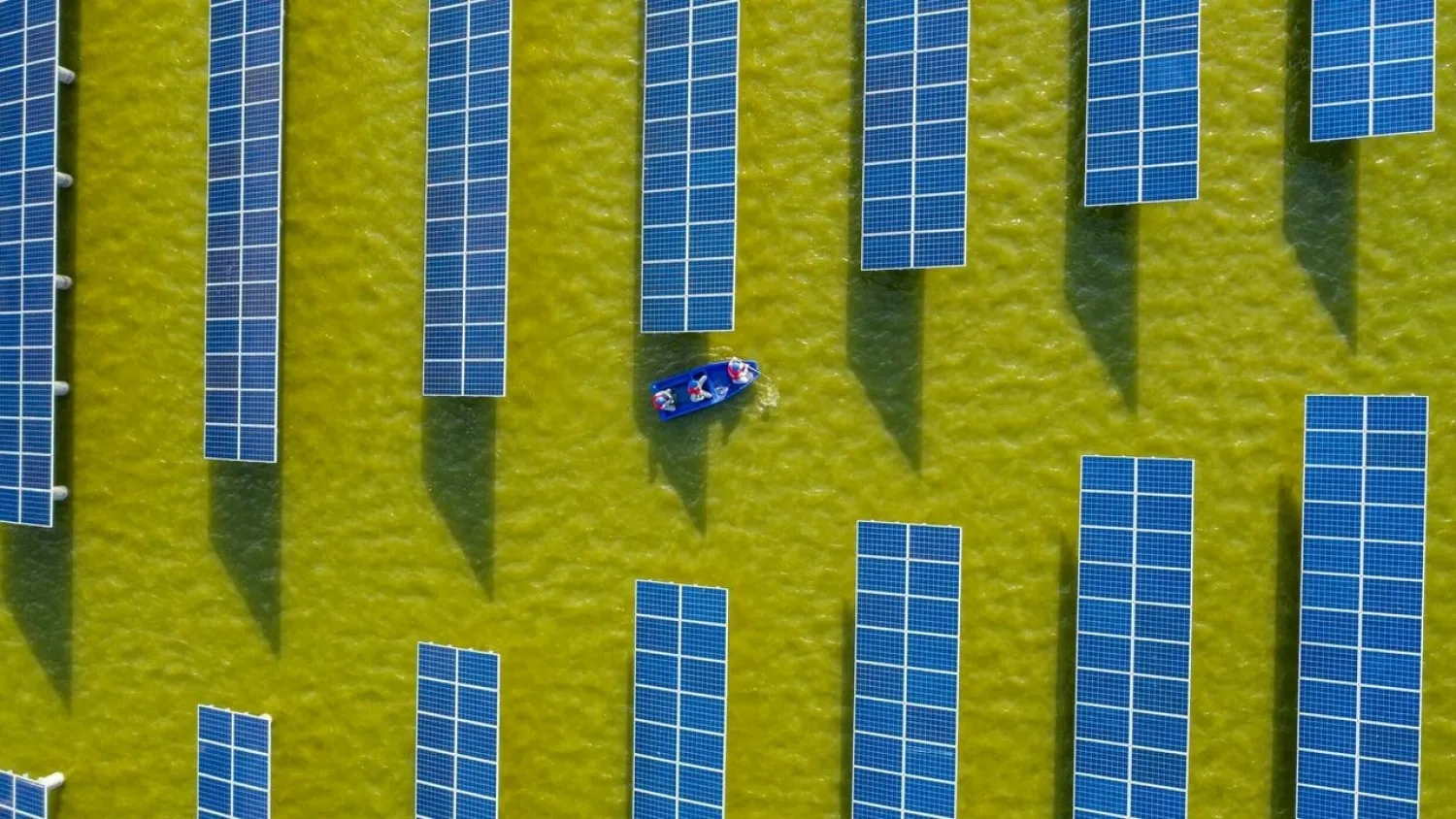

Cheaper, Changing and Crucial: The Rise of Solar Power

China is the world's biggest producer of solar technology STR AFP/File
TT

Cheaper, Changing and Crucial: The Rise of Solar Power

China is the world's biggest producer of solar technology STR AFP/File

Generating power from sunlight bouncing off the ground, working at night, even helping to grow strawberries: solar panel technology is evolving fast as costs plummet for a key segment of the world's energy transition.

The International Energy Agency says solar will have to scale up significantly this decade to meet the Paris climate target of limiting temperature rises to 1.5 degrees Celsius above pre-industrial levels.

The good news is that costs have fallen dramatically, AFP said.

In a report on solutions earlier this year, the Intergovernmental Panel on Climate Change said solar unit costs had dropped 85 percent between 2010 and 2019, while wind fell 55 percent.

"There's some claim that it's the cheapest way humans have ever been able to make electricity at scale," said Gregory Nemet, a professor at the University of Wisconsin–Madison and a lead author on that report.

Experts hope the high fossil fuel prices and fears over energy security caused by Russia's invasion of Ukraine will accelerate the uptake of renewables.

Momentum gathered pace on Sunday with the ambitious US climate bill, which earmarks $370 billion in efforts to cut greenhouse gas emissions by 40 percent by 2030.

An analysis by experts at Princeton University estimates the bill could see five times the rate of solar additions in 2025 as there were in 2020.

Nemet said solar alone could plausibly make up half of the world's electricity system by mid-century, although he cautioned against looking for "silver bullets".

"I think there really is big potential," he told AFP.

- Rapid changes -
The "photovoltaic effect" -- the process by which solar cells convert sunlight to electrical energy -- was first discovered in 1839 by the French physicist Edmond Becquerel.

After decades of innovations, silicon-based solar cells started to be developed in the United States in the 1950s, with the world's first solar-powered satellite launched in 1958.

The IPCC said of all energy technologies, small-scale ones like solar and batteries have so far proved quicker to improve and be adopted than bulkier options like nuclear.

Today, almost all of the panels glimmering on rooftops and spreading across vast fields are made in China using silicon semiconductors.

But the technology is changing quickly.

In a recent report, the IEA said these new solar cells have proven to be one-fifth more efficient in converting light to energy than standard modules installed just four or five years ago.

There are also a host of new materials and hybrid cells that experts predict could supercharge efficiency.

These include cheap, efficient and lightweight "thin film" technologies, like those using perovskites that can be printed from inks.

Experts say they raise the prospect of dramatically expanding where solar energy can be harvested -- if they can be made durable enough to withstand a couple of decades of use.

Recent research has raised hopes that it could be possible.

In one study, published in the journal Science in April, scientists added metal-containing materials to perovskite cells, making them more stable with efficiency near traditional silicon models.

Other research mixes materials for different purposes.

One study in Nature used "tandem" models, with perovskite semiconductors to absorb near-infrared light on the solar spectrum, while an organic carbon-based material absorbed ultraviolet and visible parts of the light.

And what happens after sunset?

Researchers from Stanford said this year they had produced a solar cell that could harvest energy overnight, using heat leaking from Earth back into space.

"I think that there's a lot of creativity in this industry," said Ron Schoff, who heads the Electric Power Research Institute's Renewable Energy and Fleet Enabling Technologies research.

- Location, location -
Generating more energy from each panel will become increasingly crucial as solar power is rolled out at greater scale, raising concerns about land use and harm to ecosystems.

Schoff said one efficiency-boosting design that is becoming more popular for large-scale projects is "bifacial" solar.

These double-sided units absorb energy not just directly from the sun's rays, but also from light reflected off the ground beneath.

Other solutions involve using the same space for multiple purposes -- like semi-transparent solar panels used as a protective roof for strawberry plants or other crops.

India pioneered the use of solar panels over canals a decade ago, reducing evaporation as they generate power.

Scientists in California have said that if the drought-prone US state shaded its canals, it could save around 63 billion gallons.

Construction on a pilot project is due to begin this year.

- All shapes, sizes -
Experts say solar will be among a mix of energy options, with different technologies more suitable for different places.

Schoff said ultimately those energy grids with more than 25 percent solar and wind need ways to store energy -- with batteries or large-scale facilities using things like pumped water or compressed air.

Consumers can also play their part, said Nemet, by shifting more of their energy use to daytime periods, or even hosting their own solar networks in an Airbnb-style approach.

He said the modular nature of solar means it can be rolled out in developing countries with sparse access to traditional grids.

"You could have solar on something as small as a watch and something as big as the biggest power plants in the world," he said.

"I think that's what's making people excited about it."



Olympic Tourists in Cortina Can Explore the Dolomites with the New ‘Uber Snowmobile’ Service

 The peaks of the Dolomites are seen from the Cortina Sliding Centre during the Milano Cortina 2026 Winter Olympic Games in Cortina d'Ampezzo on February 5, 2026. (AFP)
The peaks of the Dolomites are seen from the Cortina Sliding Centre during the Milano Cortina 2026 Winter Olympic Games in Cortina d'Ampezzo on February 5, 2026. (AFP)
TT

Olympic Tourists in Cortina Can Explore the Dolomites with the New ‘Uber Snowmobile’ Service

 The peaks of the Dolomites are seen from the Cortina Sliding Centre during the Milano Cortina 2026 Winter Olympic Games in Cortina d'Ampezzo on February 5, 2026. (AFP)
The peaks of the Dolomites are seen from the Cortina Sliding Centre during the Milano Cortina 2026 Winter Olympic Games in Cortina d'Ampezzo on February 5, 2026. (AFP)

The peaks of the Dolomites are seen from the Cortina Sliding Centre during the Milano Cortina 2026 Winter Olympic Games in Cortina d'Ampezzo on February 5, 2026. (AFP)

For one month starting on Saturday, Olympic spectators keen for a side trip to a UNESCO World Heritage Site can use Uber to reserve a ride on a snowmobile along the snow-covered road to the base of the Three Peaks of Lavaredo.

The dramatic, jagged limestone pinnacles stand just 23 kilometers (14.3 miles) from the Cortina venues where athletes are competing in the 2026 Winter Olympics and Paralympics.

One of the Olympic torchbearers, Giulia Baffetti, runs snowmobiling tours through Cortina-based winter activities outfit Snowdreamers. The company partnered with Uber, the official ride-hailing sponsor for the Games, to offer free tours on the weekends in February to people in town.

"Uber Snowmobile" tours, which can only be booked through Uber, include a ride in an Uber transfer bus for up to eight people from Cortina to the spot where riders mount their snowmobiles for departure. Tourgoers then follow the instructor, who leads the line of snowmobiles.

The first slots offered went fast, but Uber spokesperson Caspar Nixon said Friday that it planned to add more.

The three peaks are a magical place, Baffetti said, and this is a way for more people to experience it. Hikers and climbers flock there in the warmer months. In the winter, it’s a prime spot for cross-country skiing, snowshoeing and sledding. Snowmobiling is allowed in a limited area in order to protect the environment.

"We want to give an experience to the tourists, so they can feel the mountains in a different way," she said.

The Associated Press took the one-hour tour on Thursday, ahead of the Saturday launch, along with one other person. Helmets are essential, while heated handgrips are a most welcome feature. And that red button? Passengers can push it to stop the snowmobile if it veers off course or they feel unsafe.

The adrenaline-filled ride reaches speeds up to 40 kph (25 mph) when zooming past snow-covered trees, and drivers are instructed to slow when coming upon cross-country skiers and sledders. Deer and wolves are sometimes seen along the 7-kilometer (4.3-mile) route up to the base of the peaks.

Also visible on Thursday was the southernmost of the three Lavaredo peaks, rising sharply out of the fog. While the Dolomites are breathtaking from Cortina — and on Friday, the sun shone and the view was clear from town — they are even more impressive up close.

The route back includes a short loop around Lake Antorno. Before traversing all the ups and downs, the snowmobile instructor leading the tour offers a reminder about that red button.

Saher Deeb, an Israeli tourist, was along for the ride Thursday, one day after his 29th birthday. It was his first time on a snowmobile, and he was all smiles as he climbed off at the end.

"It was perfect," he said.


French Duo Finish Walking from France to Shanghai After 1.5 Years

 Performers throw molten iron to create sparks during a performance on the Bund promenade along the Huangpu river, ahead of the upcoming Lunar New Year of the Horse in Shanghai on February 2, 2026. (AFP)
Performers throw molten iron to create sparks during a performance on the Bund promenade along the Huangpu river, ahead of the upcoming Lunar New Year of the Horse in Shanghai on February 2, 2026. (AFP)
TT

French Duo Finish Walking from France to Shanghai After 1.5 Years

 Performers throw molten iron to create sparks during a performance on the Bund promenade along the Huangpu river, ahead of the upcoming Lunar New Year of the Horse in Shanghai on February 2, 2026. (AFP)
Performers throw molten iron to create sparks during a performance on the Bund promenade along the Huangpu river, ahead of the upcoming Lunar New Year of the Horse in Shanghai on February 2, 2026. (AFP)

Two French adventurers reached the end of an epic walk from France to Shanghai on Saturday, after nearly a year and a half crossing 16 countries almost entirely on foot.

Loic Voisot and Benjamin Humblot embraced as they stood by the river on the Bund promenade, the financial hub's distinctive skyline glittering in the background.

Voisot and Humblot set off from Annecy in September 2024.

"We were thinking about this moment almost every day for more than a year now, so it's a really strong feeling," Humblot said of reaching their destination.

Hanging out after work one day, the two friends realized they both yearned for a "great adventure".

They wanted to visit China -- but without flying, which they believe is too harmful to the environment.

A plan to set out on foot was hatched, and except for a stretch in Russia which was done by bus for safety reasons, 518 days and around 12,850 kilometers (7,980 miles) later they took the last steps to completing it.

Around 50 people gathered at the start point for the last 10km stretch of their odyssey, many local people who have been following them on social media.

Along the way their numbers swelled, as media, French residents of Shanghai and others joined.

"If your dreams are crazy, just take it step by step and sometimes you will not succeed, but sometimes you will," said Voisot.

Asked what he would do first now the walk was over, he joked: "Sleep a lot!"


Annual Orchids Show Brings Vivid Color to Chicago Winter

Orchids adorn a Volkswagen Beetle as finishing touches are placed on the 12th annual Chicago Botanic Garden Orchid Show, Friday, Feb. 6, 2026, in Glencoe, Ill. (AP)
TT

Annual Orchids Show Brings Vivid Color to Chicago Winter

Orchids adorn a Volkswagen Beetle as finishing touches are placed on the 12th annual Chicago Botanic Garden Orchid Show, Friday, Feb. 6, 2026, in Glencoe, Ill. (AP)

A soft layer of white snow blankets the grounds of the Chicago Botanic Garden. The air is chilly, the sky gray.

Inside, however, the air is warm and lights illuminate more than 10,000 vividly colored orchids. Staff members move in and out of greenhouses, preparing to open the garden’s 12th annual Orchid Show on Saturday.

This year’s theme is “Feelin’ Groovy" with several installations calling back to the 1970s, including a yellow Volkswagen Beetle filled with orchids.

“It’s just a really great way to get out of the winter cold and come into our greenhouses,” said Jodi Zombolo, associate vice president of visitor events and programs. “I think people are really looking for something to kind of bring happiness and something that they will enjoy and find whimsy in.”

The orchid family is one of the largest in the plant world and some of the species in the show are rare, exhibits horticulturist Jason Toth said. One example is the Angraecum sesquipedale, also known as Darwin’s orchid, on display in the west gallery.

Toth said the orchid led Darwin to correctly conclude that pollinators have adapted in order to reach down the flower's very long end.

"It has a great story and it’s quite remarkable-looking,” said Toth.

Elsewhere, massive, gnarly roots dangle from purple, pink and yellow Vanda orchids in the south greenhouse. These epiphytic orchids grow on the surface of trees instead of in soil.

“I think everyone’s tired of the winter,” said Toth. “So having some kind of flower show at this point is what we’re all craving. And 'Orchids' fits the bill.”

The show is expected to draw 85,000 visitors this year.