


Yemen Calls for Int’l Pressure on Houthis to End Taiz Siege

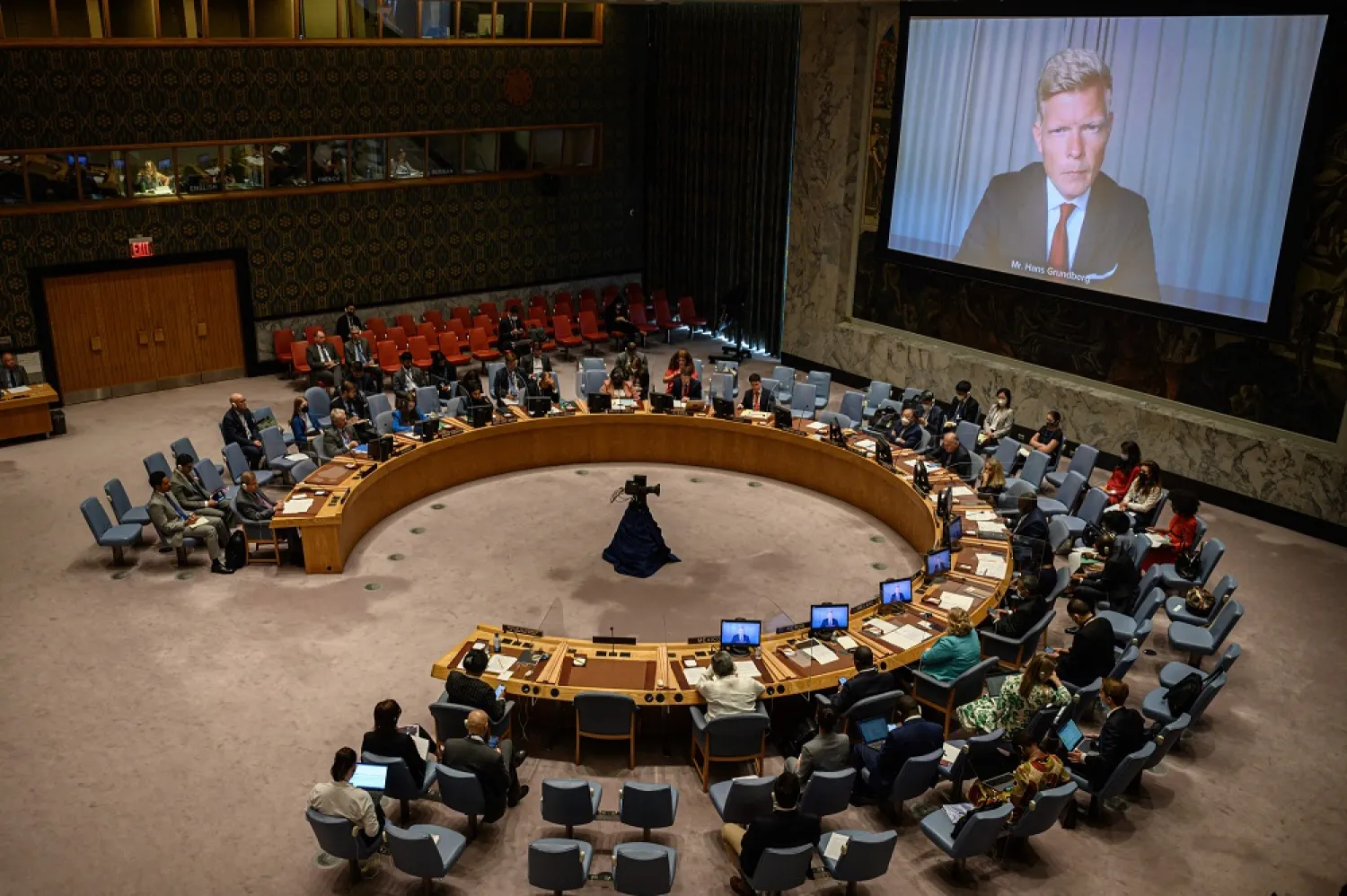
United Nations Special Envoy for Yemen Hans Grundberg (R) is displayed on a screen as he attends remotely a Security Council meeting on the situation in the Middle East at the United Nations headquarters in New York City on August 15, 2022. (AFP)
TT

Yemen Calls for Int’l Pressure on Houthis to End Taiz Siege

United Nations Special Envoy for Yemen Hans Grundberg (R) is displayed on a screen as he attends remotely a Security Council meeting on the situation in the Middle East at the United Nations headquarters in New York City on August 15, 2022. (AFP)

The legitimate government in Yemen reiterated its call on the international community to pressure the Iran-backed Houthi militias to join in good faith efforts to achieve peace in the war-torn country.

United Nations Special Envoy for Yemen Hans Grundberg acknowledged before the Security Council that no progress has been reached in reopening routes to the Houthi-besieged city of Taiz.

In a briefing before the council on Monday, he said: “Road openings in Taiz and other governorates continue to be at the forefront of my efforts. My Office has recently spent time on both sides of the frontline in Taiz, where they engaged with local authorities, as well as with local mediators and civil society organizations.”

“Several proposals with different sets of roads and sequencing options have been presented to the parties. It is regrettable that, despite these efforts, there has not been more progress achieved on road openings to date,” he added.

“For the sake of the people of Taiz, the wider population and the economy, the parties need to agree on opening roads as soon as possible,” he urged.

“Road openings are mainly a humanitarian issue, and the truce provides a conducive environment for the parties to swiftly deliver on this issue, as they have done with other elements of the truce that are improving the humanitarian situation,” he stressed.

“The people of Taiz and across Yemen deserve for the truce to deliver for them in all its aspects,” said the envoy.

Grundberg remarked that two weeks ago, the warring parties agreed to extend the truce in Yemen under the same terms for another two months, until October 2.

“I commend the parties for taking this step, which allows for the longest pause in fighting since the war began to continue. It also allows for the benefits of the humanitarian and economic measures in the truce agreement to unfold,” he said.

“Along with the truce extension, the parties committed themselves to using the next two months to continue negotiations to reach an expanded truce agreement by October 2,” he revealed.

“An expanded agreement will include additional elements that have the potential of further improving the daily lives of Yemeni men and women. It would also allow for further steps towards ending the conflict,” he noted.

“As I work with the parties to achieve this goal, we all need to remind ourselves that failure to reach an agreement to extend the truce would lead to renewed cycles of escalation and violence, with predictable and devastating consequences for Yemen’s population,” he warned.

“Yemen urgently needs avoid this scenario. And I call on the parties to make the choice to build the necessary confidence to avoid a return to war and to begin to build a lasting peace.,” he urged.

“Four and a half months in, the truce continues to broadly hold in military terms. No major military operations or changes to frontlines have occurred and there have been neither confirmed airstrikes inside Yemen nor cross-border attacks emanating from Yemen,” noted Grundberg.

The Military Coordination Committee (MCC) is an important outcome of the truce, he went on to say.

“Maintaining this channel is of the utmost importance,” he added.

The fourth meeting of the MCC is expected to take place during the last week of August in Amman, Jordan.

The parties have agreed to also meet as part of a technical working group to establish a Joint Coordination Room, which would support the MCC by managing incidents through de-escalation at the operational level, explained the envoy.

In wake of his briefing, Yemen's permanent ambassador to the Security Council Abdullah al-Saadi called on the council and international community to reassess their approach towards the Houthis.

He called on them to pressure the militias to join the peace process and prevent the exploitation of the truce to amass more forces and prepare for a new round of escalation.

The Houthis must be pressured to commit to their pledges in reopening the routes to Taiz and other cities, demanded the envoy.

“The siege by Iran-supported Houthi militias on Taiz is in its eighth year — amounting to a war crime — circumventing the truce, refusing to open main roads leading to civilians, including women and children, losing their lives,” he remarked.

“The militias are not serious about ending the situation threatening 4 million people in Taiz, preventing humanitarian assistance and goods, including the deliberate killing of children there in the hours before the extension of the truce,” he continued.

“Militias target civilians with snipers, drones and missiles, including under the truce, and will continue to violate the truce without being held accountable.”

How many civilians must die before the war is ended and their crimes are held accountable, he asked.

The militias have proven they are not serious and thwart peace, reneging on truce commitments — with 50 daily violations, leading to the death of 187 people and injuring 910 others, revealed al-Saadi.

The militias are undermining de-escalation and peace, laying siege to cities and looting incomes, using the military dossier as a bargaining chip leading to blackmail. The Yemeni people suffer under a grave situation at all levels, with dialogue remaining the best way to end conflict. The Houthis must refrain from war and escalation to save the people from further suffering, he stressed.

He noted the government has facilitated 29 round trip flights from and to Sanaa, transporting more than 13,000 travelers, despite stumbling blocks imposed by militias, as well as 34 ships transporting over 900 metric tons of fuel through Hodeidah port.

While the taxes and custom fees were enough to pay civil servants and pensions in areas controlled by Houthis, the militias collected them and deprived employees’ salaries, using that income to fund their war, said the ambassador.

The government has renewed its commitment to comprehensive and sustainable peace, based on the Gulf Cooperation Council Initiative and outcomes of national dialogue and Council resolution 2216. It will continue to build towards a comprehensive ceasefire to end the conflict and alleviate the humanitarian crisis, vowed al-Saadi.



Drone Attack by RSF in Sudan Kills 24, Including 8 Children, Doctors’ Group Says

Displaced Sudanese wait to receive humanitarian aid at the Abu al-Naga displacement camp in the Gedaref State, some 420km east of the capital Khartoum on February 6, 2026. (AFP)
TT

Drone Attack by RSF in Sudan Kills 24, Including 8 Children, Doctors’ Group Says

Displaced Sudanese wait to receive humanitarian aid at the Abu al-Naga displacement camp in the Gedaref State, some 420km east of the capital Khartoum on February 6, 2026. (AFP)

A drone attack by a notorious paramilitary group hit a vehicle carrying displaced families in central Sudan Saturday, killing at least 24 people, including eight children, a doctors’ group said.

The attack by the Rapid Support Forces occurred close to the city of Rahad in North Kordofan province, said the Sudan Doctors Network, which tracks the country’s ongoing war.

The vehicle transported displaced people who fled fighting in the Dubeiker area of North Kordofan, the doctors’ group said in a statement. Among the dead children were two infants, the group said.

The doctors’ group urged the international community and rights organizations to “take immediate action to protect civilians and hold the RSF leadership directly accountable for these violations.”

There was no immediate comment from the RSF, which has been at war against the Sudanese military for control of the country for about three years.

Sudan plunged into chaos in April 2023 when a power struggle between the military and the RSF exploded into open fighting in the capital, Khartoum, and elsewhere in the country.

The devastating war has killed more than 40,000 people, according to UN figures, but aid groups say that is an undercount and the true number could be many times higher.

It created the world’s largest humanitarian crisis with over 14 million people forced to flee their homes. It fueled disease outbreaks and pushed parts of the country into famine.


Israeli Army Allows Settlers to Spend Night Near Gaza

Israeli settlers walk toward the border with Gaza on Thursday (AFP). 
TT

Israeli Army Allows Settlers to Spend Night Near Gaza

Israeli settlers walk toward the border with Gaza on Thursday (AFP). 

The Israeli army on Friday escorted about 1,500 Jewish settlers out of an area near the Gaza Strip after allowing them to spend a single night along the border, while arresting several who insisted on staying inside occupied Palestinian territory.

An army spokesperson said such actions endanger the settlers’ lives in a combat zone and divert soldiers from their primary mission of safeguarding state security. He added, however, that the army was dealing with the group with restraint to prevent friction and internal clashes.

The settlers, affiliated with the Nachala movement, arrived on Thursday night in the northern part of the Gaza border area, which is under Israeli military control and known as the “Yellow Line.” They dispersed across seven locations according to what the army described as a plan resembling military-style deployment.

Members of the group attempted to breach the border and reach areas where Jewish settlements once stood before Israel withdrew from Gaza in 2005 under the disengagement plan led by then prime minister Ariel Sharon. The settlers said they were carrying out an operation modeled on an attack by Hamas, claiming they were “more capable” of launching such an action.

They asserted that their stated purpose was to plant trees in Gaza as a prelude to future steps involving renewed settlement activity. At the same time, they brought tents with the apparent intention of establishing an outpost.

Israeli forces blocked their advance and prevented them from crossing the border, leading to hours of maneuvering as settlers tried to evade soldiers, who repeatedly halted them.

After prolonged standoffs, a local military commander reached an arrangement allowing the group to remain overnight at the border area, on the condition that they would leave the following day. Those who refused and attempted to stay inside Gaza were detained and handed over to police, who opened investigations on charges of obstructing security forces and diverting them from their duties.

The settlers vowed to return repeatedly until they succeeded in reviving the settlement project.

The Nachala movement was founded in 2005, as Israeli-Palestinian negotiations resumed toward a two-state solution. It promotes the slogan “One state for one people” and seeks to expand Jewish settlement across what it describes as historic Israel. The group has raised funds in Israel and the United States and has been involved in establishing dozens of settlement outposts in the West Bank, many of which have since been retroactively legalized by the current government.


Paris Urges Baghdad to Avoid Being Dragged in Regional Escalation

 Iraqi Foreign Minister Fuad Hussein (R) shake hands as he receives French Foreign Minister Jean-Noel Barrot (L) upon his arrival for an official visit to Baghdad on February 5, 2026. (AFP)
Iraqi Foreign Minister Fuad Hussein (R) shake hands as he receives French Foreign Minister Jean-Noel Barrot (L) upon his arrival for an official visit to Baghdad on February 5, 2026. (AFP)
TT

Paris Urges Baghdad to Avoid Being Dragged in Regional Escalation

 Iraqi Foreign Minister Fuad Hussein (R) shake hands as he receives French Foreign Minister Jean-Noel Barrot (L) upon his arrival for an official visit to Baghdad on February 5, 2026. (AFP)
Iraqi Foreign Minister Fuad Hussein (R) shake hands as he receives French Foreign Minister Jean-Noel Barrot (L) upon his arrival for an official visit to Baghdad on February 5, 2026. (AFP)

French diplomatic sources said Paris has warned of the risks posed by the involvement of Iraqi armed factions in any potential regional escalation, stressing that Iraq should not be drawn into conflicts that do not serve its national interests at a time of mounting regional tensions.

The sources told Asharq Al-Awsat on Friday that the warning was among the messages delivered by French Foreign Minister Jean-Noel Barrot during his visit to Baghdad on Thursday, where he held talks with Prime Minister Mohammed Shia al-Sudani and Foreign Minister Fuad Hussein. The trip marked Barrot’s second official visit to Iraq in less than a year.

According to the sources, the French minister underscored that the stability and security achieved in Iraq “with great patience and effort” should not be jeopardized under any circumstances.

He cautioned that the involvement of non-state armed groups in regional confrontations could undermine Iraq’s recovery and threaten the security of both the country and the wider region.

The stance echoed remarks Barrot made to news agencies in Baghdad on Thursday, in which he said France’s priority in the region remains the fight against ISIS and preventing its resurgence.

Any security deterioration, whether in Iraq or in camps and prisons in northeastern Syria, would benefit the group, he warned.

Barrot said France is working with its partners to ensure continued security at these sites, adding that a collapse there “would not serve anyone’s interests.”

He praised Iraq’s efforts to receive detainees linked to ISIS, calling it a crucial step in international efforts to address one of the most sensitive post-conflict files.

For his part, Hussein reiterated Baghdad’s commitment to continued cooperation with the international coalition against terrorism, emphasizing Iraq’s determination to safeguard internal stability and steer clear of regional power struggles.

Iraqi foreign policy is based on balance and building relations with all partners to shield the country from regional tensions, he stressed.

The talks also addressed Iran, amid fears of escalation and its potential repercussions for Iraq.

Barrot urged the need for Tehran to respond to a US proposal for negotiations and to make substantive concessions on its nuclear program, ballistic arsenal, and destabilizing regional activities, while ending repressive policies.

Iraq, he said, must stay out of any regional confrontation.

Paris and Baghdad are also aligned on Syria, supporting a peaceful, inclusive political transition involving all components of Syrian society, alongside continued efforts to combat ISIS and prevent its return to liberated areas, he added.

French sources said Paris’ core message was to shield Iraq from being pulled into any regional escalation and to preserve its stability.