


Debate over 'Qualifications’ of Lebanese President Heats Up Between Geagea, Bassil

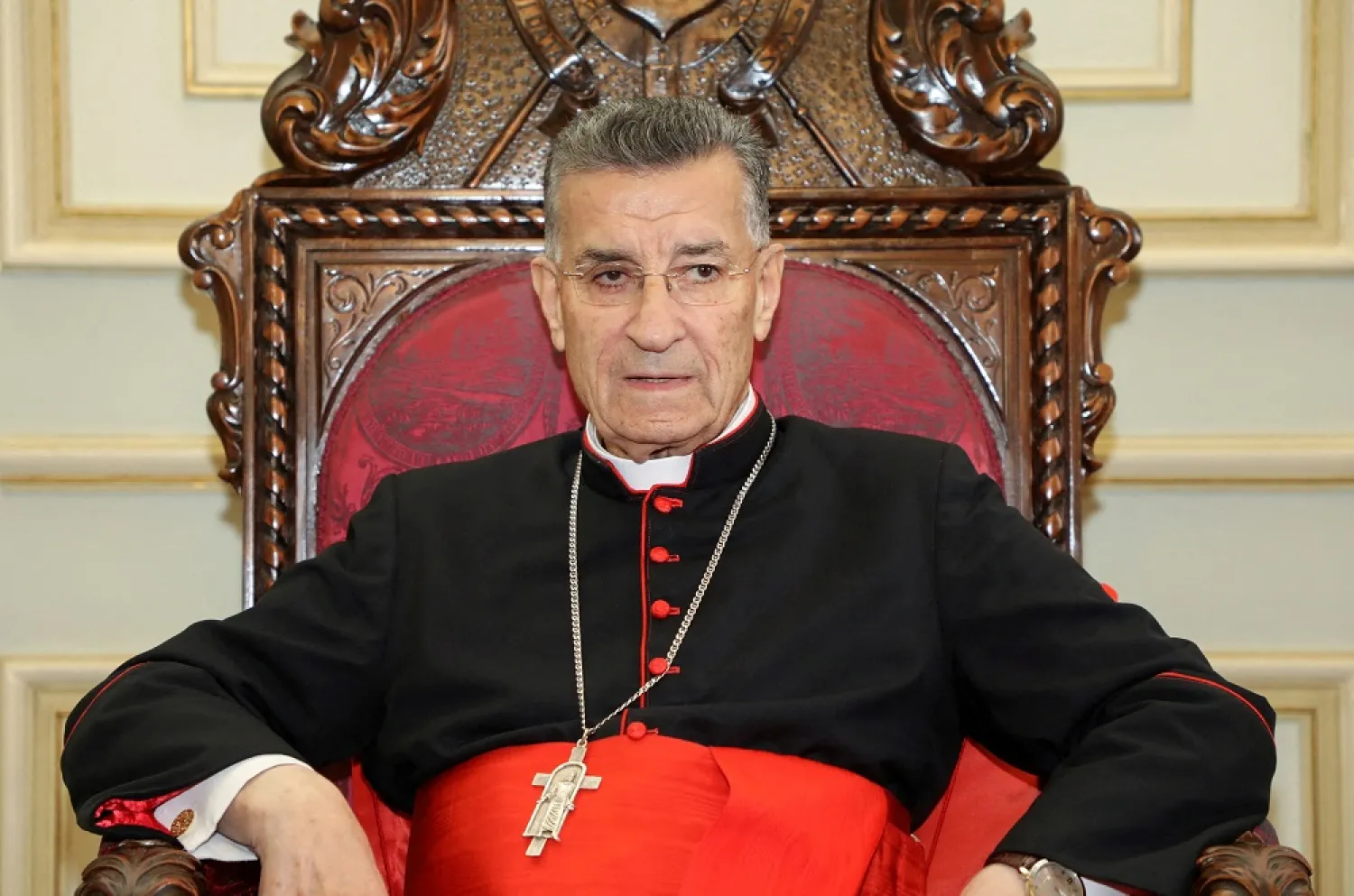
Maronite Patriarch Beshara al-Rai is pictured during a meeting in Bkirki, Lebanon, October 30, 2021. (Reuters)
TT

Debate over 'Qualifications’ of Lebanese President Heats Up Between Geagea, Bassil

Maronite Patriarch Beshara al-Rai is pictured during a meeting in Bkirki, Lebanon, October 30, 2021. (Reuters)

With the race over the presidency heating up in Lebanon, debate is raging over the qualifications of the next president.

Amid the political divides in the country, each rival camp has come up with their own set of conditions that they believe qualifies a candidate to run for the country’s top post.

The debate is particularly fierce between long-time rivals the Free Patriotic Movement, headed by MP Gebran Bassil and founded by his father-in-law and current President Michel Aoun, and the Lebanese Forces, headed by Samir Geagea.

Bassil had recently declared that the presidential candidate should enjoy the greatest popular support and that he should represent their Christian sect.

In Lebanon, the president is always a Maronite Christian, as per the National Pact that also says the prime minister is always a Sunni figure and the parliament speaker a Shiite.

Bassil’s remarks were understood as an attempt to eliminate former MP and Hezbollah candidate Suleiman Franjieh from the presidential race given that he doesn’t enjoy a sizable parliamentary bloc.

They were also interpreted as an attempt to reach a compromise with Geagea over the presidency.

The LF leader was quick to reject the proposal, saying he “would not be fooled twice”.

He instead reiterated his call on the opposition to agree on a candidate who would challenge Bassil and his ally, Hezbollah, adding that Aoun “is the weakest president in Lebanon’s history.”

As it stands, it appears impossible to bring together the leaders of the two largest Christian blocs in parliament or for them to agree to the candidacy of either Geagea or Bassil.

Moreover, the LF has said that it would be useless for Maronite Patriarch Beshara al-Rai to call the rivals to meet given the fundamental national differences between them.

The FPM, however, believes that holding a meeting for Christian leaders with Rai is “essential” to preparing for the presidential elections. Aoun’s term ends in October.

Senior sources in the FPM dismissed claims that Bassil is seeking a compromise with Geagea over the presidency.

They also said that the option of reaching an agreement with Franjieh still stands as long as the conditions set by Bassil - that the candidate head a sizeable parliamentary bloc or be nominated by a sizable Christian bloc - are met.

The sources acknowledged that the FPM and LF enjoy the largest blocs in parliament, but clarified that Bassil’s statements do not mean that the nomination of a president will be restricted to these two parties.

Moreover, they stressed that Bassil “is not seeking to run for president.”

They added that Bassil’s remarks meant that the candidate must be chosen from their Christian environment and that the choice “must not be usurped by Muslim blocs.”

Such a move would violate the National Pact, they warned, while noting that Aoun boasted the largest bloc in 2018 and retained it in 2022.

The sources added that the FPM would ultimately support any proposal offered by Rai to bring together Christian leaderships to discuss the elections and bar other parties from undermining the presidential race.

“Bassil is not eyeing the presidency,” reiterated the sources, “but he will wage a battle if he sensed an attempt to usurp the nomination by Muslim blocs. He is simply asking for the National Pact to be implemented.”

On the other side of the divide, LF sources said the party has found no common ground or any opportunity for rapprochement with the FPM.

They told Asharq Al-Awsat that Bassil has shifted the debate over the Christian representation of the president to popular representation.

They added that the FPM is no longer the greatest representative of Christians after it lost its parliamentary majority to the LF in the May elections.

Rather, the FPM is now relying on its Shiite allies, meaning Hezbollah, to add political weight to its stances.

The FPM has incurred the ire of various sects, topped by the Christians, because of its policies in recent years, continued the sources.

The sources explained that two approaches are now on the table regarding the presidency.

The first, presented by Bassil, has been tested under Aoun’s current term. It aims to cover the “Hezbollah republic” in Lebanon and has led the country to disaster, collapse and isolation.

The second, offered by the LF, calls for the establishment of a completely different republic that seeks to help Lebanon out of this dismal situation.

The sources stressed that the LF is now the “strongest popular and Christian representative. It reflects the historic path followed by Christians in Lebanon.”

Bassil and Aoun, on the other hand, were at one point the greatest representatives, but they chose to go against the historic path by undermining all Christian values that call for the establishment of a sovereign, diverse, democratic and independent state.

They abandoned all this for the state of Hezbollah, charged the sources.

Furthermore, they added that Rai was in no way prepared to call for a meeting for Christian leaders.

The dispute between the FPM and LF revolves around two political projects. One is non-Lebanese, pursued by the FPM and Hezbollah, and the other is Lebanese, advocated by the LF.

This major national divide does not demand a Christian meeting and there is no point to it given how sharp the dispute is, they added.
Germany Deports Man to Syria for First Time Since 2011

People attend a protest against reelection of Syria's president Bashar al-Assad, near Syria's embassy, Berlin, Germany May 26, 2021. (Reuters)
TT

Germany Deports Man to Syria for First Time Since 2011

People attend a protest against reelection of Syria's president Bashar al-Assad, near Syria's embassy, Berlin, Germany May 26, 2021. (Reuters)

Germany deported a man to Syria for the first time since the civil war began in that country in 2011, the interior ministry in Berlin announced on Tuesday.

A Syrian immigrant previously convicted of criminal offences in Germany was flown to Damascus and handed over to Syrian authorities on Tuesday morning, the ministry said.


Army: Lebanese Soldier among Those Killed in Monday Israeli Strike

Lebanese soldiers secure the site of an Israeli drone strike that targeted a truck in the village of Sibline, south of Beirut, on December 16, 2025. (Photo by Mahmoud ZAYYAT / AFP)
TT

Army: Lebanese Soldier among Those Killed in Monday Israeli Strike

Lebanese soldiers secure the site of an Israeli drone strike that targeted a truck in the village of Sibline, south of Beirut, on December 16, 2025. (Photo by Mahmoud ZAYYAT / AFP)

A Lebanese soldier was among three people killed in an Israeli air strike on a car in the country's south, the army said Tuesday, denying Israeli claims that he was also a Hezbollah operative.

Israel has kept up regular strikes on Lebanon, usually saying it is targeting Hezbollah, despite a November 2024 ceasefire that sought to end more than a year of hostilities with the Iran-backed militant group, which it accuses of rearming.

Lebanon's state-run National News Agency said Monday's strike on a vehicle was carried out by an Israeli drone around 10 kilometers (six miles) from the southern coastal city of Sidon and "killed three people who were inside".

The Lebanese army said on Tuesday that Sergeant Major Ali Abdullah had been killed the previous day "in an Israeli airstrike that targeted a car he was in" near the city of Sidon.

The Israeli army said it had killed three Hezbollah operatives in the strike, adding in a statement on Tuesday that "one of the terrorists eliminated during the strike simultaneously served in the Lebanese intelligence unit".

A Lebanese army official told AFP it was "not true" that the soldier was a Hezbollah member, calling Israel's claim "a pretext" to justify the attack.

Under heavy US pressure and amid fears of expanded Israeli strikes, Lebanon has committed to disarming Hezbollah, starting with the south.

The Lebanese army plans to complete the group's disarmament south of the Litani River -- about 30 kilometers from the border with Israel -- by year's end.

The latest strike came after Lebanese and Israeli civilian representatives on Friday took part in a meeting of the ceasefire monitoring committee for a second time, after holding their first direct talks in decades earlier this month.

The committee comprises representatives from Lebanon, Israel, the United States, France and the United Nations Interim Force in Lebanon (UNIFIL).

More than 340 people have been killed by Israeli fire in Lebanon since the ceasefire, according to an AFP tally of Lebanese health ministry reports.


Israel Defense Minister Vows to Stay in Gaza, Establish Outposts

Palestinians amid rubble of destroyed buildings in Jabalia, northern Gaza Strip (AFP)
TT

Israel Defense Minister Vows to Stay in Gaza, Establish Outposts

Palestinians amid rubble of destroyed buildings in Jabalia, northern Gaza Strip (AFP)

Defense Minister Israel Katz on Tuesday vowed Israel will remain in Gaza and pledged to establish outposts in the north of the Palestinian territory, according to a video of a speech published by Israeli media. 

His remarks, reported across Israeli media, come as a fragile US-brokered ceasefire between Israel and Hamas holds in Gaza, said AFP. 

Mediators are pressing for the implementation of the next phases of the truce, which would involve an Israeli withdrawal from the territory. 

Speaking at an event in the Israeli settlement of Beit El in the occupied West Bank, Katz said: "We are deep inside Gaza, and we will never leave Gaza -- there will be no such thing." 

"We are there to protect, to prevent what happened (from happening again)," he added, according to a video published by Israeli news site Ynet. 

Katz also vowed to establish outposts in the north of Gaza in place of settlements that had been evacuated during Israel's unilateral disengagement from the territory in 2005. 

"When the time comes, God willing, we will establish in northern Gaza, Nahal outposts in place of the communities that were uprooted," Katz said, referring to military-agricultural settlements set up by Israeli soldiers. 

"We will do this in the right way and at the appropriate time." 

Katz's remarks were slammed by former minister and chief of staff Gadi Eisenkot, who accused the government of "acting against the broad national consensus, during a critical period for Israel's national security." 

"While the government votes with one hand in favor of the Trump plan, with the other hand it sells fables about isolated settlement nuclei in the (Gaza) Strip," he wrote on X, referring to the Gaza peace plan brokered by US President Donald Trump. 

The next phases of Trump's plan would involve an Israeli withdrawal from Gaza, the establishment of an interim authority to govern the territory in place of Hamas and the deployment of an international stabilization force. 

It also envisages the demilitarization of Gaza, including the disarmament of Hamas, which the group has refused. 

On Thursday, several Israelis entered the Gaza Strip in defiance of army orders and held a symbolic flag-raising ceremony to call for the reoccupation and resettlement of the Palestinian territory.
