


Ali Saleh to Saddam: War is Happening... Goal is to Destroy the Iraqi Army

Asharq Al-Awsat Releases Excerpts from the Memoirs of Former Iraqi Minister of Trade Muhammad Al-Rawi

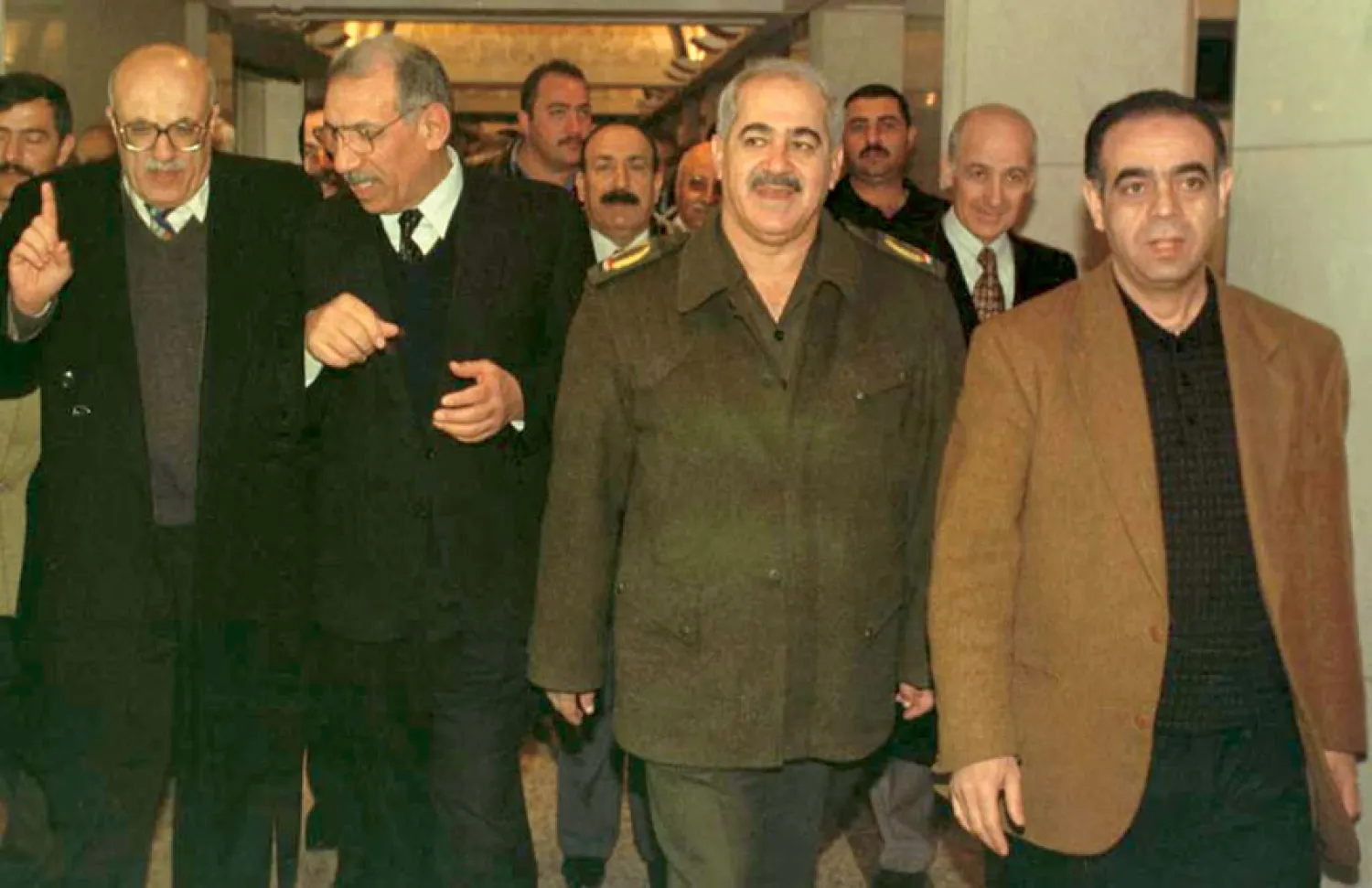
Al-Rawi with Iraqi and Jordanian officials in Baghdad in 2000 (Getty Images)
TT

Ali Saleh to Saddam: War is Happening... Goal is to Destroy the Iraqi Army

Al-Rawi with Iraqi and Jordanian officials in Baghdad in 2000 (Getty Images)

Dr. Muhammad Mahdi Salih Al-Rawi, former Iraqi Minister of Trade, presents in his new book - “Preventing Famine in Iraq - My Memoirs of the Years of the Siege 1990-2003” (to be published soon by Al-Maaref Forum) a detailed account of the efforts he made at the head of his ministry to address the sanctions imposed on Iraq in the wake of its invasion of Kuwait in 1990, which continued until the US invasion of the country in 2003.

The author talks with remarkable frankness about the differences that were plaguing Saddam Hussein’s regime, part of which is related to Lieutenant-General Hussein Kamel, the son-in-law of the Iraqi president before he split with his uncle in 1995.

Al-Rawi has worked in the Iraqi presidential office since 1982, and was, as he says, in “direct contact” with Saddam Hussein for seven years, until his appointment as Minister of Trade in 1987.

After the US invasion in 2003, Al-Rawi was arrested in Camp Cropper and was on the most wanted list of the leaders of the collapsed regime. He was detained until 2012 and is currently living in Jordan.

Asharq Al-Awsat publishes, in two episodes, excerpts from Al-Rawi’s book before its publication.

He recounts that during the rule of the late President Abdel-Rahman Aref, relations with the United States of America were severed for its support of the Israeli aggression in 1967… The rupture remained after the revolution of July 1968, until 1982, when Donald Rumsfeld visited Baghdad, as an envoy of US President Ronald Reagan.

Diplomatic relations were already restored in 1986, but soon collapsed after the end of the Iran-Iraq war.

Al-Rawi says: “In the midst of the Iraqi people’s celebrations of victory over Iran, the US House of Representatives, under pressure from the anti-Iraq Zionist lobby, agreed to impose sanctions on Iraq on Sept. 22, 1988, forty-five days after the war stopped.”

Al-Rawi talks about Iraq’s oil power before and after the war with Iran. He says: “Iraq did not need loans and credit facilities in the seventies, especially after the nationalization of oil… Oil revenues increased from one billion dollars annually to USD 26.4 billion in 1980...”

However, he explains: “The increased military spending throughout the eight-year period of the Iraq-Iran war was not the only reason for the accumulation of debts, which began in mid-1984. It was also due to the significant decline in oil revenues due to the cessation of oil trades through the southern port that Iraq used for nearly two-thirds of its exports specified by OPEC.”

He noted that the mentioned port became within the target of daily Iranian bombing. Moreover, in 1982, Syria halted its export activity through the pipeline passing through its territory to the Mediterranean, in support of Iran.

These developments have contributed to the accumulation of half of Iraq’s debts of USD 42 billion (excluding Gulf debt) at the end of the war in 1988, leaving only the Turkish oil pipeline with a capacity of half a million barrels per day.

He added that the drop in oil prices in the mid-1980s had a “significant impact on the economic situation”, as “austerity measures” were taken in many sectors with the aim of ensuring that “food and medicine insurance plans and expenditures to support the war effort were not affected.”

He continued that the Military Industrialization Command, represented by Lieutenant-General Hussein Kamel, adopted a policy of expanding the military industrial base…

“These numerous, large and ambitious goals (…) required not a few financial resources,” Al-Rawi said.

He explained: “Oil revenues did not meet the previously mentioned goals. A sharp competition emerged between the Military Industrialization Authority, and the rest of the ministries... Lieutenant-General Hussein Kamel had the last say in the state, due to the reputation he gained in developing military production in the last years of the war with Iran, and his relationship of kinship and affinity with the late president…”

The invasion of Kuwait and the sanctions

The author talked about the period after the Iraqi invasion of Kuwait in 1990:

He said that when President Georges Bush imposed a comprehensive American embargo on Iraq and froze its assets and properties in the United States, he went on the morning of Aug. 3, 1990 to the Central Bank to look at Iraq’s hard currency assets in foreign banks and central bank reserves, in his capacity as minister of Trade and acting Finance minister.

Al-Rawi noted that he asked the Central Bank governor to ​​immediately begin transferring Iraq’s foreign deposits to the Central Bank of Jordan, but he refrained, saying that the Central Bank did not report to the Minister of Finance, but to the Presidential Diwan.

On the Iraqi preparations for the war to liberate Kuwait in 1991, the author said that the needs of all governorates to prevent any food shortage during the war.

“The strategic storage was focused on the governorates of Karbala and Najaf, because they are two religious governorates that are unlikely to be subjected to aerial bombardment. The same is true for the autonomous provinces, which are also considered safe provinces. In addition, the owners of mills and kilns in Baghdad and the governorates were informed to secure sufficient storage of fuel to continue their work if the oil installations were targeted by bombing (…)”

“A week before the expiry of the deadline set by the Security Council, I traveled to Amman, and from there to Yemen to meet the late President Ali Abdullah Saleh…

Al-Rawi said that during a lunch invitation, the Yemeni leadership told him that the war would take place, and that the coalition’s military had a main goal to destroy the Iraqi army.

Al-Rawi talked about the start of the US strikes in January 1991, saying: “The aerial attack of the coalition forces has exceeded the goal of removing the Iraqi forces from Kuwait to bear a destructive plan for Iraq and to undermine all the achievements that the country has made and which have nothing to do with the war.”



US, Qatar, Egypt, Türkiye, Urge Restraint in Gaza

Members of the Palestinian Civil Defense remove the rubble of a destroyed home as they search for the bodies of Palestinians killed during the conflict in Khan Younis, southern Gaza Strip, 20 December 2025. (EPA)
TT

US, Qatar, Egypt, Türkiye, Urge Restraint in Gaza

Members of the Palestinian Civil Defense remove the rubble of a destroyed home as they search for the bodies of Palestinians killed during the conflict in Khan Younis, southern Gaza Strip, 20 December 2025. (EPA)

The United States was joined Saturday by Qatar, Egypt and Türkiye in urging parties in the Gaza ceasefire to uphold their obligations and exercise restraint, the chief US envoy said after talks in Miami.

Top officials from each nation met with Steve Witkoff, President Donald Trump's special envoy, to review the first stage of the ceasefire that came into effect on October 10.

"We reaffirm our full commitment to the entirety of the President’s 20-point peace plan and call on all parties to uphold their obligations, exercise restraint, and cooperate with monitoring arrangements," said a statement posted by Witkoff on X.

Their meeting came amid continuing strains on the agreement.

Gaza's civil defense said six people were killed Friday in Israeli shelling of a shelter. That brought to 400 the number of Palestinians killed by Israeli fire since the deal took effect.

Israel has also repeatedly accused Hamas of violating the truce, with the military reporting of its three soldiers killed in the territory since October.

Saturday's statement cited progress yielded in the first stage of the peace agreement, including expanded humanitarian assistance, return of hostage bodies, partial force withdrawals and a reduction in hostilities.

It called for "the near-term establishment and operationalization" of a transitional administration which is due to happen in the second phase of the agreement, and said consultations would continue in the coming weeks over its implementation.

Under the deal's terms, Israel is supposed to withdraw from its positions in Gaza, an interim authority is to govern the Palestinian territory instead of Hamas, and an international stabilization force is to be deployed.

On Friday, US Secretary of State Marco Rubio expressed hope that countries would contribute troops for the stabilization force, but also urged the disarmament of Hamas, warning the process would unravel unless that happened.


Lebanese Deputy PM to Asharq Al-Awsat: No Political Negotiations with Israel

Smoke rises from the site of a series of Israeli airstrikes that targeted the outskirts of the southern Lebanese village of al-Katrani on December 18, 2025. (AFP)
TT

Lebanese Deputy PM to Asharq Al-Awsat: No Political Negotiations with Israel

Smoke rises from the site of a series of Israeli airstrikes that targeted the outskirts of the southern Lebanese village of al-Katrani on December 18, 2025. (AFP)

Lebanon’s Deputy Prime Minister Tarek Mitri denied on Saturday that the appointment of civilian negotiators between Lebanon and Israel means that political negotiations have been launched between the two neighbors.

He told Asharq Al-Awsat that the negotiating team is primarily tasked with ensuring that the Lebanese army carries out Lebanon’s part of the ceasefire with Israel.

The army is close to completing the first phase of the agreement to impose state monopoly over arms in southern Lebanon, he added.

Other phases of the deal will follow to cover the whole of Lebanon.

Mitri added that attention must be focused on not giving Israel excuses to attack Lebanon, meaning Lebanon must meet its ceasefire obligations.

He warned, however, that Israel "could expand its military operations in Lebanon with or without excuses."

He noted that the United States appears to be pressuring Israel against launching a new war against Lebanon.

Lebanon is close to completing the disarmament of Hezbollah south of the Litani River, Prime Minister Nawaf Salam said on Saturday, as the country races to fulfil a key demand of its ceasefire with Israel before a year-end deadline.

The US-backed ceasefire, agreed in November 2024, ended more than a year of fighting between Israel and Hezbollah and required the disarmament of the Iran-aligned group, starting in areas south of the river adjacent to Israel.

Lebanese authorities, ‌led by President ‌Joseph Aoun and Salam, tasked the Lebanese ‌army ⁠on August ‌5 with devising a plan to establish a state monopoly on arms by the end of the year.

"Prime Minister Salam affirmed that the first phase of the weapons consolidation plan related to the area south of the Litani River is only days away from completion," a statement from his ⁠office said.

"The state is ready to move on to the second ‌phase - namely (confiscating weapons) north of the ‍Litani River - based on the ‍plan prepared by the Lebanese army pursuant to ‍a mandate from the government," Salam added.

The statement came after Salam held talks with Simon Karam, Lebanon's top civilian negotiator on a committee overseeing the Hezbollah-Israel truce.

Since the ceasefire, the sides have regularly accused each other of violations, with Israel questioning the Lebanese army's efforts to disarm Hezbollah. ⁠Israeli warplanes have increasingly targeted Hezbollah in southern Lebanon and even in the capital.

Israel has publicly urged Lebanese authorities to fulfil the conditions of the truce, saying it will act "as ‌necessary" if Lebanon fails to take steps against Hezbollah, which has refused to disarm.


Lebanese PM to Asharq Al-Awsat: 2nd Phase of Disarmament to Begin Soon Covering Regions between Litani, Awali

Prime Minister Nawaf Salam and ambassador Simon Karam meet on Saturday. (PM's office)
TT

Lebanese PM to Asharq Al-Awsat: 2nd Phase of Disarmament to Begin Soon Covering Regions between Litani, Awali

Prime Minister Nawaf Salam and ambassador Simon Karam meet on Saturday. (PM's office)

Lebanon would have completed the first phase of the army’s plan to impose state monopoly over arms, or the disarmament of Hezbollah, by the end of the year.

Prime Minister Nawaf Salam’s office confirmed on Saturday that the first phase was close to completion.

“The first phase of the weapons consolidation plan related to the area south of the Litani River is only days away from completion,” it said.

“The state is ready to move on to the second ‌phase - namely (confiscating weapons) north of the ‍Litani River - based on the ‍plan prepared by the Lebanese army pursuant to ‍a mandate from the government,” Salam added.

The cabinet will meet at the beginning of the new year after the first phase is completed.

Salam, meanwhile, told Asharq Al-Awsat that the second phase of the disarmament will cover the areas between the Litani and Awali Rivers to its north.

The third phase will cover Beirut and Mount Lebanon and the fourth covers the Bekaa followed by remaining regions.

Lebanese sources said the army has completed most of its report on its disarmament efforts south of the Litani. It has completed the confiscation and destruction of thousands of tons of ammunition and military gear. It has discovered around a hundred military tunnels in the region.

As it stands, the army is unlikely to ask for an extension of the deadline to complete the first phase by the end of the year. It may ask for a “technical” extension for a few weeks if necessary.

Salam refused to go into the details of the government’s next step after it receives the army’s detailed report on the disarmament south of the Litani.

“The military has succeeded in imposing complete state authority over the regions from south of the Litani to the southern border, except for the areas occupied by Israel and from where it should withdraw without delay,” the PM told Asharq Al-Awsat.

He confirmed that the government will convene at the beginning of the year to assess the first phase of the disarmament, stressing that Israel must take reciprocal steps, such as ceasing its violations of the ceasefire.

This will not prevent Lebanon from moving on to the second phase of implementing state monopoly over arms, he revealed.

Progress hinges of Hezbollah’s cooperation with Lebanon’s efforts to limit possession of weapons to the state and move towards activating state institutions in the South and kick off the reconstruction process with the help of Lebanon’s friends, he added.

“Imposing state monopoly over weapons is a Lebanese need before it is an international one,” he declared.

Everyone should be concerned with facilitating the process to end the cycle of violence, he urged.

Salam met on Saturday with Simon Karam, Lebanon's top civilian negotiator on the Mechanism committee overseeing the Hezbollah-Israel truce.

Karam briefed Salam on the latest meeting of the Mechanism.

Hezbollah continues to resist calls to disarm, saying the ceasefire with Israel does not cover areas north of the Litani. Party officials continue to tie disarmament to Israel’s withdrawal from regions it occupies in the South.