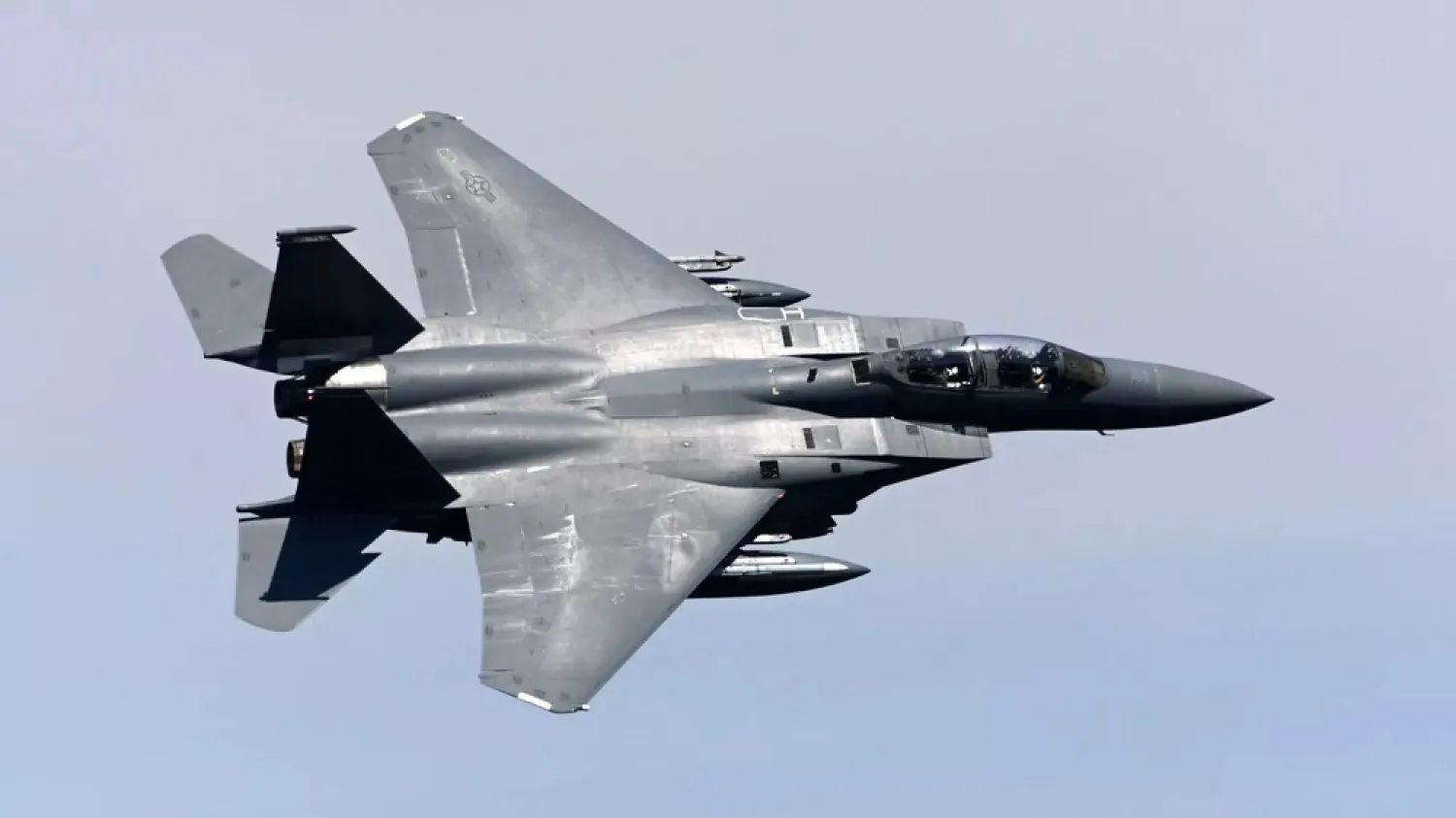
US Military Carries Out Strike in Syria on Iran-Linked Targets

The US military said it carried out air strikes in Syria's Deir Ezzor against facilities used by groups affiliated with Iran's Revolutionary Guards Corps. (AFP file photo)
TT

US Military Carries Out Strike in Syria on Iran-Linked Targets

The US military said it carried out air strikes in Syria's Deir Ezzor against facilities used by groups affiliated with Iran's Revolutionary Guards Corps. (AFP file photo)

The US military said early Wednesday it carried out airstrikes in eastern Syria that targeted areas used by militias backed by Iran's Revolutionary Guard Corps.

There was no immediate acknowledgment by Syria's state-run media of the strikes hitting Deir Ezzor. Iran as well did not acknowledge the attack.

Opposition war monitor the Syrian Observatory for Human Rights and activist collective Deir Ezzor 24 said the airstrikes targeted the Ayash Camp run by the Fatimiyoun group made up of Shiite fighters from Afghanistan. The war monitor reported that at least six Syrian and foreign militants were killed in the airstrikes.

The US military's Central Command said the strikes “took proportionate, deliberate action intended to limit the risk of escalation and minimize the risk of casualties.” It did not identify the targets, nor offer any casualty figures from the strikes, which the military said came at the orders of President Joe Biden.

“Today’s strikes were necessary to protect and defend US personnel," Central Command spokesman Col. Joe Buccino said in a statement.

The colonel added the attack was in response to an Aug. 15 attack targeting US forces. That attack saw drones allegedly launched by Iranian-backed militias target the al-Tanf Garrison used by American forces. US Central Command described the assault as causing “zero casualties and no damage” at the time.

Deir Ezzor is a strategic province that borders Iraq and contains oil fields. Iran-backed militia groups and Syrian forces control the area and have often been the target of Israeli war planes in previous strikes.

US forces entered Syria in 2015, backing allied forces in their fight against the ISIS group.


Ahmed al-Alwani: From Iraq's Protest Front Lines to a Violent Death in Beirut

Former Iraqi lawmaker Ahmed al-Alwani (X)
TT

Ahmed al-Alwani: From Iraq's Protest Front Lines to a Violent Death in Beirut

Former Iraqi lawmaker Ahmed al-Alwani (X)

Iraqi politician Ahmed al-Alwani, found dead in an apartment in Beirut on Tuesday, lived a political career shaped by the turmoil that engulfed Iraq after 2003.

From parliament, he rose to the forefront of protests against former Prime Minister Nouri al-Maliki, only to spend more than 11 years behind bars after a deadly raid on his home in Ramadi. His release in April 2025 marked a return to public life that ended with his killing in the Lebanese capital.

Al-Alwani belonged to the Albu Alwan tribe, one of the largest in Iraq's western Anbar province, which he represented in parliament. He was a member of the Iraqiya coalition led by former Prime Minister Iyad Allawi, held a doctorate in earth sciences from the University of Baghdad and chaired parliament's economic committee.

He emerged as a prominent political figure in late 2012, joining protests that erupted in Anbar before spreading to other predominantly Sunni provinces.

Centered on protest camps in Ramadi, Falluja and other Anbar cities, the demonstrations demanded an end to what protesters called the political marginalization and security targeting of Iraq's Sunni community. They also sought a review of government policies toward western Iraq.

A showdown with Maliki

Al-Alwani became one of the most outspoken champions of the protesters' demands, sharpening the confrontation with Maliki's government.

His support went well beyond the protest camps. Through speeches and public statements fiercely critical of Maliki, he became a leading figure in the political standoff between Baghdad and Sunni leaders in Anbar.

But government figures and Shi'ite political groups saw the sit-ins as a threat to political and security stability, accusing some participants of allowing armed groups to exploit the protest camps.

As tensions escalated, the protests became a major fault line in Iraq's deepening divisions, ahead of the security collapse across much of Anbar in 2014 and the rise of ISIS.

The defining turning point came on Dec. 28, 2013, when security forces raided al-Alwani's home in Ramadi and arrested him.

The raid sparked a deadly gunbattle between security personnel and al-Alwani's guards and relatives. His brother Ali and several guards were killed, along with an officer and other members of the security force.

Iraqi authorities said the force had been carrying out a judicial arrest warrant against his brother Ali when it came under fire, leaving security personnel dead and wounded.

Al-Alwani's arrest sparked political and legal objections, particularly because he was a sitting lawmaker protected by parliamentary immunity. It also deepened the confrontation between Baghdad and Anbar's protest movement.

The fallout was swift. The government ordered the Ramadi sit-in dismantled, armed clashes erupted across Anbar, and ISIS expanded into Falluja and other areas in early 2014.

Death sentences and more than a decade in prison

Al-Alwani faced a series of criminal charges stemming from the clashes during his arrest.

In November 2014, the Central Criminal Court sentenced him to death for killing two security personnel in the confrontation. He also received life sentences in separate cases involving injuries to other members of the security force.

He denied the charges.

Human rights organizations questioned the fairness of the proceedings, citing concerns over trial safeguards and his right to a defense. The Inter-Parliamentary Union, which monitored his case for years, considered the circumstances of his arrest a violation of parliamentary immunity.

Despite the death sentences, al-Alwani remained imprisoned for more than a decade until his case came under Iraq's general amnesty procedures.

On April 23, 2025, he walked free following a legal and tribal settlement. The family of one of the raid's victims withdrew its complaint and accepted financial compensation, clearing the way for his release under the general amnesty law.

A final trip to Beirut

Al-Alwani never returned to his former seat in parliament. Instead, he resumed political and social contacts, spending time in Ramadi before moving to Erbil, the capital of Iraq's Kurdistan region.

His reemergence and meetings with political and tribal figures raised fresh questions about his possible role in the next political phase, amid discussions over the future of Sunni-majority areas, including proposals for a federal region encompassing Anbar and other areas.

On Nov. 5, he traveled from Erbil to Beirut.

Lebanese media reported that he initially stayed at a hotel in the Hamra district before moving to an apartment in the Tariq al-Jadida neighborhood rented by other people.

After several days without contact, his body was found inside the apartment. Preliminary security and judicial reports indicated that he had been strangled.

His killing has thrust back into the spotlight a figure whose political rise was bound up with Iraq's fierce polarization after 2011, the protests and security clashes that followed, and the shifting balance of power in Anbar and beyond.

Whether his death in Beirut was connected to his political activities, or to his recent contacts and movements, remains an open question.


Yemeni Govt Forces Expand Operations as Houthis Face Fighting on Multiple Fronts

Government forces press ahead with Operation Dawn of Yemen against the Houthis on multiple fronts. (Military media)
TT

Yemeni Govt Forces Expand Operations as Houthis Face Fighting on Multiple Fronts

Government forces press ahead with Operation Dawn of Yemen against the Houthis on multiple fronts. (Military media)

Yemeni government forces launched 874 strikes against Houthi positions across several governorates under Operation Dawn of Yemen, as ground fighting continued and troops repelled attacks and attempted advances by the militia.

The operations targeted Houthi positions, troop concentrations and reinforcements in Marib, Al-Jawf, Taiz, Hajjah and Dhale, the military said.

Armed forces spokesperson Colonel Majed Al-Nuzaili said the strikes included 29 airstrikes, 39 drone strikes, 62 rocket launcher strikes and 744 artillery strikes.

Preliminary battlefield reports showed about 190 Houthi commanders and fighters killed or wounded and roughly 130 military vehicles and pieces of equipment destroyed or damaged, he revealed.

In Al-Jawf, warplanes struck a Houthi tank. Other airstrikes hit Houthi positions and military vehicles near Jabal Han, west of Taiz, and Dar Al-Saynah in the south. The army released footage showing strikes on Houthi fighters and equipment in both provinces.

In Marib, artillery pounded Houthi positions, concentrations and vehicles on the southern front. Drones struck reinforcements and vehicles on the northern front, while other strikes targeted newly established positions and fortifications in the south.

Fighting also continued on northern fronts and southeast of Al-Hazm, the capital of Al-Jawf, where government forces repelled Houthi movements and attacks while striking firing positions, troop concentrations and military vehicles.

In Hajjah, drones targeted Houthi sniper positions and fighters in the Hiran sector as part of wider operations against the militia's positions and fortifications.

Fierce fighting displaces families in Lahj

Heavy fighting and intensified military movements gripped the Al-Mudaribah and Ras Al-Arah in western Lahj. The Southern Giants Brigades and National Shield Forces said they had repelled major Houthi attacks on the Al-Bukrah and Al-Ruwais fronts.

Military sources reported the destruction of Houthi military vehicles. The Giants Brigades released footage showing strikes on Houthi fighters and vehicles in Lahj.

In Al-Maqatirah district, northwest of Lahj, Houthi-affiliated media reported a series of airstrikes on areas under the group's control on Wednesday. Government forces said they had destroyed Houthi military vehicles on the same front as fighting spread across areas bordering southwestern Taiz.

The clashes have worsened humanitarian conditions and driven more families from their homes as fighting nears populated areas in Al-Mudaribah, Al-Maqatirah and around Tur Al-Baha.

Families from other frontline areas have begun fleeing toward Aden and safer locations, raising fears of further displacement if fighting spreads to more residential areas.

Clashes persist in Taiz and Dhale

Government forces and the Popular Resistance continued battling the Houthis across several fronts in Taiz, particularly Al-Shaqab and Al-Aqroud, with fighting entering its 61st consecutive day, military sources said.

Airstrikes hit Houthi positions near Jabal Han, west of Taiz, and Dar Al-Saynah as troops continued repelling attacks in the province's western countryside.

Colonel Muwaffaq Al-Sabai, of the Fifth Presidential Guard Brigade in Taiz, said the Houthis had failed to break through government defenses despite massing fighters and launching attacks over more than a month.

He attributed the failure to government forces and the Popular Resistance taking the offensive initiative and improving coordination.

In Dhale, government troops repelled a Houthi attack on the Hajar front in the province's northwest. Clashes at the foot of Jabal Al-Hasha forced the attackers to retreat after suffering casualties and equipment losses, a military source said.

Meanwhile, the Giants Brigades, National Shield Forces and National Resistance continued operations on the southern and southwestern fronts.

The military spokesperson reported the recapture of positions in some sectors, while fighting continued and troops confronted Houthi movements elsewhere.


Yemeni Minister to Asharq Al-Awsat: Houthis Lose Foreign Commanders as Military Setbacks Mount

Yemeni army fighters in the Houthi-besieged city of Taiz. (AFP)
TT

Yemeni Minister to Asharq Al-Awsat: Houthis Lose Foreign Commanders as Military Setbacks Mount

Yemeni army fighters in the Houthi-besieged city of Taiz. (AFP)

The Houthis have lost numerous foreign commanders involved in directing military operations and developing offensive capabilities, a senior Yemeni official said, as the group faces mounting battlefield losses and internal divisions.

Walid al-Qudaimi, Yemen's minister of state, told Asharq Al-Awsat that airstrikes and battlefield operations had killed key foreign commanders fighting alongside the Houthis, as well as senior Houthi figures whose deaths the group has yet to disclose.

He said airstrikes and fighting across several fronts had weakened the militia's military capabilities, inflicting heavy losses in personnel, leadership and equipment.

Foreign commanders involved in directing operations and launching missile and drone attacks on government-held areas and Saudi Arabia were among those hit, he added.

Despite efforts to develop weapons and military technology, the Houthis were facing mounting setbacks and internal disintegration, al-Qudaimi said.

He said tribal leaders, sheikhs and ordinary Yemenis were increasingly recognizing the militia's agenda and refusing to send their sons into battle amid heavy casualties and growing numbers of missing fighters whose fate remained undisclosed.

Al-Qudaimi said Yemeni forces were fighting under a unified command through the joint forces, adding that Operation Dawn of Yemen would continue with Saudi support and under the direct supervision of the chairman of Yemen's Presidential Leadership Council until its objectives were met.

He said Yemenis increasingly understood the Houthis' ties to Iran and their role as one of Tehran's regional instruments, expressing his belief that large segments of the population were awaiting the group's removal and the restoration of state institutions.

The conflict extended beyond the Houthis because of the military and logistical support they received from foreign parties, al-Qudaimi said.

He stressed the importance of Yemeni diplomatic efforts to confront countries facilitating Houthi activities or providing assistance, saying such support violated diplomatic and political relations and harmed those countries' ties with Yemen.

His remarks came as Yemeni forces pressed ahead with military operations, intensifying airstrikes, drone attacks and artillery fire against Houthi positions, movements and reinforcements.

Government forces also made fresh gains in Al-Jawf province, while fighting continued on several fronts in Taiz, Dhale and Marib.

Turning to Taiz, al-Qudaimi called the city "an important key to victory over the Houthi militia," saying its residents' resistance reflected Yemenis' determination to confront the group.

He said repeated Houthi attempts to defeat the city militarily had failed despite the deployment of extensive manpower and military resources following the group's seizure of coastal areas.

Al-Qudaimi expressed hope that the Yemeni army would launch further operations to break the siege of Taiz and restore freedom of movement and access to besieged areas.

He also accused the Houthis of hypocrisy, saying they proclaimed solidarity with Gaza and the Palestinian people while besieging fellow Yemenis in Taiz and denying them basic rights to movement and daily life.