As Ukraine War Drags On, Europe’s Economy Succumbs to Crisis

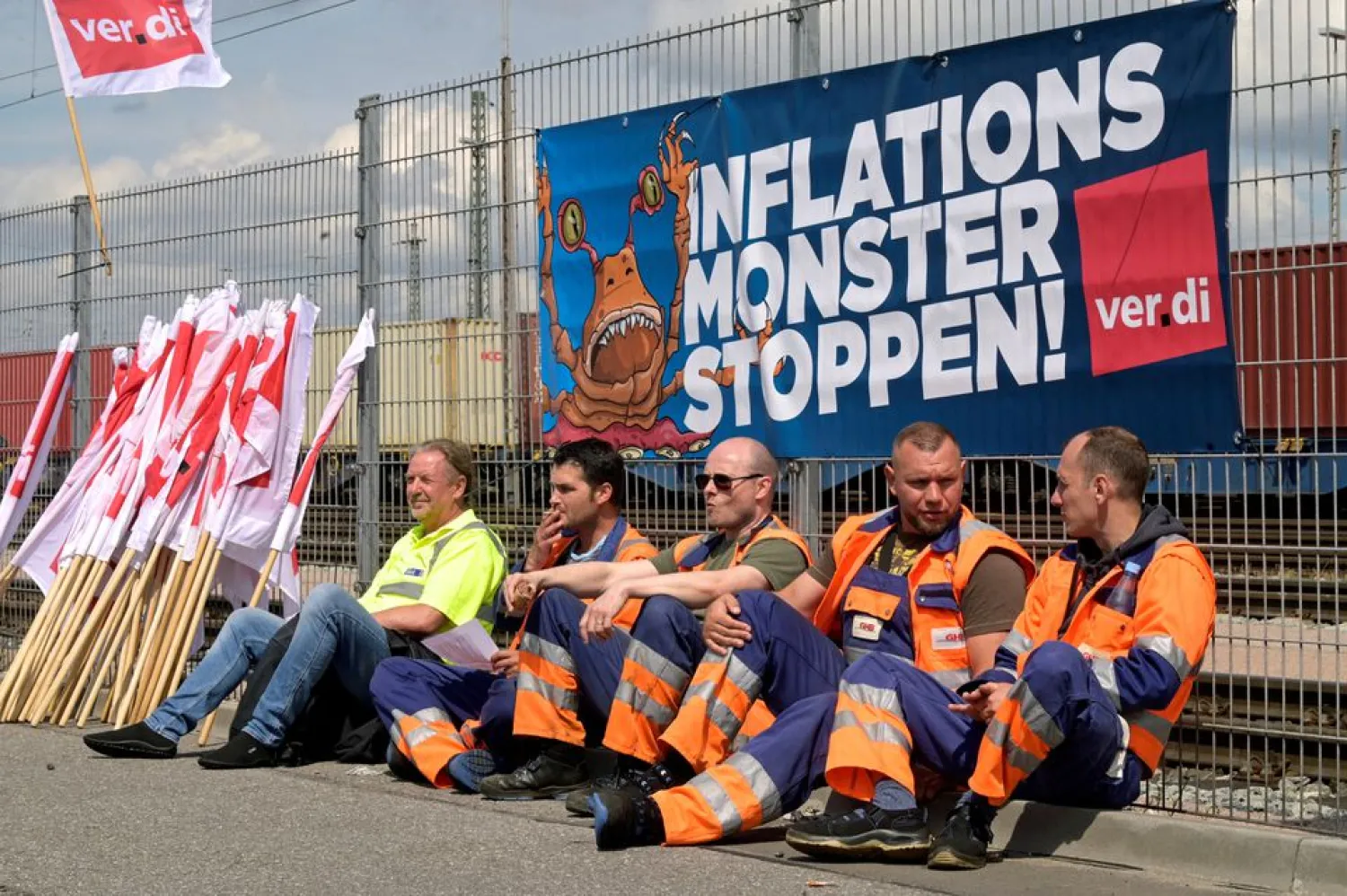
Workers sit in front of a banner reading "Stop the Inflation Monster" at the Burchardkai Container Terminal as they go on strike for higher wages in the harbor in Hamburg, Germany, June 9, 2022. (Reuters)
TT

As Ukraine War Drags On, Europe’s Economy Succumbs to Crisis

Workers sit in front of a banner reading "Stop the Inflation Monster" at the Burchardkai Container Terminal as they go on strike for higher wages in the harbor in Hamburg, Germany, June 9, 2022. (Reuters)

It was meant to be Europe's stellar year.

A post-pandemic spending euphoria, supported by copious government spending was set to drive the economy and help fatigued households regain a sense of normality after two dreadful years.

But all that changed on Feb. 24 with Russia's invasion of Ukraine. Normality is gone and crisis has become permanent.

A recession is now almost certain, inflation is nearing double digits and a winter with looming energy shortages is fast approaching.

Though bleak, this outlook is still likely to get worse before any significant improvement well into 2023.

"Crisis is the new normal," says Alexandre Bompard, the Chief Executive of retailer Carrefour. "What we have been used to in the last decades - low inflation, international trade - it's over," he told investors.

The change is dramatic. A year ago, most forecasters predicted 2022 economic growth near 5%. Now a winter recession is becoming the base case.

Households and businesses are both suffering as the fallout of the war - high food and energy prices - is now exacerbated by a devastating drought and low river levels that constrain transport.

At 9%, inflation in the euro area is at levels not seen in a half a century and it is sapping purchasing power with spare cash used up on petrol, natural gas and staple food.

Retail sales are already plunging, months before the heating season starts and shoppers are scaling down their buys. In June, retail sales volumes were down nearly 4% from a year earlier, led by a 9% drop recorded in Germany.

Consumers turn to discount chains and give up high end products, switching to discount brands. They have also started to skip certain purchases.

"Life is becoming more expensive and consumers are reluctant to consume," Robert Gentz, the co-CEO of German retailer Zalando, told reporters.

Businesses have so far coped well thanks to superb pricing power due to persistent supply constraints. But energy intensive sectors are already suffering.

Close to half of Europe's aluminum and zinc smelting capacity is already offline while much of fertilizer production, which relies on natural gas, has been shut.

Tourism has been the rare bright spot with people looking to spend some of accumulated savings and enjoy their first care-free summer since 2019.

But even the travel sector is hamstrung by capacity and labor shortages as workers laid off during the pandemic were reluctant to return.

Key airports, such as Frankfurt and London Heathrow, were forced to cap flights simply because they lacked the staff to process passengers. At Amsterdam's Schiphol, waiting times could stretch to four or five hours this summer.

Airlines also could not cope. Germany's Lufthansa had to publish an apology to customers for the chaos, admitting that it was unlikely to ease anytime soon.

Recession looms

That pain is likely to intensify, especially if Russia cuts gas exports further.

"The gas shock today is much greater; it is almost double the shock that we had back in the 70s with oil," Caroline Bain at Capital Economics said. "We've seen a 10- to 11-fold increase in the spot price of natural gas in Europe over the last two years."

While the EU has unveiled plans to accelerate its transition to renewable energy and wean the bloc off Russian gas by 2027, making it more resilient in the long run, supply shortages are forcing it seek a 15% cut in gas consumption this year.

But energy independence comes at a cost.

For ordinary people it will mean colder homes and offices in the short run. Germany for instance wants public spaces heated only to 19 degrees Celsius this winter compared with around 22 degrees previously.

Further out, it will mean higher energy costs and thus inflation as the bloc must give up its biggest and cheapest energy supplies.

For businesses, it will mean lower production, which eats further into growth, particularly in industry.

Wholesale gas prices in Germany, the bloc's biggest economy, are up five-fold in a year but consumers are protected by long term contracts, so the impact so far has been far smaller.

Still, they will have to pay a government mandated levy and once contracts roll over, prices will soar, suggesting the impact will just come with a delay, putting persistent upward pressure on inflation.

That is why many if not most economists see Germany and Italy, Europe's no. 1 and no. 4 economies with heavy reliance on gas, entering a recession soon.

While a recession in the United States is also likely, its origin will be quite different.

Silver lining

Struggling with a red-hot labor market and rapid wage growth, the US Federal Reserve has been raising interest rates quickly and has made clear it is willing to risk even a recession to tame price growth.

By contrast, the European Central Bank has only increased rates once, back to zero, and will move only cautiously, mindful that raising the borrowing cost of highly indebted euro zone nations, such as Italy, Spain and Greece could fuel worries about their ability to keep paying their debts.

But Europe will go into a recession with some strengths.

Employment is record high and firms have struggled with growing labor scarcity for years.

This suggests that companies will be keen to hang onto workers, especially since they head for the downturn with relatively healthy margins.

This could then sustain purchasing power, pointing to a relatively shallow recession with only a modest uptick in what is now a record low jobless rate.

"We see continued acute shortages of labor, historically low unemployment and a high number of vacancies," ECB board member Isabel Schnabel told Reuters earlier. "This probably implies that even if we enter a downturn, firms may be quite reluctant to shed workers on a broad scale."


Iraq Oil Output Exceeds 5 million bpd

Majnoon oil field near the Iraqi city of Basra (Reuters)
TT

Iraq Oil Output Exceeds 5 million bpd

Majnoon oil field near the Iraqi city of Basra (Reuters)

Iraq produces more than 5 million barrels of oil per day (bpd), Oil Minister Basim Mohammed told state news agency INA on Saturday.

According to Reuters, Iraq is pushing for a higher OPEC production quota as the economic fallout from the Iran war and new investment by oil majors increase pressure on Baghdad to boost output, potentially putting it at odds with the producer group.

The conflict has hit Iraq particularly hard, forcing major export cuts and depriving the state of oil revenue, which accounted for 88% of government income last year.


IMF: Any Slowdown in AI-driven Growth Would be Factor for Central Banks

IMF Managing Director Kristalina Georgieva speaks during the Annual Meetings Plenary at the Annual Meetings of the International Monetary Fund (IMF) and the World Bank Group (WBG) at the Queen Sirikit National Convention Center (QSNCC) in Bangkok on October 16, 2026. (Photo by Lillian SUWANRUMPHA / AFP)
TT

IMF: Any Slowdown in AI-driven Growth Would be Factor for Central Banks

IMF Managing Director Kristalina Georgieva speaks during the Annual Meetings Plenary at the Annual Meetings of the International Monetary Fund (IMF) and the World Bank Group (WBG) at the Queen Sirikit National Convention Center (QSNCC) in Bangkok on October 16, 2026. (Photo by Lillian SUWANRUMPHA / AFP)

Central bankers around the world would need to consider any slowdown in AI-driven growth as they assess steps in their fight against inflation, International Monetary Fund Managing Director Kristalina Georgieva said on Friday.

Georgieva said concerns about dependence on the AI investment boom and high valuations were impacting markets around the world.

"Things are going up and down, and this is likely to continue," she told an audience at IMF headquarters in Washington, adding that the volatility would complicate the job of central banks at a time when risks to price stability had been growing.

A steep rout in technology stocks on Thursday rippled through markets on fears that ⁠the Democrats' victory ⁠in the US midterm elections would increase regulatory scrutiny of AI and slow the data center build-out, sending investors to the safety of bonds.

The political jitters are hitting an AI trade already on shaky footing due to worry about return on massive spending on AI-related infrastructure, with the meltdown spurring margin calls and spooking retail investors and hedge ⁠funds alike.

Georgieva said the AI investment boom was lifting growth in some countries, helping to offset a negative oil-supply shock triggered by the war in the Middle East, but it was also adding to inflationary pressures and financial stability concerns.

The IMF last month flagged significant growth and financial stability risks from a potential ending of the AI investment boom, among other factors, including a prolonged Middle East war. At the time, it warned that a steep drop in AI investment could lead to a sharp fall in asset prices, ultimately cutting global GDP ⁠by 1.1% ⁠by 2028, including a 1.8% drop in US output.

Georgieva did not repeat the downside forecast on Friday, but acknowledged the recent market volatility.

"Should there be a slowdown in the AI-driven growth impulse, it would need to be factored in as central banks assess the necessary steps in the fight against stubborn inflation," she said.

Democrats are planning to unleash a flood of new legislation targeting artificial intelligence systems and data-center development when they take control of the US Congress in January, Reuters reported on Friday, citing congressional aides and advocates.

That would mark a sharp shift from the Republican-led Congress, where lawmakers largely focused on promoting AI development and declined to pass legislation restricting the technology.


World Food Prices Dip in October, but Remain Higher Than a Year Ago

A worker carries loaves of bread for sale at a bakery in the capital city of Cairo, Egypt November 4, 2026. (Reuters)
TT

World Food Prices Dip in October, but Remain Higher Than a Year Ago

A worker carries loaves of bread for sale at a bakery in the capital city of Cairo, Egypt November 4, 2026. (Reuters)

World food prices edged lower in October as weaker import demand contributed to monthly declines in cereal, dairy and meat prices, but were still nearly 6% higher than a year earlier, the United Nations' Food and Agriculture Organization said on Friday.

The FAO Food Price Index, which tracks monthly changes in international prices for a basket of food commodities, ‌averaged 133.9 points ‌in October, down from a revised ‌135.6 ⁠in September.

The index ⁠was 5.9% higher than a year earlier, but remained 16.4% below its March 2022 peak.

FAO's cereal price index fell 4.5% from September and was 12.6% lower than a year ago, as wheat and maize quotations declined. Wheat prices eased on weak import demand ⁠and improved production prospects, especially in Argentina.

"Expectations of ‌easing constraints on Black ‌Sea export flows added to the downward pressure on prices, ‌although continued disruptions to Black Sea logistics limited the decline," ‌FAO said in a statement.

Maize prices also eased after reaching a three-year high in September, pressured by the US harvest, expectations of ample supplies in South America and renewed ‌prospects of easing tensions in the Black Sea region.

Vegetable oil prices edged up 0.3%, ⁠as ⁠higher soybean and sunflower oil prices more than offset a fall in rapeseed oil prices.

Sugar prices rose 6.6%, their fourth straight monthly increase, to the highest level since December 2024, after rainfall disrupted harvesting in Brazil. They were now 28.8% above a year ago.

The dairy index fell 1.1%, as lower butter and cheese prices linked to ample supplies and subdued demand outweighed gains in milk powder.

The meat index declined 1.2%, while still slightly above its year-earlier level, as ovine and bovine meat prices fell.