Palestinian Toll Mounts as Israel Steps up West Bank Raids

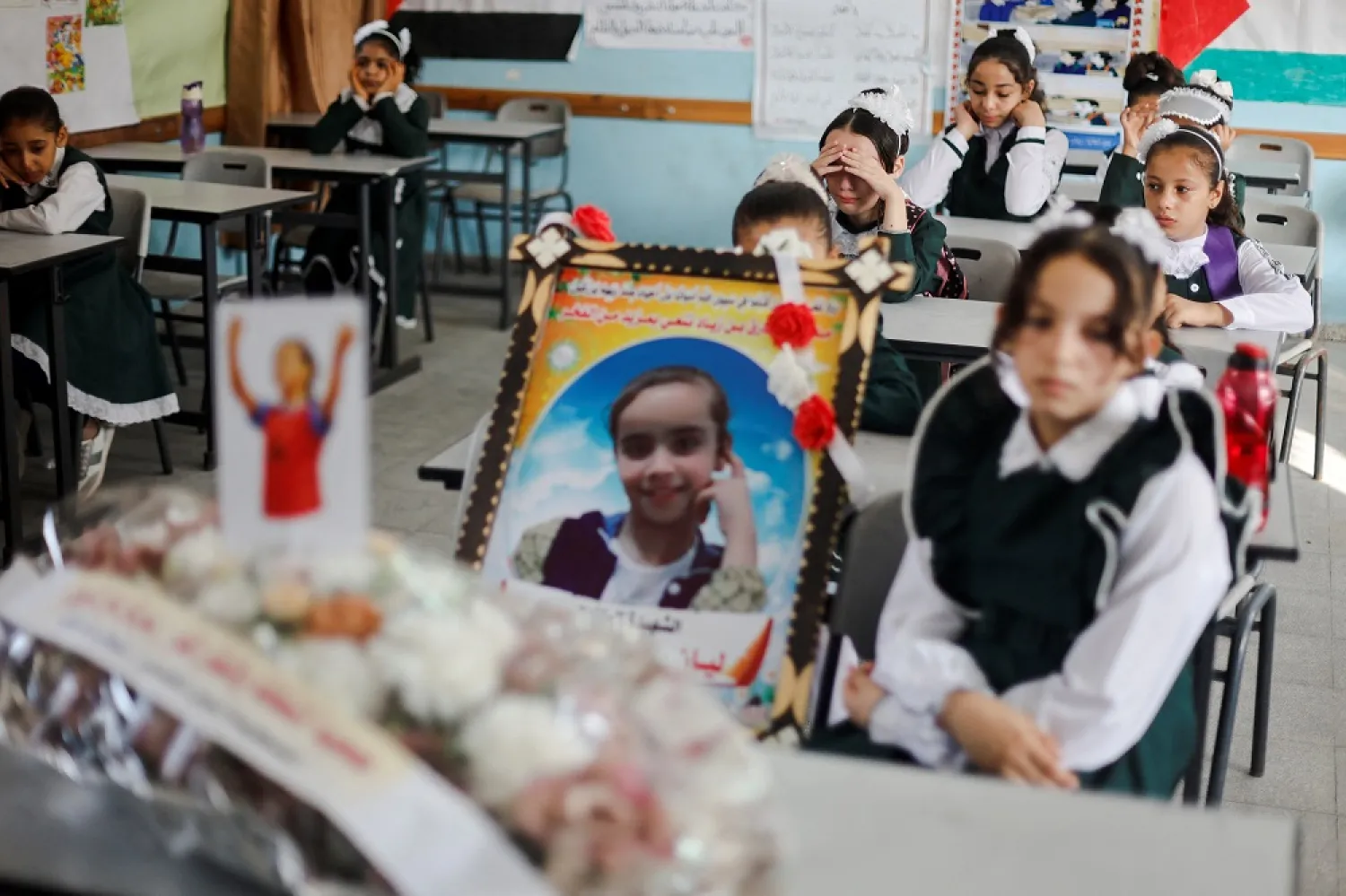
Classmates of Palestinian student Lian Al Shaer, 10, who was killed in recent Israel-Gaza fighting, react while Al Shaer's picture is displayed, as a new school year begins, in Khan Younis in the southern Gaza Strip August 29, 2022. (Reuters)
TT

Palestinian Toll Mounts as Israel Steps up West Bank Raids

Classmates of Palestinian student Lian Al Shaer, 10, who was killed in recent Israel-Gaza fighting, react while Al Shaer's picture is displayed, as a new school year begins, in Khan Younis in the southern Gaza Strip August 29, 2022. (Reuters)

At least 85 Palestinians have been killed in the West Bank this year as Israeli forces have carried out nightly raids in cities, towns and villages, making it the deadliest in the occupied territory since 2016.

The military says the vast majority were militants or stone-throwers who endangered the soldiers. The tally, from the Palestinian Health Ministry, includes Palestinians who carried out deadly attacks inside Israel.

But it also includes several civilians, including a veteran journalist and a lawyer who apparently drove unwittingly into a battle zone, as well as local youths who took to the streets in response to the invasion of their neighborhoods.

The length and frequency of the raids has pulled into focus Israel's tactics in the West Bank, where nearly 3 million Palestinians live under a decades-long occupation and Palestinians view the military’s presence as a humiliation and a threat.

Israeli troops have regularly operated across the West Bank since Israel captured the territory in 1967.

Israel says it is dismantling militant networks that threaten its citizens, and that it makes every effort to avoid harming civilians. Palestinians say the raids are aimed at maintaining Israel’s 55-year military rule over territories they want for a future state — a dream that appears as remote as ever, with no serious peace negotiations held in over a decade.

Israel stepped up the operations this past spring after a string of deadly attacks by Palestinians against Israelis killed 17 people, some carried out by militants from the West Bank. There have been no deadly attacks since May, but the relentless military operations have continued.

The Palestinian Health Ministry has reported 85 Palestinians killed by Israeli security forces in the occupied West Bank and annexed east Jerusalem since the start of the year.

With four months to go this year, that already is the highest number since 2016, the tail-end of a previous wave of violence, when 91 Palestinians were killed, according to yearly data compiled by the Israeli human rights group B'Tselem.

The ministry's tally includes attackers and known militants, but also the veteran Al Jazeera journalist Shireen Abu Akleh, and a 58-year-old man who was shot in the head outside a bakery earlier this month. The Israeli military says both might have been hit by Palestinian gunfire but has not provided evidence to substantiate its claims.

The dead include 17 teens under the age of 18, as well as six women, according to the ministry. Israel says that teenagers and women are often involved in violence, while critics accuse the army of using excessive force in many cases.

Israel is also holding more than 600 Palestinians without charge or trial in what's known as administrative detention — the highest in six years.

Amir Avivi, a retired Israeli general who now heads the Israel Defense and Security Forum, said the heightened pace of operations is the result of the recent wave of attacks and the Palestinian Authority's refusal to crack down on militants in the areas it administers.

The Palestinian Authority is mired in a crisis of legitimacy largely stemming from its cooperation with Israel on security matters. Palestinian officials say they will not help police the occupation, especially if there is no hope that doing so will lead to independence.

Rights groups say that while some Israeli missions are aimed at combatting specific threats, others are intended as a show of force, or to protect the growing population of Jewish settlers.

Ori Givati is the head of Breaking the Silence, an Israeli group opposed to the occupation that gathers testimonies of former Israeli soldiers. Some soldiers recall carrying out mock arrests, in which fully armed soldiers raid a home in the middle of the night — for training purposes.

Even more common, Givati says, are so-called “stimulus and response” operations, which he said he took part in himself when he served in the West Bank. In those, Israeli troops roll through Palestinian areas, sometimes with lights and speakers on, hoping to lure stone-throwers or gunmen into the streets so they can arrest or confront them.

“The way we occupy the Palestinians is by creating more and more friction, making our presence felt,” Givati said. “We invade their towns, their cities, their homes.”

In a statement, the army denied the allegations, saying it acts “solely against threats and terrorist operatives who pose a security threat” in Israel and the West Bank.

Israel says it investigates all cases in which Israeli troops are suspected of killing civilians, but rights groups say most of those investigations are quietly closed with soldiers rarely facing serious repercussions.

There were two notable exceptions this year.

The killing of Abu Akleh, a veteran on-air correspondent, prompted numerous independent investigations that concluded she was likely killed by Israeli fire. Israel denies targeting her and says it is still investigating.

There was also the death in January of Omar Assad, a 78-year-old who died shortly after Israeli soldiers bound and blindfolded him and left him in the cold. In that case, senior officers were reprimanded and stripped of leadership roles.

Both were American citizens, and the US raised both cases with Israel. Last week, Israel discharged four soldiers after they were caught on camera beating and kicking two detained Palestinians.

There was no such uproar over Salah Sawafta, who was shot outside the bakery as he returned from dawn prayers in the West Bank town of Tubas earlier this month. Israeli troops, who had gone to arrest suspected militants, were engaged in a firefight with Palestinian gunmen.

His family believes he was killed by an Israeli sniper in a building across the street. Zakreya Abu Dollah, the bakery owner who witnessed the shooting, said he saw Israeli soldiers fanned out on the street but no Palestinian gunmen or stone-throwers in the immediate area.

The military says it is investigating and that Sawafta might have been hit by a stray bullet fired by Palestinian militants.

Jehad Sawafta said his late brother, who made a living trading animal feed, had no connection to any political faction or militant group.

Salah had a son and four daughters, one of whom was engaged to be married this past Friday. The father of the bride was killed a week before the wedding.

“His second daughter was supposed to be married on Aug. 26, but then everything got turned upside down,” Jehad said. “Those girls adored their father because he provided a good and dignified life for them.”


Israeli Fire Kills Father and Son in Gaza, Medics Say

 Palestinians inspect tents buried under rocks and earth a day after a large sandstone slab collapsed at a displacement camp, killing at least five people, including four children, according to health officials, in Deir al-Balah, central Gaza Strip, Monday, Nov. 9, 2026. (AP)
Palestinians inspect tents buried under rocks and earth a day after a large sandstone slab collapsed at a displacement camp, killing at least five people, including four children, according to health officials, in Deir al-Balah, central Gaza Strip, Monday, Nov. 9, 2026. (AP)
TT

Israeli Fire Kills Father and Son in Gaza, Medics Say

 Palestinians inspect tents buried under rocks and earth a day after a large sandstone slab collapsed at a displacement camp, killing at least five people, including four children, according to health officials, in Deir al-Balah, central Gaza Strip, Monday, Nov. 9, 2026. (AP)
Palestinians inspect tents buried under rocks and earth a day after a large sandstone slab collapsed at a displacement camp, killing at least five people, including four children, according to health officials, in Deir al-Balah, central Gaza Strip, Monday, Nov. 9, 2026. (AP)

Israeli forces ‌killed at least three Palestinians, including a father and his 13-year-old son, in the Gaza Strip on Tuesday, local health officials said.

Medics said Fadi Rajab and his son Abubakr were killed in an airstrike that hit the roof of a displacement shelter in the Zeitoun neighborhood in Gaza City, while a ‌third person ‌was killed by gunfire in Khan ‌Younis, ⁠in the south ⁠of the enclave.

The Israeli military did not immediately comment on either of the incidents.

A US-brokered ceasefire last year called for the eventual reconstruction of Gaza, but little progress has been made. Negotiators ⁠have failed to agree on ‌terms for ‌Hamas to disarm or for Israel to withdraw its ‌troops, which control about two-thirds of ‌the territory and from which residents have been ordered to leave.

Israel says Hamas is trying to regroup and refill its arsenal, while ‌Hamas says it is committed to the ceasefire agreement and accuses ⁠Israel ⁠of trying to undermine it.

At least 1,600 Palestinians have been killed in Israeli attacks in Gaza since the ceasefire agreement, according to the territory's health officials, while Israel says four soldiers have been killed.

Palestinian authorities say more than 74,000 people have been killed in Israel's assault on Gaza, launched after Hamas-led fighters killed about 1,200 people in southern Israel on October 7, 2023.


Iraq Reopens Border Crossing with Iran

Stranded Iranians and Iraqis wait at the Iraq-Iran border following the Iraqi government's decision to close the Shalamsheh border crossing in the southern Basra province on September 12, 2026. (AFP)
TT

Iraq Reopens Border Crossing with Iran

Stranded Iranians and Iraqis wait at the Iraq-Iran border following the Iraqi government's decision to close the Shalamsheh border crossing in the southern Basra province on September 12, 2026. (AFP)

Iraqi authorities reopened on Tuesday a border crossing with Iran after closing it last month amid mounting US pressure to isolate Tehran.

The Iraqi government closed the Al-Sheeb crossing in the Maysan province in October. Two political sources told AFP that the US was pressuring Baghdad to close most crossings with neighboring Iran.

The head of Iraq's border crossings authority Alaa al-Waeli told the state news agency (INA) that Al-Sheeb crossing would reopen Tuesday morning after the completion of the "necessary procedures" required to resume operations and "ensure the smooth movement of travelers and goods".

He added that authorities would temporarily close the Al-Mandali border crossing in Diyala province starting on Friday for "maintenance".

The closure of the Al-Sheeb crossing sparked tensions between the central government and local authorities in Maysan, with several protests erupting over the shutdown of a key route.

In September, Baghdad temporarily closed several crossings with Iran after authorities determined that an unclaimed drone attack on a Saudi pipeline originated from an area near Al-Sheeb.

Pro-Iran armed groups have supported Tehran during the Middle East war, claiming hundreds of attacks on US bases in Iraq and across the region.


Egypt Permanently Lists Muslim Brotherhood as Terrorist Organization

A scene from a previous trial of Muslim Brotherhood members in Egypt (File photo: AFP). 
TT

Egypt Permanently Lists Muslim Brotherhood as Terrorist Organization

A scene from a previous trial of Muslim Brotherhood members in Egypt (File photo: AFP). 

Egyptian authorities have permanently placed the Muslim Brotherhood on the country’s list of terrorist entities, according to decisions by the Public Prosecution published in the Official Gazette on Monday.

The Brotherhood has been designated a terrorist organization in Egypt since 2013 and has been placed on the country’s terrorist entities list several times.

Most of its senior leaders, including Supreme Guide Mohamed Badie, remain in Egyptian prisons in cases involving violence and murder following the group’s removal from power that year.

Other Brotherhood members wanted by Egyptian authorities remain abroad, where they continue to lead the organization amid deep internal divisions, according to observers.

Under the latest decisions, the Public Prosecution terminated the effects of two temporary listings issued in 2022: Decision No. 6 concerning terrorist entities and Decision No. 13 concerning individuals designated as terrorists. Both were published in Egypt’s official legal gazette, Al-Waqa’i Al-Masriyya, on January 3, 2023.

Prosecutors also ordered the Brotherhood’s permanent inclusion on the list of terrorist entities.

The decision permanently added three Brotherhood figures convicted under final, binding court rulings to the list of designated terrorists.

They were identified as Abdel Rahman Hassan Mohamed Meligy, Jamal Abdel Hamid Jomaa and Osama Ibrahim Mohamed Mostafa.

The Public Prosecution cited Law No. 8 of 2015, governing lists of terrorist entities and individuals, and its subsequent amendments as the legal basis for the decisions.

A judicial source familiar with the procedures explained that listing an individual as a terrorist automatically triggers measures including asset freezes, travel bans, placement on arrival watchlists and the withdrawal or cancellation of passports.

According to observers, publication of the decision in the Official Gazette also activates a range of restrictions against the Brotherhood, including a ban on the organization, suspension of all its activities and closure of its premises.

The measures prohibit direct or indirect financing, fundraising and the collection of material donations on its behalf, as well as civic or religious outreach activities conducted under any name.

Local media reports on Monday explained that the main distinction between temporary and permanent designation lies in their legal basis.

Temporary listing follows a judicial decision issued at the request of the prosecutor general, while permanent designation is based on a final criminal conviction against an organization or individual.

International Campaign Against Brotherhood Expands

The campaign against the Muslim Brotherhood has expanded across the Arab world and internationally in recent months.

In May, US President Donald Trump’s administration discussed a national counterterrorism strategy that focused primarily on the Brotherhood, portraying it as the ideological source of modern extremist terrorism.

The move followed Washington’s designation in January of the Muslim Brotherhood in Egypt and its branches in Jordan and Lebanon as terrorist organizations.

In March, the United States added the Brotherhood’s Sudanese branch to the same list.

Argentina also moved earlier this year to designate the Brotherhood’s branches in Egypt, Jordan and Lebanon as terrorist organizations.