

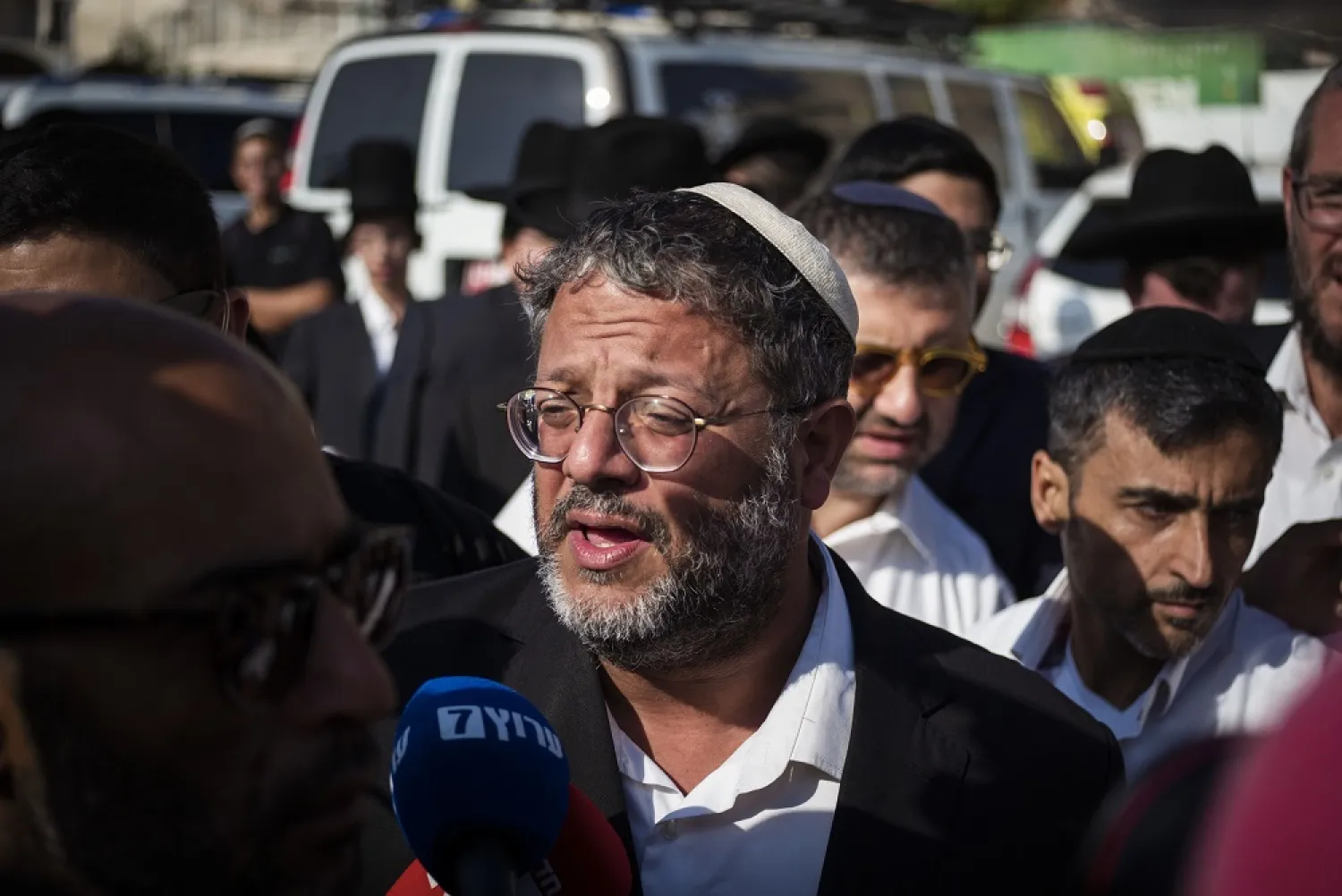

Extremist Lawmaker Surges Ahead of Elections in Israel

07 August 2022, Israel, Jerusalem: Itamar Ben-Gvir, leader of the Israeli far-right party Otzma Yehudit, speaks to the media as he enters the Al-Aqsa compound during the holy day Tisha B'Av,a day commemorating the destruction of ancient Jerusalem temples. (dpa)
TT

Extremist Lawmaker Surges Ahead of Elections in Israel

07 August 2022, Israel, Jerusalem: Itamar Ben-Gvir, leader of the Israeli far-right party Otzma Yehudit, speaks to the media as he enters the Al-Aqsa compound during the holy day Tisha B'Av,a day commemorating the destruction of ancient Jerusalem temples. (dpa)

Israeli lawmaker Itamar Ben-Gvir calls his Arab colleagues "terrorists." He wants to deport his political opponents, and in his youth, his views were so extreme that the army banned him from compulsory military service.

Yet today, the populist lawmaker who was once relegated to the margins of Israeli politics is surging ahead in the polls ahead of November elections. He has received the blessing of former Prime Minister Benjamin Netanyahu and is poised to emerge as a major force that could propel the onetime premier back to power.

Ben-Gvir’s stunning rise is the culmination of years of efforts by the media-savvy lawmaker to gain legitimacy. But it also reflects a rightward shift in the Israeli electorate that has brought his religious, ultranationalist ideology into the mainstream and all but extinguished hopes for Palestinian independence.

"Over the last year I’ve been on a mission to save Israel," Ben-Gvir recently told reporters. "Millions of citizens are waiting for a real right-wing government. The time has come to give them one."

Ben-Gvir, 46, has been a fixture of Israel’s extreme right for more than two decades, gaining notoriety in his youth as a disciple of the late radical rabbi, Meir Kahane. He first became a national figure when he famously broke a hood ornament off then-Prime Minister Yitzhak Rabin’s car in 1995.

"We got to his car, and we’ll get to him too," he said, just weeks before Rabin was assassinated by a Jewish extremist opposed to his peace efforts with the Palestinians.

Kahane’s violent anti-Arab ideology -- which included calls to ban Jewish-Arab intermarriage and for the mass expulsion of Palestinians -- was considered so repugnant that Israel banned him from parliament and the US listed his party as a terrorist group. Kahane himself was assassinated by an Arab assailant in New York in 1990.

But in recent years, his followers and some of his ideas have made their way to the Israeli mainstream — in large part thanks to Ben-Gvir.

He transitioned into politics last year after a career as a lawyer defending radical Jewish West Bank settlers. His intimate knowledge of the law has helped him test the boundaries of the country’s incitement laws and avoid sanctions that have prevented some of his closest associates from running in elections.

Ben-Gvir, for instance, calls Kahane "righteous and holy" but also says he doesn’t agree with everything his former mentor said. He's careful to limit his own calls for expulsion to those who engage in violence and lawmakers — Jewish or Arab — who he says undermine the state.

Before entering politics, he removed a photo of Baruch Goldstein -- a Jewish militant who gunned down 29 Palestinians in a mosque in 1994 -- from his living room. He no longer allows his supporters to chant "Death to Arabs" at political rallies. Instead, they are told to say, "Death to terrorists!"

Supporters say Ben-Gvir has changed, been misunderstood, or wrongly painted an extremist.

"People mature. People develop," said Nevo Cohen, Ben-Gvir’s campaign manager. "They stuck a label on Ben-Gvir that is totally wrong."

Ben-Gvir’s office turned down an interview request. But he makes frequent appearances on Israeli TV and radio, displaying a cheerful demeanor, quit wit and knack for deflecting criticism as he banters with his hosts.

He also has tapped into a wave of anti-Arab and nationalist sentiment driven by years of violence, failed peace efforts and demographic changes. Ben-Gvir’s supporters are largely religious and ultra-Orthodox Jews, who tend to have large families, and also come from the influential West Bank settler movement. Ben-Gvir himself lives in a hard-line settlement next to the West Bank city of Hebron, home to more than 200,000 Palestinians.

"He is a populist demagogue. He plays on the sentiments of hate and fear of Arabs," said Shuki Friedman, an expert on Israel’s far right at the Jewish People Policy Institute. "He interviews well, he is good on camera and he has had plenty of screen time that has given him legitimacy."

In the opposition over the past year, Ben-Gvir has positioned himself as a rabble rouser against the government -- the first ever to have an Arab party as a member. He publicly quarreled with Arab lawmakers in scenes captured on camera and widely broadcast.

In the tense run-up to last year’s Gaza war, he staged provocative visits to Arab neighborhoods, rallying ultranationalist supporters to confront Palestinians and assert "Jewish Power" — the name of his party.

He set up an outdoor parliamentary "office" in an Arab neighborhood of east Jerusalem where Jewish settlers are trying to expel Palestinians from their homes, setting off a melee. He later called for police to use live fire against Palestinian protesters at a flashpoint holy site.

His surge in the polls has made him a central figure in Netanyahu’s comeback strategy.

Netanyahu is on trial for corruption, and the public is again torn over his fitness to rule. After four consecutive inconclusive elections, Netanyahu and his Likud party hope to break the logjam with Ben-Gvir’s support.

"Yes, Ben-Gvir is someone very militant and yes, sometimes a little provocative, but he is someone who cares about Israel," said Likud lawmaker and Netanyahu confidant Miki Zohar, who insisted Ben-Gvir would fall in line under a Netanyahu-led government.

Last week, Netanyahu personally brokered a deal between Ben-Gvir and a rival far-right leader, Bezalel Smotrich, to ensure they run together. If they hadn’t, Smotrich might not have made it into parliament, depriving Netanyahu of a critical source of support.

"Joining forces is the order of the day," Netanyahu said.

One recent poll forecast Ben-Gvir’s alliance with 12 seats, which would make it parliament’s fourth-largest. That means Netanyahu almost certainly would make Ben-Gvir a Cabinet minister if he can form a government.

Ben-Gvir has said his first order of business would be to pass a law allowing deportations of those who allegedly subvert the country and its security forces. He has proposed imposing the death penalty for "terrorists" and granting immunity to soldiers accused of committing violent crimes against Palestinians.

Thabet Abu Rass, the Arab co-director of the Abraham Initiatives, which promotes Jewish-Arab coexistence, said the mainstreaming of figures like Ben-Gvir is not only a threat to Israel’s Arab citizens, but to the country as a whole.

By branding Arab members of parliament as traitors who should be expelled, Ben Gvir delegitimizes the political participation of Arab citizens — who make up around 20% of Israel's population — and the possibility of Jewish-Arab partnerships, Abu Rass said.

"It’s very dangerous for the whole Israeli society," he said. "It’s going to bring about the collapse of democracy."



Rescue Teams Search for Survivors in Building Collapse that Killed at Least 2 in Northern Lebanon

A Lebanese flag is pictured, in the aftermath of a massive explosion, in Beirut's damaged port area, Lebanon August 17, 2020. REUTERS/Hannah McKay
TT

Rescue Teams Search for Survivors in Building Collapse that Killed at Least 2 in Northern Lebanon

A Lebanese flag is pictured, in the aftermath of a massive explosion, in Beirut's damaged port area, Lebanon August 17, 2020. REUTERS/Hannah McKay

At least two people were killed and four rescued from the rubble of a multistory apartment building that collapsed Sunday in the city of Tripoli in northern Lebanon, state media reported.

Rescue teams were continuing to dig through the rubble. It was not immediately clear how many people were in the building when it fell.

The bodies pulled out were of a child and a woman, the state-run National News Agency reported.

Dozens of people crowded around the site of the crater left by the collapsed building, with some shooting in the air.

The building was in the neighborhood of Bab Tabbaneh, one of the poorest areas in Lebanon’s second largest city, where residents have long complained of government neglect and shoddy infrastructure. Building collapses are not uncommon in Tripoli due to poor building standards, according to The AP news.

Lebanon’s Health Ministry announced that those injured in the collapse would receive treatment at the state’s expense.

The national syndicate for property owners in a statement called the collapse the result of “blatant negligence and shortcomings of the Lebanese state toward the safety of citizens and their housing security,” and said it is “not an isolated incident.”

The syndicate called for the government to launch a comprehensive national survey of buildings at risk of collapse.


Israel to Take More West Bank Powers and Relax Settler Land Buys

A view of Israeli settlement of Maale Adumim, in the West Bank, Sunday, June 18, 2023. (AP)
TT

Israel to Take More West Bank Powers and Relax Settler Land Buys

A view of Israeli settlement of Maale Adumim, in the West Bank, Sunday, June 18, 2023. (AP)

Israel's security cabinet approved a series of steps on Sunday that would make it easier for settlers in the occupied West Bank to buy land while granting Israeli authorities more enforcement powers over Palestinians, Israeli media reported.

The West Bank is among the territories that the Palestinians seek for a future independent state. Much of it is under Israeli military control, with limited Palestinian self-rule in some areas run by the Western-backed Palestinian Authority (PA).

Citing statements by Finance Minister Bezalel Smotrich and Defense Minister Israel Katz, Israeli news sites Ynet and Haaretz said the measures included scrapping decades-old regulations that prevent Jewish private citizens buying land in the West Bank, The AP news reported.

They were also reported to include allowing Israeli authorities to administer some religious sites, and expand supervision and enforcement in areas under PA administration in matters of environmental hazards, water offences and damage to archaeological sites.

Palestinian President Mahmoud Abbas said the new measures were dangerous, illegal and tantamount to de-facto annexation.

The Israeli ministers did not immediately respond to requests for comment.

The new measures come three days before Prime Minister Benjamin Netanyahu is scheduled to meet in Washington with US President Donald Trump.

Trump has ruled out Israeli annexation of the West Bank but his administration has not sought to curb Israel's accelerated settlement building, which the Palestinians say denies them a potential state by eating away at its territory.

Netanyahu, who is facing an election later this year, deems the establishment of any Palestinian state a security threat.

His ruling coalition includes many pro-settler members who want Israel to annex the West Bank, land captured in the 1967 Middle East war to which Israel cites biblical and historical ties.

The United Nations' highest court said in a non-binding advisory opinion in 2024 that Israel's occupation of Palestinian territories and settlements there is illegal and should be ended as soon as possible. Israel disputes this view.


Arab League Condemns Attack on Aid Convoys in Sudan

A general view shows the opening session of the meeting of Arab foreign ministers at the Arab League Headquarters (Reuters)
TT

Arab League Condemns Attack on Aid Convoys in Sudan

A general view shows the opening session of the meeting of Arab foreign ministers at the Arab League Headquarters (Reuters)

Arab League Secretary-General Ahmed Aboul Gheit strongly condemned the attack by the Rapid Support Forces on humanitarian aid convoys and relief workers in North Kordofan State, Sudan.

In a statement reported by SPA, secretary-general's spokesperson Jamal Rushdi quoted Aboul Gheit as saying the attack constitutes a war crime under international humanitarian law, which prohibits the deliberate targeting of civilians and depriving them of their means of survival.

Aboul Gheit stressed the need to hold those responsible accountable, end impunity, and ensure the full protection of civilians, humanitarian workers, and relief facilities in Sudan.