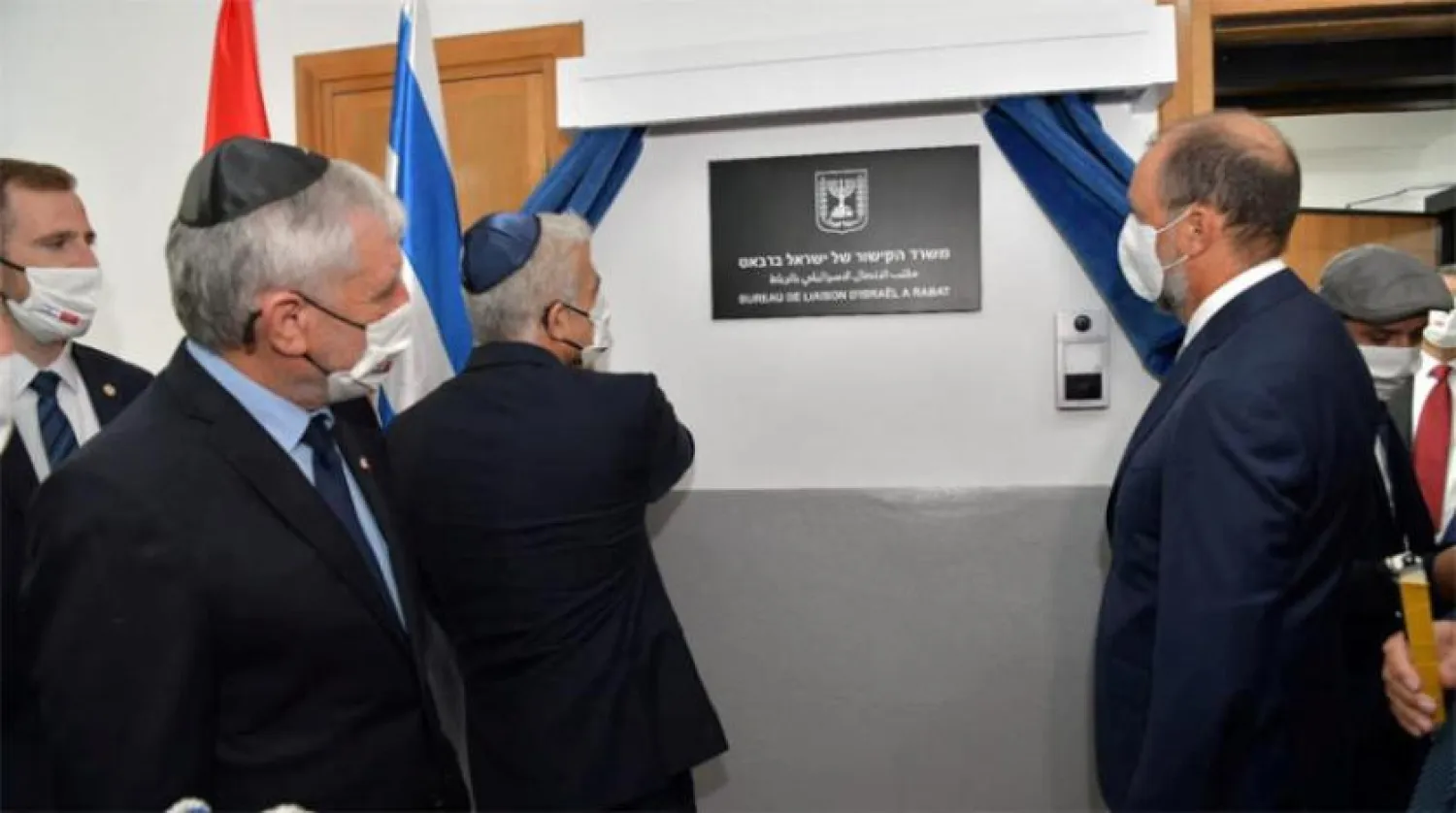
Israel Investigates Sexual Harassment Allegation in Morocco’s Liaison Office

Inauguration of Morocco’s Liaison Office in Rabat (File photo: Reuters)
TT

Israel Investigates Sexual Harassment Allegation in Morocco’s Liaison Office

Inauguration of Morocco’s Liaison Office in Rabat (File photo: Reuters)

Israel is investigating alleged misconduct, including sexual harassment, at the Liaison Office in Rabat, Morocco, according to Israeli media sources.

Ministry Inspector General Hagay Behar arrived in Morocco after severe complaints about the functioning of the mission, chaired by David Govrin.

Behar is responsible for investigations in Israeli embassies around the world.

The Israeli Ynet website reported that Behar met with embassy staff last week, and three employees were fired.

The investigation began after serious allegations of mysterious work relations in the office, financial and administrative problems, and sexual allegations.

Three of the dismissed employees were reportedly Moroccan Jews employed in the liaison office as local employees. The fourth member is an Israeli diplomat with Moroccan and French citizenship who resigned and returned to Paris.

The Israeli B channel said the focus of the investigation is the behavior of Govrin, who previously served as Israel’s ambassador to Egypt, adding that due to the suspicions, a delegation of senior officials was rushed to Morocco last week.

The Israeli Foreign Ministry is investigating allegations “about the sexual exploitation of local women” and complaints of sexual harassment within the mission.

The ministry is also investigating the disappearance of a valuable gift sent by the King of Morocco on Israel’s Independence Day.

Such gifts must be registered and turned over to the government, but the item appears to have disappeared with no record.

The Israeli Foreign Ministry is also investigating the involvement of a local businessman, Sami Cohen, in hosting official events for senior Israeli officials.

Cohen held a reception for Yair Lapid, Ayelet Shaked, and Gideon Saar and initiated meetings between them and local officials, even though he was not officially affiliated with the mission.

The team was also investigating a reported feud between Govrin and the mission’s security officer.


Iraqi PM Orders Takeover of Kurdistan Region’s Border Crossings After Oil Smuggling Probe

Iraqi soldiers deploy in Jurf al-Sakher, in Babil Province, on November 20, 2026. (AFP)
TT

Iraqi PM Orders Takeover of Kurdistan Region’s Border Crossings After Oil Smuggling Probe

Iraqi soldiers deploy in Jurf al-Sakher, in Babil Province, on November 20, 2026. (AFP)

Iraqi Prime Minister Ali al-Zaidi ordered the border crossings authority to ‌take ‌over all crossings ‌in ⁠the Kurdistan region ⁠and the federal oil ministry to manage ⁠fields ‌under Kurdish ‌security control ‌in ‌four provinces, Iraq's state news agency ‌said on Tuesday.

The orders ⁠followed ⁠an oil smuggling investigation at the North Oil Company.


Israeli Airstrikes Kill at Least Six Palestinians in Gaza, Medics Say

Palestinians gather around the remains of a car that was targeted in an Israeli strike in Gaza City on November 23, 2026. (AFP)
TT

Israeli Airstrikes Kill at Least Six Palestinians in Gaza, Medics Say

Palestinians gather around the remains of a car that was targeted in an Israeli strike in Gaza City on November 23, 2026. (AFP)

Israeli airstrikes killed at least six Palestinians, including two police officers, in the Gaza Strip on Tuesday, local health and police officials said.

Medics said three people were killed in an Israeli airstrike at a police post in Khan Younis in southern Gaza. ‌The Hamas-run interior ‌ministry said two of those were ‌police ⁠officers.

Five other people ⁠were wounded in the attack, medics added. Later on Tuesday, medics said another Israeli airstrike near the Netzarim corridor further north killed another three people.

Commenting on the two strikes, the Israeli military told Reuters it struck fighters in both areas, without giving further details.

An October 2025 ⁠US-backed ceasefire halted major fighting in the shattered ‌territory, but has not ‌stopped Israeli attacks on Gaza or secured Hamas' disarmament.

Israel, which accuses ‌Hamas of trying to regroup and rearm, has stepped ‌up its attacks in Gaza in recent months. Hamas denies the Israeli allegations, saying it is committed to the ceasefire agreement and accusing Israel of trying to derail it.

At least ‌1,600 Palestinians and five Israeli soldiers have been killed since then, according to respective ⁠Palestinian and Israeli ⁠tallies.

Israeli troops now control around two-thirds of Gaza, up from more than half at the time of the ceasefire, with Hamas controlling a sliver of territory along Gaza's coast.

Israel's more than two-year-long assault on Gaza has killed tens of thousands, caused a hunger crisis, internally displaced Gaza's entire population and led to assessments of genocide from scholars and a United Nations inquiry.

Israel has said its actions were in self-defense after Hamas-led gunmen killed 1,200 people and took more than 250 hostages in an October 2023 attack on Israel.


After Sinking of Russia’s Merkuriy, What Options Does Libya Have to Respond and Protect Its Waters?

Russian President Vladimir Putin receives Libyan National Army commander Khalifa Haftar at the Kremlin in May 2025. (LNA General Command)
TT

After Sinking of Russia’s Merkuriy, What Options Does Libya Have to Respond and Protect Its Waters?

Russian President Vladimir Putin receives Libyan National Army commander Khalifa Haftar at the Kremlin in May 2025. (LNA General Command)

Libya faces a new test of its national sovereignty after Ukraine announced it had targeted two Russian vessels off Benghazi, sinking one and raising questions about the ability of the country, divided between two rival governments, to respond.

Mutual accusations followed an explosion aboard a Russian vessel in Benghazi port on Sunday, before Ukrainian President Volodymyr Zelensky claimed responsibility on Monday for sinking the Russian warship Merkuriy, describing the operation as a “model response to Russia’s war.”

Libya is caught between competing foreign alliances, with western authorities seeking closer ties with Ukraine, while eastern Libya maintains relations with Russia involving military and logistical support.

Libyan law professor and political researcher Ramadan al-Tweijer described the Benghazi incident as “dangerous and a reflection of what is happening around the world,” warning that unless national institutions were unified, Libya would be unable to exercise full sovereignty and risked becoming one of the theaters of a global war.

Unifying institutions

The incident was not unprecedented. On March 3, Libya reported that explosions and a massive fire had partially sunk the Russian gas tanker Arctic Metagaz about 130 nautical miles north of Sirte.

Russian Foreign Minister Sergei Lavrov accused Ukraine at the time of targeting the tanker with naval drones allegedly launched from Libya’s shores.

Speaking to Asharq Al-Awsat, al-Tweijer described the Benghazi incident as a violation of national sovereignty.

“Despite its divisions, Libya will respond with all the resources at its disposal to defend its territory,” he said, acknowledging, however, that the country lacked the capabilities to enter the conflict or become a party to an international war.

He said that Libya had no alternative but to unify its national institutions, establish a single army and government, and fully restore its sovereignty. This would require a foreign policy that keeps the country out of international conflicts.

Deeper crisis

As some Libyans accused the country’s west of launching the drones, Zelensky announced on X that Ukrainian forces had sunk the Merkuriy and destroyed a military helicopter.

“Our second target was the Russian dry cargo vessel MV Angara, which the enemy used to transport weapons,” he said.

Libya’s High Council of State member Abubakr Mohammed Othman noted that the Benghazi incident raised serious questions about Libya’s ability to protect its waters and ports and safeguard its national sovereignty.

He stressed that Libya was not a party to the Russia-Ukraine war and that its territory and waters should not become an arena for settling international scores.

“Addressing this incident cannot be separated from the deeper crisis facing the Libyan state: institutional divisions, multiple centers of decision-making and the absence of a unified national authority,” he told Asharq Al-Awsat.

Full sovereignty required unified institutions and independent national decision-making, he added.

Othman called for strengthening maritime surveillance, early warning and coast guard capabilities, securing ports and critical infrastructure, and establishing clear regulations governing the entry and activities of military and foreign vessels in Libyan ports.

He also advocated cooperation and information sharing with Mediterranean countries and relevant international organizations to detect threats and prevent similar incidents.

Such measures, however, would have limited effectiveness unless accompanied by the unification of military and security institutions and decision-making authorities.

Calls for accountability

Libyan Presidential Council member Musa al-Koni described the Benghazi attack as a “declaration of war against the Libyan state,” demanding a serious and transparent international investigation to establish the circumstances and hold those responsible accountable.

He pledged immediate legal and diplomatic measures aimed at deterrence at the regional and international levels, including referring the matter to the International Court of Justice, the UN Security Council and relevant organizations.

Al-Koni also called for an emergency Security Council session, urging that Zelensky be placed on a terrorism list over what he described as terrorist acts for which the Ukrainian president had publicly claimed responsibility.

Albania’s Defense Ministry on Monday denied allegations that naval drones had been launched from its territory to target the Russian warship.

The Arab Organization for Human Rights in Libya described the targeting of critical infrastructure within a sovereign state as a flagrant violation of peremptory norms of public international law warranting legal accountability.

It noted that civilian seaports are generally classified as protected civilian objects under international humanitarian law.