


EU Policy Chief 'Less Optimistic' about Quick Revival of Iran Nuclear Deal

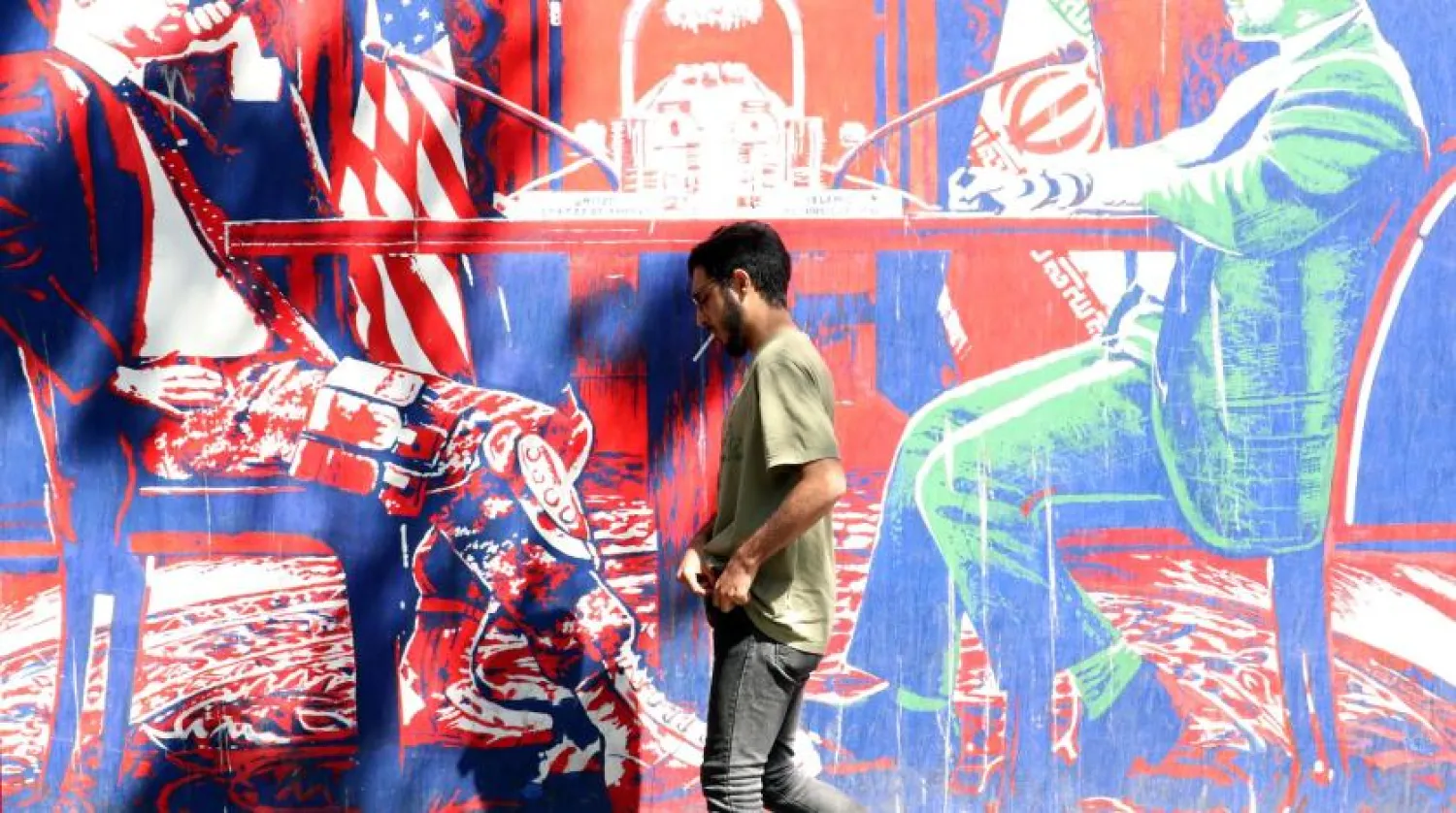
 An Iranian man walks next to mural depicting the negotiating table on the wall of the former US embassy in Tehran (EPA).
An Iranian man walks next to mural depicting the negotiating table on the wall of the former US embassy in Tehran (EPA).
TT

EU Policy Chief 'Less Optimistic' about Quick Revival of Iran Nuclear Deal

 An Iranian man walks next to mural depicting the negotiating table on the wall of the former US embassy in Tehran (EPA).
An Iranian man walks next to mural depicting the negotiating table on the wall of the former US embassy in Tehran (EPA).

EU Foreign Policy Chief Josep Borrell said that he was less optimistic about reaching an agreement on a revival of the Iran nuclear deal than he was only a short while ago.

“I am sorry to say that I am less confident today than 28 hours before...about the prospects of closing the deal right now,” Borrell told reporters in Brussels on Monday.

Meanwhile, Tehran repeated its request to end the International Atomic Energy Agency’s investigation to continue the diplomatic “marathon” aimed at reviving the nuclear agreement. It also ruled out allowing US companies to work in Iran if Washington lifted economic sanctions under the potential agreement.

Iranian Foreign Ministry spokesman Nasser Kanani said in a press conference on Monday that an agreement was “subject to closing the nuclear allegations matter.”

He added that the nuclear agreement - officially known as the Joint Comprehensive Plan of Action - and the indirect negotiations with Washington by the European Coordinator “revolve around closing the nuclear allegations against Iran, and the matter has nothing to do with the bilateral relations between Iran and the United States.”

The White House said on Friday, that there should be no link between the re-implementation of the Iranian nuclear agreement, and the verification of whether Tehran has fulfilled its obligations under the Treaty on the Non-Proliferation of Nuclear Weapons, in reference to investigations by the Atomic Energy Agency into the effects of uranium found in three unannounced Iranian sites.

On Thursday, Tehran sent its last response to the European Union’s proposal on the means to revive the agreement.

Iran’s Mehr news agency quoted Kanani as saying that Iran’s response could “create the grounds for a conclusion of the talks and for an agreement in a short amount of time if there is also mutual political will.”

- America Companies

In response to a question on whether Iran would allow American companies to operate in Iran if the nuclear agreement is revived, Kanani told the reporters: “The nuclear agreement and the possible agreement in the future do not regulate Iranian-American bilateral relations; rather, it is to resolve unnecessary crises related to Iranian activities…”

Iranian Leader Ali Khamenei had closed the door on US companies, in his first speech after the nuclear agreement was reached in July 2015, and issued warnings against “Western penetration” in Iranian decision-making centers.

- On Energy

Kanani pointed to the possibility of the return of Iranian oil and gas exports after the lifting of sanctions, in light of the energy crisis that is hitting the European continent.

“Despite the sanctions, Iran has maintained its presence in international markets,” the Iranian foreign ministry spokesman said, adding: “Given Europe’s energy supply problems triggered by the Ukraine crisis, Iran could provide Europe’s energy needs if sanctions against it are lifted.”

- Thorny Issue

The IAEA investigations constitute a stumbling block to reviving the 2015 agreement, under which Iran curbed its nuclear program in return for the easing of US, UN and European Union sanctions.

Since February 2021, Iran has frozen some inspection and monitoring measures under the nuclear deal. Those included ending the temporary implementation of the Additional Protocol concluded between the IAEA and some member states that enables the Agency to carry out rapid inspections based on short notices of undeclared sites. Tehran signed the Additional Protocol in 2003 but never ratified it

Iran has abandoned the transparency measures contained in the 2015 agreement that allow monitoring of some sectors of its nuclear program.

Last June, the IAEA Board of Governors, by an overwhelming majority, passed a resolution drafted by the United States, France, Britain and Germany criticizing Iran for its failure to explain the presence of uranium traces at the mentioned sites.

Later this month, 35 countries will meet in the IAEA Council of Governors to discuss differences with Iran, ahead of the United Nations General Assembly in New York.



Israel's Netanyahu Expected to Denounce Enemies, Allies with UN Spotlight

Israeli Prime Minister Benjamin Netanyahu speaks during a toast-raising event hosted by his Likud party, in Tel Aviv, Israel, September 17, 2026. REUTERS/Amir Cohen
TT

Israel's Netanyahu Expected to Denounce Enemies, Allies with UN Spotlight

Israeli Prime Minister Benjamin Netanyahu speaks during a toast-raising event hosted by his Likud party, in Tel Aviv, Israel, September 17, 2026. REUTERS/Amir Cohen

Israel's Prime Minister Benjamin Netanyahu, facing a difficult reelection campaign at home, addresses the UN Thursday where he is expected to lash out at both enemies as well as allies that have crossed him in recent months.

Netanyahu will also likely raise the case of Israeli ambassador to Washington Yechiel Leiter whose son, a soldier, was badly injured in an alleged Palestinian ramming attack in the occupied West Bank, reported AFP.

Foremost among Netanyahu's enemies in New York is the city's leftist Mayor Zohran Mamdani who recently vowed to execute an ICC arrest warrant when the visiting leader arrived in the city for the UN's signature gathering.

The Hague-based International Criminal Court (ICC) said in 2024 it had reasonable grounds to believe Netanyahu was responsible for alleged war crimes in his Gaza campaign that responded to Hamas' deadly October 7, 2023 attacks. Netanyahu denies the ICC claims.

But Mamdani later conceded he did not have the authority for such a maneuver, leading to howls of indignation from Netanyahu and his backers.

Ahead of his turn at the UN's signature diplomatic week, Netanyahu said he was going to "tell the truth about you," addressing Mamdani and accusing him of "supporting the Hamas terrorist monsters."

He also baselessly accused Mamdani of "inciting riots against New York Jews."

Mamdani, who has long supported Palestinian rights and accused Israel of war crimes, fired back Tuesday and said "we all know that what the prime minister has said in that video is not true."

One of Netanyahu's fiercest critics, Palestinian president Mahmud Abbas, will not be in the room after Washington denied him a visa to attend.

Erstwhile allies of Israel Britain and France will likely be in Netanyahu's firing line Thursday.

Britain has imposed limited sanctions on Israeli exports from the occupied West Bank, a move France recently followed on.

French President Emmanuel Macron drew Israel's ire for claiming Hamas was not active in the West Bank. Hamas' stronghold has traditionally been Gaza.

Netanyahu's office attacked "the gross absurdity of the claim," adding Hamas attacks "Jews almost every day."

"They have murdered countless Israeli civilians in Judea and Samaria," it added, using the Biblical name for the West Bank, which Israel seized in 1967.

Netanyahu already had poor relations with Macron, who led a push by Western nations at last year's UN General Assembly to recognize a Palestinian state.

Iran, which Israel and the United States have been at war with since launching attacks in February, will almost certainly feature in Netanyahu's speech.

Israel is insisting Washington take more comprehensive military action in Iran to prevent Tehran from obtaining nuclear weapons.

- Ferocious criticism of UN -

But the war is unpopular with the US public, and gas prices have surged in its wake.

Israel's ambassador to the UN Danny Dannon said after Iran's president spoke Wednesday that Tehran "arms Hezbollah in Lebanon, the Houthis in Yemen, Hamas in Gaza and Judea and Samaria, and militias in Iraq."

He called it a "regime that murders its own citizens when they dare to protest against it."

Netanyahu will almost certainly criticize the United Nations and its outgoing leader Antonio Guterres of whom he has been a persistent critic, even more so since the October 7, 2023 Hamas attacks on Israel.

Unusually, Guterres this week referenced in full the title of legally binding International Criminal Court measures that accuse Israel of "genocide" in Gaza.

Netanyahu's government has repeatedly accused a UN agency of providing cover for Hamas militants, claiming that some of its employees took part in the group's attack on Israel that sparked the war in Gaza.

Despite a US-brokered ceasefire in October 2025, Israel has continued its airstrikes and restricted entry of equipment that international groups say is required for the territory's reconstruction to begin.

Acting Commissioner-General of the UN's Palestinian refugees agency Christian Saunders told AFP this week Israel was being "extremely difficult" about letting in vital supplies like engine oil to Gaza for relief operations while permitting luxury commercial products.

"I think (the Israeli government) are trying to show the Israeli public why they should re-elect them," Saunders added.

As in past years when Netanyahu has addressed the UN General Assembly, he faces protest both inside and outside -- from delegations leaving the meeting in opposition to his policies, and demonstrators gathered nearby.

Israelis go to the polls on October 27.


Xi Arrives in US to Personal Trump Welcome

Chinese President Xi Jinping (L), Chinese First Lady Peng Liyuan (2-L), US President Donald Trump (2-R), and US First Lady Melania Trump (R) stand during an arrival ceremony at Joint Base Andrews, Maryland, USA, 23 September 2026. (EPA)
TT

Xi Arrives in US to Personal Trump Welcome

Chinese President Xi Jinping (L), Chinese First Lady Peng Liyuan (2-L), US President Donald Trump (2-R), and US First Lady Melania Trump (R) stand during an arrival ceremony at Joint Base Andrews, Maryland, USA, 23 September 2026. (EPA)

US President Donald Trump treated Chinese President Xi Jinping to a rare personal airport welcome Wednesday, kicking off a pomp-filled state visit aimed at smoothing superpower tensions on everything from AI and trade to Iran.

Trump and First Lady Melania shook hands with Xi and his wife Peng Liyuan after the Chinese president descended from his plane at Joint Base Andrews, a US military airfield outside Washington.

Trump, wearing a long coat and gloves, and Xi then stood side by side on the tarmac as a military band played national anthems.

A noisy flyover by two B-1 bombers clearly jolted Trump, who grimaced at the roar of jets, while his Chinese guest stood by impassively.

The personal airport greeting -- a courtesy Trump was notably denied when he visited Beijing in May -- begins three days of pageantry that will include another flyover and a state banquet at the White House on Thursday.

Six F-22 fighter jets and six F-16s were lined up on the tarmac in an apparent display of military might as US officials literally rolled out the red carpet for the Chinese leader.

But expectations of any breakthroughs are low. Analysts say the main aim of the lavish spectacle is to maintain a fragile diplomatic and trade truce between the world's biggest economies.

Xi was accompanied by his right-hand man Cai Qi and Foreign Minister Wang Yi, among others, according to Chinese state media.

There were no Chinese CEOs in Xi's delegation, two sources told AFP, despite the fact that top US tech bosses including the leaders of major AI companies are set to attend Thursday's White House state banquet.

Xi's visit will wrap up on Friday morning when the two presidential couples have tea at the White House and then visit the National Archives, home to the US Declaration of Independence.

- Trade war truce extended -

When the two leaders sit down for their highly anticipated talks on Thursday, they will be confronting a host of thorny issues led by fears -- boosted by warnings from tech CEOs -- that artificial intelligence risks wiping out humanity.

But with China and the United States racing for AI supremacy there are few expectations of any deal to regulate the rapidly advancing technology.

Preliminary talks on Sunday between US Treasury Secretary Scott Bessent and his Chinese counterpart He Lifeng included discussion of creating a communication channel for AI concerns.

There was one success Wednesday, when after further talks Bessent announced an extension of a truce in the simmering trade war between the world's two biggest economies.

The "economic detente" will now extend beyond its November 10 deadline to January 10, Bessent said.

Jonathan Czin of the Brookings Institution told AFP that expectations were low for any concrete results from the meeting but "I think there will be some extension of the gentleman's agreement."

Analysts said that China had meanwhile begun to look past Trump, whose second term ends in early 2029, and is in many ways playing for time and using the truce to consolidate its position.

- 'Oppressive dictator' -

Trump's five-star welcome for Xi has drawn criticism from China hawks within his own party, especially amid reports that Beijing supplied Iran with intelligence for attacks on US troops.

"Our commander-in-chief should keep in mind that his guest is a brutal, unelected and oppressive dictator," said Republican Senator Roger Wicker, chairman of the powerful Senate Armed Services Committee.

Trump, however, has played down the need to bring up the allegations of Chinese help for Iran, justifying it on the grounds that both Beijing and Washington spy on each other.

For Trump, Xi's visit is also a chance to focus on pageantry instead of problems at home, where the Iran war's effect on fuel prices has sent his approval rating plummeting to historic lows ahead of midterm elections in November.

American presidents very rarely travel to the airport to greet foreign leaders, although Trump welcomed Russian President Vladimir Putin off his plane in Alaska last year.

The last such welcomes at Andrews -- apart from papal visits -- are believed to be John F. Kennedy's welcome for British prime minister Harold Macmillan in 1962, and Dwight D. Eisenhower's for Soviet leader Nikita Khrushchev in 1959.


Ukraine Sent Two Captured North Korean Soldiers to South Korea, Zelenskiy Says

Ukraine's President Volodymyr Zelenskiy addresses the 81st United Nations General Assembly (UNGA) at UN headquarters in New York City, US, September 23, 2026. (Reuters)
TT

Ukraine Sent Two Captured North Korean Soldiers to South Korea, Zelenskiy Says

Ukraine's President Volodymyr Zelenskiy addresses the 81st United Nations General Assembly (UNGA) at UN headquarters in New York City, US, September 23, 2026. (Reuters)

Ukraine has transferred two North Korean prisoners of war to South Korea, Ukrainian President Volodymyr Zelenskiy said on Thursday in an address to the United Nations General Assembly.

"Recently, we sent two North Korean prisoners of war to the Republic of Korea," said Zelenskiy in his speech.

"These guys are not easy to capture alive. One of them, when he realized he was going to be taken prisoner, tried to kill himself. And he was shocked that fate did not ‌let him die."

Zelenskiy ‌did not provide more details about ‌the ⁠return. Ukraine captured the ⁠two North Koreans in Russia's Kursk region in January last year. They were the first North Korean soldiers to be apprehended alive since the country entered the Russia-Ukraine war in 2024.

Zelenskiy said at the time that he would hand them over to North Korean leader Kim Jong Un if he ⁠could facilitate their exchange for Ukrainians held captive in ‌Russia.

Human rights groups, however, ‌urged him to repatriate them to South Korea citing the risks of ‌punishments the soldiers faced. South Korean media reported that ‌the two captured soldiers had expressed their desire to defect to South Korea.

South Korea's unification and foreign ministries did not immediately respond to requests for comment.

Zelenskiy in his speech also criticized North Korea ‌for sending its troops to fight for Russia.

"This is madness too. Why should Koreans give ⁠their lives ⁠in a war against Ukraine? Kim Jong Un uses them like currency. And he gets something in return," he said.

North Korea has sent around 14,000 to 15,000 soldiers since 2024 to support Russia's war against Ukraine, according to Ukrainian and South Korean estimates. Most of them have been deployed in the Russian region of Kursk, where they helped Moscow's forces repel a Ukrainian incursion.

The country has also supplied Russia with millions of artillery and mortar rounds, ballistic missiles, long-range artillery and multiple-launch rocket systems, according to Ukrainian and independent assessments.