


Families of Europeans Held in Iran Send Letter Criticizing EU Stance

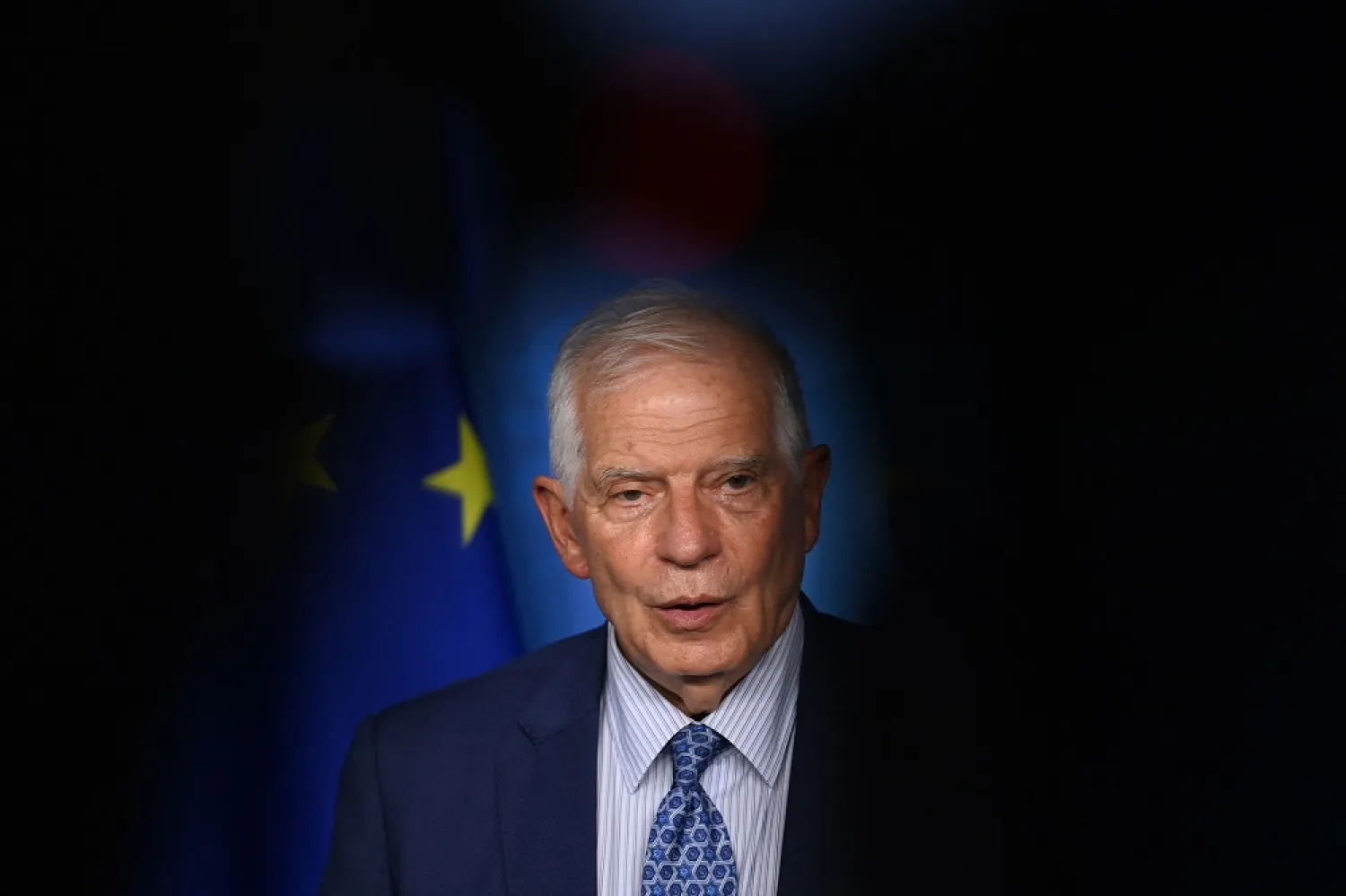
European Union High Representative for Foreign Affairs and Security Policy Josep Borrell gives a statement after Belgrade-Pristina Dialogue at the EU headquarters EEAS building in Brussels on August 18, 2022. (AFP)
TT

Families of Europeans Held in Iran Send Letter Criticizing EU Stance

European Union High Representative for Foreign Affairs and Security Policy Josep Borrell gives a statement after Belgrade-Pristina Dialogue at the EU headquarters EEAS building in Brussels on August 18, 2022. (AFP)

Families of European nationals held in Iran have sent a letter to European Union foreign policy chief Josep Borrell demanding answers over the fate of their loved ones, which they feel are being neglected as the bloc tries to revive a nuclear deal.

In recent years, Iran's Revolutionary Guards have arrested dozens of dual nationals and foreigners, mostly on charges related to espionage and security.

"Negotiations with Iran on the Joint Comprehensive Plan of Action (JCPOA) have been taking place for months. Meanwhile, several European citizens are being held hostage by Iran," said a letter addressed to Borrell seen by Reuters, dated Sept. 6.

It was signed by family members of Benjamin Brière, Kamran Ghaderi, Ahmadreza Djalali and Jamshid Sharmahd.

"We, the families of French, Swedish, German, and Austrian citizens, who have been illegally detained by the Iranian regime, are outraged that the European Union seems to be ignoring these crimes."

Borrell's office was not immediately available for comment.

Talks to revive a 2015 accord to curb Iran's nuclear program in return for the easing of sanctions have stalled since March despite hopes in August of a breakthrough.

The EU is the coordinator of the indirect talks between Iran, the United States and world powers and on Monday Borrell said he was less confident of reaching a deal after receiving Tehran's latest proposal.

Rights groups have accused Iran of trying to extract concessions from other countries through such arrests. Iran, which does not recognize dual nationality, denies taking prisoners to gain diplomatic leverage.

"All of them wonder, whether EU officials have forgotten them and how much longer they will have to endure this ordeal," the letter said, calling on Borrell to focus on their release.

"Will their release be prioritized? Will the European Union prioritize the defense of its values, the defense of human rights, over economic and other interests?" the letter added.



JMIC: 17 Tankers Hit in Strait of Hormuz in November

In this handout photo provided by the Lewis Pugh Foundation, taken from a boat accompanying endurance swimmer Lewis Pugh, smoke rises from a burning liquefied petroleum gas tanker in the Strait of Hormuz off the Musandam Peninsula, Oman, Tuesday, Nov. 17, 2026. (Lewis Pugh Foundation via AP)
TT

JMIC: 17 Tankers Hit in Strait of Hormuz in November

In this handout photo provided by the Lewis Pugh Foundation, taken from a boat accompanying endurance swimmer Lewis Pugh, smoke rises from a burning liquefied petroleum gas tanker in the Strait of Hormuz off the Musandam Peninsula, Oman, Tuesday, Nov. 17, 2026. (Lewis Pugh Foundation via AP)

Seventeen tankers have been struck in the Strait of Hormuz since Nov. 1, according to an advisory update issued Sunday by the Joint Maritime Information Center (JMIC).

In Update 118 covering maritime security through Nov. 29, JMIC reported no confirmed attacks or disruptions in the Strait of Hormuz during the latest 72-hour period, though it maintained the waterway's threat level at "severe," indicating that deliberate attacks remain highly likely.

The center stated that Iranian Revolutionary Guard Corps (IRGC) activity, including drone overflights, targeted surveillance of merchant shipping, and occasional VHF radio hailing, persisted along key transit lanes.

JMIC added that Iranian claims regarding naval mine strikes on tankers have not been confirmed by any official or national authorities.

Citing data from the US Naval Cooperation and Guidance for Shipping (NCAGS), the report noted that US-assisted commercial transits through the Strait of Hormuz averaged approximately 36 per day between Nov. 26 and Nov. 28, totaling 109 transits over the three-day window, up from an average of 32 per day between Nov. 22 and Nov. 25.

Overall commercial traffic in the waterway remained significantly below the 2025 historical baseline of roughly 138 vessels per day.

Non-facilitated cargo vessels above 1,000 deadweight tons broadcasting on Automatic Identification Systems (AIS) accounted for only three transits between Nov. 26 and Nov. 28, while approximately 217 commercial ships remained stationary at major anchorages east of the strait.


Iran's Currency Reaches Another Record Low

Iranians drive in front of a billboard featuring a missile and carrying a sentence in Persian, 'The way of honor,' in a street in Tehran, Iran, 25 November 2026.  EPA/ABEDIN TAHERKENAREH
Iranians drive in front of a billboard featuring a missile and carrying a sentence in Persian, 'The way of honor,' in a street in Tehran, Iran, 25 November 2026. EPA/ABEDIN TAHERKENAREH
TT

Iran's Currency Reaches Another Record Low

Iranians drive in front of a billboard featuring a missile and carrying a sentence in Persian, 'The way of honor,' in a street in Tehran, Iran, 25 November 2026.  EPA/ABEDIN TAHERKENAREH
Iranians drive in front of a billboard featuring a missile and carrying a sentence in Persian, 'The way of honor,' in a street in Tehran, Iran, 25 November 2026. EPA/ABEDIN TAHERKENAREH

Iran’s currency on Sunday hit a record low again as the US dollar traded at 3 million rials in exchange shops.

Tehran continues to feel the economic pain of an American military blockade of its ports during the war, along with the closure of some border crossings with neighboring countries.

Iran’s official Central Bank rate has been showing about 1.96 million rials to the dollar, but the market rate is what most Iranians pay.

Iran’s economy has struggled for years because of international sanctions and mismanagement. It experienced some relief under a 2015 nuclear deal that lifted many sanctions, but US President Donald Trump unilaterally withdrew from the accord in 2018.

Since returning to office, Trump has expanded sanctions targeting Iran’s financial sector and energy exports.


Netanyahu and Eisenkot Met but ‘Substantial Differences’ Remain

(FILES) This combination of pictures created on October 28, 2026, shows Prime Minister Benjamin Netanyahu (L) speaking to the media after voting in Jerusalem on October 27, 2026, and Yashar party leader Gadi Eisenkot addressing his supporters at the election night rally in Tel Aviv early on October 28, 2026. (Photo by Jewel SAMAD and Maya LEVIN / various sources / AFP)
TT

Netanyahu and Eisenkot Met but ‘Substantial Differences’ Remain

(FILES) This combination of pictures created on October 28, 2026, shows Prime Minister Benjamin Netanyahu (L) speaking to the media after voting in Jerusalem on October 27, 2026, and Yashar party leader Gadi Eisenkot addressing his supporters at the election night rally in Tel Aviv early on October 28, 2026. (Photo by Jewel SAMAD and Maya LEVIN / various sources / AFP)

Israeli Prime Minister Benjamin Netanyahu on Sunday sat down with opposition leader Gadi Eisenkot hours after Netanyahu offered to allow him to serve first as PM if the two formed a unity government.

Eisenkot hasn't said whether he would sign on to a rotation arrangement. He has less than a week to form a government, though he could ask Israel’s president for a two-week extension.

After the meeting, the two leaders didn't announce any progress. In a statement, they called it “businesslike” and said that both sides sought to “bridge the substantial differences between them.”

Israel has been in political limbo since last month’s election gave neither Eisenkot nor Netanyahu a sufficient majority to lead the next government. Eisenkot’s bloc won 48 of the 120 seats in the parliament, or Knesset, and Netanyahu’s won 53. Israel’s Palestinian citizens turned out in historic numbers to vote and secured the other 19 seats for the Arab-led parties.

Eisenkot has decried Netanyahu as unfit for office. But he could ultimately form a partnership with him to establish a unity government made up of Jewish-led parties. Or he could unite his bloc of parties that pledged to oust Netanyahu with the Arab-led parties.

Another option is to work with the ultra-Orthodox parties, though that approach would face substantial opposition from Eisenkot’s voters and political allies.