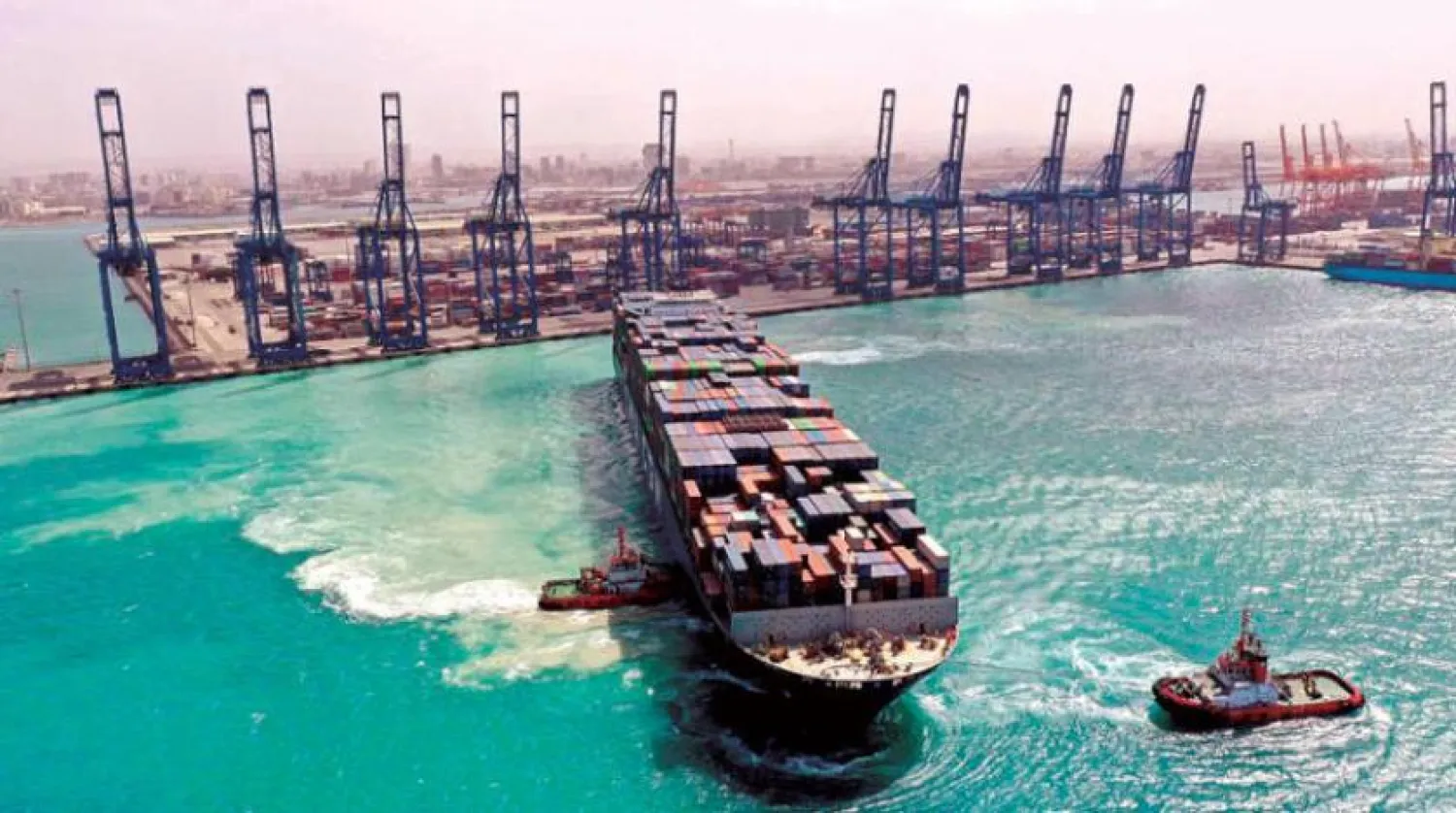
Saudi Arabia Establishes Duty-Free Markets in Airports, Ports

Saudi Arabia agrees to establish free markets at land, sea and air ports (Asharq Al-Awsat)
TT

Saudi Arabia Establishes Duty-Free Markets in Airports, Ports

Saudi Arabia agrees to establish free markets at land, sea and air ports (Asharq Al-Awsat)

Saudi Arabia has opened a new trade path by approving the establishment of duty-free markets in airports, seaports, and land ports. This supports the Kingdom’s aspirations for infrastructure development, logistics support and providing a unique business environment in the transport sector.

The Cabinet, chaired by King Salman bin Abdulaziz on Tuesday at Al-Salam Palace, approved the establishment of duty-free markets in airports, seaports, and land ports.

The Cabinet decision permits sale, in these markets, to passengers arriving and departing from the Kingdom.

Establishing duty-free markets aligns with Saudi Arabia’s plans for strategic transformation in providing support services and operational processes.

The Kingdom’s Transport Ministry is focused on upgrading provided services, developing the operational aspect in line with future plans, building strong alliances and providing a distinctive travel experience through integrated work and by investing with the private sector to achieve the highest standards of efficiency and operation.

In other news, Saudi Arabia is scheduled to inaugurate on Wednesday the Port of Jazan Primary and Downstream Industries (JPDI), located in the south of the Kingdom on the Red Sea, which represents one of the most prominent global trade corridors.
The inauguration is set to be sponsored by Governor of Jazan Prince Mohammed bin Nasser bin Abdulaziz.

The Royal Commission in Jubail and Yanbu, represented by the Jubail and Yanbu Industrial Services Company, and Hutchison Ports had announced the signing of an agreement to invest and operate JCPDI Port, which consists of world-class, multipurpose terminals within the Jazan City for Primary and Downstream Industries (JCPDI).

The port is located on the international trade corridor across the Red Sea, near the Bab al-Mandab Strait, the Horn of Africa, and on China’s Belt and Road Initiative.

Establishing the port is an important step in the Kingdom’s journey towards economic development and diversification of sources of income. The port, as a logistical gateway, will serve to be a great supporter of the city’s economic, industrial, and logistical renaissance.


Turkish Cenbank Says to Maintain Tight Monetary Stance Till Price Stability

Turkish Central Bank Governor Fatih Karahan speaks during a press conference in Istanbul, Türkiye, February 7, 2025. REUTERS/Dilara Senkaya
TT

Turkish Cenbank Says to Maintain Tight Monetary Stance Till Price Stability

Turkish Central Bank Governor Fatih Karahan speaks during a press conference in Istanbul, Türkiye, February 7, 2025. REUTERS/Dilara Senkaya

Turkish Central Bank Governor Fatih Karahan on Wednesday said the bank would maintain its tight monetary policy until price stability is achieved.

According to Reuters, He was speaking about Türkiye's monetary policy and macroeconomic outlook during a visit to Bangkok for a meeting of the World Bank.

Here are some details from the governor's presentation:

* Underlying inflation ⁠is moderating despite ⁠elevated energy prices
* Soft demand dampens inflationary impulses from supply shocks
* Proactive measures limit the possible contagion from trade-restricted funds
* Turkish lira preference remains strong under tight monetary policy
* The ⁠tight monetary policy stance, which will be maintained until price stability is achieved, will strengthen the disinflation process through demand, exchange rate, and expectation channels
* The Monetary Policy Committee (MPC) will determine the policy rate by taking into account realized and expected inflation and its underlying trend in a way to ensure ⁠the tightness ⁠required by the projected disinflation path in line with the interim targets
* Monetary policy decisions are made prudently on a meeting-by-meeting basis with a focus on the inflation outlook
* Monetary policy stance will be tightened in case of a significant deviation in inflation outlook from the interim targets


Lebanon’s Deepening Cost-of-Living Crisis Raises Fears of Unrest

A woman carries grocery bags in Beirut amid continued price increases (Reuters)
TT

Lebanon’s Deepening Cost-of-Living Crisis Raises Fears of Unrest

A woman carries grocery bags in Beirut amid continued price increases (Reuters)

Lebanon’s worsening cost-of-living crisis and widening poverty are threatening to erase the country’s fragile economic recovery, raising fears of social unrest as inflation accelerates and the fallout from successive wars deepens.

Two major rounds of fighting over the past two years have wiped out much of the progress made in restoring economic growth, undermining efforts by the country’s political leadership and government to overcome the financial collapse and revive support from regional and international partners.

Food inflation has reached an average of 20% this year, with monthly increases of around 2%, while a recent World Bank report on Lebanon’s poverty outlook highlighted a sharp deterioration in food security.

The number of people facing crisis or emergency levels of food insecurity rose to approximately 1.24 million in 2026, up from 874,000 in 2025, with South Lebanon and Nabatieh among the hardest-hit regions.

Business and labor union sources warned that worsening living conditions could spark a wave of protests, confronting the government with challenges extending beyond its ongoing disputes with public sector employees and retirees.

Low incomes and soaring prices have already prompted intermittent strikes, partially disrupting ministries and public institutions and affecting Treasury revenues from vital services.

According to employer and labor representatives, more than a quarter of Lebanon’s residents now face severe poverty or acute economic hardship.

Based on the World Bank’s figures and an average household size of five, this represents roughly 250,000 families.

The sources estimated that broader financial hardship affects nearly 80% of residents, as cumulative price increases have pushed the inflation index close to 9,000 percentage points, largely reflecting successive surges since the financial and monetary crisis erupted in 2019.

The World Bank highlighted the deterioration in household living conditions following the escalation of hostilities in spring 2026.

Displaced families have become increasingly dependent on informal support networks and dwindling financial resources after losing income and productive assets.

Meanwhile, reduced electricity generation at Lebanon’s fuel-powered state plants has forced households to shoulder steep increases in private generator subscription fees, further eroding purchasing power. The crisis is compounded by the government’s strained finances and concerns over a further decline in Treasury revenues.

Lebanon’s financial collapse has left an estimated loss gap exceeding $70 billion, while successive rounds of fighting since autumn 2023 have caused more than $27 billion in direct and indirect economic and reconstruction-related losses, according to official estimates.

The World Bank forecasts a 6.4% contraction in gross domestic product in 2026, reversing the fragile 4.2% recovery recorded the previous year. Annual inflation rose to 17.3% in the first half of 2026, compared with 14.6% in 2025.

Despite conflict-related pressures, the World Bank reported that Lebanon’s public finances maintained a surplus of $1 billion, equivalent to 2.5% of GDP, through the end of May.

The surplus represented a 32% year-on-year increase, supported by a 26.6% rise in government revenues, particularly receipts from fuel excise taxes.

Public spending climbed 23.7%, driven by higher public sector salaries, capital expenditure, hospitalization costs and conflict-related Treasury advances.

Meanwhile, prices for water, electricity, gas and other fuels rose 25.3% year-on-year, while transportation costs increased 29.5% by midyear.

On the monetary front, the World Bank linked the Lebanese pound’s stable exchange rate against the US dollar to tight liquidity in local currency.

However, foreign currency reserves at Banque du Liban fell to $11.6 billion in mid-August, enough to cover approximately 6.6 months of imports, compared with $12.1 billion in mid-February.

The decline reflected the central bank’s need to draw on its reserves to meet foreign currency obligations amid reduced dollar availability in the market.

Lebanon’s trade deficit widened 8.8% year-on-year to $10.2 billion by the end of July, as exports fell 16.6% and imports rose 4.2%.

The report attributed the deterioration to conflict-related disruptions affecting exports, alongside higher oil prices and insurance premiums.

Energy imports rose 9% in value to approximately $3 billion during the first seven months of the year, despite a 31% decline in imported volumes.

The imbalance placed additional pressure on Lebanon’s current account, further straining foreign currency inflows and reserves.



IMF: Saudi Attacks Could Have Negative Spillover 'Everywhere'

IMF Managing Director Kristalina Georgieva gestures during the Managing Director briefing on the Global Policy Agenda during the 2026 IMF-World Bank Group Annual Meetings at the Queen Sirikit National Convention Center (QSNCC) in Bangkok on October 14, 2026. (Photo by ANTHONY WALLACE / AFP)
TT

IMF: Saudi Attacks Could Have Negative Spillover 'Everywhere'

IMF Managing Director Kristalina Georgieva gestures during the Managing Director briefing on the Global Policy Agenda during the 2026 IMF-World Bank Group Annual Meetings at the Queen Sirikit National Convention Center (QSNCC) in Bangkok on October 14, 2026. (Photo by ANTHONY WALLACE / AFP)

International Monetary Fund head Kristalina Georgieva said Wednesday that recent attacks on Saudi Arabia could impact people "everywhere” as "the Saudi economy is important for the region and the world."

Given the Saudi economy’s importance, “these developments have potentially negative spillovers for everybody, everywhere," IMF managing director Georgieva said at a news conference during the Annual Meetings of the Fund and World Bank in Bangkok.

The warning comes at a time when energy flows and shipping activity in the region are under pressure, with supply disruptions potentially affecting energy and trade costs as well as economic activity, particularly in economies dependent on oil and gas imports.

The IMF’s forecasts, released on Tuesday, highlight the scale of the expected impact of the disruptions on the region’s economies. The IMF expects the economies of the Middle East and Central Asia to contract by 0.3 percent in 2026, followed by growth of 6.3 percent in 2027, a trajectory that reflects the pressures of the current crisis as well as the anticipated recovery as the disruptions ease and energy and trade flows are restored.

The expected repercussions vary across regional economies depending on their exposure to shipping disruptions and their ability to maintain exports. In its outlook for Saudi Arabia, the IMF raised its 2027 growth forecast to 7.9 percent, from 2.4 percent in July and 3.4 percent in April.

Meanwhile, it lowered its estimate for the economy’s contraction in 2026 to 3.3 percent, compared with 5 percent in its July update and 6.4 percent in April.

This trajectory reflects expectations that production and exports will regain momentum as shipping disruptions subside, although the speed and scale of the recovery will remain tied to developments in the security situation and the normalization of energy and trade flows.

The Saudi Ministry of Finance has projected stronger growth of 12.8 percent in 2027, according to the pre-budget statement.