


Germany’s Scholz Sees No Imminent Nuclear Deal with Iran

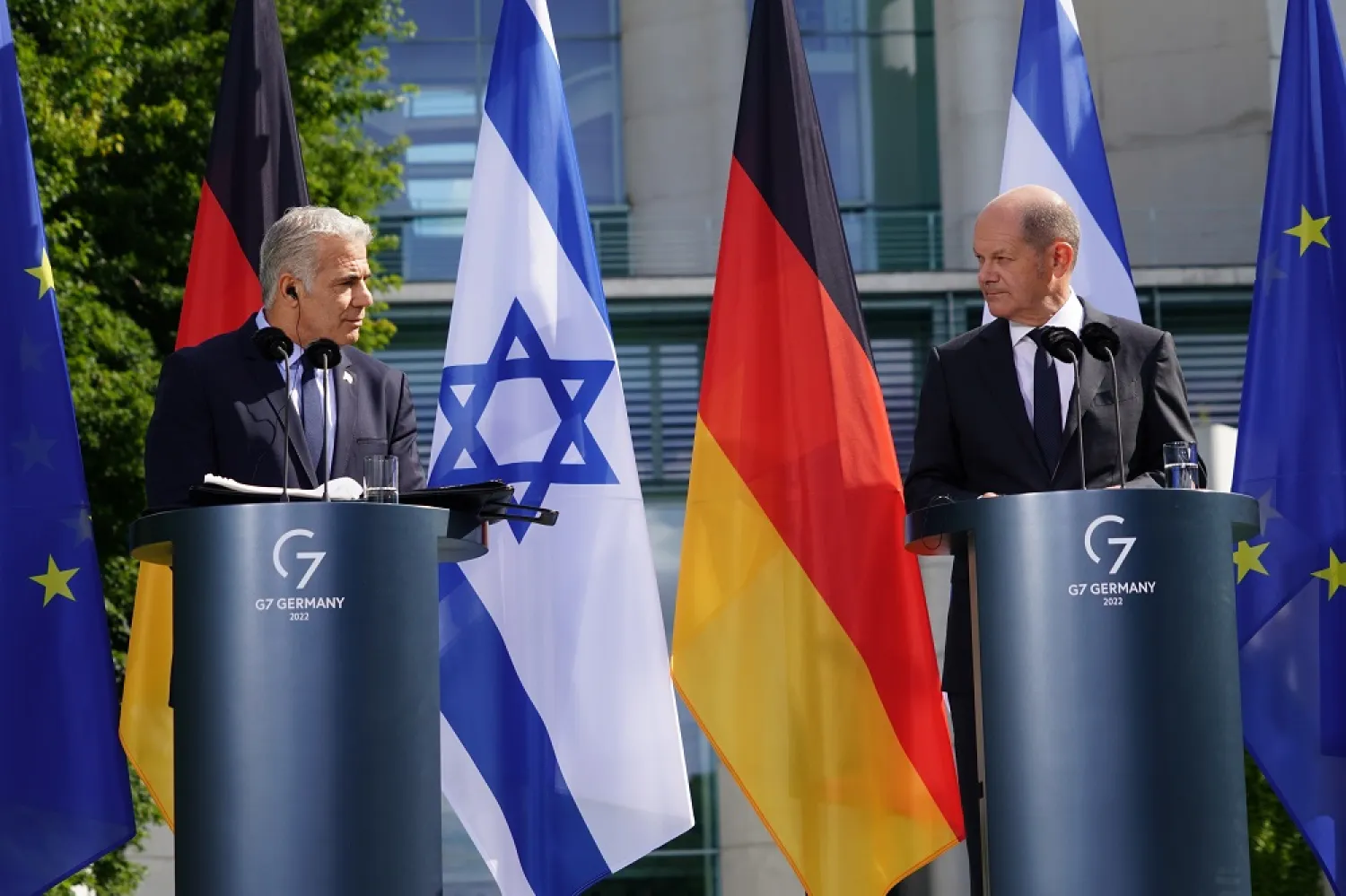
Israeli Prime Minister Yair Lapid (L) speaks next to German Chancellor Olaf Scholz (R) during a joint press conference at the chancellery in Berlin, Germany, 12 September 2022. (EPA)
TT

Germany’s Scholz Sees No Imminent Nuclear Deal with Iran

Israeli Prime Minister Yair Lapid (L) speaks next to German Chancellor Olaf Scholz (R) during a joint press conference at the chancellery in Berlin, Germany, 12 September 2022. (EPA)

German Chancellor Olaf Scholz made clear Monday that he doesn't expect an agreement with Iran in the immediate future to restore Tehran's tattered nuclear deal with world powers, though he said there's no reason for Iran not to sign up and European countries would remain "patient."

Scholz spoke after meeting in Berlin with Israeli Prime Minister Yair Lapid, who insisted that restoring the 2015 agreement would be "a critical mistake." Germany, along with France, Britain, Russia and China, is still a party to the deal and involved in talks on its revival that have dragged on for over a year.

The European countries "have made proposals, and there is no reason now for Iran not to agree to these proposals, but we have to take note of the fact that this isn't the case, so it certainly won't happen soon, although it looked for a while like it would," Scholz said.

"We remain patient, but we also remain clear: Iran must be prevented from being able to deploy nuclear weapons," he added.

The German leader said that "a functioning international agreement to limit and monitor the Iranian nuclear program is the right way" to do that.

But Lapid said that "it is time to move past the failed negotiations with Iran," which he said can't and won't achieve the goal of stopping Iran getting a nuclear weapon. His office said he also shared intelligence with the German government.

"Removing sanctions and pouring hundreds of billions of dollars into Iran will bring waves of terrorism, not only to the Middle East, but also across Europe," Lapid said.

Israel, which encouraged the US to withdraw from the nuclear deal in 2018, has opposed a renewed agreement between Iran and the world powers. It says lifting sanctions will allow Iran to funnel billions of dollars to hostile militant groups and says an improved deal must also address Iran’s regional military activities and support for hostile groups such as Hezbollah in Lebanon and other militias in Syria.

Speaking Monday at the Jerusalem Post Conference in New York, Israeli Defense Minister Benny Gantz said Iran has built at least 10 facilities "for mid- and long-range, precise missiles and weapons" in neighboring Syria, including one reportedly targeted by Israel in a recent airstrike.

Gantz said that Iran has produced "more and more advanced centrifuges – including at underground facilities where activities are prohibited" and called for Iran to be held accountable. His remarks couldn't be independently verified.

The United States unilaterally pulled out of the nuclear accord in 2018 under then President Donald Trump and reimposed sanctions on Iran, prompting Tehran to start backing away from the deal’s terms.

Iran earlier this month responded to a final draft of a roadmap for parties to return to the tattered nuclear deal and bring the US back on board.

A probe by the International Atomic Energy Agency into man-made uranium particles found at three undeclared sites in the country has become a key sticking point in the talks for renewing the agreement.

Iran’s hard-line president, Ebrahim Raisi, has said that the IAEA investigation into the issue must be halted in order for the 2015 deal to be renewed.

The IAEA, the UN nuclear watchdog agency, has for years sought answers from Iran to its questions about the particles. US intelligence agencies, Western nations and the IAEA have said Iran ran an organized nuclear weapons program until 2003. Iran long has denied ever seeking nuclear weapons.

Germany, France and Britain said in a statement at the weekend that "Iran must fully and, without delay, cooperate in good faith with the IAEA."

IAEA Director-General Rafael Grossi said at the agency's Vienna headquarters that he hopes Iran will start cooperating "as soon as possible."

"We are ready; we want this to happen," he said. "We are not in the business of aggravating or creating situations. We just want this issue to be clarified, so I really hope that they will start looking into this issue in a different way."

Asked whether he expects to face political pressure from various sides on the issue, Grossi replied that "political pressure is always there; the thing is what I do with that pressure." He added that Iran appears to be "pushing their national interest in the way they see it."



US Authorizes Iranian Oil Sales Amid Talks on Final Peace Deal

US Treasury Secretary Scott Bessent attends a bilateral meeting during the G7 Summit in Evian-les-Bains, France, June 17, 2026. (Reuters)
TT

US Authorizes Iranian Oil Sales Amid Talks on Final Peace Deal

US Treasury Secretary Scott Bessent attends a bilateral meeting during the G7 Summit in Evian-les-Bains, France, June 17, 2026. (Reuters)

The United States authorized Iranian oil sales on Monday, easing decades-old sanctions as it pushes toward a final peace deal with Tehran in return for commitments on nuclear inspections and free transit through the Strait of Hormuz.

The general license, announced by the Treasury Department, allows the sale of crude oil and petrochemical and petroleum products of Iranian origin through August 21.

The license says Iranian oil can be imported into the US when necessary to complete ‌its sale, delivery ‌or offloading. The US has not meaningfully imported Iranian ‌oil ⁠since Washington imposed measures ⁠after the 1979 revolution.

"In line with the ongoing productive talks in Switzerland, Iran has committed to free and open transit in the Strait of Hormuz and to permit International Atomic Energy Agency (IAEA) inspectors into their country," Treasury Secretary Scott Bessent wrote on X.

"As part of the framework, Treasury has issued a temporary 60-day general license authorizing the production, delivery and sale of Iranian oil."

Under a memorandum of ⁠understanding signed last week between Washington and Tehran, the US ‌agreed to issue waivers for the export ‌of Iranian crude oil, petroleum products and derivatives, and all associated services, including banking transactions, insurances ‌and transportation.

Payment of funds to Iran may be made in US dollar-denominated ‌funds, according to the license.

Cuba, North Korea and Crimea are among those excluded from the license.

Washington first sanctioned Iran in 1979 when revolutionary students seized the US embassy in Tehran, holding diplomats hostage. Numerous additional sanctions have been imposed since then over the ‌nuclear program and Iran's support for groups the US deems terrorist organizations.

Independent Chinese refiners have been the main buyers ⁠of sanctioned Iranian ⁠oil, taking advantage of deep discounts as others avoided such purchases. India, South Korea, Japan, Italy, Greece, Taiwan and Türkiye were also major buyers of Iranian crude before US sanctions were reimposed in 2018.

Mediators said on Monday that Washington and Tehran made "encouraging progress" at the first round of talks aimed at reaching a final peace deal. The talks began under the terms of the memorandum of understanding reached last week to extend a tenuous ceasefire from April for at least another 60 days.

Oil prices had risen sharply when Tehran started blockading the Strait of Hormuz, prompting a US blockade of Iranian ports, but after the interim deal, fell to their lowest since before the war began on February 28 with US-Israeli attacks on Iran.


Taiwan Begins 5-Day Military Drill with Tanks Patrolling Streets

This picture taken and released by Taiwan's Central News Agency (CNA) on June 22, 2026 shows a row of armored military vehicles driving along the highway in Taoyuan, Taiwan. (AFP photo / CNA Photo)
TT

Taiwan Begins 5-Day Military Drill with Tanks Patrolling Streets

This picture taken and released by Taiwan's Central News Agency (CNA) on June 22, 2026 shows a row of armored military vehicles driving along the highway in Taoyuan, Taiwan. (AFP photo / CNA Photo)

Taiwan kicked off a five-day set of military drills on Monday aimed at boosting the island's combat readiness in case of a Chinese military attack.

In the city of Taoyuan, home to the island's largest international airport, tanks drove down city streets and highways, videos and photos of the exercise showed, as armored vehicles from the Army’s 269th Infantry Brigade conducted combat readiness patrols morning.

The Immediate Combat Readiness Exercises are meant to test how rapidly military units can deploy, especially in the face of a possible sudden escalation of Chinese grey-zone warfare. Grey-zone tactics refer to a range of aggressive tactics that vary from navy ship patrols to drone flights, but fall short of direct combat.

The exercises, announced Sunday afternoon, are meant to be realistic, the Ministry of Defense said in a statement, with an emphasis on “real-time, live-fire and on-site."

These exercises are designed to simulate what would happen before enemy forces launched their ships, according to Taiwan's semi-official Central News Agency. The series of exercises could also include impromptu ones in the future, including real-time responses to Chinese military drills.

China's People's Liberation Army sent 23 aircraft towards Taiwan from Sunday into Monday morning, according to Taiwan's defense ministry. That was accompanied by seven navy ships and five other Chinese government ships. China sends war planes, drones and navy ships towards the island on a daily basis.

Taiwan regularly conducts combat readiness drills as it seeks to bolster its defense capabilities amid ongoing military pressure from China, which claims the self-governed island as its own territory and has not ruled out the use of force to bring it under its control. Earlier in June, Taiwan fired rockets in China's direction for the first time as part of a military exercise.


EU Chief Hails 'Statesman' Starmer after Resignation

European Commission President Ursula von der Leyen gives a press statement on sanctions against Russia at the EU headquarters in Brussels on June 9, 2026. (Photo by Nicolas TUCAT / AFP)
TT

EU Chief Hails 'Statesman' Starmer after Resignation

European Commission President Ursula von der Leyen gives a press statement on sanctions against Russia at the EU headquarters in Brussels on June 9, 2026. (Photo by Nicolas TUCAT / AFP)

EU chief Ursula von der Leyen on Monday praised British Prime Minister Keir Starmer for bolstering "European" security after he announced his resignation.

"It can take many leaders years to grow into the statesman you became in just two years. European and Ukrainian security is stronger because of you. Thank you, dear Keir," the European Commission president posted online.