Settler High-rises Risk 'Palestinian Island' In Jerusalem

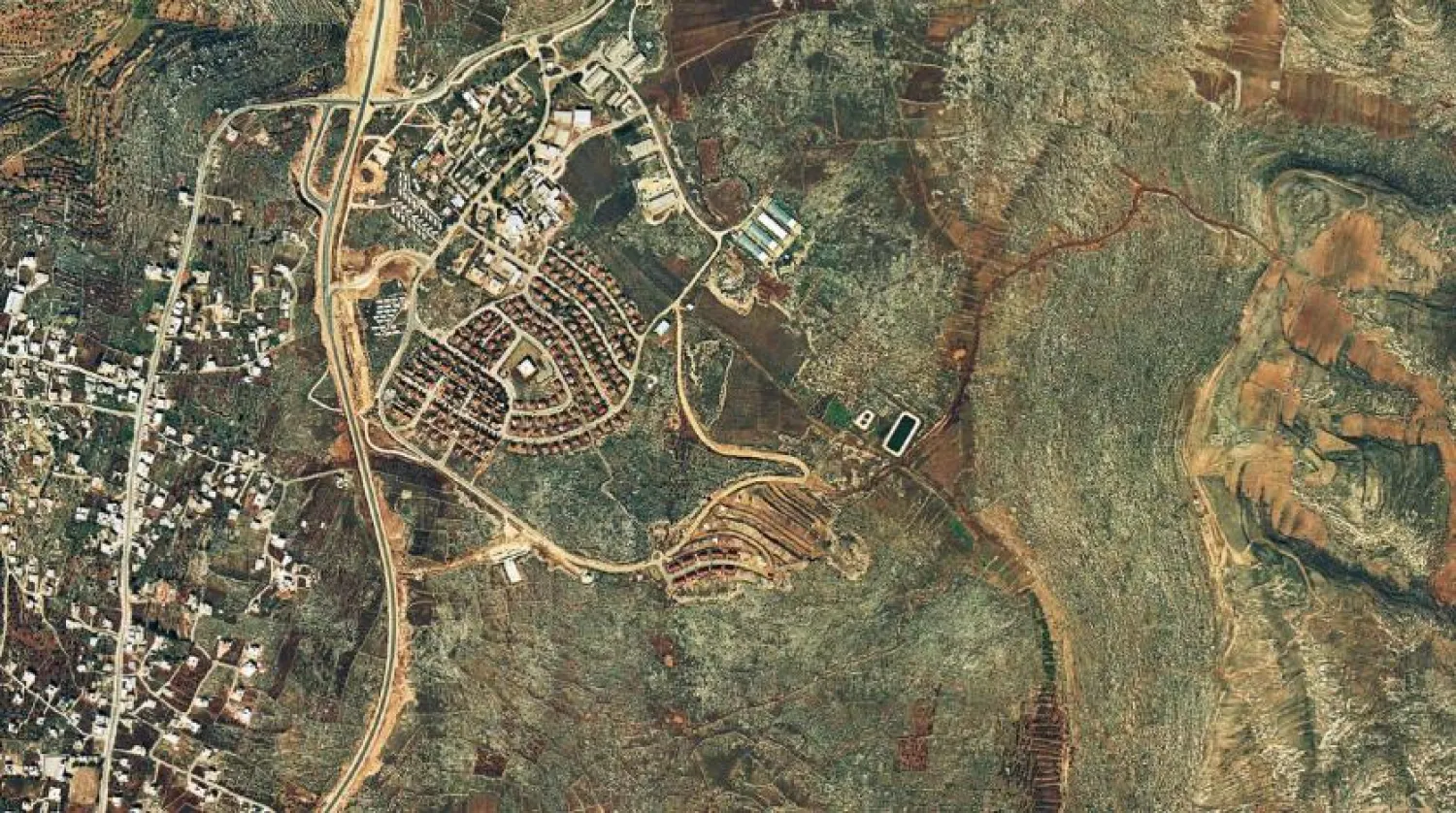
An aerial view shows the Israeli settlement of Ofra in the occupied West Bank as seen in 1997 and obtained by Reuters from "Peace Now" on June 3, 2019. Peace Now/Handout via REUTERS
TT

Settler High-rises Risk 'Palestinian Island' In Jerusalem

An aerial view shows the Israeli settlement of Ofra in the occupied West Bank as seen in 1997 and obtained by Reuters from "Peace Now" on June 3, 2019. Peace Now/Handout via REUTERS

From his home in Israeli-annexed east Jerusalem, Palestinian Farid Salman enjoys a clear, unobstructed view of the city, but new residential tower blocs for Jewish settlers could box him in.

Salman lives in the Arab neighborhood of Beit Safafa where Israeli authorities recently granted pre-approval for 700 settler homes in the proposed Givat Shaked development, including four 24-storey buildings.

Standing on a grassy, litter-strewn hill beside his home, the 66-year-old gardener told AFP that he is, "like any Palestinian, afraid of what will happen here when there's a settlement".

More than a dozen construction cranes are already scattered across his sweeping view of west Jerusalem, a busy area where cars race down a highway beside two stadiums and residential areas.

"Tomorrow they will be right here, on our side of the border," Salman said, referring to the Green Line, which much of the international community views as the legitimate demarcation between west Jerusalem and the city's east, which Palestinians claim as the capital of a future independent state.

Israel captured east Jerusalem in the Six-Day War of 1967 and later annexed it in a move not recognized by most of the international community. Leaders across Israel's political spectrum now describe Jerusalem as the nation's "undivided capital".

The Givat Shaked plan has been a source of controversy since it was first proposed in the mid-1990s.

There was a UN Security Council move to condemn it in 1995 as a threat to the then-nascent Oslo peace process, as it risked isolating Beit Safafa from the rest of east Jerusalem and the Israeli-occupied West Bank. The United States vetoed it but pushed Israel to cancel the plan.

Today the hilly neighborhood is dotted with white water tanks atop low-rise homes, surrounding a mosque with a golden dome.

It is not clear why Givat Shaked's approval has regained momentum, but with Israel heading towards fresh elections in November -- its fifth vote in less than four years -- some politicians are openly courting right-wing voters who back settlement expansion and Israeli control over east Jerusalem.

One of those politicians is Interior Minister Ayelet Shaked, a right-wing nationalist who has struggled for support since party leader and former prime minister Naftali Bennett announced he was stepping away from politics.

"Despite all internal and external pressure, the Givat Shaked project has been approved," minister Shaked told Israeli media earlier this month after a decision by a Jerusalem planning board.

"It is unthinkable to prevent development and construction in this area, or anywhere else in the city," she added, underscoring her conviction that all of Jerusalem is Israel's capital and rejecting any claims of Palestinian control over the city's east.

Shaked also stressed the need "to increase the supply of housing" in Jerusalem.

But Daniel Seidemann, founder of the anti-settlement watchdog Ir Amim, said such claims are disingenuous.

It "has nothing to do with genuine housing needs of Israelis and Palestinians," Seidemann, a lawyer, told AFP. "This is all about national struggle between Israelis and Palestinians.

"If this was actually about housing needs, this area would be developed as it should be: as an organic part of the Palestinian neighborhood.

"Instead the land is being ripped out of Beit Safafa and turned into an Israeli neighborhood for geopolitical and ideological purposes."

Beit Safafa, home to nearly 16,000 residents, lies on the Green Line and is tucked in the southwestern corner of east Jerusalem, making it particularly vulnerable to isolation.

It is already confined by two settlements, Gilo and Givat Hamatos, that lie to its south.

The proposed Givat Shaked towers could effectively sever the community from the broader Palestinian territories.

"It's like a Palestinian island," said Seidemann, who accused Israel of "trying to create an overwhelming Israeli presence in east Jerusalem that will fragment and marginalize Palestinians".

Palestinian homes in east Jerusalem are regularly demolished by Israeli authorities who insist they were built without proper permits -- which, Palestinians say, for them, are almost impossible to obtain.

Salman expressed his frustration over what he sees as a gross double standard, with settler high-rises given a green light while permits for Palestinian homes vanish into Israeli bureaucracy.

"We are not against building," he said. "But they have to think about us."


Drone Strikes Hit Homes in Sudan's Capital

A man walks near heavily-damaged buildings in the Lamab suburb on the southwestern outskirts of Sudan's capital Khartoum on July 30, 2025 as residents return amidst reconstruction efforts. (Photo by Ebrahim Hamid / AFP)
TT

Drone Strikes Hit Homes in Sudan's Capital

A man walks near heavily-damaged buildings in the Lamab suburb on the southwestern outskirts of Sudan's capital Khartoum on July 30, 2025 as residents return amidst reconstruction efforts. (Photo by Ebrahim Hamid / AFP)

Drones struck residential areas in and around Sudan's capital Khartoum early on Sunday, destroying homes, witnesses said.

"People were trying to rescue family members trapped under the rubble," one witness said. Authorities did not immediately report on casualties.


Battles in Lahij and Taiz as Airstrikes Target Houthi Capabilities

A government fighter in battle against the Houthis. (Military media)
TT

Battles in Lahij and Taiz as Airstrikes Target Houthi Capabilities

A government fighter in battle against the Houthis. (Military media)

Military clashes have renewed between Yemeni government forces and the Houthis along the frontlines of the Lahij and Taiz governorates, amid an escalation in air and artillery strikes under Operation Dawn of Yemen, as government troops continue daily ground and air operations against the group's capabilities.

At dawn on Saturday, fierce fighting broke out on the Maabaq front in the Al-Maqatirah district, north of Lahij, pitting government forces and tribal fighters against the Houthis.

Field sources said that the clashes witnessed heavy exchanges of artillery fire and gunfire and airstrikes by warplanes on Houthi positions.

In Taiz, government forces repelled a Houthi attack on the city's western front with the Taiz Axis Media Center saying there were dead and wounded among the Houthi attackers, without specifying an exact toll.

The media center said an airstrike destroyed a rocket launchpad atop Jabal Habashi, while another strike targeted a Houthi gathering in Al-Munim, killing several members, including a commander. Warplanes carried out three airstrikes on Houthi positions in western Taiz.

The Yemeni Armed Forces announced on Friday that they had carried out 854 strikes targeting Houthi positions, gatherings, and movements as part of Operation Dawn of Yemen, stating that the operations left 193 of the group's leaders and fighters dead or wounded.

Armed Forces spokesperson Staff Colonel Majid Al-Nuzaili said the operations comprised 31 airstrikes and 687 artillery, 91 drone, and 45 rocket launcher strikes.


Fire at Power Station in Iraq's Basra Kills at Least 4, Injures 35

Firefighters work near houses damaged by a fire near the Hartha power station, north of Basra, Iraq, November 21, 2026. REUTERS/Mohammed Aty
TT

Fire at Power Station in Iraq's Basra Kills at Least 4, Injures 35

Firefighters work near houses damaged by a fire near the Hartha power station, north of Basra, Iraq, November 21, 2026. REUTERS/Mohammed Aty

At least 4 people were killed and 35 injured in a fire at a power station in southern Iraq on Saturday, with the toll expected to rise, security officials said.

Civil defense teams brought the fire at the Hartha ‌power station north of ‌Basra under control after firefighters responded to ‌the ⁠incident, Iraq's state ⁠news agency, INA, reported.

The fire spread to neighboring houses and forced operations at the power station to stop, the security officials said.

The fire broke out at around 6 a.m. (0300 GMT), with most casualties reported among residents of the affected houses who suffered burns and smoke ⁠inhalation, Iraq's Security Media Cell said.

Iraq's Electricity ‌Ministry said the incident ‌involved a gas pipeline supplying the power station.

Prime Minister Ali al-Zaidi ‌ordered an urgent investigation into the explosion at the ‌station to determine its causes and establish responsibility, his office said.

The Hartha station has an installed generating capacity of 800 megawatts but had been operating at around 400 megawatts before ‌the fire, the security officials said.

Pictures from the scene showed severely damaged sections ⁠of a ⁠gas pipeline, with the surrounding ground blackened and debris scattered across the site, Reuters reported.

There was no immediate official information on what caused the incident or the full extent of the damage.

Iraq's electricity infrastructure has long struggled with decades of underinvestment, inadequate maintenance and an inability to meet peak demand, particularly during the extremely hot summer months. Fires and technical failures at substations and power facilities have previously disrupted electricity supplies and caused widespread outages.