Saudi Arabia to Employ AI in Farms

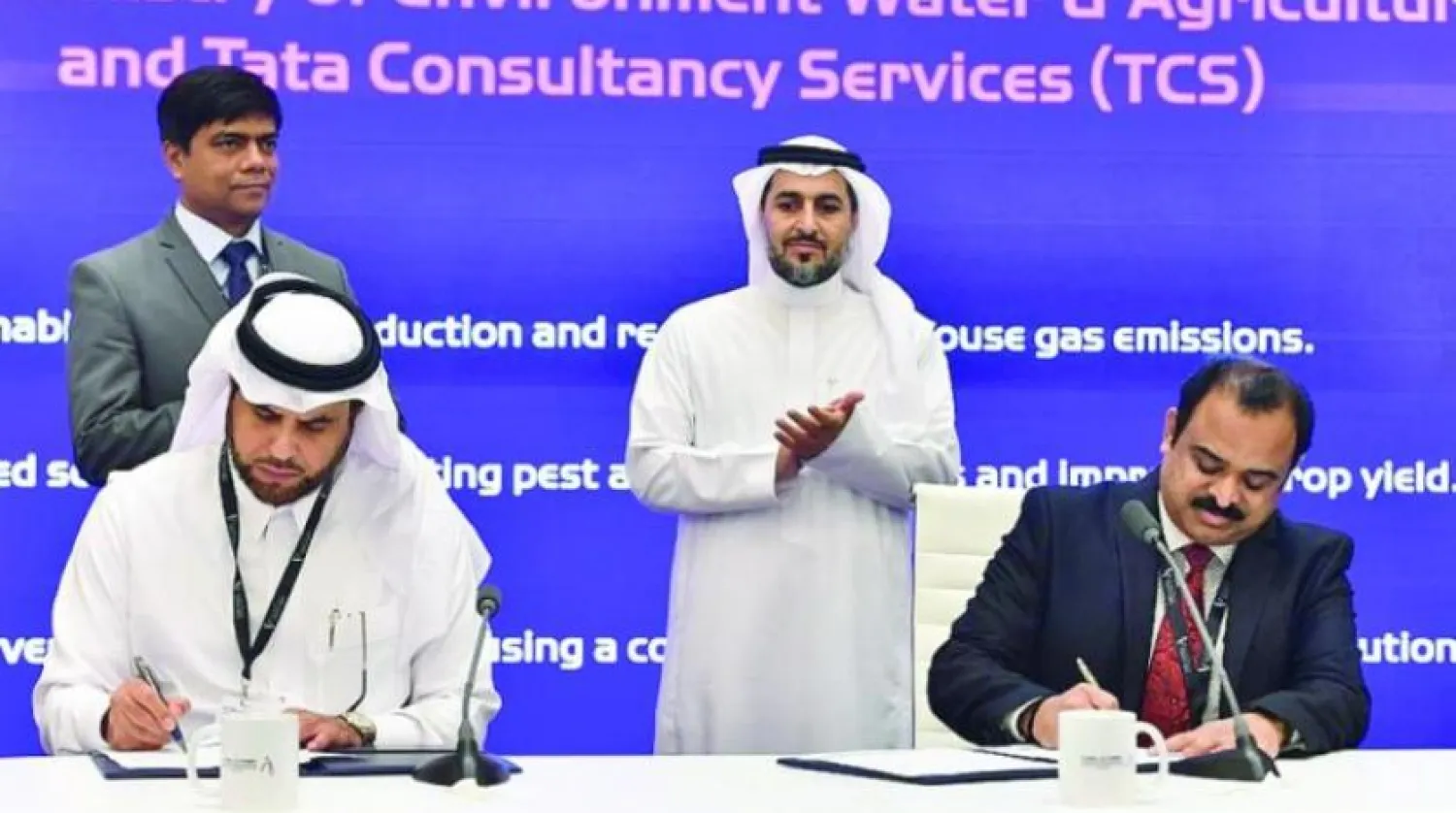
The Deputy Minister of Environment, Water, and Agriculture, Mansour al-Mushaiti, witnessed the signing ceremony of several agreements in agriculture (Asharq Al-Awsat)
TT

Saudi Arabia to Employ AI in Farms

The Deputy Minister of Environment, Water, and Agriculture, Mansour al-Mushaiti, witnessed the signing ceremony of several agreements in agriculture (Asharq Al-Awsat)

Several Saudi companies signed Wednesday local and international agreements and memoranda of understanding (MoU) on the sidelines of the second edition of the Global AI Summit in Riyadh.

The Ministry of Environment, Water, and Agriculture signed a memorandum of understanding (MoU) between the ministry and Tata for consultancy services in various industrial sectors.

The MoU aims to employ artificial intelligence in agriculture, improve the sustainability of food production, reduce carbon emissions, and use existing AI-based solutions to detect pests and diseases and improve crop quality.

The Deputy Minister of Environment, Water, and Agriculture, Mansour al-Mushaiti, also witnessed the signing of a memorandum of understanding between the ministry and Saudi Signify Company, which specializes in food, to benefit from AI technologies in establishing smart farms.

Director of the Public Administration of Information Technology and Digital Transformation at the Ministry of Environment, Water, and Agriculture Abdulhamid al-Olewi said that signing the memorandum is part of the ministry's keenness to develop all aspects that can serve the agricultural services in Saudi Arabia.

He indicated that it meets the ministry's strategy for digital transformation and Vision 2030 goals.

CEO of Saudi Signify Company Abdulrahman Kheirallah said that the company focuses on providing innovative lighting solutions that help meet local orders with increasing production.

The company targets three main fields: smart farms provided with a dynamic lighting system inspired by the natural light system, smart farms for aquaculture equipped with a plan to control lighting with the use of custom-designed lighting conditions to improve the water environment to enhance fish production, and smart gardening farms with the GrowWise control system to receive a sustainable, predictable quality and locally produced crops.

Also, the Saudi Electricity Company (SEC) signed memoranda of understanding with Microsoft, Udacity, and Datarobot, on the sidelines of its participation in the Global AI Summit.

The memorandum signed with Microsoft aims to sustain and boost skills in AI, while the agreement with Udacity seeks to develop skills according to learning paths in digital transformation and AI.

SEC agreed with Datarobot to develop learning and implement smart solutions using AI.

These partnerships enhance the Electricity Company's efforts in AI, in line with its digital transformation strategy.

Furthermore, the Saudi Company for Artificial Intelligence (SCAI), a PIF-owned company, signed an MoU with the Saudi Technology and Security Comprehensive Control Company (Tahakom).

The two parties will collaborate to develop the AI infrastructure and super-computing capabilities necessary to power the next generation of AI applications.

The companies will leverage their joint technical capabilities to cultivate and implement the infrastructure required to process the vast amounts of data smart cities generate.

The collaboration is set to further enable a climate of innovation across the Kingdom's AI ecosystem, contribute to developing homegrown intellectual property, and inspire the next generation of talented Saudi data scientists.

Moreover, the Transport General Authority signed a memorandum of understanding with Princess Nourah Bint Abdul Rahman University in the presence of Deputy Minister Rumaih al-Rumaih and the university's rector, Princess Einas el-Issa.

The agreement aims to support areas of cooperation between the two parties in scientific research and innovation in the transport sectors, develop curricula, provide consultations and training, train human resources skills in the same fields, and enhance social awareness of the importance of various transport services.


Europe’s Hera Spacecraft Begins Close Inspections of an Asteroid Rammed by NASA in a 2022 Test

This undated image provided by the European Space Agency on Nov. 5, 2026 and taken by the Hera spacecraft, shows asteroid Didymos. (European Space Agency via AP)
TT

Europe’s Hera Spacecraft Begins Close Inspections of an Asteroid Rammed by NASA in a 2022 Test

This undated image provided by the European Space Agency on Nov. 5, 2026 and taken by the Hera spacecraft, shows asteroid Didymos. (European Space Agency via AP)

A European spacecraft has begun close inspections of an asteroid rammed by NASA four years ago in a planetary defense test.

The European Space Agency announced Wednesday that the Hera spacecraft is now studying Didymos and its moonlet Dimorphos from just 15 miles to 18 miles (25 kilometers to 30 kilometers) away, The AP news reported.

NASA’s Dart spacecraft deliberately slammed into little Dimorphos in 2022 to see whether such a defensive move might help save Earth from a killer space rock one day.

The impact shortened the moonlet’s orbit around Didymos. More importantly, it nudged the moonlet into a slightly different path around the sun.

Next month, the small car-sized Hera, launched in 2024, will venture even closer — just 12 miles (20 kilometers) away.

ESA officials consider this a “crash site investigation” worthy of its finest robotic detective. Hera is carrying 25 science instruments as well as a pair of shoebox-sized Cubesats to survey Dimorphos even more closely and attempt to land on it.

The Dart spacecraft — short for Double Asteroid Redirection Test — sent rubble and even boulders flying off Dimorphos, providing an extra kick to the impact’s momentum. The debris trail extended thousands of miles (more than 10,000 kilometers) into space for months.

Some of that debris could still be in the vicinity, according to scientists.

Dimorphos is an estimated 500 feet (151 meters) in diameter. Didymos is roughly 2,560 feet (780 meters) in diameter.


Euclid Mission Data Release Spans More than 900 Million Galaxies

Looking across vast distances means peering into the past because of the time needed for light from distant objects to reach us (Reuters)
TT

Euclid Mission Data Release Spans More than 900 Million Galaxies

Looking across vast distances means peering into the past because of the time needed for light from distant objects to reach us (Reuters)

The European Space Agency has released its first big collection of data from the orbiting Euclid telescope's mission to map the universe's large-scale structure, including observations of more than 900 million galaxies, as scientists investigate the puzzling cosmic components dark matter and dark energy.

The data unveiled on Thursday covered a survey of the sky equal to about 9,500 times the size of the moon as viewed from Earth. The mission's goal is to complete the largest-ever three-dimensional atlas of the cosmos, spanning more than a third of the sky, in 2031.

Thursday's release encompassed around 13 months of Euclid observations, totaling an enormous 1.7 petabytes — 1.7 million gigabytes — of data, Reuters reported.

"It marks a major milestone for ESA's Euclid mission and for everyone involved," said astrophysicist Valeria Pettorino, ESA's Euclid project scientist.

Euclid, launched from Florida in 2023, is gathering data on how the universe has expanded and how its structure has formed over time while amassing information about the nature of dark energy and dark matter and the role of gravity on large scales.

"Euclid will not just take images of galaxies in the sky, in two dimensions, but will also measure their distance, the third dimension. This will tell us where galaxies are in space and time, across 10 billion years, and in all directions beyond our galactic plane," Pettorino said.

"Galaxies cluster along filaments, surrounded by empty space, and form a network that we call the cosmic web. Euclid will reconstruct the cosmic web and how it has grown over time. This is important because the exact configuration of the cosmic web, how many clusters or voids are there, how fast it changed, depend on the properties of dark energy and dark matter," Pettorino said.

The universe's contents include ordinary matter as well as dark matter and dark energy.

Ordinary matter — stars, planets, gas, dust and all the familiar stuff on Earth — represents about 5% of the contents. Dark matter, known from the gravitational effects it exerts on galactic scales, is invisible material that may make up about 27% of the cosmos. Dark energy, thought to be responsible for the accelerated expansion of the universe, may account for 68%.

Dark matter and dark energy do not emit or absorb light and cannot be directly observed.

Previous Euclid data releases covered only a few days of observations. The newly released dataset includes more than a year of data and still spans only 14% of the total sky area Euclid is due to survey in visible and near-infrared light over six years. This data release will be completed next year with the first results on dark energy and dark matter.

GRAVITATIONAL LENSING

Light traveling toward Earth from faraway galaxies can be bent and distorted by normal matter and dark matter in the foreground, an effect called gravitational lensing. Thus, the nearer galaxy's gravity warps the light coming from the one behind.

Gravitational lensing is one of the tools being used to study dark matter's distribution. The new Euclid data includes about 15,000 strong gravitational lens candidates, exceeding the total number discovered in the previous half century.

"Gravitational lenses are nature's own weighing scales," said Natalie Lines, a doctoral student in astrophysics at the University of Portsmouth in England and a member of the Euclid Consortium of scientists.

"How strongly the light is bent tells us how much matter a galaxy contains, including invisible components like dark matter. With thousands of lenses, we can study how dark matter is spread through galaxies and understand how galaxies form and evolve over cosmic time," Lines said.

Lines noted the sharpness of the Euclid images over a huge area of the cosmos.

"Telescopes on Earth can cover large areas of the night sky, but their view is blurred by the atmosphere. The Hubble and James Webb space telescopes take beautifully sharp images, but only of tiny patches of sky. Euclid does both at once, and that is crucial for finding things that are small and rare, like strong gravitational lenses," Lines said.

Looking across vast distances means peering into the past because of the time needed for light from distant objects to reach us. The most distant objects Euclid has viewed are quasars, the brilliant cores of galaxies powered by supermassive black holes. The telescope has pinpointed 60 million of them.

"Euclid has found some dating back to when the universe was just 5% of its current age, so their light set off around 13 billion years ago," Lines said.


Saudi Reef: Coffee Production Reaches 7,400 Tons in 2026

The program also provides specialized training in organic farming, pest control, modern irrigation, and coffee cultivation - SPA
TT

Saudi Reef: Coffee Production Reaches 7,400 Tons in 2026

The program also provides specialized training in organic farming, pest control, modern irrigation, and coffee cultivation - SPA

The Sustainable Agricultural Rural Development Program (Saudi Reef) reported that Saudi coffee production rose from 800 tons annually in 2020 to approximately 7,400 tons in 2026, an increase of more than 825%, supporting Saudi Vision 2030 objectives.

Saudi Reef spokesperson Majed Al-Buraikan said the number of beneficiaries in the coffee sector exceeded 6,200 in 2026, up 207% from 2021, while total support surpassed SAR 185 million, SPA reported.

The funding supports small-scale producers, agricultural investment, and coffee value chains.

Al-Buraikan said approximately 4.4 million coffee seedlings are expected to raise production to more than 20,000 tons at full capacity.

The program also provides specialized training in organic farming, pest control, modern irrigation, and coffee cultivation.

Development efforts included producing 1,000 improved cuttings to enhance varieties and productivity, agricultural projects involving 8,000 coffee seedlings, and cultivation trials at 12 sites to expand cultivation and improve yields, quality, and sustainability.

The program’s 2026 targets included increasing annual production to 7,000 tons and raising self-sufficiency from 0.5% to 4.4%. Actual production exceeded the target, reaching 7,400 tons.