

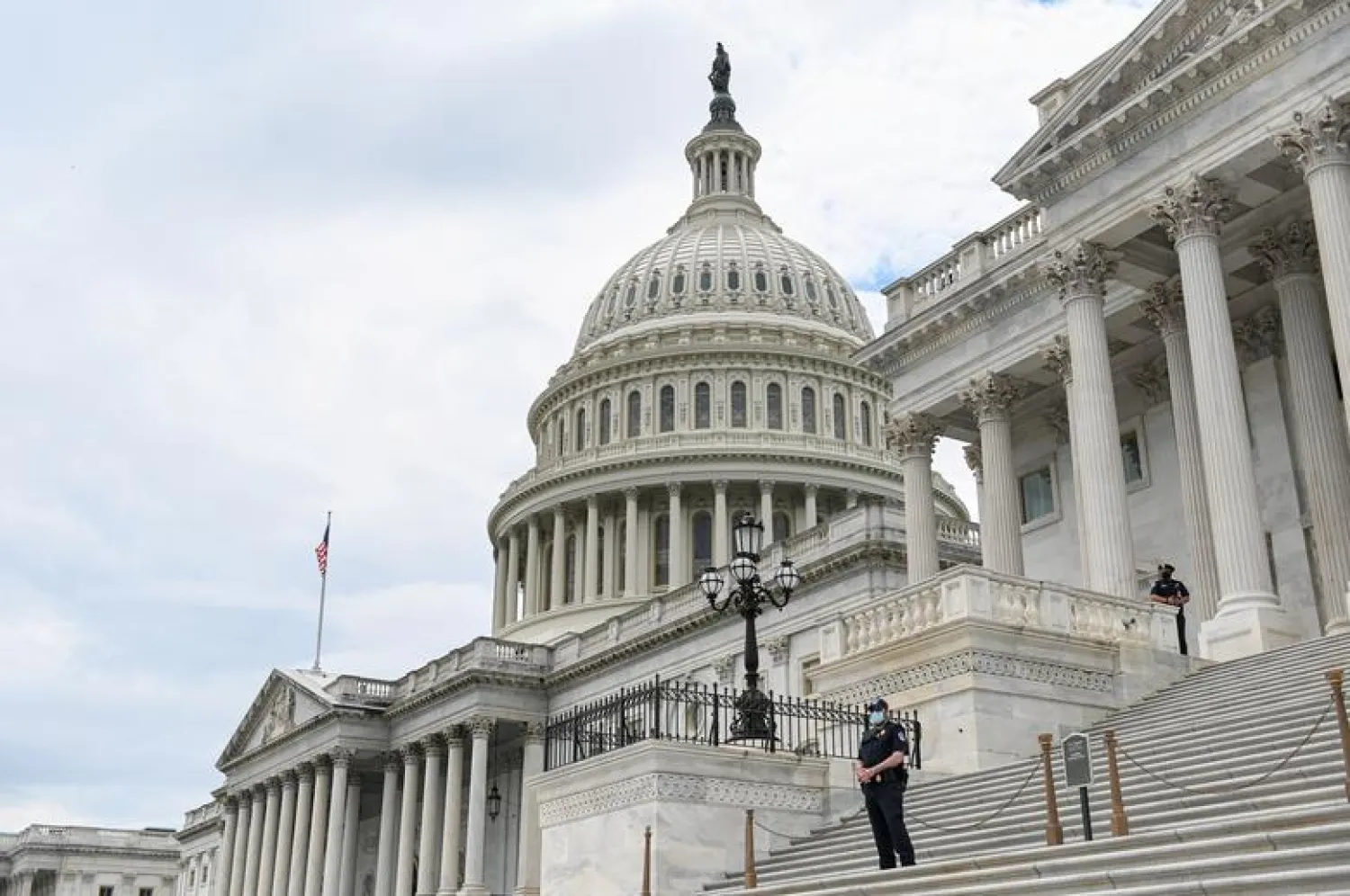

US Administration Weighs Up New Sanctions on Iran

FILE PHOTO: Police officers wearing face masks guard the US Capitol Building in Washington, US, May 14, 2020. REUTERS/Erin Scott
TT

US Administration Weighs Up New Sanctions on Iran

FILE PHOTO: Police officers wearing face masks guard the US Capitol Building in Washington, US, May 14, 2020. REUTERS/Erin Scott

US reports revealed that the US administration was considering imposing new sanctions on entities linked to Iran, for encouraging attacks on writer Salman Rushdie, who was stabbed last month during an event in New York.

Rushdie spent years under police protection after the first Iranian leader, Khomeini, issued a fatwa in 1989 calling for his execution because of his 1988 book, “The Satanic Verses.”

The author was stabbed severally by Hadi Matar, an American citizen of Lebanese origin, prior to a lecture at the Institute Chautauqua, New York, on Aug. 12. The suspected attacker had expressed “respect” to Khomeini, but denied reports of sympathy for Iran’s Revolutionary Guards.
According to an article published by The Wall Street Journal (WSJ), the sanctions under consideration include restricting the access of these Iran-affiliated entities to the global financial system.

The report added that US officials considered elements of the Iranian regime liable because of their support for the fatwa, or Islamic edict, issued by Khomeini in 1989, demanding Rushdie’s death over “The Satanic Verses.”

No decision has been made on whether the sanctions would target the 15th Khordad Foundation in Iran, a charitable organization operating under the supervision of the Office of the Supreme Leader.

The Foundation put a bounty of about $2.5 million on Rushdie’s head in 1997, raising it to $2.8 million in late 1998 and then again to $3.3 million in 2012. The organization has been silent since the author was attacked this summer, the WSJ reported.

Iranian media organizations, including the semi official Fars news agency, have also publicly pledged to contribute to the bounty. In 2016, 40 Iranian state-run news outlets added $600,000 to the bounty for the killing of Rushdie. That amount included the equivalent of $30,000 from Fars, which published a list of the news outlets.

According to the newspaper, US sanctions would complicate the international dealings of the relevant organizations, from receiving donations to sending funds and investing abroad.

Meanwhile, bipartisan US lawmakers announced that they would introduce legislation Thursday that would solidify US sanctions against Iran in order to apply pressure to the regime as it attempts to obtain nuclear weapons, Fox News reported.

The lawmakers said that the legislation, titled the Solidify Iran Sanctions Act (SISA), would create a necessary deterrent by targeting the country’s energy sector and making it more difficult to finance terrorist operations or develop ballistic missiles.

Fox News quoted Rep. Michelle Steel, who is leading the bill, as saying: “From brutal abuses committed against its own people, to its never-ending threats towards free and democratic societies, the Iranian regime has proven time and again that they are a rogue state with no interest in preserving regional or global peace.”

She added: “It is more important than ever that we prevent the unacceptable threat of a nuclear Iran from becoming a reality. Existing sanctions have proven successful in preventing such a catastrophe, and we must ensure that we can continue to place economic and strategic pressures on Iran to prevent them from developing nuclear weapons or supporting terrorists.”



TotalEnergies Tells Trump ‘Too Expensive’ to Reinvest in Venezuela

FILE PHOTO: A logo of French oil and gas company TotalEnergies is seen on the eve of the opening of the 2025 Paris International Agriculture Fair (Salon International de l'Agriculture) at the Porte de Versailles exhibition center in Paris, France, February 21, 2025. REUTERS/Sarah Meyssonnier/File Photo
TT

TotalEnergies Tells Trump ‘Too Expensive’ to Reinvest in Venezuela

FILE PHOTO: A logo of French oil and gas company TotalEnergies is seen on the eve of the opening of the 2025 Paris International Agriculture Fair (Salon International de l'Agriculture) at the Porte de Versailles exhibition center in Paris, France, February 21, 2025. REUTERS/Sarah Meyssonnier/File Photo

The CEO of French oil major TotalEnergies said it was “too expensive and too polluting” to return to Venezuela, despite calls from US President Donald Trump for oil giants to invest billions in the country.

The company quit Venezuela in 2022 but the Trump administration has urged oil majors to return since the US military operation to capture the country’s president, Nicolás Maduro, on Jan. 3.

Speaking on Wednesday, TotalEnergies CEO Patrick Pouyanné told reporters the company quit the country “because it clashed with our strategy. It was too expensive and too polluting and that is still the case,” according to Reuters.

The Trump administration has called on US energy giants to invest $100 billion to rebuild Venezuela’s oil industry.

Trump has pledged to support American oil companies that invest in Venezuela with government security assistance, saying last month that energy firms previously had problems “because they didn’t have Trump as a president.”

Venezuela boasts the world’s largest oil reserves but some US oil firms have expressed caution about rushing to re-enter — including Exxon Mobil.

Exxon CEO Darren Woods recently made headlines for saying at a White House meeting with Trump that the Venezuelan market is “uninvestable” in its current state.
Trump subsequently lashed out at Woods, threatening to sideline the oil giant and accusing the company of “playing too cute.”

Infrastructure Constraints
TotalEnergies started operating in Venezuela in the 1990s. Its departure followed a strategic shift away from heavy and high-sulfur crude and amid safety concerns.

Pouyanné has previously said that Venezuela is not high on the firm’s agenda.

TotalEnergies on Wednesday reported a slight drop in fourth-quarter profit and reduced share buybacks amid a weaker crude price environment.

Shares of the Paris-listed company rose nearly 2% during morning deals, notching a new 52-week high.


US Forces Withdraw from Syria's Al-Tanf Base

An American soldier shakes hands with a member of the Syrian Democratic Forces (SDF) in the Al-Tanf region - December 28, 2024 (US Army)
TT

US Forces Withdraw from Syria's Al-Tanf Base

An American soldier shakes hands with a member of the Syrian Democratic Forces (SDF) in the Al-Tanf region - December 28, 2024 (US Army)

US forces have withdrawn to Jordan from Syria's Al-Tanf base, where they had been deployed as part of the international coalition against the ISIS group, two Syrian military sources told AFP on Wednesday.

One source said "the American forces withdrew entirely from Al-Tanf base today" and decamped to another in Jordan, adding Syrian forces were being deployed to replace them.

A second source confirmed the withdrawal, adding the Americans had been moving equipment out for the past 15 days.

The second source said the US troops would "continue to coordinate with the base in Al-Tanf from Jordan".

During the Syrian civil war and the fight against ISIS, US forces were deployed in the country's Kurdish-controlled northeast and at Al-Tanf, near the borders with Jordan and Iraq.

The Kurdish-led Syrian Democratic Forces (SDF) had been a major partner of the anti-ISIS coalition, and were instrumental in the group's territorial defeat in Syria in 2019.

However, after the fall of longtime ruler Bashar al-Assad over a year ago, the United States has drawn closer to the new government in Damascus, recently declaring that the need for its alliance with the Kurds had largely passed.

Syria agreed to join the anti-ISIS coalition when President Ahmed al-Sharaa visited the White House in November.

As Sharaa's authorities seek to extend their control over all of Syria, the Kurds have come under pressure to integrate their forces and de facto autonomous administration into the state, striking an agreement to do so last month after losing territory to advancing government troops.

Since then, the US has been conducting an operation to transfer around 7,000 suspected extremists from Syria -- where many were being held in detention facilities by Kurdish fighters -- to neighboring Iraq.

Following the withdrawal from Al-Tanf and the government's advances in the northeast, US troops are mainly now based at the Qasrak base in Hasakeh, according to the Syrian Observatory for Human Rights.

Despite ISIS's territorial defeat, the group remains active.

It was blamed for a December attack in Palmyra in which a lone gunman opened fire on American personnel, killing two US soldiers and a US civilian.

Washington later conducted retaliatory strikes on ISIS targets in Syria.


Samsung Starts Mass Production of Next-gen AI Memory Chip

A man walks past the logo of Samsung Electronics displayed on a glass door at the company's Seocho building in Seoul on January 29, 2026. (Photo by Jung Yeon-je / AFP)
TT

Samsung Starts Mass Production of Next-gen AI Memory Chip

A man walks past the logo of Samsung Electronics displayed on a glass door at the company's Seocho building in Seoul on January 29, 2026. (Photo by Jung Yeon-je / AFP)

Samsung Electronics has started mass production of a next-generation memory chip to power artificial intelligence, the South Korean firm announced Thursday, touting an "industry-leading" breakthrough.

The high-bandwidth "HBM4" chips are a key component for AI data centers, with US tech giant Nvidia -- now the world's most valuable company -- widely expected to be one of Samsung's main customers.

Samsung said it had "begun mass production of its industry-leading HBM4 and has shipped commercial products to customers".

"This achievement marks a first in the industry, securing an early leadership position in the HBM4 market," AFP quoted it as saying in a statement.

A global frenzy to build AI data centers has sent orders for advanced, high-bandwidth memory microchips soaring.

South Korea's two chip giants, SK hynix and Samsung, have been racing to start HBM4 production.

Taipei-based research firm TrendForce predicts that memory chip industry revenue will surge to a global peak of more than $840 billion in 2027.

The South Korean government has pledged to become one of the world's top three AI powers, alongside the United States and China.

Samsung and SK hynix are among the leading producers of high-performance memory chips.