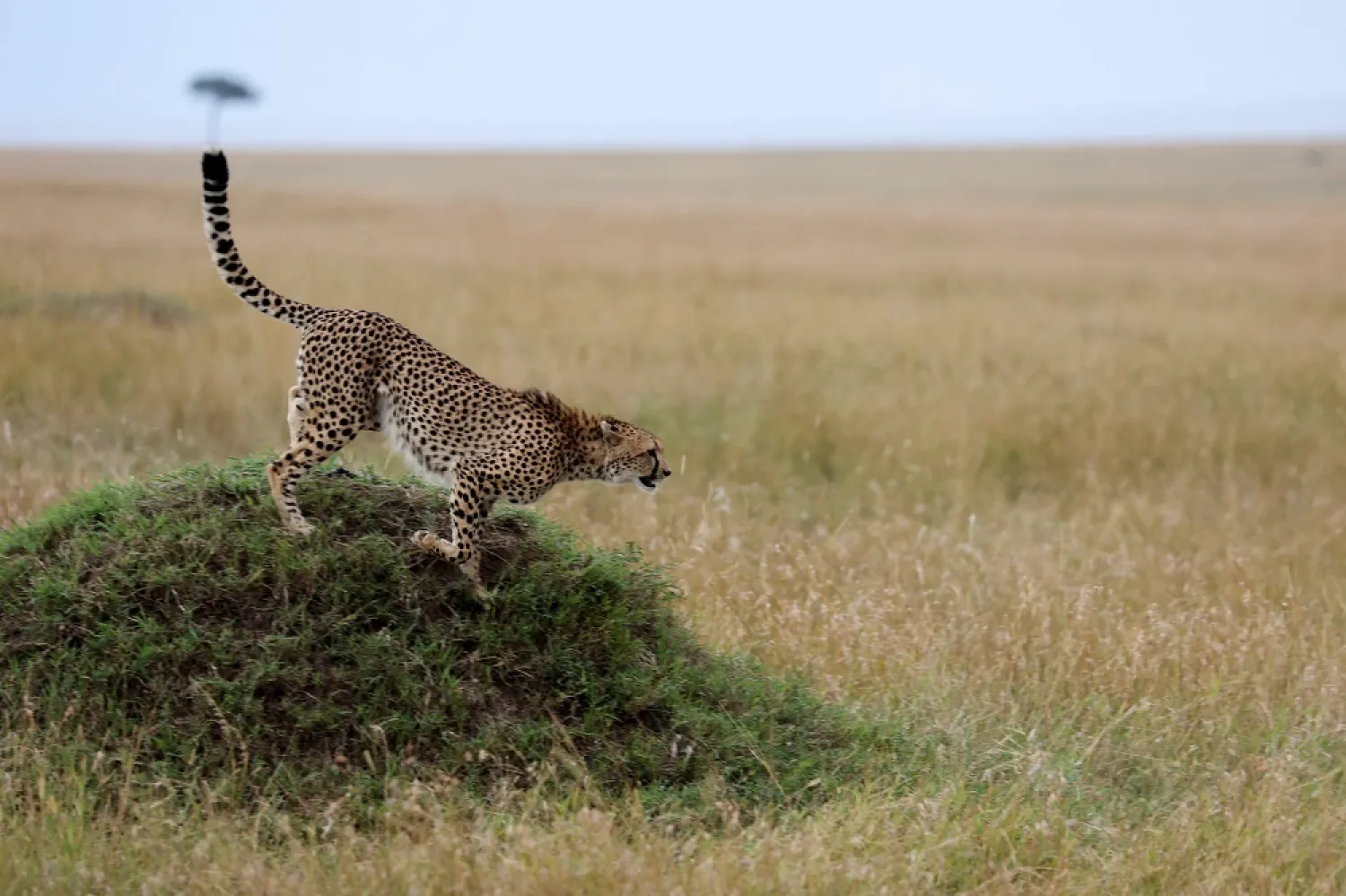
Cheetahs Make a Comeback in India after 70 Years

A cheetah runs off a mount in the Masai Mara National Park, Kenya, September 2, 2022. (Reuters)
TT

Cheetahs Make a Comeback in India after 70 Years

A cheetah runs off a mount in the Masai Mara National Park, Kenya, September 2, 2022. (Reuters)

Seven decades after cheetahs died out in India, they're back.

Eight big cats from Namibia made the long trek Saturday in a chartered cargo flight to the northern Indian city of Gwalior, part of an ambitious and hotly contested plan to reintroduce cheetahs to the South Asian country.

Then they were moved to their new home: a sprawling national park in the heart of India where scientists hope the world’s fastest land animal will roam again.

Indian Prime Minister Narendra Modi released the cats into their enclosure Saturday morning. The cats emerged from their cage, tentatively at first while continuously scanning their new surroundings.

“When the cheetah will run again … grasslands will be restored, biodiversity will increase and eco-tourism will get a boost,” said Modi.

Cheetahs were once widespread in India and became extinct in 1952 from hunting and loss of habitat. They remain the first and only predator to die out since India’s independence in 1947. India hopes importing African cheetahs will aid efforts to conserve the country's threatened and largely neglected grasslands.

There are less than 7,000 adult cheetahs left globally, and they now inhabit less than 9% of their original range. Shrinking habitat, due to the increasing human population and climate change, is a huge threat and India's grasslands and forests could offer “appropriate” homes for the big cat, said Laurie Marker, of the Cheetah Conservation Fund, an advocacy and research group assisting in bringing the cats to India.

“To save cheetahs from extinction, we need to create permanent places for them on earth,” she said.

Cheetah populations in most countries are declining. An exception to this is South Africa, where the cats have run out of space. Experts hope that Indian forests could offer these cats space to thrive. There are currently a dozen cheetahs in quarantine in South Africa, and they are expected to arrive at the Kuno National Park soon.

Earlier this month, four cheetahs captured at reserves in South Africa were flown to Mozambique, where the cheetah population has drastically declined.

Some experts are more cautious.

There could be “cascading and unintended consequences” when a new animal is brought to the mix, said Mayukh Chatterjee of the International Union for Conservation of Nature.

For example, a tiger population boom in India has led to more conflict with people sharing the same space. With cheetahs, there are questions about how their presence would affect other carnivores like striped hyenas, or even prey like birds.

“The question remains: How well it's done,” he said.

The initial eight cheetahs from Namibia will be quarantined at a facility in the national park and monitored for a month to make sure they're not carrying pests. Then they will be released into a larger enclosure in the park to help them get used to their new environment.

The enclosures contain natural prey — such as spotted deer and antelope, which scientists hope they'll learn to hunt — and are designed to prevent other predators like bears or leopards from getting in.

The cheetahs will be fitted with tracking collars and released into the national park in about two months. Their movements will be tracked routinely, but for the most part, they'll be on their own.

The reserve is big enough to hold 21 cheetahs and if they were to establish territories and breed, they could spread to other interconnected grasslands and forests that can house another dozen cheetahs, according to scientists.

There is only one village with a few hundred families still residing on the fringes of the park. Indian officials said they'd be moved soon, and any livestock loss due to cheetahs will be compensated. The project is estimated to cost $11.5 million over five years, including $6.3 million that will be paid for by state-owned Indian Oil.

The continent-to-continent relocation has been decades in the making. The cats that originally roamed India were Asiatic cheetahs, genetically distinct cousins of those that live in Africa and whose range stretched to Saudi Arabia.

India had hoped to bring in Asiatic cheetahs, but only a few dozen of these survive in Iran and that population is too vulnerable to move.

Many obstacles remain, including the presence of other predators in India like leopards that may compete with cheetahs, said conservation geneticist Pamela Burger of University of Veterinary Medicine in Vienna.

“It would be better to conserve them now where they are than to put effort in creating new sites where the outcome is questionable,” she said.

Dr. Adrian Tordiffe, a veterinary wildlife specialist from South Africa associated with the project, said the animals need a helping hand. He added that conservation efforts in many African countries hadn't been as successful, unlike in India where strict conservation laws have preserved big cat populations.

“We cannot sit back and hope that species like the cheetah will survive on their own without our help,” he said.


Europe’s Hera Spacecraft Begins Close Inspections of an Asteroid Rammed by NASA in a 2022 Test

This undated image provided by the European Space Agency on Nov. 5, 2026 and taken by the Hera spacecraft, shows asteroid Didymos. (European Space Agency via AP)
TT

Europe’s Hera Spacecraft Begins Close Inspections of an Asteroid Rammed by NASA in a 2022 Test

This undated image provided by the European Space Agency on Nov. 5, 2026 and taken by the Hera spacecraft, shows asteroid Didymos. (European Space Agency via AP)

A European spacecraft has begun close inspections of an asteroid rammed by NASA four years ago in a planetary defense test.

The European Space Agency announced Wednesday that the Hera spacecraft is now studying Didymos and its moonlet Dimorphos from just 15 miles to 18 miles (25 kilometers to 30 kilometers) away, The AP news reported.

NASA’s Dart spacecraft deliberately slammed into little Dimorphos in 2022 to see whether such a defensive move might help save Earth from a killer space rock one day.

The impact shortened the moonlet’s orbit around Didymos. More importantly, it nudged the moonlet into a slightly different path around the sun.

Next month, the small car-sized Hera, launched in 2024, will venture even closer — just 12 miles (20 kilometers) away.

ESA officials consider this a “crash site investigation” worthy of its finest robotic detective. Hera is carrying 25 science instruments as well as a pair of shoebox-sized Cubesats to survey Dimorphos even more closely and attempt to land on it.

The Dart spacecraft — short for Double Asteroid Redirection Test — sent rubble and even boulders flying off Dimorphos, providing an extra kick to the impact’s momentum. The debris trail extended thousands of miles (more than 10,000 kilometers) into space for months.

Some of that debris could still be in the vicinity, according to scientists.

Dimorphos is an estimated 500 feet (151 meters) in diameter. Didymos is roughly 2,560 feet (780 meters) in diameter.


Euclid Mission Data Release Spans More than 900 Million Galaxies

Looking across vast distances means peering into the past because of the time needed for light from distant objects to reach us (Reuters)
TT

Euclid Mission Data Release Spans More than 900 Million Galaxies

Looking across vast distances means peering into the past because of the time needed for light from distant objects to reach us (Reuters)

The European Space Agency has released its first big collection of data from the orbiting Euclid telescope's mission to map the universe's large-scale structure, including observations of more than 900 million galaxies, as scientists investigate the puzzling cosmic components dark matter and dark energy.

The data unveiled on Thursday covered a survey of the sky equal to about 9,500 times the size of the moon as viewed from Earth. The mission's goal is to complete the largest-ever three-dimensional atlas of the cosmos, spanning more than a third of the sky, in 2031.

Thursday's release encompassed around 13 months of Euclid observations, totaling an enormous 1.7 petabytes — 1.7 million gigabytes — of data, Reuters reported.

"It marks a major milestone for ESA's Euclid mission and for everyone involved," said astrophysicist Valeria Pettorino, ESA's Euclid project scientist.

Euclid, launched from Florida in 2023, is gathering data on how the universe has expanded and how its structure has formed over time while amassing information about the nature of dark energy and dark matter and the role of gravity on large scales.

"Euclid will not just take images of galaxies in the sky, in two dimensions, but will also measure their distance, the third dimension. This will tell us where galaxies are in space and time, across 10 billion years, and in all directions beyond our galactic plane," Pettorino said.

"Galaxies cluster along filaments, surrounded by empty space, and form a network that we call the cosmic web. Euclid will reconstruct the cosmic web and how it has grown over time. This is important because the exact configuration of the cosmic web, how many clusters or voids are there, how fast it changed, depend on the properties of dark energy and dark matter," Pettorino said.

The universe's contents include ordinary matter as well as dark matter and dark energy.

Ordinary matter — stars, planets, gas, dust and all the familiar stuff on Earth — represents about 5% of the contents. Dark matter, known from the gravitational effects it exerts on galactic scales, is invisible material that may make up about 27% of the cosmos. Dark energy, thought to be responsible for the accelerated expansion of the universe, may account for 68%.

Dark matter and dark energy do not emit or absorb light and cannot be directly observed.

Previous Euclid data releases covered only a few days of observations. The newly released dataset includes more than a year of data and still spans only 14% of the total sky area Euclid is due to survey in visible and near-infrared light over six years. This data release will be completed next year with the first results on dark energy and dark matter.

GRAVITATIONAL LENSING

Light traveling toward Earth from faraway galaxies can be bent and distorted by normal matter and dark matter in the foreground, an effect called gravitational lensing. Thus, the nearer galaxy's gravity warps the light coming from the one behind.

Gravitational lensing is one of the tools being used to study dark matter's distribution. The new Euclid data includes about 15,000 strong gravitational lens candidates, exceeding the total number discovered in the previous half century.

"Gravitational lenses are nature's own weighing scales," said Natalie Lines, a doctoral student in astrophysics at the University of Portsmouth in England and a member of the Euclid Consortium of scientists.

"How strongly the light is bent tells us how much matter a galaxy contains, including invisible components like dark matter. With thousands of lenses, we can study how dark matter is spread through galaxies and understand how galaxies form and evolve over cosmic time," Lines said.

Lines noted the sharpness of the Euclid images over a huge area of the cosmos.

"Telescopes on Earth can cover large areas of the night sky, but their view is blurred by the atmosphere. The Hubble and James Webb space telescopes take beautifully sharp images, but only of tiny patches of sky. Euclid does both at once, and that is crucial for finding things that are small and rare, like strong gravitational lenses," Lines said.

Looking across vast distances means peering into the past because of the time needed for light from distant objects to reach us. The most distant objects Euclid has viewed are quasars, the brilliant cores of galaxies powered by supermassive black holes. The telescope has pinpointed 60 million of them.

"Euclid has found some dating back to when the universe was just 5% of its current age, so their light set off around 13 billion years ago," Lines said.


Saudi Reef: Coffee Production Reaches 7,400 Tons in 2026

The program also provides specialized training in organic farming, pest control, modern irrigation, and coffee cultivation - SPA
TT

Saudi Reef: Coffee Production Reaches 7,400 Tons in 2026

The program also provides specialized training in organic farming, pest control, modern irrigation, and coffee cultivation - SPA

The Sustainable Agricultural Rural Development Program (Saudi Reef) reported that Saudi coffee production rose from 800 tons annually in 2020 to approximately 7,400 tons in 2026, an increase of more than 825%, supporting Saudi Vision 2030 objectives.

Saudi Reef spokesperson Majed Al-Buraikan said the number of beneficiaries in the coffee sector exceeded 6,200 in 2026, up 207% from 2021, while total support surpassed SAR 185 million, SPA reported.

The funding supports small-scale producers, agricultural investment, and coffee value chains.

Al-Buraikan said approximately 4.4 million coffee seedlings are expected to raise production to more than 20,000 tons at full capacity.

The program also provides specialized training in organic farming, pest control, modern irrigation, and coffee cultivation.

Development efforts included producing 1,000 improved cuttings to enhance varieties and productivity, agricultural projects involving 8,000 coffee seedlings, and cultivation trials at 12 sites to expand cultivation and improve yields, quality, and sustainability.

The program’s 2026 targets included increasing annual production to 7,000 tons and raising self-sufficiency from 0.5% to 4.4%. Actual production exceeded the target, reaching 7,400 tons.