Emir of Qatar: All Welcome without Discrimination at World Cup 2022https://english.aawsat.com/home/article/3886596/emir-qatar-all-welcome-without-discrimination-world-cup-2022
Emir of Qatar: All Welcome without Discrimination at World Cup 2022
Emir of Qatar Sheikh Tamim Bin Hamad Al Thani addresses the 77th session of the United Nations General Assembly, Tuesday, Sept. 20, 2022 at UN headquarters. (AP)
Emir of Qatar: All Welcome without Discrimination at World Cup 2022
Emir of Qatar Sheikh Tamim Bin Hamad Al Thani addresses the 77th session of the United Nations General Assembly, Tuesday, Sept. 20, 2022 at UN headquarters. (AP)
Emir of Qatar Sheikh Tamim bin Hamad Al Thani stressed on Tuesday that his country will welcome the world and open its doors without discrimination during the FIFA World Cup 2022, which kicks off on November 20.
Speaking before the 77th session of the United Nations General Assembly in New York, Sheikh Tamim said Qatar is on the threshold of hosting the world's teams and their fans.
It is opening doors for all of them “without discrimination to enjoy the football matches and the amazing atmosphere of the tournament, in addition to witnessing the economic and cultural renaissance in my country,” he added.
He pointed out that Qatar took on the challenge of hosting the landmark event 12 years ago, which required absolute resolve, determination, planning, and hard work.
Sheikh Tamim explained that the Qatari people will receive with “open arms football fans from all walks of life,” adding that no matter how diverse the nationalities, religions, and ideas are, “our duty is to overcome obstacles, extend a hand of friendship, build bridges of understanding and celebrate our common humanity.”
He concluded his address to the General Assembly: “On behalf of my people and my behalf, I invite you all to come to Qatar and enjoy this unique tournament. You are all welcome.”
Man City Falls at Aston Villa and Arsenal Moves Level on Top of Premier Leaguehttps://english.aawsat.com/sports/5333216-man-city-falls-aston-villa-and-arsenal-moves-level-top-premier-league
Aston Villa's Nicolas Jackson, left, challenges for the ball with Manchester City's Marc Guehi during the English Premier League soccer match between Aston Villa and Manchester City in Birmingham, England, Saturday, Oct. 24, 2026. (AP Photo/Morgan Harlow)
Man City Falls at Aston Villa and Arsenal Moves Level on Top of Premier League
Aston Villa's Nicolas Jackson, left, challenges for the ball with Manchester City's Marc Guehi during the English Premier League soccer match between Aston Villa and Manchester City in Birmingham, England, Saturday, Oct. 24, 2026. (AP Photo/Morgan Harlow)
Manchester City's perfect start to the Premier League ended in a 2-1 loss at Aston Villa, allowing Arsenal to move level on points atop the standings on Saturday.
Nicolas Jackson scored both goals for Villa against a City that was aiming for an eighth straight league win.
Victory extended Villa’s outstanding recent run to six wins from seven games in all competitions.
“It is incredible," The Associated Press quoted Jackson as saying. "It was difficult but we got the win and that is the most important thing. Now we can focus on the next one.”
After City's defeat in the early kickoff, defending champion Arsenal took advantage by beating Everton 2-0 at Emirates Stadium.
Ezri Konsa and Gabriel Magalhaes scored in each half for Mikel Arteta's team, which is second on goal difference.
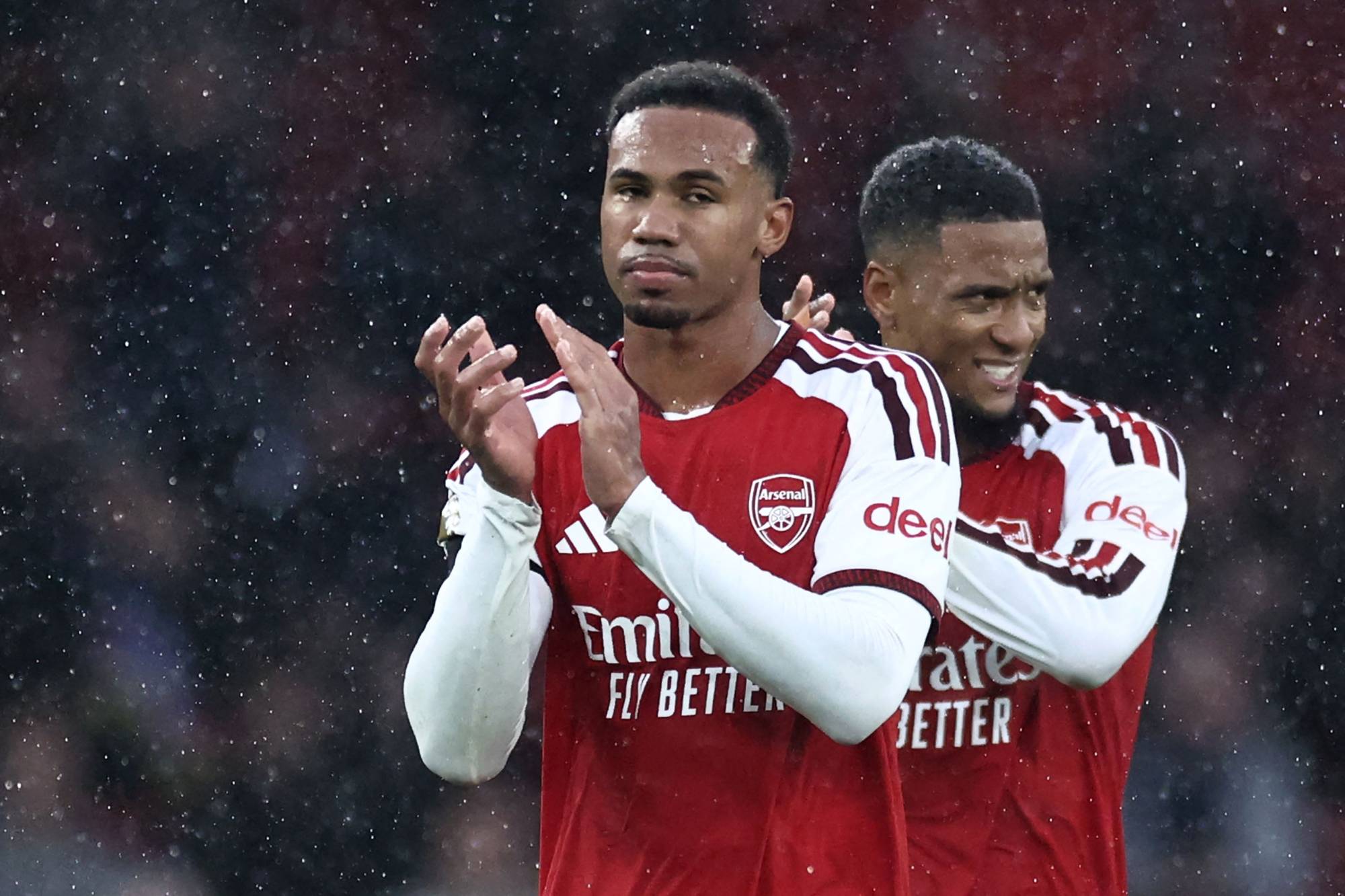
Arsenal's Brazilian defender #06 Gabriel Magalhaes (L) and Arsenal's English defender #15 Ezri Konsa (R) applaud fans after the English Premier League football match between Arsenal and Everton at the Emirates Stadium in London on October 24, 2026. Arsenal won the game 2-0. (Photo by Henry NICHOLLS / AFP)
Fulham beat Coventry 1-0 and Chelsea was playing Tottenham in the late kickoff.
Arsenal ends unlikely run Konsa scored his first goal for Arsenal since joining from Villa at the start of the season and ended the champion's run of 13 games without scoring from a set-piece.
Last season's title victory relied heavily on Arsenal's scoring efficiency from corners, in particular, but Konsa's scrambled goal after seven minutes was its first in any competition this term, excluding penalties.
“A goal from a set-piece has felt like it has been coming. Today was the day,” Konsa said.
Gabriel was also on target, heading in the second in the 68th for his first of the campaign.
After showing its Champions League credentials with a 2-2 draw at Bayern Munich midweek, Arsenal strengthened its title defense with victory against Everton to move to neck and neck with City, with just goal difference separating them.
“We’re very happy with the victory, the performance and the week, because we were given a terrible schedule,” Arteta said. “We just have to focus on what we can do, and we’re very pleased with 90% of the performances and results.”
Emery a ‘tactical genius’ Villa is rapidly climbing the standings after a desperate start to the campaign saw it fail to win its opening four games and picked up just one point.
The difficult start was understandable after a hugely disruptive offseason when a raft of star players left the club including Morgan Rogers, Ollie Watkins, Konsa, Emi Martinez and Youri Tielemans.
Unai Emery, who transformed the club from relegation battler to Champions League contender, was forced to rebuild a team that won the Europa League last season, and has done that in double-quick time.
Villa's last defeat was on Sept. 12, to Nottingham Forest 2-1. Since then Emery's team is unbeaten.
Jackson is up to seven goals in all competitions. He fired the opener inside six minutes at Villa Park.
Erling Haaland headed City level in the second half, but Jackson got his second and the winner with a first-time finish that squirmed under goalkeeper Gianluigi Donnarumma.
City fell to a fourth defeat at Villa Park in as many seasons.
“Emery is just a tactical genius. Especially against Man City at our place we have been really good," Villa defender Matty Cash said. “He always has a plan for something and is always coming up with new ideas. When you play against top teams you have to adapt and we did that today.”
Maresca not so perfect now Maresca said City would learn lessons from its first league defeat.
The Italian enjoyed a perfect start in England's top flight since succeeding Pep Guardiola in the offseason.
Villa joined Arsenal and European champion Paris Saint-Germain as the only teams to beat City in any competition this season.
“I don’t think we deserved to lose today, but we lost,” Maresca said. “You can always learn something.”
Oscar Bobb scored in the 80th to seal victory for Fulham at Coventry.
Al-Arabi Wins Second Round of Saudi Toyota Drift Championship in Al-Ahsahttps://english.aawsat.com/sports/5333159-al-arabi-wins-second-round-saudi-toyota-drift-championship-al-ahsa
Al-Arabi Wins Second Round of Saudi Toyota Drift Championship in Al-Ahsa
Al-Amri finished second and Yousef Bahuwairth third. The result reversed the first round, which Al-Amri won ahead of Al-Arabi - SPA
Saudi Arabia's Mohammed Al-Arabi won the Professional category in the second round of the 2026 Saudi Toyota Drift Championship in Al-Ahsa, setting up a title decider with Oman's Ahmed Al-Amri in the final round.
Al-Amri finished second and Yousef Bahuwairth third. The result reversed the first round, which Al-Amri won ahead of Al-Arabi.
In the Semi-Professional category, Fahad bin Rubayyi won, ahead of Sultan Al-Aqili and Saud Al-Abbasi. In the Amateur category, Qaswara Hammam took first place, followed by Amir Al-Aqili and Osama Al-Asiri, SPA reported.
The round drew a large crowd and 47 drivers: 19 Professional, 19 Semi-Professional, and nine Amateur. It was supervised by the Saudi Automobile and Motorcycle Federation, managed by Bakhashab Motorsport, and held in partnership with Jameel Motorsport.
The third and final round, which will decide the 2026 champions in all three categories, takes place in Jeddah on November 26 and 27.
The championship is part of the federation's efforts to develop motorsport in the Kingdom, support national talent, and strengthen safety standards.
'Weeks, Not Days' in Kompany Recovery, Say Bayernhttps://english.aawsat.com/sports/5333051-weeks-not-days-kompany-recovery-say-bayern
FILE - Bayern's head coach Vincent Kompany arrives for the German Bundesliga soccer match between FC Augsburg and FC Bayern Munich in Augsburg, Germany, Oct. 10, 2026. (AP Photo/Matthias Schrader, File)
FILE - Bayern's head coach Vincent Kompany arrives for the German Bundesliga soccer match between FC Augsburg and FC Bayern Munich in Augsburg, Germany, Oct. 10, 2026. (AP Photo/Matthias Schrader, File)
Bayern Munich expect coach Vincent Kompany to miss an extended period as he continues his hospital treatment for a virus after collapsing on the training pitch on Friday.
Speaking at a press conference on Saturday, Bayern sporting director Max Eberl confirmed Kompany was still hospitalized in a "stable" condition.
Kompany's English assistant coach Aaron Danks will replace the 40-year-old for Sunday's Bundesliga match at Freiburg.
Eberl told reporters "examinations were continuing" to determine the nature of the former Manchester City and Belgium captain's condition, with a recovery timeframe yet to be determined.
"Vinnie will be given all the time he needs. We're not starting to put together any timeframes.
"We need to firstly figure out what it is and then we'll discuss calmly what recovery time is to be. We won't be talking about days, but weeks. We need to all be clear on that."
Taking Saturday's press conference in Kompany's absence, Danks said he had spoken with the former center-back briefly on Friday but only to wish him well.
"I explained to him that we wouldn't be having no football conversations. It was just checking in on his health and making sure he's OK.
"All the football operations are in our hands and we'll work together as a team to keep the club moving forward."
Bayern's second team's game was postponed after Kompany's collapse but Eberl said the club did not consider trying to postpone Sunday's Bundesliga game.
"I think the greatest joy for Vinnie would be for us to play well tomorrow and, ideally, get a positive result," AFP quoted Eberl as saying.
"That would probably be one of the best things we could do to help him recover."
Danks confirmed Germany captain Joshua Kimmich, who has been on bereavement leave since Tuesday, would also miss Sunday's game.
Kompany returned to the dugout for Wednesday's home clash with Arsenal despite missing the pre-match press conference due to the virus.
Speaking after the Arsenal game, Kompany said his body reacted after he tried to push through the illness.
"I caught a pretty nasty virus last week, and of course I didn't listen to my body -- and then at some point my body just said, 'enough is enough!'"
The defending champions sit on top of the Bundesliga table ahead of Sunday's game, one point above Freiburg.
Their next Champions League match is on November 3 in Madrid against Atletico.
لم تشترك بعد
انشئ حساباً خاصاً بك لتحصل على أخبار مخصصة لك ولتتمتع بخاصية حفظ المقالات وتتلقى نشراتنا البريدية المتنوعة