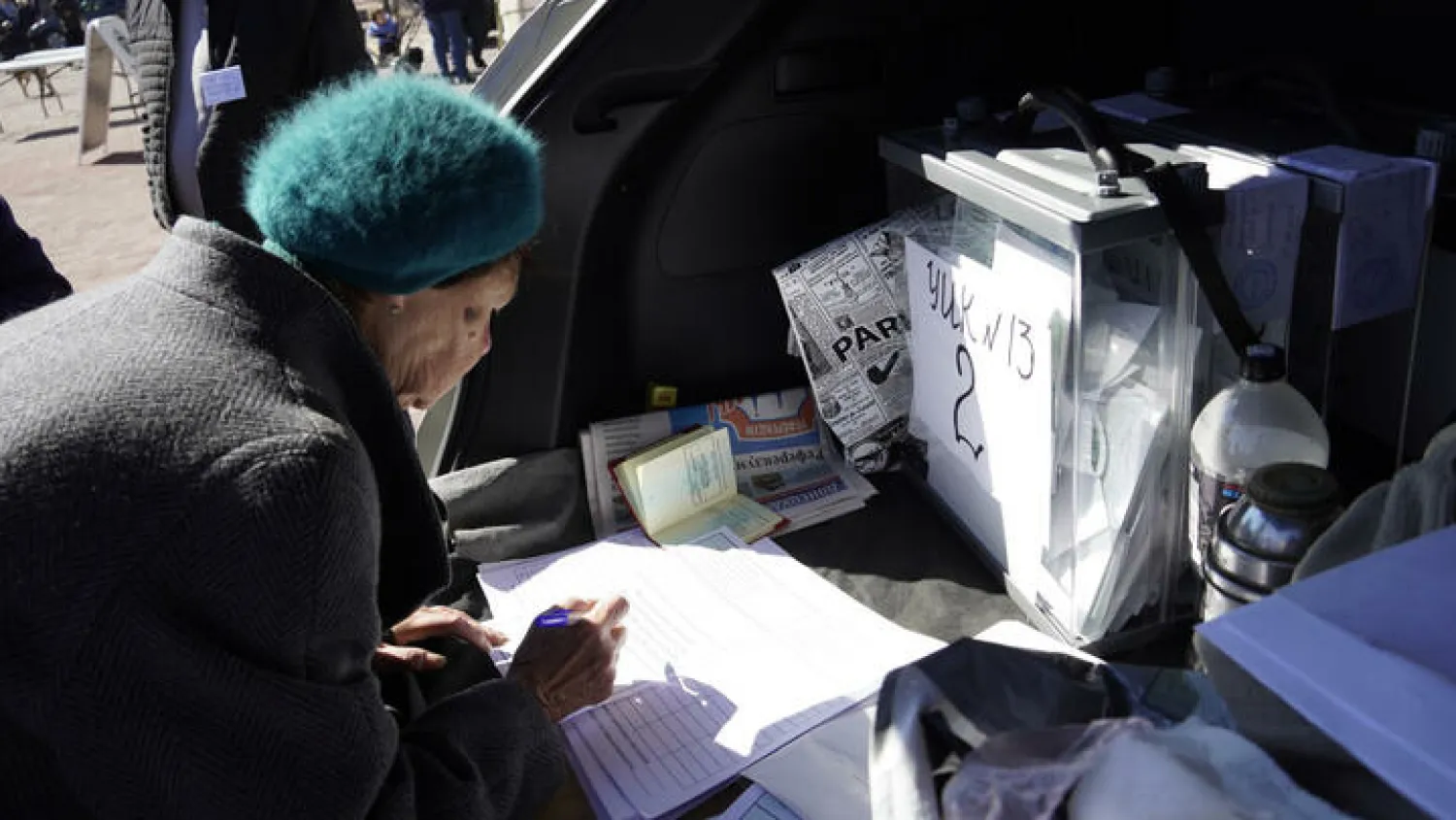
The Four Kremlin-held Ukraine Regions Voting on Annexation

After provisional results, lawmakers would be expected to formally annex the four territories, which would need Putin's signature to be enacted - AFP
TT

The Four Kremlin-held Ukraine Regions Voting on Annexation

After provisional results, lawmakers would be expected to formally annex the four territories, which would need Putin's signature to be enacted - AFP

Four regions of Ukraine that are mostly controlled by Russian forces are voting in polls that close Tuesday on whether or not to ask Russia to annex them.

Kyiv and its allies have criticized the ballots as a "sham" and vowed not to recognize the results. Here's what you need to know about the regions hosting them:

- Lugansk -
The Lugansk region, home to 2.1 million people before the war, borders Russia on three sides and forms part of the industrial Donbas area along with neighboring Donetsk, AFP reported.

Around 98 percent of the predominantly Russian-speaking region is assessed by Ukrainian authorities to be under Russian control, the most of any of the four regions holding annexation polls.

Until Russia's invasion in February, Moscow-backed separatists controlled just under half of the region since 2014 after nationwide demonstrations ousted Ukraine's Kremlin-friendly president.

After a battle of attrition that lasted months, Russia pushed Ukrainian forces out of Lugansk altogether in early July, a move trumpeted by Moscow as a strategic victory.

But Kyiv's successful advances in September have seen its forces edge back into the region.

- Donetsk -
Donetsk, with a pre-war population of 4.1 million, is in a mining and steel base in the larger Donbas area, and is home to one of Ukraine's largest cities, also named Donetsk.

Around half of the prominently Russian-speaking region has been controlled by Moscow-backed separatists since 2014.

Bordering the Black Sea, its port city of Mariupol was reduced to rubble during a brutal siege shortly after the Russian invasion.

Ukraine authorities say around two-thirds of the region is under Russian control. Fighting has raged for months around a frontline in the center of the region.

- Zaporizhzhia -
Home to Europe's largest nuclear plant on the Dniepr river, the Zaporizhzhia region with a pre-war population of about 1.6 million also borders the Black Sea.

Among the four regions staging annexation polls, it has the lowest proportion of land assessed to be under Russian control -- 63 percent.

The region's main city of Zaporizhzhia remains in Ukrainian hands, although Moscow controls its main port of Berdyansk.

Russian troops seized the nuclear facility in March and fighting near it in recent weeks spurred calls from Kyiv and its allies for the establishment of a demilitarized zone around the facility.

- Kherson -
The westernmost of the four regions holding annexation polls is Kherson, which was one of the first Ukrainian regions to fall under Russian control after the invasion began.

With a population of one million before the war, the key agricultural area is divided by the Dniepr rivers which runs through it. It also forms the gateway to Crimea -- the peninsula annexed by Moscow in 2014.

The four regions together create a crucial land corridor between Russia and Crimea, which is otherwise only joined to the mainland by bridge.

Ukraine's counterattack for Kherson in August triggered the relocation of Russian reinforcements -- which cleared the path for a successful assault by Kyiv in the eastern Kharkiv region.

Partisans have reportedly attacked Russian occupation units and officials, while Ukrainian forces have destroyed river bridges leaving Russian units at risk of entrapment.

Currently 83 percent of the region is assessed by Ukrainian authorities to be under Russian control.


Third US Aircraft Carrier Arrives in Middle East

This US Navy handout photograph released by US Naval Forces Central Command on November 4, 2026, shows the Nimitz-class aircraft carrier USS Theodore Roosevelt (CVN 71) sails alongside Royal Australian Navy Supply-class replenishment oiler HMAS Stalwart (A304). (AFP / NAVCENT Public Affairs / US Navy)
TT

Third US Aircraft Carrier Arrives in Middle East

This US Navy handout photograph released by US Naval Forces Central Command on November 4, 2026, shows the Nimitz-class aircraft carrier USS Theodore Roosevelt (CVN 71) sails alongside Royal Australian Navy Supply-class replenishment oiler HMAS Stalwart (A304). (AFP / NAVCENT Public Affairs / US Navy)

The USS Theodore Roosevelt aircraft carrier arrived in the Middle East on Sunday, media reports said, bringing the number of American carrier strike groups in the region to three.

The deployment, which was reported by the National News and Axios journalist Barak Ravid, comes as fighting reignites in the region, with Iran claiming a drone attack on Bahrain on Sunday, ending a lull in strikes in the war.

Iran also fired drones at Bahrain on Friday -- the first strikes since September against countries in the energy-rich Gulf, which has been targeted several times in the conflict that erupted in February.

US President Donald Trump plans to discuss the war at a trilateral meeting with his Chinese and Russian counterparts Xi Jinping and Vladimir Putin this week, an official said Friday.

Months of diplomacy have failed to resolve the war, which began with US-Israeli strikes that killed Iran's supreme leader Ali Khamenei.


US Airports Slowly Return to Normal After Three Days of Disruption

Passengers wait at Ronald Reagan Washington National Airport (DCA), in Arlington, Virginia, just outside Washington, DC, on November 14, 2026. (AFP)
TT

US Airports Slowly Return to Normal After Three Days of Disruption

Passengers wait at Ronald Reagan Washington National Airport (DCA), in Arlington, Virginia, just outside Washington, DC, on November 14, 2026. (AFP)

US air travel was slowly returning to normal on Monday after three days of widespread disruption following an extraordinary no-takeoff order issued by US aviation authorities.

The ground stop issued Friday afternoon was only the second time such a directive had been issued nationwide in the busy US airspace since planes were grounded following the 9/11 attacks, and was blamed by the Trump administration on a faulty upgrade to communications equipment.

On Monday morning, more than 250 US-related flights -- those traveling within, into or out of the United States -- scheduled for the same day were cancelled, according to industry tracker FlightAware.

That marked a dramatic shift from the more than 2,300 flights cancelled on Sunday.

There were delays to more than 700 US-related flights scheduled for Monday, compared to more than 10,000 the previous day.

The Trump administration sought to reassure weary flyers as questions remained over how such chaos could unfold in the world's largest economy, a country that prides itself on its technological prowess.

Throughout the weekend, stranded passengers wandered through chaotic airports and sat on floors, waiting for updates or to be rebooked.

Officials blamed Friday's colossal snafu on faulty work to upgrade air traffic control communication cables.

President Donald Trump on Sunday ended uncharacteristic days of silence on the ground stop, but only to blame his predecessor Joe Biden for the debacle.

Trump insisted he inherited a mess from the Biden administration and said Congress, which his party has controlled for two years, must approve funds to upgrade America's outdated air traffic control system.

"The Biden Administration was an FAA disaster," Trump said, referring to the Federal Aviation Administration.

"Everything they touched turned bad. Big money spent unwisely, making an old and broken system worse than when they began," Trump said.

FAA chief Bryan Bedford said Saturday that air travel for millions of Americans stranded at airports would return to normal by the close of business on Sunday.

But Transportation Secretary Sean Duffy said Sunday morning it will actually take longer to get planes, crews and travelers to where they need to be.

"We're going to see things come back to normal today, but probably fully normal tomorrow," Duffy said on ABC News.

"We had airplanes and crews out of position because of Friday, so it takes a little bit of time to do that."

- 'I'm the secretary' -

Duffy also rejected calls for his resignation over the travel chaos, insisting he inherited woefully outdated air traffic control infrastructure such as radar equipment that dates back to the 1960s.

"So when we do work and things go wrong, of course I'm the secretary. But I also have to acknowledge what was delivered to me," Duffy said in an interview on CNN.

The ground stop not only plunged US air travel into chaos, but it also raised serious concerns about the country's aging infrastructure.

Duffy has appealed for $50 billion in funds to upgrade and modernize the air traffic control system, and called for Congress, which controls the purse strings of the US government, to "meet this moment."

But Democrats quickly pounced to say Congress under Trump's Republicans could already have done this.


Republican 2028 Field Takes Shape After Midterm Drubbing

 US Vice President JD Vance delivers remarks during a Veterans Day ceremony at Arlington National Cemetery in Arlington, Virginia, on November 11, 2026. (AFP)
US Vice President JD Vance delivers remarks during a Veterans Day ceremony at Arlington National Cemetery in Arlington, Virginia, on November 11, 2026. (AFP)
TT

Republican 2028 Field Takes Shape After Midterm Drubbing

 US Vice President JD Vance delivers remarks during a Veterans Day ceremony at Arlington National Cemetery in Arlington, Virginia, on November 11, 2026. (AFP)
US Vice President JD Vance delivers remarks during a Veterans Day ceremony at Arlington National Cemetery in Arlington, Virginia, on November 11, 2026. (AFP)

The Republican Party's midterm drubbing has opened the door to a crowded battle to succeed President Donald Trump, with a wide field of potential 2028 contenders gearing up for presidential bids, according to interviews with more than a dozen people involved in prospective campaigns.

Allies and operatives around Vice President JD Vance, US Senator Ted Cruz of Texas, Florida Governor Ron DeSantis and former Virginia Governor Glenn Youngkin have begun making early preparations or assessing potential campaigns, the people said.

They are "at least trying to get their ducks in order to run," said one Republican operative familiar with the activity.

More Republicans are expected to join them, according to Republican donors, strategists and influential conservative leaders, some of whom spoke on the condition of anonymity to describe private conversations.

Some potential candidates are also considering sitting out 2028 and waiting until 2032, calculating that Trump's unpopularity and the party's midterm losses could make the next presidential election an especially difficult one for the Republican nominee.

After those losses, many Republicans no longer view Vance as Trump's inevitable successor. While potential rivals explore bids, donors are holding back their money and some Republicans are taking a fresh look at governors who can claim distance from Washington and the Trump administration.

"What happened (in the midterms) was a major reset and changed everything as it relates to presidential politics," said Bob Vander Plaats, an Iowa evangelical leader and chief executive of The Family Leader, a conservative Christian advocacy organization.

Had Republicans fared better, "JD Vance would have been a lock in terms of the heir apparent," Vander Plaats said. Now, "he’ll probably have competition and a lot of competition."

VANCE STILL THE MAN TO BEAT

Vance appears likely to ‌run, according to four ‌people familiar with his thinking, but has not yet formally decided as he weighs the souring political environment for Republicans and the effect of a ‌campaign on ⁠his young family.

A ⁠Vance ally, speaking on the condition of anonymity, said Vance and his political operation expected Republican figures opposed to the vice president's brand of conservatism would emerge after the midterms to promote rival presidential candidates.

The person said Vance favored a competitive primary instead of an early Trump endorsement because it would prove his mettle for a general election.

Vance would enter the race with formidable advantages as the sitting vice president with a national profile. One Republican operative who worked on a competitive House race described the nomination as Vance's to lose.

"I think if he wants the nomination, he probably wins it in an ugly fashion," the operative said, predicting a potentially nasty contest.

But running from the vice presidency could complicate his path. After largely avoiding public disagreement with Trump, Vance blamed the Iran war for Republicans’ midterm defeat. A week later, Trump directed him to focus on domestic issues instead of efforts to secure a peace deal with Iran.

The fallout from the conflict will likely prove a challenge for the broader Republican field, as candidates navigate how much to distance themselves from a war that Trump continues to defend.

The Vance ally said the vice president considered the midterm ⁠result a rejection of the Iran war rather than voters' verdict on the Trump presidency. When the war ends, the person said, Vance and populist ‌Republicans will be able to rebuild Trump's coalition of voters.

CRUZ, OTHER RIVALS SEE AN OPENING

Cruz has spoken openly with associates about another White House ‌run, after his failed attempt for the nomination in 2016, and has begun early preparations, according to two people familiar with the activity. Representatives for Cruz did not respond to a request for comment.

Over a steak dinner with conservative ‌economist Stephen Moore before the midterms, Cruz said he planned to launch a bid, Moore told Reuters. On Texas Lieutenant Governor Dan Patrick's podcast in August, Cruz was similarly direct: “It's no secret that I want ‌to be president."

Cruz has spent months positioning himself as a conservative who would return Republicans to a market-first domestic policy and a more traditional approach to international relations, emphasizing that any military action must be in US national interests and not aimed at nation-building.

"He says he's the mantle to the Reagan Republican wing of the party," Moore said.

One Republican donor said calls from potential candidates to major funders are likely to pick up soon, followed by donor retreats and trips to primary states early next year.

Hovering over the emerging field is Trump. He has said the Republican Party has a deep bench but suggested after the midterms that he may not endorse anyone in the primary.

Several strategists said Trump's backing could ‌reshape the Republican nominating race.

"Unless the president swoops in with an endorsement early, there’s plenty of time," said Kellyanne Conway, Trump's 2016 campaign manager and first-term senior counselor. "His endorsement is still the biggest get in all of politics."

DISTANCE FROM TRUMP MAY BENEFIT GOVERNORS

Some Republicans see a lane for conservative ⁠governors who could tout their executive experience and distance ⁠themselves from Washington and Trump's sagging popularity.

DeSantis is keeping his options open for 2028 and considering waiting until 2032, believing Trump’s low approval rating could make it difficult for any Republican to win in the upcoming election cycle, according to a party operative familiar with his thinking. Florida was one of the few Republican strongholds to withstand the Democratic wave in the midterms.

Youngkin is also considering a run, according to Moore and another person familiar with his thinking. He has remained active in national Republican politics since winning the Virginia governorship in 2021 despite the state's leftward turn in recent decades. In August, he began a nationwide education advocacy group widely seen in party circles as a possible launching pad for a presidential bid.

Youngkin, whose term ended in January, supports Trump but is not seen as close to him, which could potentially help him if the party is looking for a reset.

"I know Glenn Youngkin very well and if he can find an avenue, he’s likely to get in the race," Moore said.

Another potential contender is Secretary of State Marco Rubio, who three Republican donors said they hoped would enter the race.

But several people familiar with Rubio's thinking said a 2028 bid appears unlikely for now, with some close to him expecting him to spend time in the private sector. A former aide pointed instead to a possible 2032 run.

The latest Reuters/Ipsos poll showed some 45% of Republican voters said they believed Rubio would be an "excellent" presidential candidate, with 43% saying the same of Vance.

Representatives for DeSantis, Youngkin and Rubio did not respond to requests for comment.

The early jockeying comes as some Republicans have grown pessimistic about their party's 2028 prospects.

Robert Bigelow, a major conservative donor who gave around $14 million to the main pro-Trump super PAC in the 2024 election, blamed Trump for the midterm defeats and said he expected Democrats to win the White House in 2028.

Still, Bigelow said he likes both Vance and Rubio and had suggested them as a potential ticket when Trump asked him in February who should succeed him.

Despite thinking the Democrats’ election "tsunami” could last a decade, Bigelow said Vance should run.

“You can run again," he said. "But not to run at all is a mistake.”