


Studies in Contemporary Saudi Poetry

Studies in Contemporary Saudi Poetry
TT

Studies in Contemporary Saudi Poetry

Studies in Contemporary Saudi Poetry

The Jeddah Literature and Cultural Club recently published a new book, “In Poetry Fields: Studies in Contemporary Saudi Poetry” by Dr. Abdullah bin Abdul Rahman al-Haidari, professor of Literature and criticism at the Imam Mohammad ibn Saud Islamic University (IMSIU). The book is the 266th publication of the club.

The book includes four research published in three local and foreign journals: Arabic Science Journal (published by the Imam Mohammad ibn Saud Islamic University), Journal of the Faculty of Dar Al Uloom - Fayoum University, and the Sohag University Journal of Literature. The three studies explore phenomena in the contemporary Saudi poetry.

The first study, “Picture of Disability in Saudi Poetry: Study of Content and Form”, focuses on the link between creativity and disabilities in the Arabic literature.

The second research is entitled “Poetry in Face of Terrorism: Study of Samples of Saudi Poetry”.

The third research, “Inventions in Saudi Poetry: Astonishment, Familiarity, and Caution” focuses on three topics: the presence of female inventors in Saudi poetry, image of female inventors in Saudi poetry, and artistic characteristics and aesthetic styles in the poetry of female inventors.

The fourth research, “Echo of Modern Technology in Saudi Poetry”, was used by the author to discuss complaints about advancement, the start of using mobiles in the Kingdom, the internet’s debut in Saudi Arabia, the new media concept, and domination of cellphones. The research explored two main topics: technology in studies of Saudi researchers, and modern technologies in Saudi poems.

In his book, the author sought to use scientific research to shed light on the burdens of the local society, observe changes in people’s lives, and analyze samples of Saudi poetry that focused on major aspects that other creatives have overlooked.

The front cover features a painting by Artist Nasser bin Abdullah al-Moussa that expresses the content of the 206-page book, which is expected to be featured at the Jeddah Club’s pavilion at the Riyadh International Bookfair.

The author, Dr. Abdullah bin Abdul Rahman al-Haidari is specialized in Saudi literature, and already has over 20 books in literature and criticism including: “Biography in Saudi Literature”, “Hussein Sarhan as a Storyteller”, “Hussein Sarhan’s Prose Works, Biography in the Kingdom of Saudi Arabia”, and “Conferences of Saudi Novelists.”
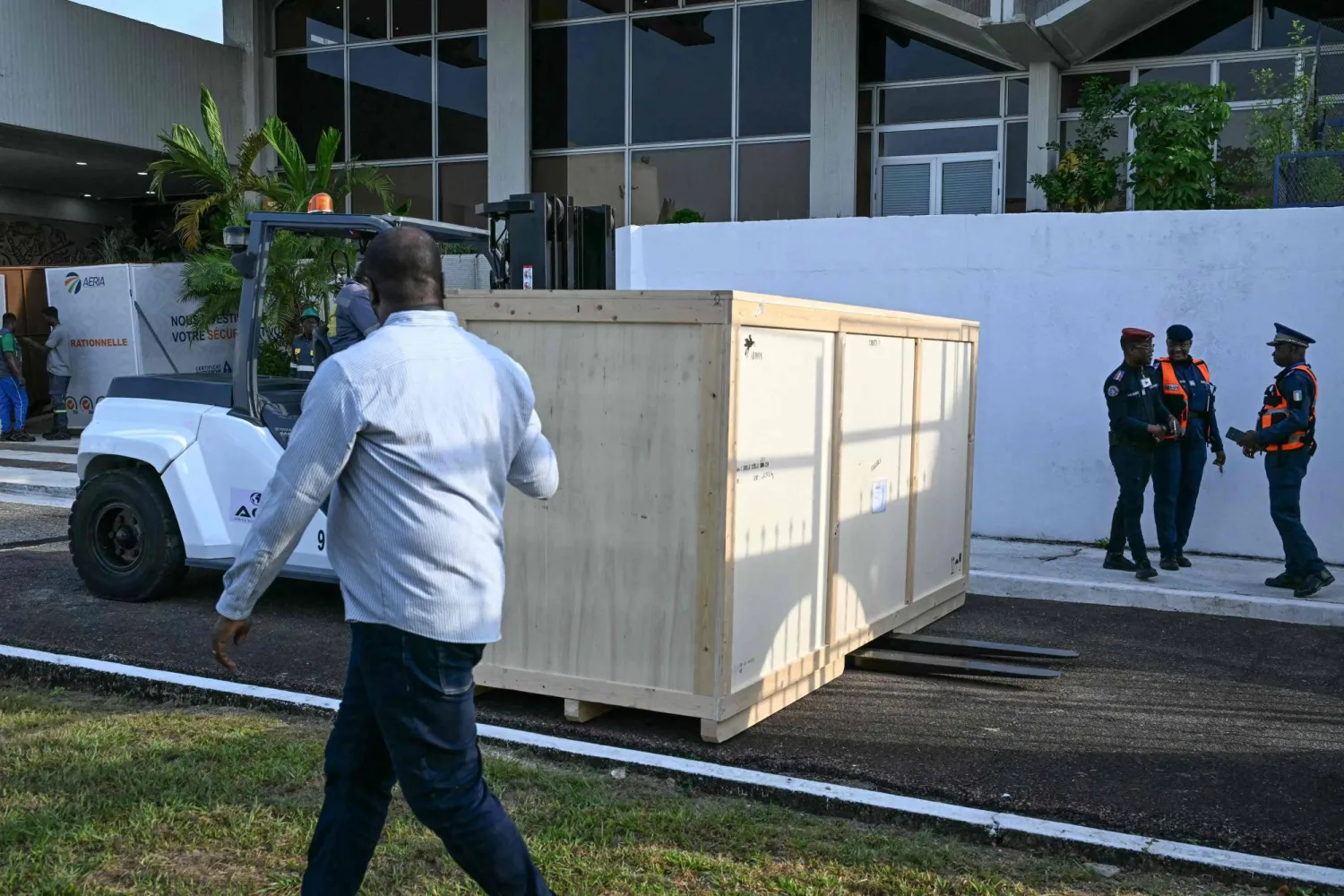



'Talking Drum' Looted by France in 1916 Back in Ivory Coast

A crate containing the Djidji Ayokwe drum, at the airport in Abidjan, Ivory Coast. (Photo by Issouf SANOGO / AFP)
TT

'Talking Drum' Looted by France in 1916 Back in Ivory Coast

A crate containing the Djidji Ayokwe drum, at the airport in Abidjan, Ivory Coast. (Photo by Issouf SANOGO / AFP)

The Djidji Ayokwe "talking drum", which was looted by French colonial troops in 1916 and taken to France, arrived back in Ivory Coast Friday, in the latest repatriation of stolen artifacts.

The wooden drum, more than three meters (10 feet) long and weighing 430 kilos (950 pounds), was used by the Ebrie tribe to transmit messages.

It was officially handed over on February 20 after France's parliament approved removing the artifact from the national museum collections to enable its return.

Ivory Coast had asked in late 2018 for the return of the Djidji Ayokwe among 148 works of art taken during the colonial period.

It arrived aboard a specially chartered plane at Ivory Coast's main city Abidjan and remained inside a huge wooden crate stamped "fragile", AFP journalists saw.

"It's an historic day and I feel deep emotion," Culture Minister Francoise Remarck said, welcoming its arrival at the airport, where the Ebrie community also sang and played drums.

"We are living a moment of justice and remembrance," the minister added.

French President Emmanuel Macron promised in 2021 to send the drum and other artifacts back home to the west African country.

It is one of hundreds of objects France is preparing to send back to Africa, with the efforts set to be accelerated by the passing of a new law to authorize mass repatriations.

"We are happy and relieved to know that this sacred piece of our culture is back on its native land," Aboussou Guy Georges Mobio, an Ebrie village chief, told AFP.

The drum will initially be held in a "safe space" to allow it to acclimatize, the culture minister said.

It is due to go on display at the Museum of Civilizations in Abidjan which has been specially renovated.

The "talking drum" was used by the Ebrie community to warn of danger, mobilize for war or call villagers to ceremonies.

It was seized by colonial authorities in 1916 before being shipped to France in 1929 and exhibited in Paris.

Senegal and Benin have also asked for the repatriation of their treasures.

In late 2020, the French parliament adopted a law providing for the permanent return to Benin of 26 artifacts from the royal treasures of Dahomey.

The return of cultural artifacts taken from ex-colonies in Africa and elsewhere has become a sensitive issue, with museums, institutions and collectors in Europe and the United States facing pressure to give them back.


Red Sea Fund Launches Second Round to Support Film Projects in Production Stage

File photo of the fifth day of the Red Sea International Film Festival - SPA
TT

Red Sea Fund Launches Second Round to Support Film Projects in Production Stage

File photo of the fifth day of the Red Sea International Film Festival - SPA

The Red Sea Fund, affiliated with the Red Sea Film Foundation, announced the opening of applications to support film projects in the production stage within the second round of this year’s support program, which will continue until March 21, as part of its efforts to enhance the cinema industry and empower innovators in the region, SPA reported.

The round aims to support promising cinematic voices from the Kingdom and the Arab world, as well as filmmakers from Africa and Asia, through financial grants that help complete film projects and present their creative narratives globally, with a special focus on projects ready to enter production and begin filming.


Prince Mohammed bin Salman Project Restores Historic Al-Jami' Mosque in Tabuk Region

The renovation utilized modern technologies to restore the mosque's original identity - SPA
TT

Prince Mohammed bin Salman Project Restores Historic Al-Jami' Mosque in Tabuk Region

The renovation utilized modern technologies to restore the mosque's original identity - SPA

The Prince Mohammed bin Salman Project for the Development of Historical Mosques has completed the restoration of Al-Jami' Mosque in Duba, Tabuk Region, as part of its mission to preserve the Kingdom's architectural heritage under Vision 2030.

As one of Duba’s oldest landmarks, the mosque is deeply intertwined with the city’s maritime history, traditionally serving as a central meeting point for sailors. Throughout its history, the mosque underwent several construction phases, including significant contributions by King Abdulaziz and King Fahd, before its selection for the current national development project, SPA reported.

The renovation utilized modern technologies to restore the mosque's original identity, increasing its area to 972.23 square meters and its capacity to 779 worshippers. The architectural style is inspired by traditional Red Sea heritage, incorporating natural materials like stone, mud, and wood for intricate mashrabiyas.

Executed by specialized Saudi firms, the project balances traditional standards with sustainability to rehabilitate the site for worship while highlighting its cultural significance. By restoring such landmarks, the project ensures the preservation of the Kingdom’s diverse architectural and social memory for future generations.